

The DOI matches its Crossref record; 1 of the 1 references it cites were found in a registry or an index.
Describing and Modeling the Burden of Hospitalization of Patients With Neoplasms in Ghana Using Routine Health Data for 2012-2017
Abstract
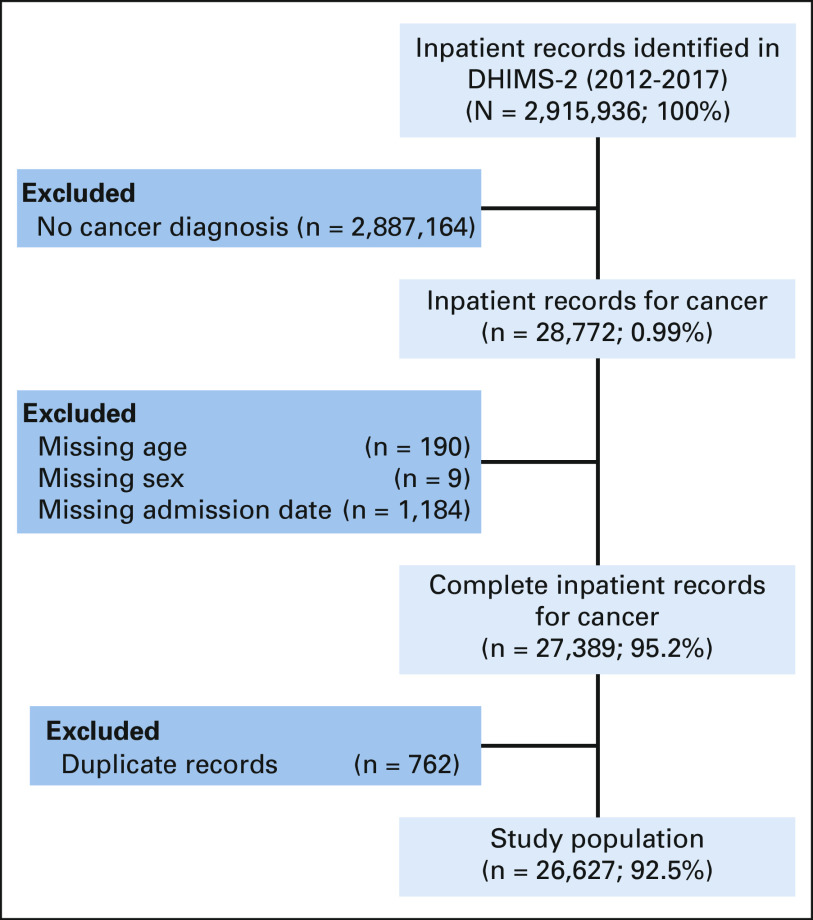
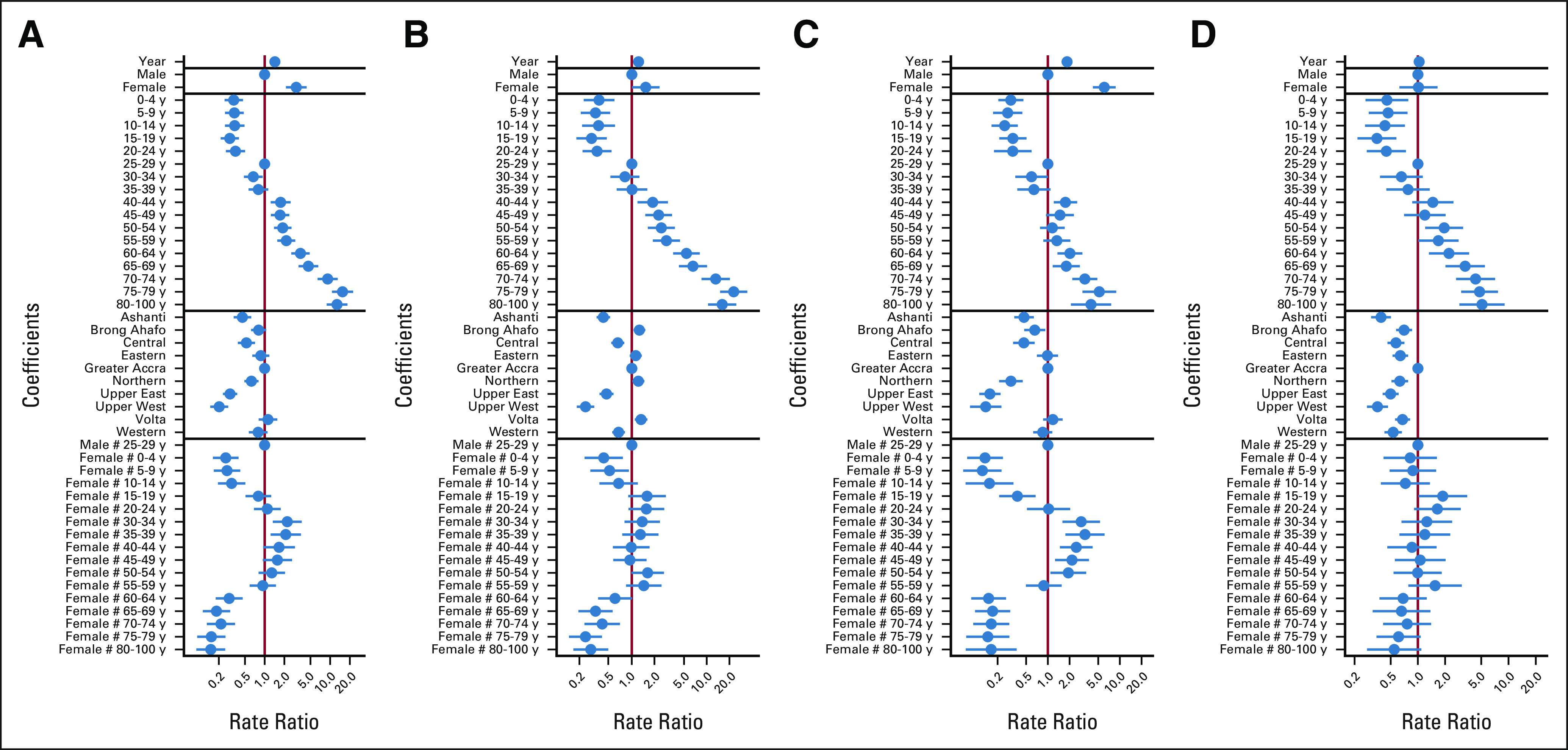
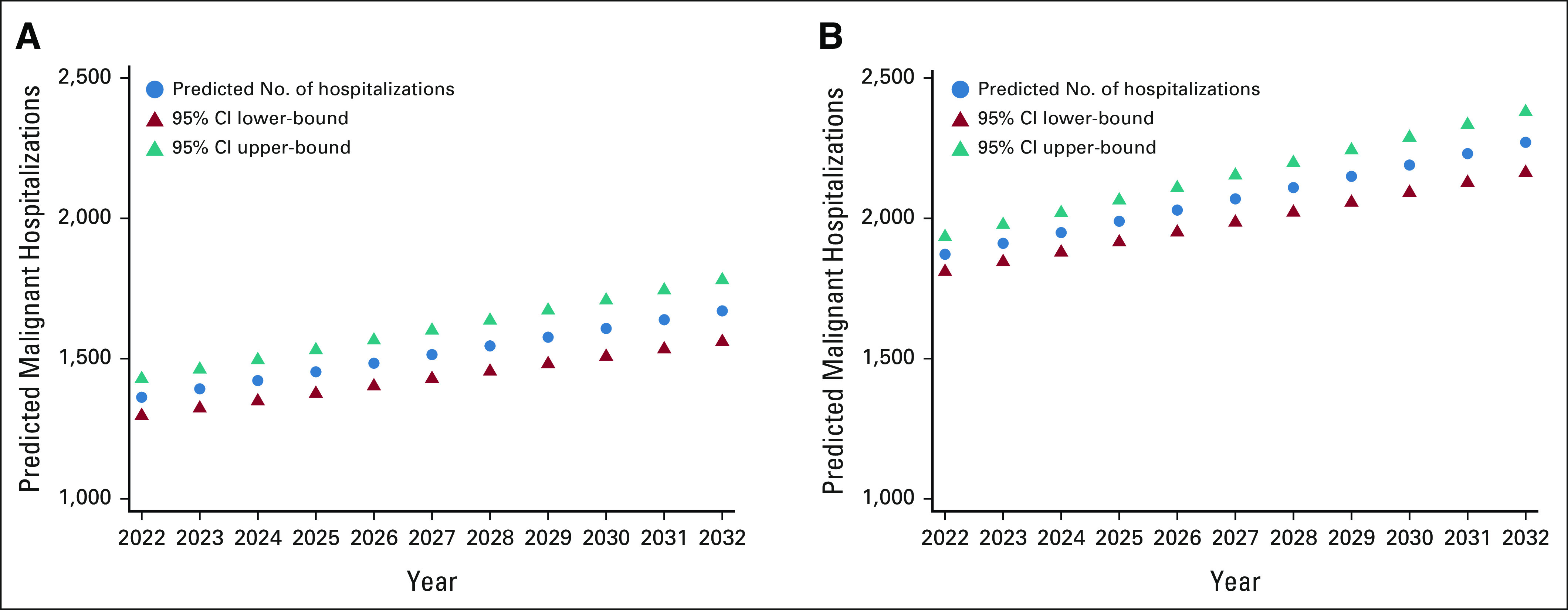
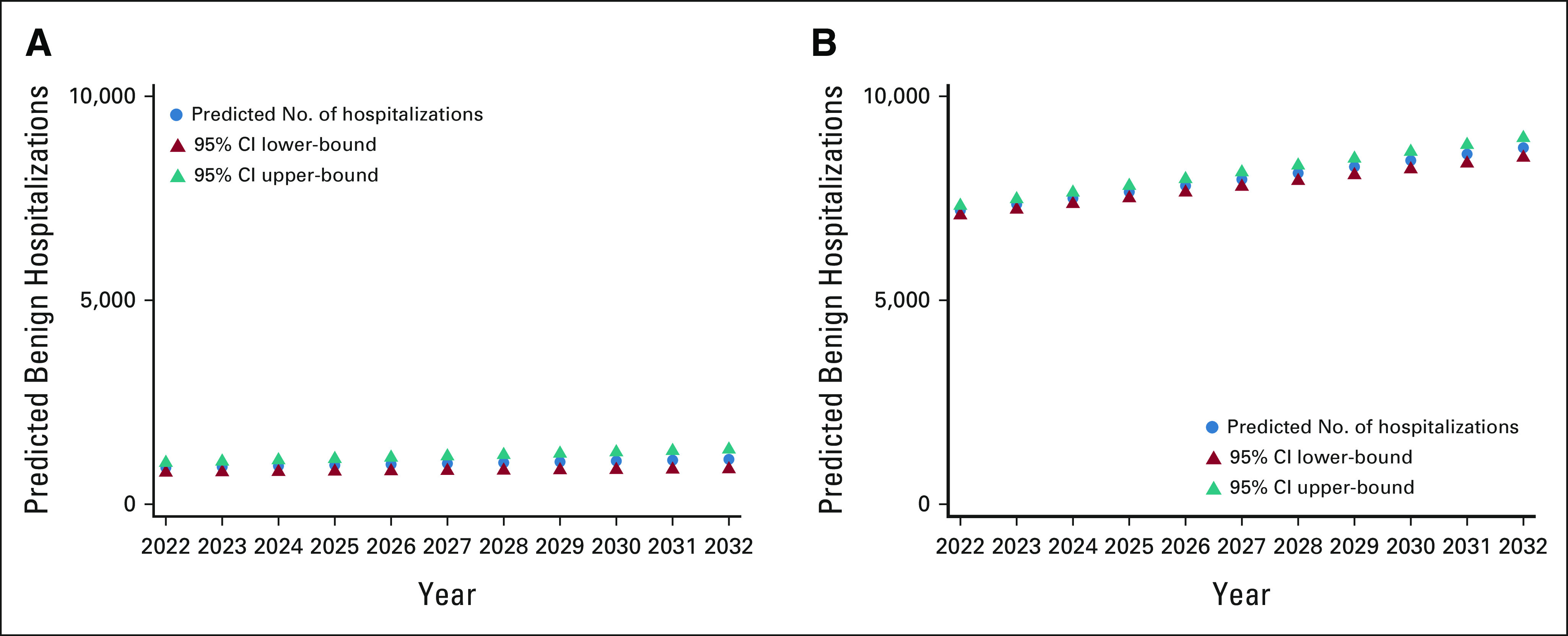
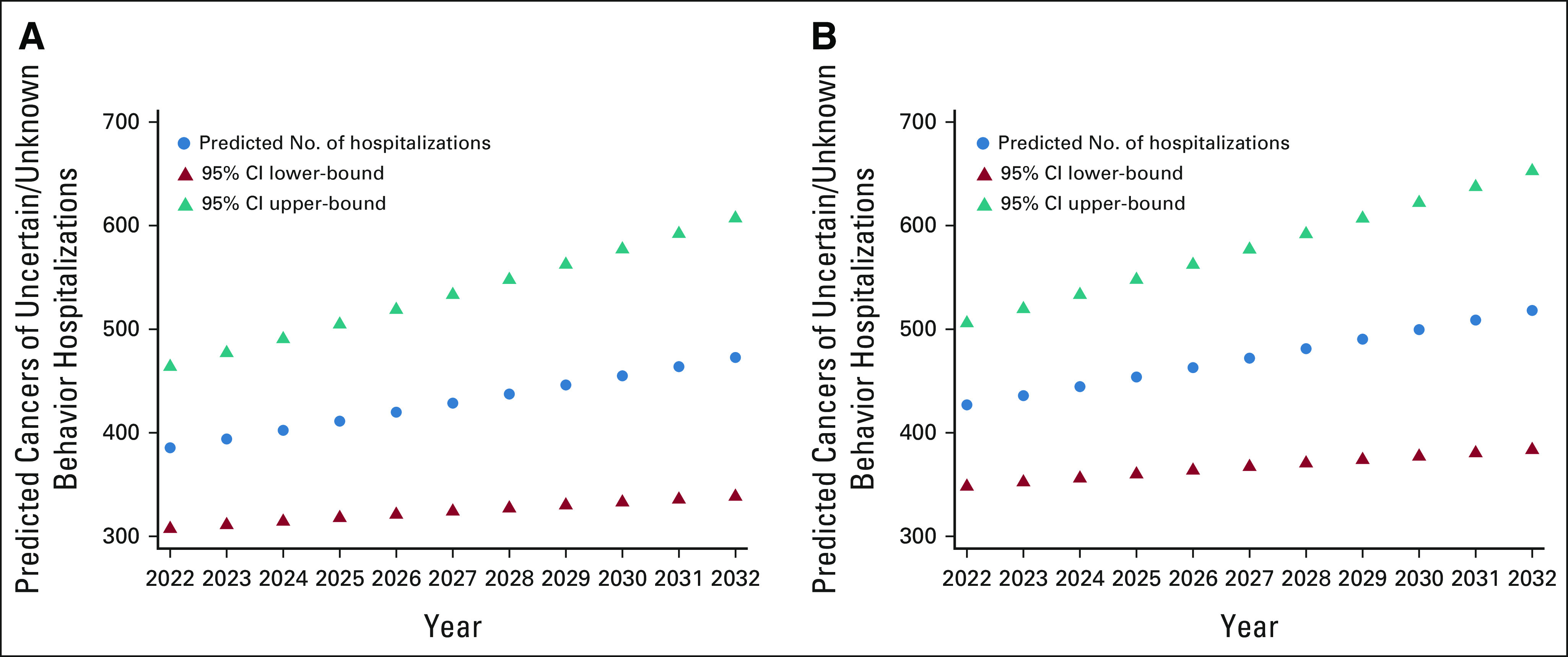
PURPOSE: The increasing cancer burden calls for reliable data on current and future associated hospitalizations to enable health care resource planning, especially in low- and middle-income countries. We provide nationwide estimates of the current and future burden of hospitalization because of neoplasms in Ghana. METHODS: We conducted secondary data (2012-2017) analysis using nationwide routine administrative inpatient health data from the Ghana Health Service. Multivariable Poisson regression was used to model spatial and temporal hospitalization trends stratified by sex and 5-year age group. In conjunction with official population projections, the model was used to predict future hospitalization up to 2032. RESULTS: Out of 2,915,936 hospitalization records extracted for 6 years, 26,627 (1.0%) were for neoplasms, most of them benign (D10-D36, 15,362; 57.7%) and in female patients (20,159; 76%). In total, 9,463 (35.5%) patients with malignancies were mostly female (5,307; 56.1%), had a median age 50 years (interquartile range, 34-66 years) and a median duration of stay of 4 days (interquartile range, 2-8 days). Poisson regression for the malignant cancers revealed an annual increase in hospitalizations with a relative rate of 1.23 (95% CI, 1.19 to 1.27). The estimated hospitalization rate for malignancies of female patients was 1.5 times higher than that of male patients (relative rate, 1.53; 95% CI, 1.00 to 2.34), adjusted for age. We predicted an increase of 67.5% malignant cancer hospitalizations from the empirical years (2012-2017) into the prediction years (2022-2032) in Ghana. CONCLUSION: In the absence of a national population-based cancer registry, this nationwide study used secondary health services data on hospitalizations as a proxy for neoplasm morbidity burden. Our results can support planning public health resources and building evidence-based advocacy campaigns for neoplasm-prevention efforts.
Overview
The claims and statistics of this paper haven’t been checked yet.
Run the check — free, no account needed. It reads the open-access text and checks the sources it cites.
Integrity signals
Registry
Cites
Statistics
Figures
Verification
Claims the paper makes
The claims and statistics of this paper haven’t been checked yet.
Run the check — free, no account needed. It reads the open-access text and checks the sources it cites.
Claims other papers make about this one
Each is checked against this paper’s own text: does it say what the citing paper says it does?
In the citing paper
“It is currently the country's most comprehensive national database of routine health data [12].”
From The Burden of Hospital Morbidity and Mortality in Ghana: A Four-Year Retrospective Analysis of National Data (2026) · cites this paper as [12]
Self-check
Percentages, sums and reported differences re-computed from the paper’s own numbers.
The self-check needs the paper’s full text.
Citations
Cites
Profile of cancer patients’ seen at Korle Bu teaching hospital in Ghana (A cancer registry review)
Calys-Tagoe, B. N., Yarney, J., Kenu, E., Owusu Amanhyia, N. A. K., Enchill, E., & Obeng, I. (2014) · BMC Research Notes · doi:10.1186/1756-0500-7-577 · Cited by 53
Research works printed but not linked: 33
- 10.1016/j.gheart.2016.10.024 · DOI
- Institute for Health Metrics and Evaluation (IHME), 2018, Findings From the Global Burden of Disease Study 2017
- 10.1016/S2214-109X(19)30374-2 · DOI
- 10.1093/ije/dyr050 · DOI
- World Health Organization, 2018, Noncommunicable Diseases Country Profiles 2018
- 10.1002/ijc.31937 · DOI · Paper page
- 10.1371/journal.pmed.1001885 · DOI · Paper page
- 10.1002/sim.4780100407 · DOI
- Spasoff RA, 1999, Epidemiologic Methods for Health Policy
- 10.1136/bmj.l2239 · DOI
- 10.1093/pubmed/fdm065 · DOI
- 10.1186/1471-2407-14-362 · DOI
- Ministry of Health, 2011, National Strategy for Cancer Control in Ghana 2012-2016
- 10.1200/JGO.2016.005744 · DOI
- Ohene-Yeboah M, 2012, Ghana Med J, 46, 8
- 10.4314/jmbs.v3i3.4 · DOI
- Ghana Statistical Service, 2014, 2010 Population and Housing Census Report
- WHO, International Statistical Classification of Diseases and Related Health Problems 10th Revision (ICD-10) Version for 2010
- 10.1186/s12885-019-5480-0 · DOI
- 10.1200/JGO.2016.006098 · DOI
- 10.1017/CBO9781139013567 · DOI · Paper page
- Hilbe J, 1999, Stata Tech Bull, 8
- StataCorp LLP, 2015, Stata Statistical Software (Version Release 14)
- Adaletey DL, 2014, J Health Inform Afr, 2
- International Agency for Research on Cancer, 2019, The Global Cancer Observatory. Globocan, 2018
- 10.1016/j.ejca.2007.11.014 · DOI
- 10.1002/(SICI)1097-0258(19971030)16:20<2297::AID-SIM668>3.0.CO;2-F · DOI
- Godlewski D, 2012, Contemp Oncol (Pozn), 16, 38
- Comber H, 2006, Trends in Irish Cancer Incidence 1994-2002 With Projections to 2020
- 10.1002/1097-0142(19860615)57:12<2454::AID-CNCR2820571235>3.0.CO;2-D · DOI
- French D, 2006, Ulster Med J, 75, 120
- 10.1038/sj.bjc.6603746 · DOI
- 10.1038/nrc1781 · DOI
Cited by
Manyeh, A. K., Odopey, C. T., Ackon, A. N. E., Gmayinaam, V. U., Dzissem, P., Acquah, E., & Immurana, M. (2026) · doi:10.64898/2026.01.13.26344071
Metadata
- Authors
- Narh, C. T., Der, J. B., Ofosu, A., Blettner, M., & Wollschlaeger, D.
- Venue
- JCO Global Oncology
- Published
- 2022-08
- Issue
- 8
- ISSN
- 2687-8941
- PMC
- PMC9470136
- Cited by
- 4
- References
- 1
- Language
- en
About these checks
Registry, retraction, Cites and statistics results are computed, not judged, with one exception: a printed reference that no index lists is read once by a model before it counts as a citation error. Claims are extracted by a model and kept only when their quote appears verbatim in the text; each cited source is then checked, with a model’s help, for whether it says what the claim relies on. Those verdicts can be wrong — read the claim’s quote and the cited source before relying on one.
Statistics and arithmetic are recomputed, not judged.
Confidence bands are shown only for fields calibrated on our annotated test set. None is calibrated yet, so no band is shown.
What counts as a claim ›How we measure confidence ›How we check this ›
Are you an author, or do you see a problem with this page? Request a review
How to cite
Cite CoChat for the checks on this page, and the paper for its own findings.
- This page
- CoChat. (2026). Citation check: Describing and Modeling the Burden of Hospitalization of Patients With Neoplasms in Ghana Using Routine Health Data for 2012-2017. https://app.cochat.ai/papers/10.1200/go.21.00416
- The paper
- Narh, C. T., Der, J. B., Ofosu, A., Blettner, M., & Wollschlaeger, D. (2022). Describing and Modeling the Burden of Hospitalization of Patients With Neoplasms in Ghana Using Routine Health Data for 2012-2017. JCO Global Oncology. https://doi.org/10.1200/go.21.00416
Data sources
Bibliographic data: Semantic Scholar, OpenAlex, Crossref.
Contains information from the Semantic Scholar Academic Graph Datasets, made available under the ODC Attribution License (ODC-BY 1.0).
Semantic Scholar’s data is described in: Kinney, R., et al. (2023). The Semantic Scholar Open Data Platform. arXiv:2301.10140.
