

Association of Nighttime Sleep Duration at 1.5 Years With Height at 3 Years: The Japan Environment and Children's Study
Open accessThe DOI matches its Crossref record; 27 of the 27 references it cites were found in a registry or an index; none of the 47 sources its claims cite is checked for support yet.
Abstract
Context: Adequate nighttime sleep duration has been considered beneficial for linear growth in children; however, there is limited and conflicting evidence regarding the association between sleep duration and subsequent linear growth. Objective: To investigate the association between sleep duration at 1.5 years and height at 3 years of age. Methods: The Japan Environment and Children's Study is a nationwide prospective birth cohort study. Data from 52 140 term singleton births born at an appropriate-for-gestational age without background disorders that could potentially affect linear growth in the analyses were included. Nighttime and total sleep durations were calculated based on a self-administered questionnaire completed by caregivers. Tall stature was defined as height at or above the 75th percentile among participants. Results: After adjustment for height at 1.5 years, sex, monthly age, mother's height, presence of siblings at 1.5 years, environmental tobacco smoke at 1.5 years, daily TV/DVD screen time at 2 years, attendance at nursery at 2 years, household annual income at birth, and parents’ educational status, multivariate odds ratio (95% CI) for tall stature at 3 years were 1.09 (1.01-1.17), 1.09 (1.01-1.17), and 1.25 (1.14-1.37) for 9.5 or 10, 10.5 or 11, and ≥ 11.5 hours of nighttime sleep duration at 1.5 years, respectively, compared with those with ≤ 9 hours sleep (P for trend <.0001). Total sleep duration was not associated with tall stature. Conclusion: This study underscores the importance of nighttime sleep duration, not total sleep duration, in the linear growth of very young children.
Overview
CoChat Summary
TL;DR
In a nationwide Japanese birth cohort of 52,140 children, longer nighttime sleep duration at 1.5 years was associated with higher odds of tall stature at 3 years after adjustment, whereas total sleep duration was not. The findings suggest nighttime sleep, rather than total sleep including naps, may matter for early linear growth.
Key findings
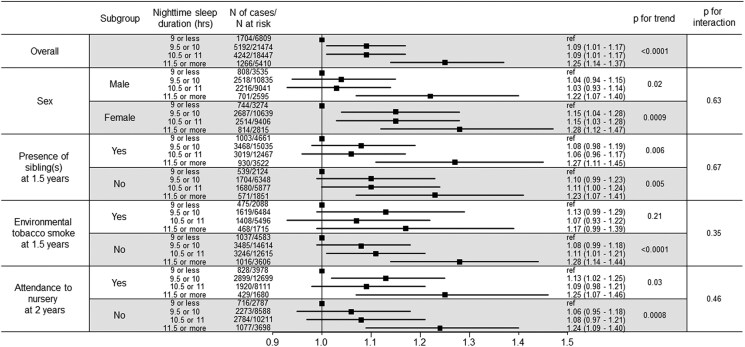
- Adjusted odds ratios for tall stature at 3 years compared with ≤9 hours of nighttime sleep at 1.5 years were 1.09 (95% CI, 1.01-1.17) for 9.5 or 10 hours, 1.09 (1.01-1.17) for 10.5 or 11 hours, and 1.25 (1.14-1.37) for ≥11.5 hours (P for trend <.0001).
- Total sleep duration was not associated with tall stature in multivariate models (Model 2 ORs 0.98, 1.00, and 1.02; P for trend = .51), despite a crude positive association (P for trend = .008).
- Tall stature was observed in 28.0% of children with nighttime sleep ≥11.5 hours versus 23.8% in those with ≤9 hours; for total sleep, tall stature was 25.8% at ≥13.5 hours versus 24.3% at ≤11 hours.
- Longer nighttime or total sleep duration was not associated with short stature in multivariate analyses, and stratified analyses found no interactions by sex, presence of siblings, environmental tobacco smoke, or nursery attendance.
Methods
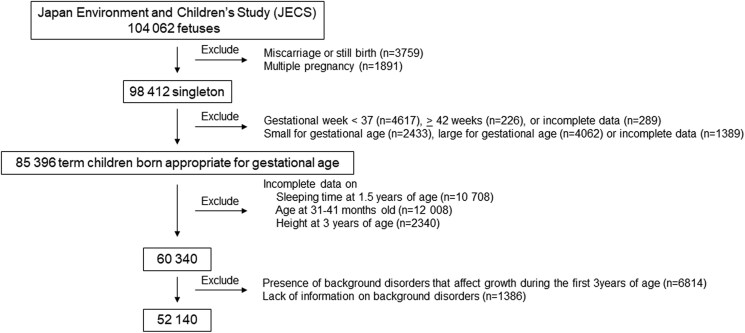
- The Japan Environment and Children’s Study is a nationwide prospective birth cohort; after exclusions, 52,140 term singleton births born appropriate for gestational age without background disorders potentially affecting linear growth were analyzed.
- Nighttime and total sleep durations at 1.5 years were calculated from a caregiver self-administered questionnaire; height at 3 years was collected by questionnaire, and sex- and age-adjusted height SDS was used to define tall stature as ≥75th percentile (HT-SDS ≥0.50) and short stature as <25th percentile (HT-SDS < −1.08).
- Multivariable logistic regression estimated odds ratios for tall or short stature, with Model 1 adjusted for height at 1.5 years, sex, monthly age at 3 years, and mother’s height; Model 2 further adjusted for siblings, environmental tobacco smoke, daily TV/DVD screen time, nursery attendance, household income, and parental educational status. Trend tests and stratified analyses were also performed.
Limitations
- The paper states that sleep duration was self-reported by questionnaire, based on a single day, and that sleep quality including wakefulness was not thoroughly investigated; defining naps was difficult, so nighttime and total sleep duration were used instead.
- The paper states that father’s height was unavailable for 46.7% of participants and that a longer longitudinal evaluation was not performed, as sleeping habits change as children grow.
- Evident from the text: this is an observational cohort, so causality cannot be established; height data were primarily measured at nursery schools, municipal health centers, and medical facilities and transcribed by caregivers, and residual confounding may remain despite adjustment.
Model-written summary. Check it against the paper before relying on it.
Integrity signals
Registry
Cites
Statistics
Figures
Verification
Claims the paper makes
0 Valid · 0 Not valid · 16 Not checked · 26 Own results and interpretations
A result the paper reports from its own data — it cites no other source for it, so there is none to check. The quote shows it is in the paper.
In the paper
“Longer nighttime sleep duration was positively associated with tall stature (crude OR 1.32 [95% CI, 1.21-1.43]) in subjects with sleep time ≥ 11.5 hours compared to those with ≤ 9 hours (Table 2).”
§ Association of Nighttime Sleep Duration at 1.5 Years With Height at 3 Years: The Japan Environment and Children's Study > Results > Nighttime Sleep Duration and Subsequent Tall Stature
plainstates an association- Asserted: passes — The authors put it forward as true.
- Checkable: passes — It can be checked against evidence.
- Load-bearing: passes — The paper’s conclusions depend on it.
- Based: passes — The paper gives a reason why it holds.
A result the paper reports from its own data — it cites no other source for it, so there is none to check. The quote shows it is in the paper.
In the paper
“After adjustment for height at 1.5 years, sex, monthly age, mother's height, presence of siblings at 1.5 years, environmental tobacco smoke at 1.5 years, daily TV/DVD screen time at 2 years, attendance at nursery at 2 years, household annual income at birth, and parents’ educational status, multivariate odds ratio (95% CI) for tall stature at 3 years were 1.09 (1.01-1.17), 1.09 (1.01-1.17), and 1.”
- Also stated in: § Nighttime Sleep Duration and Subsequent Tall Stature · plain
“After full adjustment (Model 2), multivariable ORs (95% CIs) for tall stature were 1.09 (1.01-1.17), 1.09 (1.01-1.17), and 1.25 (1.14-1.37), in those with 9.5 or 10 hours, 10.5 or 11 hour, and ≥ 11.5 hours of nighttime sleep duration, respectively, and we observed a linear trend between nighttime sleep duration and tall stature (P < .0001).”
- Also stated in: § Discussion · plain
“In this nationwide birth cohort study, we found a positive association between nighttime sleep duration and subsequent tall stature in young children.”
§ Association of Nighttime Sleep Duration at 1.5 Years With Height at 3 Years: The Japan Environment and Children's Study > Abstract > Results
plainstates an association- Asserted: passes — The authors put it forward as true.
- Checkable: passes — It can be checked against evidence.
- Load-bearing: passes — The paper’s conclusions depend on it.
- Based: passes — The paper gives a reason why it holds.
- Also stated in: § Nighttime Sleep Duration and Subsequent Tall Stature · plain
A result the paper reports from its own data — it cites no other source for it, so there is none to check. The quote shows it is in the paper.
In the paper
“Total sleep duration was not associated with tall stature.”
- Also stated in: § Nighttime Sleep Duration and Subsequent Tall Stature · plain
“Longer total sleep duration, which included daytime naps, was positively associated with tall stature in the crude analysis (P for trend = .008), but not in the multivariate analyses (Model 1 or Model 2).”
- Also stated in: § Discussion · plain
“Notably, we also revealed a lack of association between total sleep duration and subsequent tall stature”
§ Association of Nighttime Sleep Duration at 1.5 Years With Height at 3 Years: The Japan Environment and Children's Study > Abstract > Results
plain- Asserted: passes — The authors put it forward as true.
- Checkable: passes — It can be checked against evidence.
- Load-bearing: passes — The paper’s conclusions depend on it.
- Based: passes — The paper gives a reason why it holds.
- Also stated in: § Nighttime Sleep Duration and Subsequent Tall Stature · plain
A check of a cited source is scheduled, or we don’t hold its full text yet; the claim is checked once it runs.
In the paper
“GH secretion has been shown to peak during the onset of night-time sleep, particularly during slow-wave sleep (8-10)”
§ Association of Nighttime Sleep Duration at 1.5 Years With Height at 3 Years: The Japan Environment and Children's Study > Discussion
What the sources say
- Check pendingcites [8] Takahashi Y, Kipnis DM, Daughaday WH. Growth hormone secretion during sleep. J Clin Invest. 1968; 47(9): 2079‐ 2090. 5675428 PMC297368 source
- Not checked yetcites [9] Holl RW, Hartman ML, Veldhuis JD, Taylor WM, Thorner MO. Thirty-second sampling of plasma growth hormone in man: correlation with sleep stages. J Clin Endocrinol Metab. 1991; 72(4): 854‐ 861. 2005213 source
A check is scheduled.
- Not checked yetcites [10] Sassin JF, Parker DC, Mace JW, Gotlin RW, Johnson LC, Rossman LG. Human growth hormone release: relation to slow-wave sleep and sleep-walking cycles. Science. 1969; 165(3892): 513‐ 515. 4307378 source
A check is scheduled.
plainstates an association- Asserted: passes — The authors put it forward as true.
- Checkable: passes — It can be checked against evidence.
- Load-bearing: passes — The paper’s conclusions depend on it.
- Based: passes — The paper gives a reason why it holds.
In the paper
“Given the importance of adequate sleep for human health and the established link between slow-wave sleep and GH secretion (8-10), sleep duration is potentially associated with linear growth.”
§ Association of Nighttime Sleep Duration at 1.5 Years With Height at 3 Years: The Japan Environment and Children's Study > Abstract > Conclusion
What the sources say
- Check pendingcites [8] Takahashi Y, Kipnis DM, Daughaday WH. Growth hormone secretion during sleep. J Clin Invest. 1968; 47(9): 2079‐ 2090. 5675428 PMC297368 source
- Not checked yetcites [9] Holl RW, Hartman ML, Veldhuis JD, Taylor WM, Thorner MO. Thirty-second sampling of plasma growth hormone in man: correlation with sleep stages. J Clin Endocrinol Metab. 1991; 72(4): 854‐ 861. 2005213 source
Checked before — its earlier verdict is held back until a new check runs.
- Not checked yetcites [10] Sassin JF, Parker DC, Mace JW, Gotlin RW, Johnson LC, Rossman LG. Human growth hormone release: relation to slow-wave sleep and sleep-walking cycles. Science. 1969; 165(3892): 513‐ 515. 4307378 source
Checked before — its earlier verdict is held back until a new check runs.
hedgedstates an association- Asserted: passes — The authors put it forward as true.
- Checkable: passes — It can be checked against evidence.
- Load-bearing: passes — The paper’s conclusions depend on it.
- Based: passes — The paper gives a reason why it holds.
- Rests on an assumption not shown here.
9 more claims
Create a free account to see all 42 claims and to verify the 47 references still open.
- It may state two separate claims as one. 18
- Probably not a substantial claim. 22
Claims other papers make about this one
Each is checked against this paper’s own text: does it say what the citing paper says it does?
In the citing paper
“Kawai et al. utilized a large-scale birth cohort in the Japan Environment and Children’s Study (JECS) (9, 10) and demonstrated that nighttime sleep duration of ≥9.5 h at 1.5 years of age was associated with higher odds of tall stature (≥75th percentile among participants) at 3 years of age, compared with a sleep duration of ≤9 h (11).”
In the citing paper
“However, the study primarily focused on sleep duration, and other sleep dimensions, including sleep timing and sleep fragmentation, were not incorporated into the analytical model.”
Self-check
Percentages, sums and reported differences re-computed from the paper’s own numbers.
Each contradiction between two passages listed here was confirmed by an independent check.
Rated minor: it would not touch a result — a value no result rests on, a p-value that stays on the same side of the significance level, or a conflict that is clerical, resolved elsewhere in the paper, or outside its own findings.
In the paper
“| Household annual income, thousand yen | Unknown | 3199 (6.1%) | 388 (5.7%) | 1303 (6.1%) | 1153 (6.6%) | 355 (4.3%)”
§ Association of Nighttime Sleep Duration at 1.5 Years With Height at 3 Years: The Japan Environment and Children's Study > Results > Subject Characteristics
Reported 4.3 · recomputed 6.561922
Rated minor: it would not touch a result — a value no result rests on, a p-value that stays on the same side of the significance level, or a conflict that is clerical, resolved elsewhere in the paper, or outside its own findings.
In the paper
“| Environmental tobacco smoke at 1.5 years | Yes | 15 783 (30.3%) | 2088 (30.7%) | 6484 (30.2%) | 5496 (29.8%) | 1715 (31.7%) | 6532 (67.9%) | 7623 (69.2%) | 12 397 (68.6%) | 8866 (66.0%) |”
§ Association of Nighttime Sleep Duration at 1.5 Years With Height at 3 Years: The Japan Environment and Children's Study > Results > Subject Characteristics
Reported 15783 · recomputed 35418
Rated minor: it would not touch a result — a value no result rests on, a p-value that stays on the same side of the significance level, or a conflict that is clerical, resolved elsewhere in the paper, or outside its own findings.
In the paper
“| Height at 3 years | Talla | 13 002 (24.9%) | 1552 (23.8%) | 5205 (24.2%)”
§ Association of Nighttime Sleep Duration at 1.5 Years With Height at 3 Years: The Japan Environment and Children's Study > Results > Subject Characteristics
Reported 23.8 · recomputed 22.793362
Rated minor: it would not touch a result — a value no result rests on, a p-value that stays on the same side of the significance level, or a conflict that is clerical, resolved elsewhere in the paper, or outside its own findings.
In the paper
“| Household annual income, thousand yen | Unknown | 3199 (6.1%) | 388 (5.7%) | 1303 (6.1%) | 1153 (6.6%) | 355 (4.3%)”
§ Association of Nighttime Sleep Duration at 1.5 Years With Height at 3 Years: The Japan Environment and Children's Study > Results > Subject Characteristics
Reported 6.6 · recomputed 6.250339
Rated minor: it would not touch a result — a value no result rests on, a p-value that stays on the same side of the significance level, or a conflict that is clerical, resolved elsewhere in the paper, or outside its own findings.
In the paper
§ Association of Nighttime Sleep Duration at 1.5 Years With Height at 3 Years: The Japan Environment and Children's Study > Results > Subject Characteristics
“Total sleep duration (hours) 12.5 or 13 n = 18 076”
§ Association of Nighttime Sleep Duration at 1.5 Years With Height at 3 Years: The Japan Environment and Children's Study > Results > Nighttime Sleep Duration and Subsequent Tall Stature
“| | Number at risk | 6809 | 21 474 | 18 447 | 5410 | | 9617 | 11 023 | 18 706 | 13 424 | |”
3 more findings
Create a free account to see every finding of this check.
Citations
Cites
Meta-Analysis of Short Sleep Duration and Obesity in Children and Adults
Cappuccio, F. P., Taggart, F. M., Kandala, N.-B., Currie, A., Peile, E., Stranges, S., & Miller, M. A. (2008) · Sleep · doi:10.1093/sleep/31.5.619 · Cited by 2,076 · cited 1×
“Short sleep duration has been associated with metabolic complications, including child - hood obesity (6, 7).”
Rationale and study design of the Japan environment and children’s study (JECS)
Working Group of the Epidemiological Research for Children’s Environmental Health, Kawamoto, T., Nitta, H., Murata, K., Toda, E., Tsukamoto, N., Hasegawa, M., Yamagata, Z., Kayama, F., Kishi, R., et al. (2014) · BMC Public Health · doi:10.1186/1471-2458-14-25 · Cited by 834
Growth hormone secretion during sleep
Takahashi, Y., Kipnis, D. M., & Daughaday, W. H. (1968) · Journal of Clinical Investigation · doi:10.1172/jci105893 · Cited by 797 · cited 2×
“GH secretion has been shown to peak during the onset of night-time sleep, particularly during slow-wave sleep (8-10), and there is evidence of a clinical association between the duration of slow-wave sleep and linear growth.”
Sleep is essential to health: an American Academy of Sleep Medicine position statement
Ramar, K., Malhotra, R. K., Carden, K. A., Martin, J. L., Abbasi-Feinberg, F., Aurora, R. N., Kapur, V. K., Olson, E. J., Rosen, C. L., Rowley, J. A., et al. (2021) · Journal of Clinical Sleep Medicine · doi:10.5664/jcsm.9476 · Cited by 648 · cited 1×
“Sleep is crucial for human health, and its disruption, such as a short sleep duration, has been linked to the development of various diseases (5, 6).”
Baseline Profile of Participants in the Japan Environment and Children’s Study (JECS)
Michikawa, T., Nitta, H., Nakayama, S. F., Yamazaki, S., Isobe, T., Tamura, K., Suda, E., Ono, M., Yonemoto, J., Iwai-Shimada, M., et al. (2018) · Journal of Epidemiology · doi:10.2188/jea.je20170018 · Cited by 597 · cited 1×
“Descriptions of the JECS have been reported previously (18, 19).”
Children’s sleep and health: A meta-review
Matricciani, L., Paquet, C., Galland, B., Short, M., & Olds, T. (2019) · Sleep Medicine Reviews · doi:10.1016/j.smrv.2019.04.011 · Cited by 453 · cited 2×
“Sleep is crucial for human health, and its disruption, such as a short sleep duration, has been linked to the development of various diseases (5, 6).”
Human Growth Hormone Release: Relation to Slow-Wave Sleep and Sleep-Waking Cycles
Sassin, J. F., Parker, D. C., Mace, J. W., Gotlin, R. W., Johnson, L. C., & Rossman, L. G. (1969) · Science · doi:10.1126/science.165.3892.513 · Cited by 413
New Japanese neonatal anthropometric charts for gestational age at birth
Itabashi, K., Miura, F., Uehara, R., & Nakamura, Y. (2014) · Pediatrics International · doi:10.1111/ped.12331 · Cited by 412
Millward, D. J. (2017) · Nutrition Research Reviews · doi:10.1017/s0954422416000238 · Cited by 368
Thirty-Second Sampling of Plasma Growth Hormone in Man: Correlation with Sleep Stages*
HOLL, R. W., HARTMAN, M. L., VELDHUIS, J. D., TAYLOR, W. M., & THORNER, M. O. (1991) · The Journal of Clinical Endocrinology & Metabolism · doi:10.1210/jcem-72-4-854 · Cited by 239
Dynamics of the sleep EEG after an early evening nap: experimental data and simulations
Werth, E., Dijk, D. J., Achermann, P., & Borbely, A. A. (1996) · American Journal of Physiology-Regulatory, Integrative and Comparative Physiology · doi:10.1152/ajpregu.1996.271.3.r501 · Cited by 219 · cited 1×
“In addition, an observational study involving 9 young adults with evening naps reported reduced slow-wave sleep during the following nighttime sleep compared to those without evening naps (27).”
Isojima, T., Kato, N., Ito, Y., Kanzaki, S., & Murata, M. (2016) · Clinical Pediatric Endocrinology · doi:10.1297/cpe.25.71 · Cited by 181 · cited 1×
“Sex-and age-adjusted height SDS (HT-SDS) were calculated based on normal growth standards for Japanese children from a national survey conducted in 2000 (21).”
Knutson, K. L. (2005) · American Journal of Human Biology · doi:10.1002/ajhb.20405 · Cited by 174
Growth and growth biomarker changes after adenotonsillectomy: systematic review and meta-analysis
Bonuck, K. A., Freeman, K., & Henderson, J. (2008) · Archives of Disease in Childhood · doi:10.1136/adc.2008.141192 · Cited by 170
Sleep Duration From Ages 1 to 10 Years: Variability and Stability in Comparison With Growth
Jenni, O. G., Molinari, L., Caflisch, J. A., & Largo, R. H. (2007) · Pediatrics · doi:10.1542/peds.2006-3300 · Cited by 145 · cited 1×
“A cohort study involving 305 Swiss children reported no association between sleep duration and height at any age between 1 and 10 years (12).”
Lee, C. ‐., Hsu, W. ‐., Chang, W. ‐., Lin, M. ‐., & Kang, K. ‐. (2016) · Clinical Otolaryngology · doi:10.1111/coa.12549 · Cited by 132 · cited 1×
“For instance, a meta-analysis revealed that adenotonsillectomy in children with obstructive sleep apnea increased the duration of slow-wave sleep (22) and stimulated linear growth (23) due to increased GH secretion (24, 25).”
Infant Growth in Length Follows Prolonged Sleep and Increased Naps
Lampl, M., & Johnson, M. L. (2011) · Sleep · doi:10.1093/sleep/34.5.641 · Cited by 91
Sleep duration and growth outcomes across the first two years of life in the GUSTO study
Zhou, Y., Aris, I. M., Tan, S. S., Cai, S., Tint, M. T., Krishnaswamy, G., Meaney, M. J., Godfrey, K. M., Kwek, K., Gluckman, P. D., et al. (2015) · Sleep Medicine · doi:10.1016/j.sleep.2015.07.006 · Cited by 78 · cited 1×
“A birth cohort study involving 899 children in Singapore revealed a positive association between sleep duration at 3 months and height at 2 years of age (14).”
Sleep habits and height at ages 5 to 11.
Gulliford, M. C., Price, C. E., Rona, R. J., & Chinn, S. (1990) · Archives of Disease in Childhood · doi:10.1136/adc.65.1.119 · Cited by 74 · cited 2×
“In contrast, a cross-sectional study involving 5145 children 5 to 11 years of age in England and Scotland demonstrated weak and inverse associations between sleep duration and growth (11).”
A genetic approach to evaluation of short stature of undetermined cause
Murray, P. G., Clayton, P. E., & Chernausek, S. D. (2018) · The Lancet Diabetes & Endocrinology · doi:10.1016/s2213-8587(18)30034-2 · Cited by 67 · cited 1×
“Many genes that contribute to short stature have been identified (3).”
Deciphering short stature in children
Polidori, N., Castorani, V., Mohn, A., & Chiarelli, F. (2020) · Annals of Pediatric Endocrinology & Metabolism · doi:10.6065/apem.2040064.032 · Cited by 62
Inzaghi, E., Reiter, E., & Cianfarani, S. (2019) · Hormone Research in Paediatrics · doi:10.1159/000502901 · Cited by 57
Metabolic Aspects of Sleep Apnea
Grunstein, R. R. (1996) · Sleep · doi:10.1093/sleep/19.suppl_10.s218 · Cited by 55 · cited 1×
“For instance, a meta-analysis revealed that adenotonsillectomy in children with obstructive sleep apnea increased the duration of slow-wave sleep (22) and stimulated linear growth (23) due to increased GH secretion (24, 25).”
Sleep-disordered breathing and hormones
Saaresranta, T., & Polo, O. (2003) · European Respiratory Journal · doi:10.1183/09031936.03.00062403 · Cited by 49
Somatic growth of lean children: the potential role of sleep
Jiang, Y.-R., Spruyt, K., Chen, W.-J., Shen, X.-M., & Jiang, F. (2014) · World Journal of Pediatrics · doi:10.1007/s12519-014-0500-2 · Cited by 18 · cited 1×
“A cross-sectional study in China reported that short sleep duration was associated with shorter height in 143 lean children (13).”
Naps not as effective as a night of sleep at dissipating sleep pressure
Tarokh, L., Van Reen, E., Achermann, P., & Carskadon, M. A. (2021) · Journal of Sleep Research · doi:10.1111/jsr.13295 · Cited by 5 · cited 1×
“Although findings from pediatric samples are extremely limited, an observational study involving 46 participants 10 to 23 years of age revealed that multiple naps distributed throughout the day were not as effective in producing slow-wave activity as nighttime sleep (26).”
Association between height and sleep duration in Korean adults
Seo, M., & Hwang, I. C. (2021) · Internal Medicine Journal · doi:10.1111/imj.15181 · Cited by 2 · cited 1×
“However, there is limited evidence on this topic, and the conclusions drawn in previous studies have been conflicting (11-17).”
Cited by
Senoo, S., Shimizu, K., Fujimoto, M., Yamaguchi, Y., Sunada, H., Masumoto, T., Morita, A., Noma, H., Namba, N., & on behalf of the Japan Environment Children's Study Group (2026) · Frontiers in Public Health · doi:10.3389/fpubh.2026.1945746
A review of sleep-related indicators measured in large population-based cohort studies in Japan
Ariyada, K., Yamagishi, K., Seol, J., Yanagisawa, M., & Iwagami, M. (2026) · Environmental Health and Preventive Medicine · doi:10.1265/ehpm.25-00277
“The outcomes included low birth weight in infants, autism spectrum disorder in children, and child height [79, 85, 90, 94].”
Aoki, Y., Nakai, M., Sawada, H., Moritake, H., The Japan Environment and Children’s Study Group, Kamijima, M., Yamazaki, S., Fukami, M., Kishi, R., Ota, C., et al. (2026) · BMC Public Health · doi:10.1186/s12889-026-28796-x
“Covariates were selected a priori based on prior literature, biological plausibility, and a conceptual framework of factors potentially associated with both outdoor play and postnatal growth among children born SGA [13, 22– 26].”
Self-citation
Metadata
- Authors
- Kawai, M., Baba, S., Tanigawa, K., Ikehara, S., Kawasaki, R., & Iso, H.
- Affiliations
- Osaka Women's and Children's Hospital (JP)
- The University of Osaka (JP)
- National Center for Global Health and Medicine (JP)
- Corresponding author
- Kawai, Masanobu
- Venue
- The Journal of Clinical Endocrinology & Metabolism
- Publisher
- The Endocrine Society
- Published
- 2024-09-17
- Volume
- 110
- Issue
- 6
- Pages
- e1866-e1873
- ISSN
- 0021-972X (ISSN-L)
- 1945-7197
- PMC
- PMC12086428
- OpenAlex
- W4402575992
- Cited by
- 3
- References
- 27
- Citations by year
- 2026: 3
- FWCI
- 0.64
- Type
- journal article
- Language
- en
- Open access
- hybrid
- doi.org
- Licence
- Locations
- The Journal of Clinical Endocrinology & Metabolism (publishedVersion, cc-by)
- Europe PMC (PubMed Central) (publishedVersion, cc-by)
- PubMed Central (publishedVersion, cc-by)
- PubMed (publishedVersion)
- Funders
- Ministry of the Environment, Japan
- Topics
- Social Sciences › Psychology › Experimental and Cognitive Psychology › Sleep and related disorders
- Life Sciences › Neuroscience › Cognitive Neuroscience › Sleep and Wakefulness Research
- Health Sciences › Medicine › Pediatrics, Perinatology and Child Health › Human Health and Disease
- Keywords
- nighttime sleep duration, total sleep duration, linear growth, tall stature, early childhood, infant sleep, Japan Environment and Children's Study, birth cohort
- MeSH terms
- Birth Cohort, Sleep Duration, Body Height, Child Development, Child, Preschool, Female, Humans, Infant, Japan, Male, Prospective Studies, Surveys and Questionnaires, Sleep, Time Factors
About these checks
Registry, retraction, Cites and statistics results are computed, not judged, with one exception: a printed reference that no index lists is read once by a model before it counts as a citation error. Claims are extracted by a model and kept only when their quote appears verbatim in the text; each cited source is then checked, with a model’s help, for whether it says what the claim relies on. Those verdicts can be wrong — read the claim’s quote and the cited source before relying on one.
A language model drew the claims from the paper on 2026-11-28, under version 3 of the claim definition (model deepseek-v4.1-flash, prompt extract-v3).
A second model labelled each claim on 2026-11-28 (model jev-1.13-20260917, definition revision gold-guideline-v0.2).
Statistics and arithmetic are recomputed, not judged.
Confidence bands are shown only for fields calibrated on our annotated test set. None is calibrated yet, so no band is shown.
What counts as a claim ›How we measure confidence ›How we check this ›
Are you an author, or do you see a problem with this page? Request a review
Data sources
Bibliographic data: Semantic Scholar, OpenAlex, Crossref.
Contains information from the Semantic Scholar Academic Graph Datasets, made available under the ODC Attribution License (ODC-BY 1.0).
Semantic Scholar’s data is described in: Kinney, R., et al. (2023). The Semantic Scholar Open Data Platform. arXiv:2301.10140.
