

Earlier bedtime at 1.5 years is associated with greater height gain at 3 years of age: a nationwide birth cohort study of the Japan environment and children’s study
Open accessThe DOI matches its Crossref record; 29 of the 29 references it cites were found in a registry or an index; none of the 18 sources its claims cite is checked for support yet.
Abstract
Background: Previous studies have shown inconsistent associations between sleep duration and height gain in early childhood. The relationships of bedtime and nighttime awakenings with growth remain unclear. We investigated whether sleep characteristics at 1.5 years were associated with subsequent height gain. Methods: Forty-nine thousand two hundred eight singleton, term toddlers classified as appropriate for gestational age were selected from the Japan Environment and Children’s Study. Nighttime sleep was defined as sleep between 20:00 and 07:59. Nighttime sleep duration, bedtime, and nighttime awakenings were categorized as long (≥10 h) or short (<10 h), early (20:00–21:59) or late (≥22:00), and infrequent (<3) or frequent (≥3), respectively. Linear mixed-effects models were used to examine associations with height and height standard deviation scores (SDS). Results: The early bedtime group showed greater monthly increases in height and height SDS than the late bedtime group, corresponding to 18-month differences of 0.13 cm ( B = 7.21 × 10 − 3 cm/month, 95% confidence interval (CI) 0.06 to 0.20; p < 0.001) and 0.046 SD ( B = 2.53 × 10 − 3 SD/month, 95% CI 0.027 to 0.064; p < 0.001), respectively. The long sleep group did not differ significantly from the short sleep group in either outcome in the primary multivariable model. In continuous analyses, sleep duration was significantly associated with height gain, but not with height SDS gain. In an additional analysis including sleep outside the predefined nighttime window, the >14-h group showed smaller increases in height and height SDS than the 11–14-h group, whereas the <11-h group did not differ significantly from the 11–14-h group. The infrequent nighttime awakenings group did not differ significantly from the frequent nighttime awakenings group in either outcome. Conclusion: Earlier bedtime at 1.5 years was associated with greater height gain, although the magnitude of the association was small. The associations of sleep duration with height gain varied between nighttime and 24-h sleep analyses. The observed association with earlier bedtime may have practical relevance because bedtime can be discussed during routine child health guidance; however, given the observational study design, these findings should not be interpreted as evidence of a causal effect.
Overview
CoChat Summary
TL;DR
In a nationwide Japanese birth cohort of 49,208 singleton term AGA toddlers, earlier bedtime at 1.5 years was associated with greater height and height SDS gain from 1.5 to 3 years, while categorical nighttime sleep duration and nighttime awakenings were not significantly associated in the primary adjusted model. The association was small and observational, and sleep-duration findings varied by modeling and by nighttime vs 24-hour definitions.
Key findings
- In adjusted linear mixed-effects models, the early bedtime group (20:00–21:59) had greater monthly increases than the late bedtime group (≥22:00): height B = 7.21 × 10⁻³ cm/month (95% CI 3.26 × 10⁻³ to 11.15 × 10⁻³; p < 0.001) and height SDS B = 2.53 × 10⁻³ SD/month (95% CI 1.51 × 10⁻³ to 3.56 × 10⁻³; p < 0.001), corresponding to 18-month differences of 0.13 cm and 0.046 SD.
- Categorical nighttime sleep duration (≥10 h vs <10 h) was not significantly associated with height or height SDS in the primary multivariable model (p = 0.385 and p = 0.436, respectively). Continuous sleep duration was significantly associated with height gain (B = 2.47 × 10⁻³ cm/month, 95% CI 0.69 × 10⁻³ to 4.25 × 10⁻³; p = 0.006) but not height SDS gain (p = 0.944).
- In an additional 24-h sleep analysis, the >14-h group showed smaller monthly increases than the 11–14-h group in height (B = −7.48 × 10⁻³ cm/month, 95% CI −13.66 × 10⁻³ to −1.29 × 10⁻³; p = 0.018) and height SDS (B = −2.79 × 10⁻³ SD/month, 95% CI −4.40 × 10⁻³ to −1.19 × 10⁻³; p < 0.001); the <11-h group did not differ significantly.
- Infrequent (<3) vs frequent (≥3) nighttime awakenings did not differ significantly in height or height SDS in the primary model; the frequent awakenings group included 957 children vs 48,251 in the infrequent group.
Methods
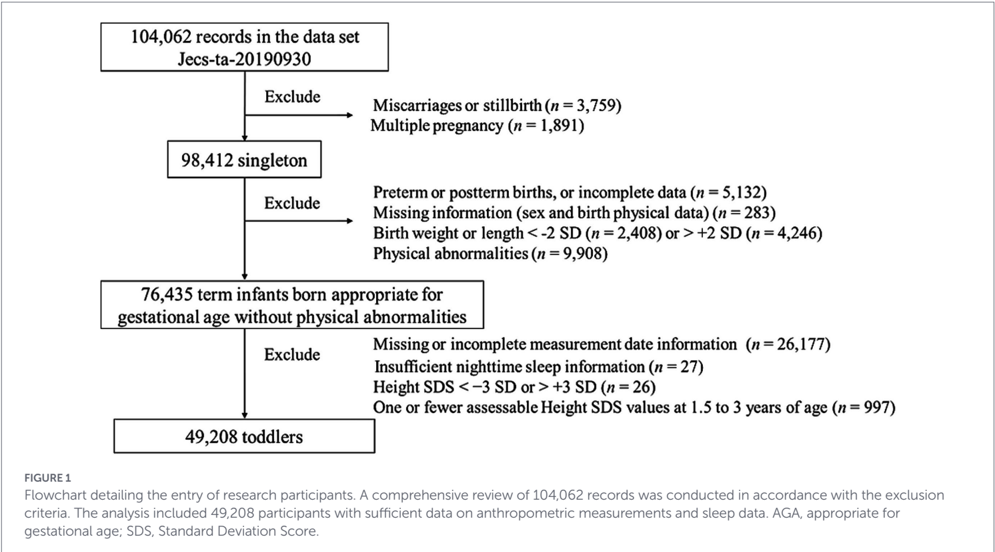
- The Japan Environment and Children’s Study (JECS) nationwide birth cohort provided 49,208 singleton, term, appropriate-for-gestational-age toddlers after exclusions. Sleep at 1.5 years was caregiver-reported in 0.5-h intervals; nighttime sleep was defined as 20:00–07:59, with bedtime categorized as early (20:00–21:59) or late (≥22:00), sleep duration as long (≥10 h) or short (<10 h), and nighttime awakenings as infrequent (<3) or frequent (≥3).
- Height and height SDS were assessed at 1.5, 2, 2.5, and 3 years. Linear mixed-effects models included a sleep-variable × time interaction and a random intercept for each child, adjusted for sleep duration, bedtime, nighttime awakenings, sex, parental height SDS, parental education, household income, and number of income earners; sensitivity analyses used alternative cutoffs, alternative nighttime windows, and total 24-h sleep duration.
Limitations
- Stated: sleep was assessed only at 1.5 years, so it may not represent sleep throughout follow-up and may cause exposure misclassification; the predefined 20:00–07:59 nighttime window may misclassify sleep duration; daytime naps could not be clearly defined or separately evaluated; residual confounding by health conditions, reverse causality, nutrition, and daytime behaviors cannot be excluded; substantial exclusions (e.g., 26,177 for unknown measurement year/month) may introduce selection bias; sleep was caregiver-reported without actigraphy or polysomnography; some reference standards and thresholds predate the cohort.
- Stated: the frequent awakenings group was very small, limiting statistical power and precision, so the null finding for awakenings does not rule out a small association.
- Evident from the text: the observational design precludes causal interpretation; the effect magnitude was small; secondary comparisons were exploratory and p-values were not adjusted for multiple testing.
Model-written summary. Check it against the paper before relying on it.
Integrity signals
Registry
Cites
Statistics
Figures
Verification
Claims the paper makes
0 Valid · 0 Not valid · 13 Not checked · 105 Own results and interpretations
A result the paper reports from its own data — it cites no other source for it, so there is none to check. The quote shows it is in the paper.
In the paper
“Through LMM analysis using the large dataset from the JECS, a nationwide birth cohort study, we found that earlier bedtime was significantly associated with greater height gain from 1.5 to 3 years of age, whereas the association between sleep duration and height gain varied according to how sleep duration was modeled and which other sleep characteristics were included in the model.”
§ Earlier bedtime at 1.5 years is associated with greater height gain at 3 years of age: a nationwide birth cohort study of the Japan environment and children’s study > Discussion
plainstates an association- Asserted: passes — The authors put it forward as true.
- Checkable: passes — It can be checked against evidence.
- Load-bearing: passes — The paper’s conclusions depend on it.
- Based: passes — The paper gives a reason why it holds.
A result the paper reports from its own data — it cites no other source for it, so there is none to check. The quote shows it is in the paper.
In the paper
“The associations of sleep duration with height gain varied between nighttime and 24-h sleep analyses.”
- Also stated in: § Discussion · plain
“The associations of sleep duration with height gain varied between nighttime and 24-h sleep analyses.”
§ Earlier bedtime at 1.5 years is associated with greater height gain at 3 years of age: a nationwide birth cohort study of the Japan environment and children’s study > Abstract > Conclusion
plainstates an association- Asserted: passes — The authors put it forward as true.
- Checkable: passes — It can be checked against evidence.
- Load-bearing: passes — The paper’s conclusions depend on it.
- Based: passes — The paper gives a reason why it holds.
- Also stated in: § Discussion · plain
A result the paper reports from its own data — it cites no other source for it, so there is none to check. The quote shows it is in the paper.
In the paper
“The early bedtime group showed significantly greater monthly increases in both height (B = 7.57 × 10⁻³ cm/month, p < 0.001) and height SDS (B = 2.48 × 10⁻³ SD/month, p < 0.001).”
§ Earlier bedtime at 1.5 years is associated with greater height gain at 3 years of age: a nationwide birth cohort study of the Japan environment and children’s study > Results
plainstates an association- Asserted: passes — The authors put it forward as true.
- Checkable: passes — It can be checked against evidence.
- Load-bearing: passes — The paper’s conclusions depend on it.
- Based: passes — The paper gives a reason why it holds.
A result the paper reports from its own data — it cites no other source for it, so there is none to check. The quote shows it is in the paper.
In the paper
“At 1.5 years of age, the baseline time point for the LMM analysis, mean height SDS was significantly higher in the long sleep group than in the short sleep group (p < 0.001).”
§ Earlier bedtime at 1.5 years is associated with greater height gain at 3 years of age: a nationwide birth cohort study of the Japan environment and children’s study > Results
plainstates an association- Asserted: passes — The authors put it forward as true.
- Checkable: passes — It can be checked against evidence.
- Load-bearing: unclear — It is unclear whether the paper’s conclusions depend on it.
- Based: passes — The paper gives a reason why it holds.
A result the paper reports from its own data — it cites no other source for it, so there is none to check. The quote shows it is in the paper.
In the paper
“In contrast, the number of nighttime awakenings was not significantly associated with height gain.”
§ Earlier bedtime at 1.5 years is associated with greater height gain at 3 years of age: a nationwide birth cohort study of the Japan environment and children’s study > Discussion
plainn = 957- Asserted: passes — The authors put it forward as true.
- Checkable: passes — It can be checked against evidence.
- Load-bearing: unclear — It is unclear whether the paper’s conclusions depend on it.
- Based: passes — The paper gives a reason why it holds.
53 more claims
Create a free account to see all 118 claims and to verify the 18 references still open.
- Probably not a substantial claim. 52
- It may state two separate claims as one. 24
Self-check
Percentages, sums and reported differences re-computed from the paper’s own numbers.
Each contradiction between two passages listed here was confirmed by an independent check.
Rated minor: it would not touch a result — a value no result rests on, a p-value that stays on the same side of the significance level, or a conflict that is clerical, resolved elsewhere in the paper, or outside its own findings.
In the paper
§ Earlier bedtime at 1.5 years is associated with greater height gain at 3 years of age: a nationwide birth cohort study of the Japan environment and children’s study > Results
“The adjusted estimate for the frequent versus infrequent awakenings groups corresponded to an 18-month difference of approximately 0.117 cm (95% CI − 0.071 to 0.305 cm) in height and 0.047 SD (95% CI − 0.002 to 0.096 SD) in height SDS.”
§ Earlier bedtime at 1.5 years is associated with greater height gain at 3 years of age: a nationwide birth cohort study of the Japan environment and children’s study > Methods > Statistical analyses
“| Nighttime awakenings(< 3 vs. ≥ 3) | 6.49 (−3.97, 16.95) | 0.222 | 3.50 (−7.14, 14.14) | 0.519 |”
Citations
Cites
Investigation of the freely available easy-to-use software ‘EZR’ for medical statistics
Kanda, Y. (2013) · Bone Marrow Transplantation · doi:10.1038/bmt.2012.244 · Cited by 18,767
Data Structures for Statistical Computing in Python
McKinney, W. (2010) · Proceedings of the Python in Science Conference · doi:10.25080/majora-92bf1922-00a · Cited by 11,032
Linear Mixed Models for Longitudinal Data
Molenberghs, G., & Verbeke, G. (2000) · Springer Series in Statistics · doi:10.1007/978-1-4419-0300-6 · Cited by 2,646
Paruthi, S., Brooks, L. J., D’Ambrosio, C., Hall, W. A., Kotagal, S., Lloyd, R. M., Malow, B. A., Maski, K., Nichols, C., Quan, S. F., et al. (2016) · Journal of Clinical Sleep Medicine · doi:10.5664/jcsm.5866 · Cited by 1,562
National Sleep Foundation's sleep quality recommendations: first report
Ohayon, M., Wickwire, E. M., Hirshkowitz, M., Albert, S. M., Avidan, A., Daly, F. J., Dauvilliers, Y., Ferri, R., Fung, C., Gozal, D., et al. (2017) · Sleep Health · doi:10.1016/j.sleh.2016.11.006 · Cited by 1,304
Rationale and study design of the Japan environment and children’s study (JECS)
Working Group of the Epidemiological Research for Children’s Environmental Health, Kawamoto, T., Nitta, H., Murata, K., Toda, E., Tsukamoto, N., Hasegawa, M., Yamagata, Z., Kayama, F., Kishi, R., et al. (2014) · BMC Public Health · doi:10.1186/1471-2458-14-25 · Cited by 834
Linear mixed models for longitudinal data
(2000) · Springer Series in Statistics · doi:10.1007/b98969 · Cited by 818
Growth hormone secretion during sleep
Takahashi, Y., Kipnis, D. M., & Daughaday, W. H. (1968) · Journal of Clinical Investigation · doi:10.1172/jci105893 · Cited by 797
Normal sleep patterns in infants and children: A systematic review of observational studies
Galland, B. C., Taylor, B. J., Elder, D. E., & Herbison, P. (2012) · Sleep Medicine Reviews · doi:10.1016/j.smrv.2011.06.001 · Cited by 734
Baseline Profile of Participants in the Japan Environment and Children’s Study (JECS)
Michikawa, T., Nitta, H., Nakayama, S. F., Yamazaki, S., Isobe, T., Tamura, K., Suda, E., Ono, M., Yonemoto, J., Iwai-Shimada, M., et al. (2018) · Journal of Epidemiology · doi:10.2188/jea.je20170018 · Cited by 597
Metadata
- Authors
- Senoo, S., Shimizu, K., Fujimoto, M., Yamaguchi, Y., Sunada, H., Masumoto, T., Morita, A., Noma, H., Namba, N., & on behalf of the Japan Environment Children's Study Group
- Affiliations
- Tottori University (JP)
- Tottori University Hospital (JP)
- The Institute of Statistical Mathematics (JP)
- Corresponding author
- Namba, Noriyuki
- ORCID
- Venue
- Frontiers in Public Health
- Publisher
- Frontiers Media SA
- Published
- 2026-09-24
- Volume
- 14
- Pages
- 1945746-1945746
- ISSN
- 2296-2565 (ISSN-L)
- PMC
- PMC13646113
- OpenAlex
- W7214239030
- Cited by
- 0
- References
- 29
- FWCI
- 0.00
- Type
- journal article
- Language
- en
- Open access
- gold
- doi.org
- Licence
- Locations
- Frontiers in Public Health (publishedVersion, cc-by)
- PubMed Central (publishedVersion, cc-by)
- PubMed (publishedVersion)
- DOAJ (DOAJ: Directory of Open Access Journals) (submittedVersion)
- Funders
- Ministry of Environment
- Topics
- Social Sciences › Psychology › Experimental and Cognitive Psychology › Sleep and related disorders
- Life Sciences › Neuroscience › Cognitive Neuroscience › Sleep and Wakefulness Research
- Life Sciences › Neuroscience › Endocrine and Autonomic Systems › Circadian rhythm and melatonin
- Keywords
- bedtime, sleep duration, height gain, child growth, toddlers, nocturnal awakenings, nocturnal sleep, height standard deviation score, Japan Environment and Children's Study, sleep timing
- MeSH terms
- Birth Cohort, Sleep Duration, Body Height, Child, Preschool, Female, Humans, Infant, Japan, Male, Sleep, Time Factors
About these checks
Registry, retraction, Cites and statistics results are computed, not judged, with one exception: a printed reference that no index lists is read once by a model before it counts as a citation error. Claims are extracted by a model and kept only when their quote appears verbatim in the text; each cited source is then checked, with a model’s help, for whether it says what the claim relies on. Those verdicts can be wrong — read the claim’s quote and the cited source before relying on one.
A language model drew the claims from the paper on 2026-11-28, under version 3 of the claim definition (model deepseek-v4.1-flash, prompt extract-v3).
A second model labelled each claim on 2026-11-28 (model jev-1.13-20260917, definition revision gold-guideline-v0.2).
Statistics and arithmetic are recomputed, not judged.
Confidence bands are shown only for fields calibrated on our annotated test set. None is calibrated yet, so no band is shown.
What counts as a claim ›How we measure confidence ›How we check this ›
Are you an author, or do you see a problem with this page? Request a review
How to cite
Cite CoChat for the checks on this page, and the paper for its own findings.
- This page
- CoChat. (2026). Citation check: Earlier bedtime at 1.5 years is associated with greater height gain at 3 years of age: a nationwide birth cohort study of the Japan environment and children’s study. https://app.cochat.ai/papers/10.3389/fpubh.2026.1945746
- The paper
- Senoo, S., Shimizu, K., Fujimoto, M., Yamaguchi, Y., Sunada, H., Masumoto, T., Morita, A., Noma, H., Namba, N., & on behalf of the Japan Environment Children's Study Group. (2026). Earlier bedtime at 1.5 years is associated with greater height gain at 3 years of age: a nationwide birth cohort study of the Japan environment and children’s study. Frontiers in Public Health. https://doi.org/10.3389/fpubh.2026.1945746
Data sources
Bibliographic data: Semantic Scholar, OpenAlex, Crossref.
Contains information from the Semantic Scholar Academic Graph Datasets, made available under the ODC Attribution License (ODC-BY 1.0).
Semantic Scholar’s data is described in: Kinney, R., et al. (2023). The Semantic Scholar Open Data Platform. arXiv:2301.10140.
