

Long-term Recordings of Arcuate Nucleus Kisspeptin Neurons Across the Mouse Estrous Cycle
Open accessThe DOI matches its Crossref record; 25 of the 26 references it cites were found in a registry or an index.
Abstract
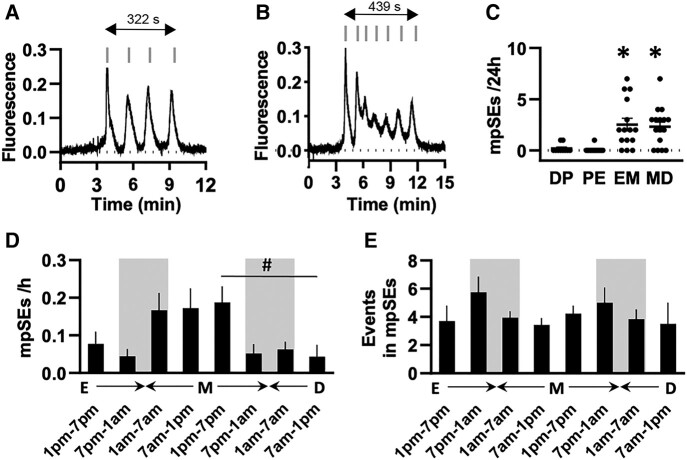
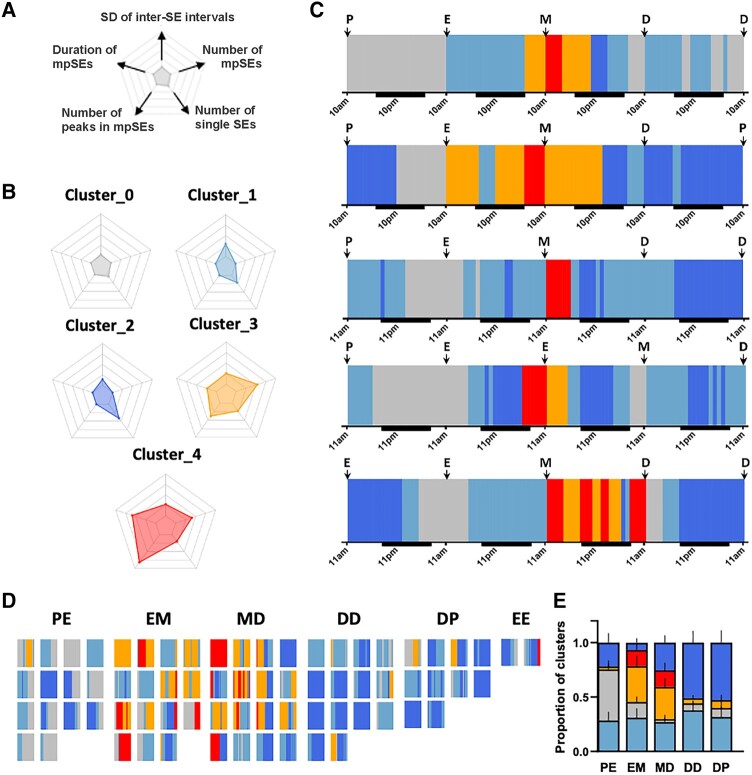
The arcuate nucleus kisspeptin (ARNKISS) neurons represent the GnRH pulse generator that likely drives pulsatile gonadotropin secretion in all mammals. Using an improved GCaMP fiber photometry system enabling long-term continuous recordings, we aimed to establish a definitive profile of ARNKISS neuronal activity across the murine estrous cycle. As noted previously, a substantial reduction in the frequency of ARNKISS neuron synchronization events (SEs) occurs on late proestrus and extends into estrus. The SE amplitude remains constant throughout the cycle. During metestrus, we unexpectedly detected many multipeak SEs where many SEs occurred rapidly, within 160 seconds of each other. By applying a machine learning-based, k-means clustering analysis, we were further able to detect substantial within-stage variability in the patterns of pulse generator activity. Estrous cycle-dependent changes in SE activity occurred around the time of lights on and off. We also find that a mild stressor such as vaginal lavage reduces ARNKISS neuron SE frequency for up to 3 hours. These observations provide a comprehensive account of ARNKISS neuron activity across the estrous cycle, highlight a new pattern of multipeak SE activity, and introduce a new k-means clustering approach for analyzing ARNKISS neuron population behavior.
Overview
The claims and statistics of this paper haven’t been checked yet.
Free: it reads the open-access text and checks the first 5 claims that cite a source we can check. Create a free account to check every claim.
Integrity signals
Registry
Cites
Statistics
Figures
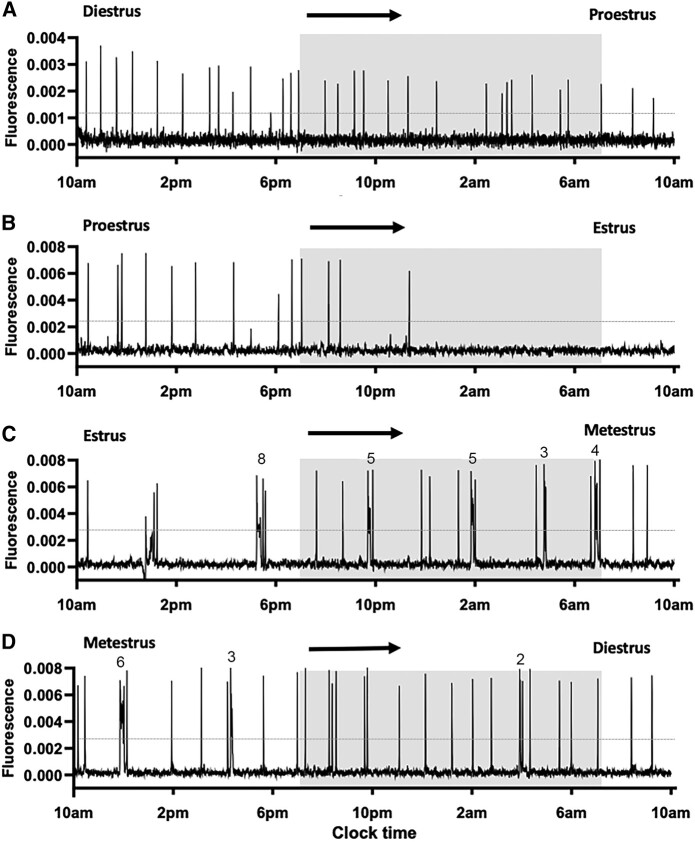
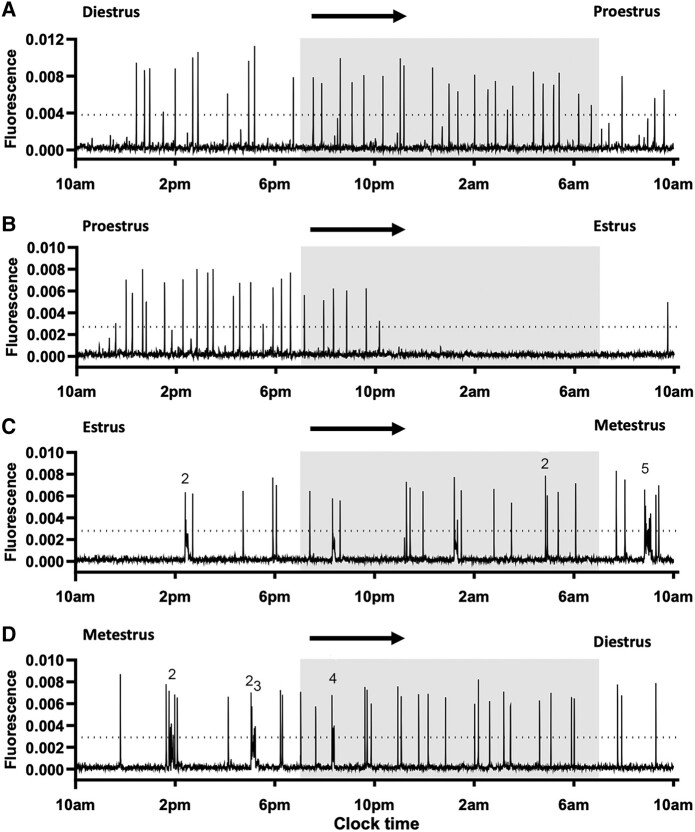
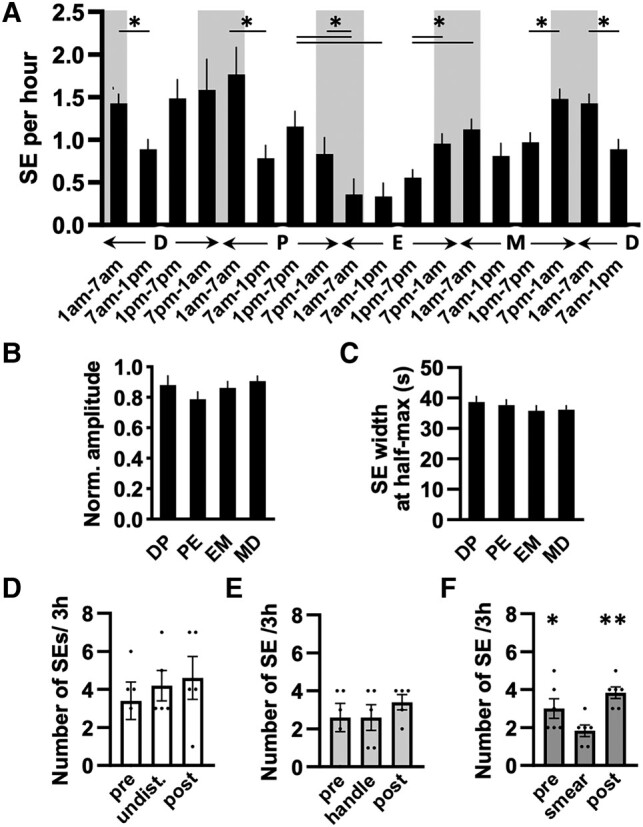
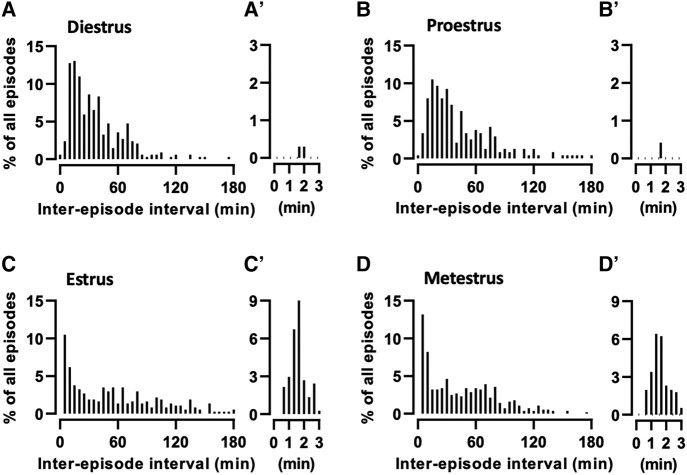
Verification
Claims the paper makes
The claims and statistics of this paper haven’t been checked yet.
Free: it reads the open-access text and checks the first 5 claims that cite a source we can check. Create a free account to check every claim.
Claims other papers make about this one
Each is checked against this paper’s own text: does it say what the citing paper says it does?
The cited source says what the claim attributes to it.
In the citing paper
“The GCaMP6 expression in ARNKISS neurons in Kiss1Cre/+ Ai162+/+ mice was determined previously to be ~99% providing a robust and consistent GCaMP6 level29,62.”
From Brainstem noradrenergic modulation of the kisspeptin neuron GnRH pulse generator in mice (2025) · cites this paper as [62]
Self-check
Percentages, sums and reported differences re-computed from the paper’s own numbers.
The self-check needs the paper’s full text.
Citations
Cites
Daigle, T. L., Madisen, L., Hage, T. A., Valley, M. T., Knoblich, U., Larsen, R. S., Takeno, M. M., Huang, L., Gu, H., Larsen, R., et al. (2018) · Cell · doi:10.1016/j.cell.2018.06.035 · Cited by 817
Staging of the estrous cycle and induction of estrus in experimental rodents: an update
Ajayi, A. F., & Akhigbe, R. E. (2020) · Fertility Research and Practice · doi:10.1186/s40738-020-00074-3 · Cited by 561
Definition of the hypothalamic GnRH pulse generator in mice
Clarkson, J., Han, S. Y., Piet, R., McLennan, T., Kane, G. M., Ng, J., Porteous, R. W., Kim, J. S., Colledge, W. H., Iremonger, K. J., et al. (2017) · Proceedings of the National Academy of Sciences · doi:10.1073/pnas.1713897114 · Cited by 392
Self-citationThe Gonadotropin-Releasing Hormone Pulse Generator
Herbison, A. E. (2018) · Endocrinology · doi:10.1210/en.2018-00653 · Cited by 261
Self-citationEffect of Estrous Cycle on Behavior of Females in Rodent Tests of Anxiety
Lovick, T. A., & Zangrossi, H. (2021) · Frontiers in Psychiatry · doi:10.3389/fpsyt.2021.711065 · Cited by 216
Pulse and Surge Profiles of Luteinizing Hormone Secretion in the Mouse
Czieselsky, K., Prescott, M., Porteous, R., Campos, P., Clarkson, J., Steyn, F. J., Campbell, R. E., & Herbison, A. E. (2016) · Endocrinology · doi:10.1210/en.2016-1351 · Cited by 209
Self-citationNeuroendocrine control of gonadotropin‐releasing hormone: Pulsatile and surge modes of secretion
Goodman, R. L., Herbison, A. E., Lehman, M. N., & Navarro, V. M. (2022) · Journal of Neuroendocrinology · doi:10.1111/jne.13094 · Cited by 157
Self-citationNeuroendocrine Control of the Ovarian Cycle of the Rat
Levine, J. E. (2015) · Knobil and Neill's Physiology of Reproduction · doi:10.1016/b978-0-12-397175-3.00026-0 · Cited by 140
Visualisation of Kiss1 Neurone Distribution Using a Kiss1‐CRE Transgenic Mouse
Yeo, S. ‐., Kyle, V., Morris, P. G., Jackman, S., Sinnett‐Smith, L. C., Schacker, M., Chen, C., & Colledge, W. H. (2016) · Journal of Neuroendocrinology · doi:10.1111/jne.12435 · Cited by 137
GnRH Pulse Generator Activity Across the Estrous Cycle of Female Mice
McQuillan, H. J., Han, S. Y., Cheong, I., & Herbison, A. E. (2019) · Endocrinology · doi:10.1210/en.2019-00193 · Cited by 127
Self-citation
Cited by
GnRH pulse generator activity in mouse models of polycystic ovary syndrome
Zhou, Z., Han, S. Y., Pardo-Navarro, M., Wall, E. G., Desai, R., Vas, S., Handelsman, D. J., & Herbison, A. E. (2025) · eLife · doi:10.7554/elife.97179.3 · Cited by 17
Self-citationBrainstem noradrenergic modulation of the kisspeptin neuron GnRH pulse generator in mice
Vas, S., Morris, P. G., Gul, Z., Ruiz-Cruz, M., Han, S. Y., & Herbison, A. E. (2025) · Nature Communications · doi:10.1038/s41467-025-60837-8 · Cited by 7
“The GCaMP6 expression in ARN KISS neurons in Kiss1 Cre/+ Ai162 +/+ mice was determined pre-viouslytobe~99%providingarobustandconsistentGCaMP6level 29,62 .”
Self-citationNeurokinin receptor antagonists for vasomotor symptoms: from KNDy neurons to clinical translation
Torres, E., Wall, E. G., & Navarro, V. M. (2026) · Nature Reviews Endocrinology · doi:10.1038/s41574-026-01247-8 · Cited by 8
“It is worth noting that in the absence of sex steroids, the hyperacti-vation of KNDy neurons can lead to clusters of increased synchronized activity, also referred to as multi-peak synchronization events 27,53–55 , that might translate into several temperature events.”
Self-citationChang, B., Wall, E. G., Herbison, A. E., & Han, S. Y. (2025) · Endocrinology · doi:10.1210/endocr/bqaf099 · Cited by 6
Self-citationLong-term optical monitoring of genetically encoded fluorescent indicators
Tang, Q., Cook, J. N., Yurgel, M. E., Hattar, S. S., & Jones, J. R. (2025) · PNAS Nexus · doi:10.1093/pnasnexus/pgaf372 · Cited by 5
Phillips, C. D., DeFazio, R. A., & Moenter, S. M. (2025) · Endocrinology · doi:10.1210/endocr/bqaf057 · Cited by 2
Yeo, S., Gül, Z., Zhou, Z., Mureşan, L., Wall, E. G., & Herbison, A. E. (2025) · Journal of Neuroendocrinology · doi:10.1111/jne.70050 · Cited by 4
“29,30 The role of the proestrous peak in Ccn3 mRNA is unknown but might possibly result in elevated levels of CCN3 protein on estrous and, conceivably, this may be involved in the slowing of ARN KISS neurons synchronization events and pulsatile LH secretion.”
Self-citationRobust serotonin activation of the kisspeptin GnRH pulse generator in male and female mice
Morris, P. G., Liu, X., Birt, E., Vas, S., Ruiz-Cruz, M., Schafer, D. M., McQuillan, H. J., & Herbison, A. E. (2026) · Endocrinology · doi:10.1210/endocr/bqag034 · Cited by 2
“Regularly cycling mice, as determined by vaginal lavage and cytology (23), were investigated between 10 AM and 4 PM on the diestrous stage of the cycle.”
Self-citationCell Signaling in the Circadian Pacemaker: New Insights from in vivo Imaging
Bonnefont, X. (2024) · Neuroendocrinology · doi:10.1159/000539344 · Cited by 3
“These methodologies have already demonstrated success in investigating neuroendocrine systems, including the intricate regulation of the pituitary gland and hypothalamic neurons governing reproduction and food intake [16 – 20].”
The GnRH pulse generator activity in mouse models of polycystic ovary syndromePreprint
Zhou, Z., Han, S. Y., Pardo-Navarro, M., Wall, E. G., Desai, R., Vas, S., Handelsman, D. J., & Herbison, A. E. (2024) · eLife · doi:10.7554/elife.97179.1
Self-citationGnRH pulse generator activity in mouse models of polycystic ovary syndromePreprint
Zhou, Z., Han, S. Y., Pardo-Navarro, M., Wall, E. G., Desai, R., Vas, S., Handelsman, D. J., & Herbison, A. E. (2024) · eLife · doi:10.7554/elife.97179.2 · Cited by 2
Self-citationAn Integrated Workflow for Long-Term Fiber Photometry Analysis
Pourmir, F., Cook, J. N., Sweck, S. O., & Jones, J. R. (2026) · eNeuro · doi:10.1523/eneuro.0128-26.2026
“…unfold over these longer timescales, shaped by internal state, environmental context, and recurring biological rhythms rather than by brief stimulus-evoked events (Hrvatin et al., 2020; Rinker et al., 2023; Yaguchi et al., 2023; Chen et al., 2024; Vandendoren et al., 2024; Vas et al., 2024).”
DeFazio, R. A., Burgess, C. R., Burger, L. L., Gibson, A. G., & Moenter, S. M. (2026) · Journal of Neuroendocrinology · doi:10.1111/jne.70298
Metadata
- Authors
- Vas, S., Wall, E., Zhou, Z., Kalmar, L., Han, S. Y., & Herbison, A. E.
- Affiliations
- University of Cambridge (GB)
- Department of Toxicology, University of Cambridge , Cambridge CB2 1QR , UK
- Corresponding author
- Herbison, Allan E
- Venue
- Endocrinology
- Publisher
- The Endocrine Society
- Published
- 2024-01-16
- Volume
- 165
- Issue
- 3
- ISSN
- 0013-7227 (ISSN-L)
- 1945-7170
- PMC
- PMC10873703
- OpenAlex
- W4391295165
- Cited by
- 14
- References
- 26
- Citations by year
- 2026: 4 · 2025: 6 · 2024: 4
- FWCI
- 5.49
- Type
- journal article
- Language
- en
- Open access
- hybrid
- doi.org
- Licence
- Locations
- Endocrinology (publishedVersion, cc-by)
- PubMed Central (publishedVersion, cc-by)
- PubMed (publishedVersion)
- Apollo (University of Cambridge) (submittedVersion, cc-by)
- St Andrews Research Repository (St Andrews Research Repository) (submittedVersion, cc-by)
- Apollo (cc-by)
- Funders
- Wellcome Trust (212242/Z/18/Z)
- Topics
- Health Sciences › Medicine › Reproductive Medicine › Hypothalamic control of reproductive hormones
- Health Sciences › Medicine › Reproductive Medicine › Reproductive Biology and Fertility
- Life Sciences › Neuroscience › Endocrine and Autonomic Systems › Regulation of Appetite and Obesity
- Keywords
- kisspeptin neurons, arcuate nucleus, estrous cycle, GnRH pulse generator, K-means clustering, circadian rhythm, pulsatile gonadotropin secretion, mice
- MeSH terms
- Animals, Arcuate Nucleus of Hypothalamus, Female, Luteinizing Hormone, Gonadotropin-Releasing Hormone, Neurons, Estrous Cycle, Mice, Kisspeptins
About these checks
Registry, retraction, Cites and statistics results are computed, not judged, with one exception: a printed reference that no index lists is read once by a model before it counts as a citation error. Claims are extracted by a model and kept only when their quote appears verbatim in the text; each cited source is then checked, with a model’s help, for whether it says what the claim relies on. Those verdicts can be wrong — read the claim’s quote and the cited source before relying on one.
Statistics and arithmetic are recomputed, not judged.
Confidence bands are shown only for fields calibrated on our annotated test set. None is calibrated yet, so no band is shown.
What counts as a claim ›How we measure confidence ›How we check this ›
Are you an author, or do you see a problem with this page? Request a review
Data sources
Bibliographic data: Semantic Scholar, OpenAlex, Crossref.
Contains information from the Semantic Scholar Academic Graph Datasets, made available under the ODC Attribution License (ODC-BY 1.0).
Semantic Scholar’s data is described in: Kinney, R., et al. (2023). The Semantic Scholar Open Data Platform. arXiv:2301.10140.
