

The DOI matches its Crossref record; 34 of the 35 references it cites were found in a registry or an index.
Incidence of Thyroid-Related Adverse Events in Melanoma Patients Treated With Pembrolizumab
Open accessAbstract
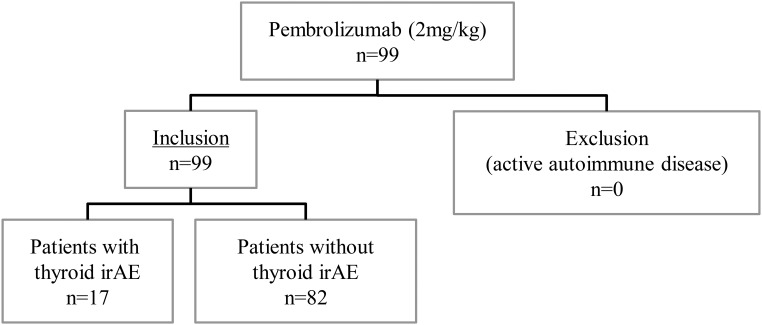
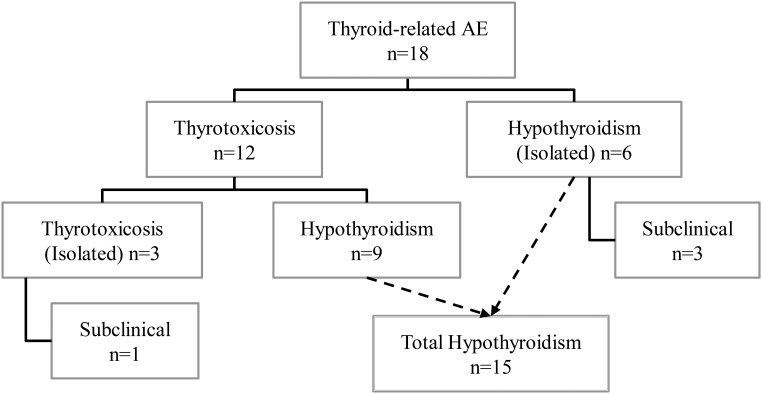
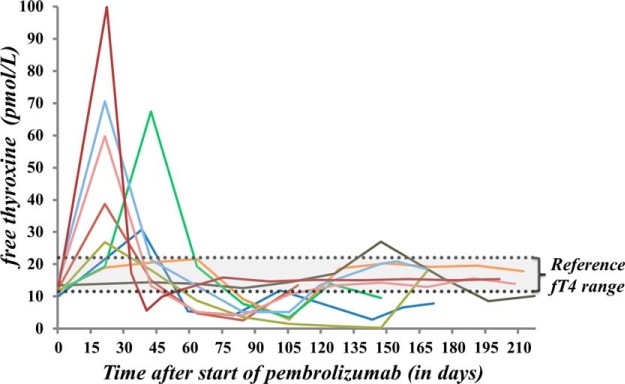
Context: Immune checkpoint blockade is associated with endocrine-related adverse events.Thyroid dysfunction during pembrolizumab therapy, an anti-programmed cell death 1 (PD-1) receptor monoclonal antibody, remains to be fully characterized.Objective: To assess the incidence and characteristics of pembrolizumab-associated thyroid dysfunction.Design and Setting: Thyroid function was monitored prospectively in melanoma patients who initiated pembrolizumab within an expanded access program at a referral oncology center.18 Fluorodeoxyglucose uptake on positron emission tomography/computed tomography ( 18 FDG-PET/CT) was reviewed in cases compatible with inflammatory thyroiditis.Patients: Ninety-nine patients with advanced melanoma (age, 26.3-93.6 years; 63.6% females) who received at least one administration of pembrolizumab.Main Outcome Measures: Patient characteristics, thyroid function (TSH, free T 4 ), thyroid autoantibodies, and 18 FDG-PET/CT.Results: Eighteen adverse events of thyroid dysfunction were observed in 17 patients.Thyrotoxicosis occurred in 12 patients, of which nine evolved to hypothyroidism.Isolated hypothyroidism was present in six patients.Levothyroxine therapy was required in 10 of 15 hypothyroid patients.Thyroid autoantibodies were elevated during thyroid dysfunction in four of 10 cases.Diffuse increased 18 FDG uptake by the thyroid gland was observed in all seven thyrotoxic patients who progressed to hypothyroidism.Conclusions: Thyroid dysfunction is common in melanoma patients treated with pembrolizumab.Hypothyroidism and thyrotoxicosis related to inflammatory thyroiditis are the most frequent presentations.Serial measurements of thyroid function tests are indicated during anti-PD-1 monoclonal antibody therapy.Thyrotoxicosis compatible with inflammatory thyroiditis was associated with diffuse increased 18 FDG uptake by the thyroid gland.The prospective role of thyroid autoantibodies should be further investigated, together with the histopathological correlates.(
Overview
The claims and statistics of this paper haven’t been checked yet.
Run the check — free, no account needed. It reads the open-access text and checks the sources it cites.
Integrity signals
Registry
Cites
Statistics
Figures
Verification
Claims the paper makes
The claims and statistics of this paper haven’t been checked yet.
Run the check — free, no account needed. It reads the open-access text and checks the sources it cites.
Claims other papers make about this one
Each is checked against this paper’s own text: does it say what the citing paper says it does?
The source backs part of the claim, not all of it — or backs it for a different population, condition or comparison.
In the citing paper
“To the best of our knowledge at the time of writing, only nine cases of ICPi-induced Graves’ hyperthyroidism and seven cases of induced Graves’ orbitopathy have been described in the literature, associated with anti-PD-1 or anti-CTLA-4 treatment or their combination (Table 3), with only one patient presenting with both thyrotoxicosis and orbitopathy [19,29,30,31,35,36,37,38,39,40,41,42,43,44].”
From Graves’ Disease during Immune Checkpoint Inhibitor Therapy (A Case Series and Literature Review) (2021) · cites this paper as [19]
Experimental — accuracy not yet measuredThe source backs part of the claim, not all of it — or backs it for a different population, condition or comparison.
In the citing paper
“ICPi-induced thyrotoxicosis is generally due to destructive thyroiditis, with a first stage of hyperthyroidism which then resolves or evolves into secondary hypothyroidism (50–80%) [17,18,19].”
From Graves’ Disease during Immune Checkpoint Inhibitor Therapy (A Case Series and Literature Review) (2021) · cites this paper as [19]
Experimental — accuracy not yet measured
Self-check
Percentages, sums and reported differences re-computed from the paper’s own numbers.
The self-check needs the paper’s full text.
Citations
Cites
PD-1 and PD-L1 Immune Checkpoint Blockade to Treat Breast Cancer
Hartkopf, A. D., Taran, F., Wallwiener, M., Walter, C. B., Krämer, B., Grischke, E., & Brucker, S. Y. (2016) · Breast Care · doi:10.1159/000453569 · Cited by 30,989
(2016) · Springer eBooks · doi:10.1007/978-3-319-40618-3 · Cited by 17,300
Adverse Renal Effects of Immune Checkpoint Inhibitors: A Narrative Review
Wanchoo, R., Karam, S., Uppal, N. N., Barta, V. S., Deray, G., Devoe, C., Launay‐Vacher, V., Jhaveri, K. D., & on behalf of Cancer and Kidney International Network Workgroup on Immune Checkpoint Inhibitors (2017) · American Journal of Nephrology · doi:10.1159/000455014 · Cited by 15,320
The blockade of immune checkpoints in cancer immunotherapy
Pardoll, D. M. (2012) · Nature Reviews Cancer · doi:10.1038/nrc3239 · Cited by 13,838
Toxicity and response criteria of the Eastern Cooperative Oncology Group
Oken, M. M., Creech, R. H., Tormey, D. C., Horton, J., Davis, T. E., Mcfadden, E. T., & Carbone, P. P. (1982) · American Journal of Clinical Oncology · doi:10.1097/00000421-198212000-00014 · Cited by 11,686
Combined Nivolumab and Ipilimumab or Monotherapy in Untreated Melanoma
Larkin, J., Chiarion-Sileni, V., Gonzalez, R., Grob, J. J., Cowey, C. L., Lao, C. D., Schadendorf, D., Dummer, R., Smylie, M., Rutkowski, P., et al. (2015) · New England Journal of Medicine · doi:10.1056/nejmoa1504030 · Cited by 8,157
Herbst, R. S., Baas, P., Kim, D.-W., Felip, E., Pérez-Gracia, J. L., Han, J.-Y., Molina, J., Kim, J.-H., Arvis, C. D., Ahn, M.-J., et al. (2016) · The Lancet · doi:10.1016/s0140-6736(15)01281-7 · Cited by 6,449
Pembrolizumab for the Treatment of Non–Small-Cell Lung Cancer
Garon, E. B., Rizvi, N. A., Hui, R., Leighl, N., Balmanoukian, A. S., Eder, J. P., Patnaik, A., Aggarwal, C., Gubens, M., Horn, L., et al. (2015) · New England Journal of Medicine · doi:10.1056/nejmoa1501824 · Cited by 6,198
Egner, J. R. (2010) · JAMA · doi:10.1001/jama.2010.1525 · Cited by 6,011
Pembrolizumab versus Ipilimumab in Advanced Melanoma
Robert, C., Schachter, J., Long, G. V., Arance, A., Grob, J. J., Mortier, L., Daud, A., Carlino, M. S., McNeil, C., Lotem, M., et al. (2015) · New England Journal of Medicine · doi:10.1056/nejmoa1503093 · Cited by 5,887
Self-citation
Research works printed but not linked: 2
- [10]Delivanis D Merten MM Kottschade L Ryder M Immune therapies targeting the thyroid: new insights from a comprehensive review of pembrolizumab-induced thyroiditis cases at Mayo Clinic. Presented at 85th Annual Meeting of the American Thyroid Association: Lake Buena Vista, FL; October 20, 2015 Abstract 88.
- [12]Jansen Y Schreuer M Seremet T Awada G Wilgenhof S Neyns B Single-center experience with pembrolizumab in patients with ipilimumab pretreated advanced melanoma. In: Proceedings of European Association of Dermato Oncology; October 29, 2015; Marseille, France Abstract.
Cited by
Sorted by citations
Adverse effects of immune-checkpoint inhibitors: epidemiology, management and surveillance
Martins, F., Sofiya, L., Sykiotis, G. P., Lamine, F., Maillard, M., Fraga, M., Shabafrouz, K., Ribi, C., Cairoli, A., Guex-Crosier, Y., et al. (2019) · Nature Reviews Clinical Oncology · doi:10.1038/s41571-019-0218-0 · Cited by 2,314
Collateral damage: Insulin-dependent diabetes induced with checkpoint inhibitors
Stamatouli, A. M., Quandt, Z., Perdigoto, A. L., Clark, P. L., Kluger, H., Weiss, S. A., Gettinger, S., Sznol, M., Young, A., Rushakoff, R., et al. (2018) · Diabetes · doi:10.2337/dbi18-0002 · Cited by 590
Endocrine Toxicity of Cancer Immunotherapy Targeting Immune Checkpoints
Chang, L., Barroso‐Sousa, R., Tolaney, S. M., Hodi, F. S., Kaiser, U. B., & Min, L. (2018) · Endocrine Reviews · doi:10.1210/er.2018-00006 · Cited by 550
on behalf of the Intensive Care in Hematological and Oncological Patients (iCHOP) Collaborative Group, Kroschinsky, F., Stölzel, F., von Bonin, S., Beutel, G., Kochanek, M., Kiehl, M. G., & Schellongowski, P. (2017) · Critical Care · doi:10.1186/s13054-017-1678-1 · Cited by 518
Thyroid Autoimmunity: Role of Anti-thyroid Antibodies in Thyroid and Extra-Thyroidal Diseases
Fröhlich, E., & Wahl, R. (2017) · Frontiers in Immunology · doi:10.3389/fimmu.2017.00521 · Cited by 464
Metadata
- Authors
- de Filette, J., Jansen, Y., Schreuer, M., Everaert, H., Velkeniers, B., Neyns, B., & Bravenboer, B.
- Affiliations
- Vrije Universiteit Brussel (BE)
- Venue
- The Journal of Clinical Endocrinology & Metabolism
- Publisher
- The Endocrine Society
- Published
- 2016-11
- Volume
- 101
- Issue
- 11
- Pages
- 4431-4439
- ISSN
- 0021-972X (ISSN-L)
- 1945-7197
- PMC
- PMC5095250
- OpenAlex
- W2512251660
- Cited by
- 244
- References
- 35
- Citations by year
- 2026: 14 · 2025: 15 · 2024: 24 · 2023: 26 · 2022: 35 · 2021: 22 · 2020: 33 · 2019: 29 · 2018: 23 · 2017: 22 · 2016: 1
- FWCI
- 13.41
- Type
- journal article
- Language
- en
- Open access
- hybrid
- doi.org
- Licence
- cc-by-nc
- Locations
- The Journal of Clinical Endocrinology & Metabolism (publishedVersion, cc-by-nc)
- PubMed Central (publishedVersion, cc-by-nc)
- PubMed (publishedVersion)
- VUBIR (Vrije Universiteit Brussel) (submittedVersion)
- Funders
- Amgen
- Bristol-Myers Squibb
- Vrije Universiteit Brussel
- Merck Sharp and Dohme
- Topics
- Health Sciences › Medicine › Oncology › Cancer Immunotherapy and Biomarkers
- Health Sciences › Medicine › Endocrinology, Diabetes and Metabolism › Thyroid Disorders and Treatments
- Health Sciences › Medicine › Endocrinology, Diabetes and Metabolism › Adrenal Hormones and Disorders
- Keywords
- pembrolizumab, melanoma, immune checkpoint blockade, thyroid dysfunction, thyrotoxicosis, hypothyroidism, thyroid autoantibodies, FDG PET/CT, levothyroxine, PD-1 inhibitors
- MeSH terms
- Positron Emission Tomography Computed Tomography, Adult, Aged, Aged, 80 and over, Antineoplastic Agents, Female, Humans, Hypothyroidism, Male, Melanoma, Middle Aged, Thyroiditis, Thyrotoxicosis, Antibodies, Monoclonal, Humanized
About these checks
Registry, retraction, Cites and statistics results are computed, not judged, with one exception: a printed reference that no index lists is read once by a model before it counts as a citation error. Claims are extracted by a model and kept only when their quote appears verbatim in the text; each cited source is then checked, with a model’s help, for whether it says what the claim relies on. Those verdicts can be wrong — read the claim’s quote and the cited source before relying on one.
Statistics and arithmetic are recomputed, not judged.
Confidence bands are shown only for fields calibrated on our annotated test set. None is calibrated yet, so no band is shown.
What counts as a claim ›How we measure confidence ›How we check this ›
Are you an author, or do you see a problem with this page? Request a review
