

Anastrozole vs Letrozole to Augment Height in Pubertal Males With Idiopathic Short Stature: A 3-Year Randomized Trial
Open accessThe DOI matches its Crossref record; 46 of the 46 references it cites were found in a registry or an index; none of the 78 sources its claims cite is checked for support yet.
Abstract
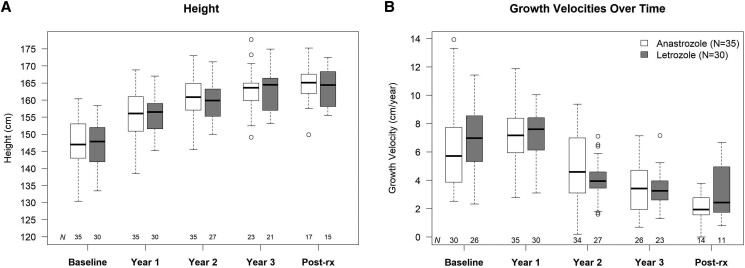
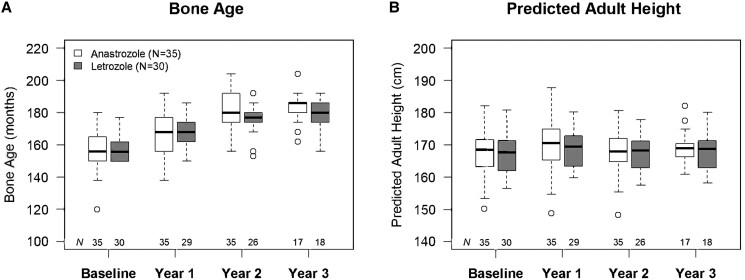
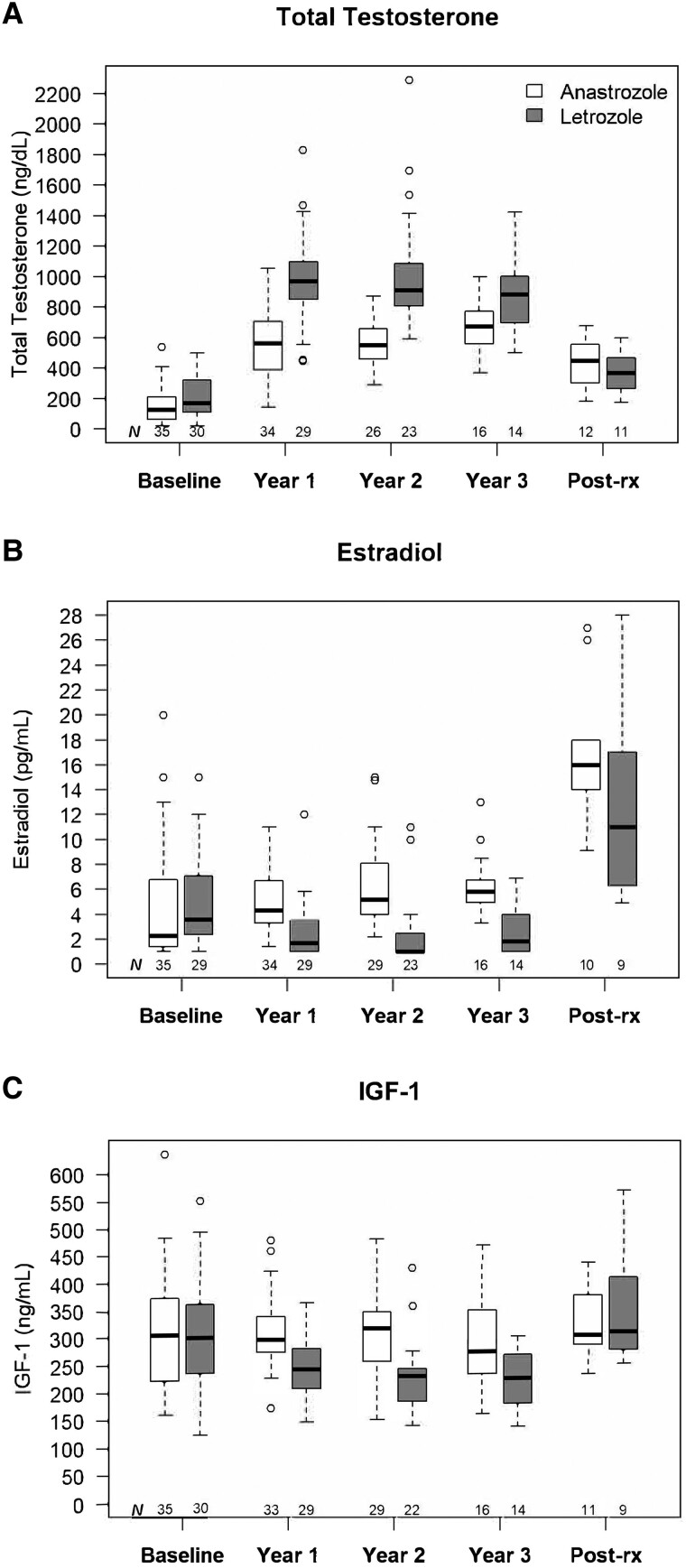
Context: Insufficient efficacy and safety data for off-label use of aromatase inhibitors to augment height in boys with short stature. Objective: To compare anastrozole and letrozole in treatment of idiopathic short stature in pubertal boys. Design: Open-label trial with 2 treatment arms. Setting: Pediatric Endocrine Clinic at Stanford. Participants: A total of 79 pubertal males ≥10 years with bone age (BA) ≤ 14 years, predicted adult height (PAH) < 5th percentile or >10 cm below mid-parental height. Intervention: Anastrozole 1.0 mg or letrozole 2.5 mg daily for up to 3 years. Main Outcome Measures: Annual hormone levels and growth parameters during treatment and a year posttherapy; annual BA and PAH (primary outcome measure); spine x-rays and dual energy X-ray absorptiometry at baseline and 2 years. Results: Compared with anastrozole (n = 35), letrozole (n = 30) resulted in higher testosterone levels, lower estradiol and IGF-1 levels, and slower growth velocity and BA advance. The PAH increase observed at year 1 in both groups did not persist at years 2 and 3. Change in PAH from baseline was not different between treatment groups. In groups combined, PAH gain over 3 years vs baseline was +1.3 cm (P = .043) in linear mixed models. Conclusion: Letrozole caused greater deviations than anastrozole in hormone levels, growth velocity, and BA advancement, but no group differences in PAH or side effects were found. Change in PAH after 2 to 3 years of treatment was minimal. The efficacy of AI as monotherapy for height augmentation in pubertal boys with idiopathic short stature may be limited, and safety remains an issue.
Overview
CoChat Summary
TL;DR
In this 3-year open-label randomized trial of pubertal males with idiopathic short stature, letrozole produced greater hormonal suppression and slower growth/bone-age advancement than anastrozole, but neither agent produced a clear persistent predicted adult height gain. Combined groups had a small PAH increase of +1.3 cm at 3 years (P = .043), with safety concerns including BMD Z-score declines and posttreatment low testosterone in some boys.
Key findings
- Letrozole vs anastrozole: higher testosterone (year 1 mean 982 vs 552 ng/dL), lower estradiol (2.6 vs 5.1 pg/mL) and IGF-1 (247.3 vs 316.1 ng/mL), and slower growth velocity (P interaction .039) and bone-age advance (P < .001).
- PAH increased at year 1 in both groups (anastrozole P = .001; letrozole P = .05) but not at years 2 or 3; change in PAH from baseline did not differ between treatment groups. Combined 3-year PAH gain was +1.3 cm (P = .043); descriptive last-BA analysis showed +0.7 cm combined.
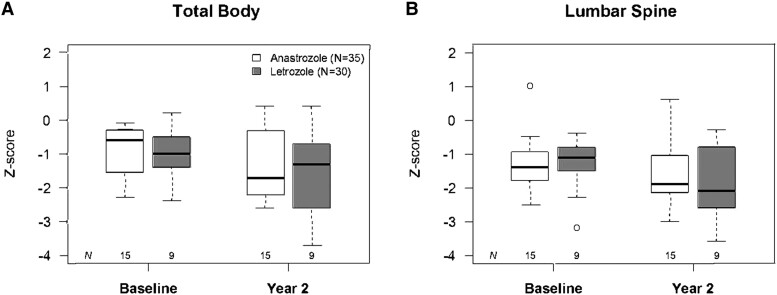
- Safety: adverse events totaled 25 (13 anastrozole, 12 letrozole); no vertebral compression fractures or de novo spine x-ray findings at 2 years. DXA whole-body and lumbar Z-scores declined significantly in both groups from baseline to 2 years, with no significant between-group difference.
- Posttreatment, 9 of 23 boys had testosterone <350 ng/dL and 4 of 23 had <200 ng/dL; mean hormone levels generally normalized after discontinuation.
Methods
- Open-label randomized 1:1 block trial at the Stanford Pediatric Endocrine Clinic; 79 pubertal males ≥10 years with bone age ≤14 years and PAH <5th percentile or >10 cm below mid-parental height were consented, and 65 (35 anastrozole, 30 letrozole) were analyzed after exclusions for nonadherence or hGH use.
- Intervention: anastrozole 1.0 mg or letrozole 2.5 mg daily for up to 3 years; visits every 6 months, annual bone ages, spine x-rays and DXA at baseline and 2 years, and a posttreatment follow-up about 1 year later.
- Primary outcome was change in PAH; mixed effects linear regression modeled outcomes by treatment arm, timepoint, and interaction, with per-protocol analysis excluding subjects who did not complete the first year; analyses used R version 4.0.
Limitations
- Stated: no untreated control group; potential selective loss from subject dropout; lack of true final height data; posttreatment follow-up had no bone ages; DXA and spine x-rays were obtained only in subsets.
- Stated: treatment duration was arbitrarily limited to 3 years; no complete blood counts were monitored for erythrocytosis; GH stimulation tests were not performed; the ISS definition differed from the conventional 1.2 percentile threshold.
- Evident: the open-label design and absence of placebo may affect reporting or adherence; modest sample size and dropout by year 3 (49 completed 3 years) limit power for between-group PAH differences; DXA and spine x-ray subsets were small.
Model-written summary. Check it against the paper before relying on it.
Integrity signals
Registry
Cites
Statistics
Figures
Verification
Claims the paper makes
0 Valid · 3 Not valid · 31 Not checked · 146 Own results and interpretations
A result the paper reports from its own data — it cites no other source for it, so there is none to check. The quote shows it is in the paper.
In the paper
“Compared with anastrozole (n = 35), letrozole (n = 30) resulted in higher testosterone levels, lower estradiol and IGF-1 levels, and slower growth velocity and BA advance.”
- Also stated in: § Auxologic Findings During Treatment · plain
“BA advanced more slowly in the letrozole group as well (Fig. 2A).”
§ Anastrozole vs Letrozole to Augment Height in Pubertal Males With Idiopathic Short Stature: A 3-Year Randomized Trial > Abstract > Results
plainstates a causen = 30- Asserted: passes — The authors put it forward as true.
- Checkable: passes — It can be checked against evidence.
- Load-bearing: passes — The paper’s conclusions depend on it.
- Based: passes — The paper gives a reason why it holds.
- Also stated in: § Auxologic Findings During Treatment · plain
A result the paper reports from its own data — it cites no other source for it, so there is none to check. The quote shows it is in the paper.
In the paper
“No compression fractures were observed in any of the subjects.”
§ Anastrozole vs Letrozole to Augment Height in Pubertal Males With Idiopathic Short Stature: A 3-Year Randomized Trial > Results > Safety
plainn = 39- Asserted: passes — The authors put it forward as true.
- Checkable: passes — It can be checked against evidence.
- Load-bearing: unclear — It is unclear whether the paper’s conclusions depend on it.
- Based: passes — The paper gives a reason why it holds.
A result the paper reports from its own data — it cites no other source for it, so there is none to check. The quote shows it is in the paper.
In the paper
“Nevertheless, mean IGF-1 values in both groups remained well within the reported normal range for Tanner 4-5 males (161-467 ng/mL, mean 290).”
§ Anastrozole vs Letrozole to Augment Height in Pubertal Males With Idiopathic Short Stature: A 3-Year Randomized Trial > Results > Hormonal Analysis During Treatment
boosted- Asserted: passes — The authors put it forward as true.
- Checkable: passes — It can be checked against evidence.
- Load-bearing: unclear — It is unclear whether the paper’s conclusions depend on it.
- Based: passes — The paper gives a reason why it holds.
- Rests on an assumption not shown here.
A result the paper reports from its own data — it cites no other source for it, so there is none to check. The quote shows it is in the paper.
In the paper
“The groups combined did demonstrate a small, barely significant gain in PAH at 3 years in the regression modeling.”
§ Anastrozole vs Letrozole to Augment Height in Pubertal Males With Idiopathic Short Stature: A 3-Year Randomized Trial > Discussion
boosted- Asserted: passes — The authors put it forward as true.
- Checkable: passes — It can be checked against evidence.
- Load-bearing: unclear — It is unclear whether the paper’s conclusions depend on it.
- Based: passes — The paper gives a reason why it holds.
A result the paper reports from its own data — it cites no other source for it, so there is none to check. The quote shows it is in the paper.
In the paper
“In contrast, IGF-1 remained unchanged during therapy with anastrozole.”
§ Anastrozole vs Letrozole to Augment Height in Pubertal Males With Idiopathic Short Stature: A 3-Year Randomized Trial > Results > Hormonal Analysis During Treatment
plain- Asserted: passes — The authors put it forward as true.
- Checkable: passes — It can be checked against evidence.
- Load-bearing: unclear — It is unclear whether the paper’s conclusions depend on it.
- Based: passes — The paper gives a reason why it holds.
67 more claims
Create a free account to see all 180 claims and to verify the 78 references still open.
- It may state two separate claims as one. 73
- Probably not a substantial claim. 47
Self-check
Percentages, sums and reported differences re-computed from the paper’s own numbers.
Each contradiction between two passages listed here was confirmed by an independent check.
Rated minor: it would not touch a result — a value no result rests on, a p-value that stays on the same side of the significance level, or a conflict that is clerical, resolved elsewhere in the paper, or outside its own findings.
In the paper
“a lower limit of detection of 3 ng/dL (0.1 pmol/L) for T”
§ Anastrozole vs Letrozole to Augment Height in Pubertal Males With Idiopathic Short Stature: A 3-Year Randomized Trial > Materials and Methods > Laboratory Evaluation
Reported 0.1 · recomputed 104.01
Rated minor: it would not touch a result — a value no result rests on, a p-value that stays on the same side of the significance level, or a conflict that is clerical, resolved elsewhere in the paper, or outside its own findings.
In the paper
“from 2.7 to 12.3 pg/mL (9.1 to 45.15 pmol/L) in the L group”
§ Anastrozole vs Letrozole to Augment Height in Pubertal Males With Idiopathic Short Stature: A 3-Year Randomized Trial > Results > Posttreatment Analysis
Reported 9.1 · recomputed 9.91197
Rated minor: it would not touch a result — a value no result rests on, a p-value that stays on the same side of the significance level, or a conflict that is clerical, resolved elsewhere in the paper, or outside its own findings.
In the paper
“Mean serum testosterone was 185.7 (range, 21-537) ng/dL (6.44 pmol/L)”
§ Anastrozole vs Letrozole to Augment Height in Pubertal Males With Idiopathic Short Stature: A 3-Year Randomized Trial > Results > Baseline Characteristics
Reported 6.44 · recomputed 6438.219
Rated minor: it would not touch a result — a value no result rests on, a p-value that stays on the same side of the significance level, or a conflict that is clerical, resolved elsewhere in the paper, or outside its own findings.
In the paper
“E2 levels decreased in the letrozole group from 4.9 pg/mL at baseline to 2.6 at year 1 (17.99 to 13.22 pmol/L)”
§ Anastrozole vs Letrozole to Augment Height in Pubertal Males With Idiopathic Short Stature: A 3-Year Randomized Trial > Results > Hormonal Analysis During Treatment
Reported 13.22 · recomputed 9.54486
Rated minor: it would not touch a result — a value no result rests on, a p-value that stays on the same side of the significance level, or a conflict that is clerical, resolved elsewhere in the paper, or outside its own findings.
In the paper
§ Anastrozole vs Letrozole to Augment Height in Pubertal Males With Idiopathic Short Stature: A 3-Year Randomized Trial > Results > Posttreatment Analysis
“Mean FSH in the letrozole cohort trended higher than in the anastrozole cohort (4.4 vs 2.5 mIU/mL).”
§ Anastrozole vs Letrozole to Augment Height in Pubertal Males With Idiopathic Short Stature: A 3-Year Randomized Trial > Results > Hormonal Analysis During Treatment
“FSH (mIU/mL) | 3.3 (1.9) | 7.3 (3.7) | 7.5 (3.5) | 6.6 (2.4) | 4.1 (0.8)”
2 more findings
Create a free account to see every finding of this check.
Citations
Cites
RADIOGRAPHIC ATLAS OF SKELETAL DEVELOPMENT OF THE HAND AND WRIST
GREULICH, W. W., & PYLE, S. I. (1959) · The American Journal Of The Medical Sciences · doi:10.1097/00000441-195909000-00030 · Cited by 5,585
Bayley, N., & Pinneau, S. R. (1952) · The Journal of Pediatrics · doi:10.1016/s0022-3476(52)80205-7 · Cited by 1,196 · cited 1×
“Predicted adult height was calculated by the Bayley-Pinneau method [31].”
MethodConsensus Statement on the Use of Gonadotropin-Releasing Hormone Analogs in Children
Carel, J.-C., Eugster, E. A., Rogol, A., Ghizzoni, L., Palmert, M. R., & on behalf of the members of the ESPE-LWPES GnRH Analogs Consensus Conference Group (2009) · Pediatrics · doi:10.1542/peds.2008-1783 · Cited by 817 · cited 1×
“Other potential treatments to prolong the pubertal growth period in males, such as GnRH analog therapy, suppress both testosterone and estrogen production, resulting in an undesirable delay in masculinization [18].”
BackgroundGonadal Steroids and Body Composition, Strength, and Sexual Function in Men
Finkelstein, J. S., Lee, H., Burnett-Bowie, S.-A. M., Pallais, J. C., Yu, E. W., Borges, L. F., Jones, B. F., Barry, C. V., Wulczyn, K. E., Thomas, B. J., et al. (2013) · New England Journal of Medicine · doi:10.1056/nejmoa1206168 · Cited by 782
Cohen, P., Rogol, A. D., Deal, C. L., Saenger, P., Reiter, E. O., Ross, J. L., Chernausek, S. D., Savage, M. O., Wit, J. M., & participants, O. B. O. T. 2. I. C. W. (2008) · The Journal of Clinical Endocrinology & Metabolism · doi:10.1210/jc.2008-0509 · Cited by 737
Geisler, J., Haynes, B., Anker, G., Dowsett, M., & Lønning, P. E. (2002) · Journal of Clinical Oncology · doi:10.1200/jco.20.3.751 · Cited by 604 · cited 1×
“AIs are Food and Drug Administration-approved for adjuvant use in postmenopausal women with breast cancer [8-11] and have been used off-label to treat hypogonadism in males, as they have been shown to increase testosterone con - centrations through the elevation of gonadotropins because of estrogen…”
BackgroundLetrozole Therapy Alone or in Sequence with Tamoxifen in Women with Breast Cancer
(2009) · New England Journal of Medicine · doi:10.1056/nejmoa0810818 · Cited by 496 · cited 1×
“AIs are Food and Drug Administration-approved for adjuvant use in postmenopausal women with breast cancer [8-11] and have been used off-label to treat hypogonadism in males, as they have been shown to increase testosterone con - centrations through the elevation of gonadotropins because of estrogen…”
BackgroundHistory of Aromatase: Saga of an Important Biological Mediator and Therapeutic Target
Santen, R. J., Brodie, H., Simpson, E. R., Siiteri, P. K., & Brodie, A. (2009) · Endocrine Reviews · doi:10.1210/er.2008-0016 · Cited by 442 · cited 1×
“Aromatase is a cytochrome P450 enzyme that catalyzes the formation of C18 estrogens (estrone and estradiol [E2]) from C19 androgens (androstenedione and testosterone) [7].”
BackgroundIdiopathic short stature: Definition, epidemiology, and diagnostic evaluation
Wit, J. M., Clayton, P. E., Rogol, A. D., Savage, M. O., Saenger, P. H., & Cohen, P. (2008) · Growth Hormone & IGF Research · doi:10.1016/j.ghir.2007.11.004 · Cited by 260 · cited 1×
“Of children with short stature, approximately 60% to 80% of cases can be classified as having idiopathic short stature (ISS) where no pathology or alternative diagnosis can be found [3, 5].”
BackgroundAromatase inhibitors for treatment of advanced breast cancer in postmenopausal women
Gibson, L., Lawrence, D., Dawson, C., & Bliss, J. (2009) · Cochrane Database of Systematic Reviews · doi:10.1002/14651858.cd003370.pub3 · Cited by 252
Cited by
Yackobovitch‐Gavan, M., Tenenbaum, A., Phillip, M., Lazar, L., & Oron, T. (2025) · The Journal of Clinical Endocrinology & Metabolism · doi:10.1210/clinem/dgaf224 · Cited by 11
Cui, Y., Zhang, Q., Hou, L., & Luo, X. (2025) · The Journal of Clinical Endocrinology & Metabolism · doi:10.1210/clinem/dgaf271 · Cited by 10
Liu, X., Liu, F., Qi, Y., Han, X., Ma, S., & Zheng, R. (2025) · BMC Pediatrics · doi:10.1186/s12887-025-05703-8 · Cited by 6
“Since estrogen is the primary hormone regulating epiphyseal fusion, the use of aromatase inhibitors is thought to inhibit the conversion of androgens to estrogen, slowing skeletal maturation and allowing for a longer period of growth [29–31].”
İmre, E., Akçay, S., & Yavuz, D. G. (2025) · HORMONES · doi:10.1007/s42000-025-00640-8 · Cited by 6
“Moreover, E2 levels decreased and gonadotropins (LH and FSH) rose during treatment [ 17 ].”
Abalı, Z. Y., Yıldız, M., Abalı, S., Moniri, A., Baş, F., Önal, H., Çilsaat, G., Toksoy, G., Turan, S., Poyrazoğlu, Ş., et al. (2025) · The Journal of Clinical Endocrinology & Metabolism · doi:10.1210/clinem/dgaf612 · Cited by 5
Aromatase Inhibitor Monotherapy to Augment Height in Boys: Does It Work and Is It Safe?
Geffner, M. E. (2024) · Journal of the Endocrine Society · doi:10.1210/jendso/bvae196 · Cited by 4
Near Final Height in Males treated with Aromatase Inhibitors
Bouliari, A., An, A., Lekarev, O., & Lin‐Su, K. (2026) · Journal of Clinical Research in Pediatric Endocrinology · doi:10.4274/jcrpe.galenos.2025.2025-10-4 · Cited by 3
“When comparing hormonal changes the letrozole group had a greater increase in the testosterone levels and a greater decrease in the estradiol levels (13).”
InfluentialSun, Y., Zhou, Z., Qiang, J., Wang, F., Chen, S., & Pan, H. (2025) · Endocrine · doi:10.1007/s12020-025-04398-2 · Cited by 1
“Idiopathic short stature (ISS) refers to a condition of short stature without an identifiable etiological cause, affecting up to 80% of children assessed for growth-related issues [1, 2].”
Abalı, Z. Y., Bereket, A., & Güran, T. (2026) · The Journal of Clinical Endocrinology & Metabolism · doi:10.1210/clinem/dgag029 · Cited by 1
Ting, T. L., & Chen, S.-C. (2026) · The Journal of Clinical Endocrinology & Metabolism · doi:10.1210/clinem/dgag028 · Cited by 1
Amirkashani, D., Tavakoli, G., Ghanbari, A., Orangi, K., & Izadi, F. (2025) · Research Square · doi:10.21203/rs.3.rs-7103844/v1
Sun, Y., Zhou, Z., Guo, X., Du, H., Wang, F., Chen, S., & Pan, H. (2025) · Endocrine · doi:10.1007/s12020-025-04349-x
“Idiopathic short stature (ISS) is a condition characterized by short stature without an identi fi able pathological cause, affecting up to 80% of all children evaluated for growth issues [1, 2].”
XU, S., LIAN, Q., SHEN, Y., & LI, L. (2026) · Research Square · doi:10.21203/rs.3.rs-10301768/v1
Evaluation of Children with Precocious Puberty for the Primary Care Provider
Maravolo, P. V., Al‐Bitar, F., & Jibrin, D. (2026) · Advances in Family Practice Nursing · doi:10.1016/j.yfpn.2025.12.004
Angulo, M., & Butler, M. G. (2026) · Journal of Endocrinological Investigation · doi:10.1007/s40618-026-03046-4
Korol, N. I., Mulesa, O., Symkanych, O., & Slyvka, M. (2026) · RSC Advances · doi:10.1039/d6ra03272a
“8 14 These examples highlight the pharmacological relevance of triazole-containing compounds as key structural elements in modern drug design.”
Ghanim, R., Awad, M. H., Ehtisham, S., Mughal, M. Z., & Thalange, N. K. S. (2026) · Pediatric Reports · doi:10.3390/pediatric18060152
“In a 3-year trial of anastrozole or letrozole monotherapy, the PAH increase seen at year 1 did not persist at years 2 and 3, and the gain over 3 years was 1.3 cm [29].”
Influential
Metadata
- Authors
- Zegarra, W., Ranadive, S., Toulan, D., & Neely, E. K.
- Affiliations
- Stanford Medicine (US)
- Palo Alto Medical Foundation (US)
- Corresponding author
- Neely, E Kirk
- ORCID
- Neely, E Kirk
- Venue
- Journal of the Endocrine Society
- Publisher
- The Endocrine Society
- Published
- 2024-08-27
- Volume
- 8
- Issue
- 10
- Pages
- bvae141-bvae141
- ISSN
- 2472-1972 (ISSN-L)
- PMC
- PMC11388000
- OpenAlex
- W4401895431
- Cited by
- 17
- References
- 46
- Citations by year
- 2026: 8 · 2025: 8 · 2024: 1
- FWCI
- 3.70
- Type
- journal article
- Language
- en
- Open access
- gold
- doi.org
- Licence
- Locations
- Journal of the Endocrine Society (publishedVersion, cc-by-nc-nd)
- PubMed Central (publishedVersion, cc-by-nc-nd)
- PubMed (publishedVersion)
- Funders
- Stanford Maternal and Child Health Research Institute
- Topics
- Health Sciences › Medicine › Endocrinology, Diabetes and Metabolism › Growth Hormone and Insulin-like Growth Factors
- Health Sciences › Medicine › Reproductive Medicine › Hypothalamic control of reproductive hormones
- Health Sciences › Medicine › Endocrinology, Diabetes and Metabolism › Hormonal and reproductive studies
- Keywords
- idiopathic short stature, anastrozole, letrozole, aromatase inhibitors, pubertal boys, predicted adult height, bone age, growth rate, testosterone, estradiol, insulin-like growth factor I, off-label drug use, pediatric endocrinology
About these checks
Registry, retraction, Cites and statistics results are computed, not judged, with one exception: a printed reference that no index lists is read once by a model before it counts as a citation error. Claims are extracted by a model and kept only when their quote appears verbatim in the text; each cited source is then checked, with a model’s help, for whether it says what the claim relies on. Those verdicts can be wrong — read the claim’s quote and the cited source before relying on one.
A language model drew the claims from the paper on 2026-11-28, under version 3 of the claim definition (model deepseek-v4.1-flash, prompt extract-v3).
A second model labelled each claim on 2026-11-28 (model jev-1.13-20260917, definition revision gold-guideline-v0.2).
Statistics and arithmetic are recomputed, not judged.
Confidence bands are shown only for fields calibrated on our annotated test set. None is calibrated yet, so no band is shown.
What counts as a claim ›How we measure confidence ›How we check this ›
Are you an author, or do you see a problem with this page? Request a review
Data sources
Bibliographic data: Semantic Scholar, OpenAlex, Crossref.
Contains information from the Semantic Scholar Academic Graph Datasets, made available under the ODC Attribution License (ODC-BY 1.0).
Semantic Scholar’s data is described in: Kinney, R., et al. (2023). The Semantic Scholar Open Data Platform. arXiv:2301.10140.
