

The DOI matches its Crossref record; 34 of the 34 references it cites were found in a registry or an index.
Long-term efficacy of mycophenolate mofetil in myelin oligodendrocyte glycoprotein antibody-associated disorders: A prospective study
Open accessAbstract
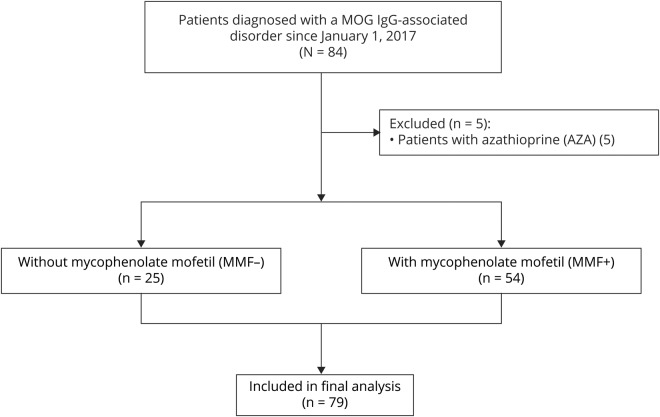
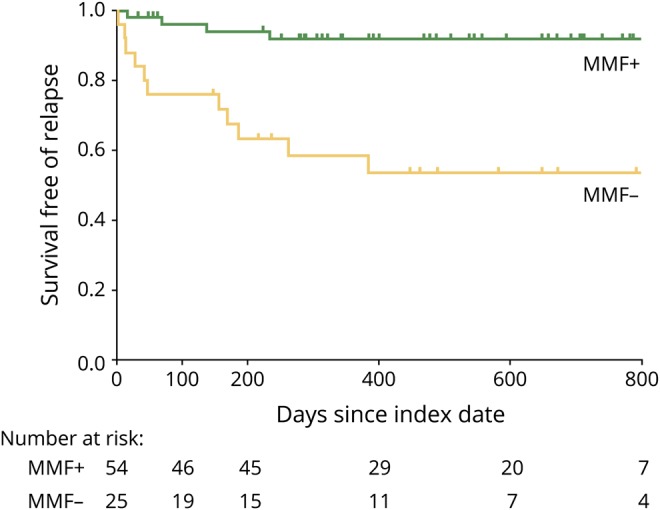
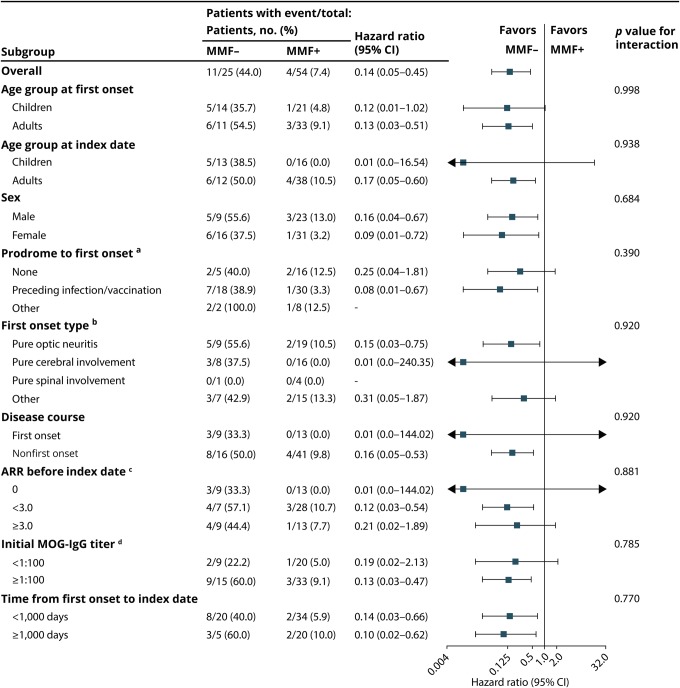
OBJECTIVE: To investigate whether the use of mycophenolate mofetil (MMF) could reduce the relapse risk in patients with myelin oligodendrocyte glycoprotein (MOG)-immunoglobulin G (IgG)-associated disorders (MOGADs). METHODS: This prospective observational cohort study included patients with MOGAD at Peking Union Medical College Hospital between January 1, 2017, and April 30, 2019. The patients were divided into 2 groups: those with (MMF+) or without (MMF-) MMF therapy. The primary outcome was relapse at follow-up. We used Cox proportional hazards models to calculate hazard ratios (HRs) for relapse. RESULTS: Seventy-nine patients were included in our MOG cohort. Fifty (63.3%) were adults at index date, and 47 (59.5%) were women. Fifty-four (68.4%) were in the MMF+ group, and 25 (31.6%) were in the MMF- group. Clinical and demographic factors, MOG-IgG titer, and follow-up time (median, 472.5 days for MMF+, 261.0 days for MMF-) were comparable between the groups. Relapse rates were 7.4% (4/54) in the MMF+ group and 44.0% (11/25) in the MMF- group. Of all potential confounders, only the use of MMF was associated with reduced risk of relapse. The HR for relapse among patients in the MMF+ group was 0.14 (95% CI, 0.05-0.45) and was 0.08 (95% CI, 0.02-0.28) in a model adjusted for age, sex, disease course, and MOG-IgG titer. MMF therapy also remained associated with a reduced relapse risk in sensitivity analyses. Only one patient (1.9%) discontinued MMF therapy because of adverse effect. CONCLUSIONS: These findings provide a clinical evidence that MMF immunosuppression therapy may prevent relapse in patients with MOGAD. CLASSIFICATION OF EVIDENCE: This study provides class IV evidence that for patients with MOGAD, MMF reduces relapse risk.
Overview
The claims and statistics of this paper haven’t been checked yet.
Run the check — free, no account needed. It reads the open-access text and checks the sources it cites.
Integrity signals
Registry
Cites
Statistics
Figures
Verification
Claims the paper makes
The claims and statistics of this paper haven’t been checked yet.
Run the check — free, no account needed. It reads the open-access text and checks the sources it cites.
Claims other papers make about this one
Each is checked against this paper’s own text: does it say what the citing paper says it does?
The cited source says what the claim attributes to it.
In the citing paper
“In any case, the long-term persistence of (re-)activatable autoantigen-specific ThEx cells in patients in remission may well explain the less-than-perfect treatment efficacy of steroid-sparing agents, 64-67 depletion of CD19/CD20 memory B cells, 68,69 as well as exacerbation of disease by b -IFN. 27,70”
From Autoantigen-specific CD4+ T cells acquire an exhausted phenotype and persist in human antigen-specific autoimmune diseases (2024) · cites this paper as [65]
Self-check
Percentages, sums and reported differences re-computed from the paper’s own numbers.
The self-check needs the paper’s full text.
Citations
Cites
Diagnostic criteria for multiple sclerosis: 2010 revisions to the McDonald criteria
Polman, C. H., Reingold, S. C., Banwell, B., Clanet, M., Cohen, J. A., Filippi, M., Fujihara, K., Havrdova, E., Hutchinson, M., Kappos, L., et al. (2011) · Annals of Neurology · doi:10.1002/ana.22366 · Cited by 9,802
International consensus diagnostic criteria for neuromyelitis optica spectrum disorders
Wingerchuk, D. M., Banwell, B., Bennett, J. L., Cabre, P., Carroll, W., Chitnis, T., de Seze, J., Fujihara, K., Greenberg, B., Jacob, A., et al. (2015) · Neurology · doi:10.1212/wnl.0000000000001729 · Cited by 4,649
Fundamentals of Biostatistics.
(1969) · Annals of Internal Medicine · doi:10.7326/0003-4819-70-4-873 · Cited by 4,573
Sanjeev, B. (2006) · Jaypee Brothers Medical Publishers (P) Ltd. eBooks · doi:10.5005/jp/books/10313 · Cited by 1,002
in cooperation with the Neuromyelitis Optica Study Group (NEMOS), Jarius, S., Ruprecht, K., Kleiter, I., Borisow, N., Asgari, N., Pitarokoili, K., Pache, F. C., Stich, O., Beume, L.-A., et al. (2016) · Journal of Neuroinflammation · doi:10.1186/s12974-016-0718-0 · Cited by 900
Distinction between MOG antibody-positive and AQP4 antibody-positive NMO spectrum disorders
Sato, D. K., Callegaro, D., Lana-Peixoto, M. A., Waters, P. J., Jorge, F. M. D. H., Takahashi, T., Nakashima, I., Apostolos-Pereira, S. L., Talim, N., Simm, R. F., et al. (2014) · Neurology · doi:10.1212/wnl.0000000000000101 · Cited by 850
MOG encephalomyelitis: international recommendations on diagnosis and antibody testing
Jarius, S., Paul, F., Aktaş, O., Asgari, N., Dale, R. C., Seze, J. D., Franciotta, D. M., Fujihara, K., Jacob, A., Kim, H. J., et al. (2018) · Journal of Neuroinflammation · doi:10.1186/s12974-018-1144-2 · Cited by 754
Clinical presentation and prognosis in MOG-antibody disease: a UK study
Juryńczyk, M., Messina, S., Woodhall, M. R., Raza, N., Everett, R., Roca‐Fernández, A., Tackley, G., Hamid, S. H. M., Sheard, A., Reynolds, G. L., et al. (2017) · Brain · doi:10.1093/brain/awx276 · Cited by 742
Tables of the number of patients required in clinical trials using the logrank test
Freedman, L. S. (1982) · Statistics in Medicine · doi:10.1002/sim.4780010204 · Cited by 722
Neuromyelitis Optica Study Group (NEMOS), Trebst, C., Jarius, S., Berthele, A., Paul, F., Schippling, S., Wildemann, B., Borisow, N., Kleiter, I., Aktas, O., et al. (2014) · Journal of Neurology · doi:10.1007/s00415-013-7169-7 · Cited by 595
Cited by
Sorted by citations
Jarius, S., Paul, F., Weinshenker, B. G., Levy, M., Kim, H. J., & Wildemann, B. (2020) · Nature Reviews Disease Primers · doi:10.1038/s41572-020-0214-9 · Cited by 503
Ambrosius, W., Michalak, S., Kozubski, W. P., & Kalinowska, A. (2020) · International Journal of Molecular Sciences · doi:10.3390/ijms22010100 · Cited by 181
Ringelstein, M., Ayzenberg, I., Lindenblatt, G., Fischer, K., Gahlen, A., Novi, G., Hayward-Koennecke, H. K., Schippling, S., Rommer, P. S., Kornek, B., et al. (2021) · Neurology Neuroimmunology & Neuroinflammation · doi:10.1212/nxi.0000000000001100 · Cited by 160
Bruijstens, A. L., Wendel, E., Lechner, C., Bartels, F., Finke, C., Breu, M., Flet‐Berliac, L., de Chalus, A., Adamsbaum, C., Capobianco, M. A. N., et al. (2020) · European Journal of Paediatric Neurology · doi:10.1016/j.ejpn.2020.10.005 · Cited by 160
Al-Ani, A., Chen, J. J.-W., & Costello, F. (2023) · Journal of Neurology · doi:10.1007/s00415-023-11737-8 · Cited by 81
Saggau, C., Bacher, P., Esser, D., Rasa, M., Meise, S., Mohr, N., Kohlstedt, N., Hutloff, A., Schacht, S.-S., Dargvainiene, J., et al. (2024) · Immunity · doi:10.1016/j.immuni.2024.08.005 · Cited by 79
Trewin, B. P., Brilot, F., Reddel, S., Dale, R. C., & Ramanathan, S. (2024) · Autoimmunity Reviews · doi:10.1016/j.autrev.2024.103693 · Cited by 82
Clinical and neuroimaging findings in MOGAD–MRI and OCT
Bartels, F., Lu, A., Oertel, F. C., Finke, C., Paul, F., & Chien, C. (2021) · Clinical & Experimental Immunology · doi:10.1111/cei.13641 · Cited by 68
Recent developments in MOG-IgG associated neurological disorders
Hegen, H., & Reindl, M. (2020) · Therapeutic Advances in Neurological Disorders · doi:10.1177/1756286420945135 · Cited by 68
Gospe, S. M., Chen, J. J.-W., & Bhatti, M. T. (2020) · Eye · doi:10.1038/s41433-020-01334-8 · Cited by 60
Neuromyelitis optica spectrum disorders
Paul, S. A., Mondal, G. P., Bhattacharyya, R., Ghosh, K. C., & Bhat, I. A. (2020) · Journal of the Neurological Sciences · doi:10.1016/j.jns.2020.117225 · Cited by 51
Yin, H., Wang, Y., Liu, M., Zhang, D., Ren, H., Mao, Z., Zhang, Y., Peng, B., Cui, L., & Xu, Y. (2023) · Annals of Neurology · doi:10.1002/ana.26623 · Cited by 36
Self-citationAkaishi, T., Misu, T., Takahashi, T., Takai, Y., Nishiyama, S., Fujimori, J., Ishii, T., Aoki, M., Fujihara, K., & Nakashima, I. (2020) · Journal of Neuroimmunology · doi:10.1016/j.jneuroim.2020.577467 · Cited by 35
Bilodeau, P., Vishnevetsky, A., Molazadeh, N., Lotan, I., Anderson, M., Romanow, G., Salky, R., Healy, B. C., Matiello, M., Chitnis, T., et al. (2024) · Multiple Sclerosis Journal · doi:10.1177/13524585241226830 · Cited by 27
Treatment and Relapse Prevention of Typical and Atypical Optic Neuritis
Saitakis, G., & Chwalisz, B. K. (2022) · International Journal of Molecular Sciences · doi:10.3390/ijms23179769 · Cited by 27
The Treatment of Myelin Oligodendrocyte Glycoprotein Antibody Disease: A State-of-the-Art Review
Chwalisz, B. K., & Levy, M. (2022) · Journal of Neuro-Ophthalmology · doi:10.1097/wno.0000000000001684 · Cited by 24
“Similarly, a recent prospective study from China evaluating MMF showed improved outcomes, especially in a subset of patients with isolated optic neuritis or high MOG-IgG titers, with 86% of patients having a reduced risk of relapse (15).”
Lu, Q., Luo, J., Hao, H.-J., Liu, R., Jin, H., Jin, Y., & Gao, F. (2020) · Journal of Neurology · doi:10.1007/s00415-020-10236-4 · Cited by 24
Wang, X., Kong, L., Zhao, Z., Shi, Z., Chen, H., Lang, Y., Lin, X., Du, Q., & Zhou, H. (2022) · Frontiers in Immunology · doi:10.3389/fimmu.2022.953993 · Cited by 21
Current and emerging biologics for the treatment of neuromyelitis optica spectrum disorders
Duchow, A. S., Paul, F., & Bellmann–Strobl, J. (2020) · Expert Opinion on Biological Therapy · doi:10.1080/14712598.2020.1749259 · Cited by 21
Lai, Q., Zhang, Y., Cai, M., Zheng, Y., Qiao, S., Fang, G., & Shen, C.-H. (2021) · Therapeutic Advances in Neurological Disorders · doi:10.1177/17562864211054157 · Cited by 21
Self-citationSechi, E., Gastaldi, M., Cortese, R., Bisecco, A., Vogrig, A., Giannoccaro, M. P., Zuliani, L., Zoccarato, M., Casagrande, S., Sartori, S., et al. (2025) · Journal of Neuroimmunology · doi:10.1016/j.jneuroim.2025.578781 · Cited by 20
Zhang, Y., Yin, H., Zhang, D., Xu, Y., Peng, B., & Cui, L. (2022) · Journal of Neurology · doi:10.1007/s00415-022-11118-7 · Cited by 20
Self-citationEmerging drugs for the treatment of neuromyelitis optica
Duchow, A. S., Chien, C., Paul, F., & Bellmann–Strobl, J. (2020) · Expert Opinion on Emerging Drugs · doi:10.1080/14728214.2020.1803828 · Cited by 20
Emerging drugs for the treatment of adult MOG-IgG-associated diseases
Contentti, E. C., Marrodán, M., & Correale, J. D. (2021) · Expert Opinion on Emerging Drugs · doi:10.1080/14728214.2021.1919082 · Cited by 19
Evaluation and Management of Acute Myelopathy
Sechi, E., & Flanagan, E. P. (2021) · Seminars in Neurology · doi:10.1055/s-0041-1733792 · Cited by 20
Treatment of myelin oligodendrocyte glycoprotein immunoglobulin G–associated disease
Healy, S., Elhadd, K. T., Gibbons, E. L., Whittam, D., Griffiths, M. J., Jacob, A., & Huda, S. (2021) · Clinical and Experimental Neuroimmunology · doi:10.1111/cen3.12630 · Cited by 17
Wang, M., Zeng, P., Chen, D., Xue, H., Cui, Z., Zhang, H., Jia, D., & Zhang, C. (2021) · Multiple Sclerosis and Related Disorders · doi:10.1016/j.msard.2021.103035 · Cited by 16
Meta-analysis of effectiveness of steroid-sparing attack prevention in MOG-IgG-associated disorder
Thakolwiboon, S., Zhao-Fleming, H. H., Karukote, A., Mao‐Draayer, Y., Flanagan, E. P., & Avila, M. (2021) · Multiple Sclerosis and Related Disorders · doi:10.1016/j.msard.2021.103310 · Cited by 16
Optic neuritis: a comprehensive review of current therapies and emerging treatment strategies
Chaitanuwong, P., & Moss, H. E. (2025) · Frontiers in Neurology · doi:10.3389/fneur.2025.1605075 · Cited by 17
Li, Z., Sun, H., Fan, X., Yuan, P., Jiang, Y., Wu, P., Zhong, M., Ma, J., Jiang, L., & Li, X. (2021) · Frontiers in Neurology · doi:10.3389/fneur.2021.642664 · Cited by 15
Clinical characteristics of optic neuritis phenotypes in a 3-year follow-up Chinese cohort
Feng, C., Chen, Q., Zhao, G., Li, Z., Chen, W.-M., Sha, Y., Sun, X., Wang, M., & Tian, G. (2021) · Scientific Reports · doi:10.1038/s41598-021-93976-1 · Cited by 15
Zheng, Y., Cai, M., Li, E., Fang, W. J., Shen, C., & Zhang, Y. (2021) · Frontiers in Immunology · doi:10.3389/fimmu.2021.671425 · Cited by 11
Self-citationThe Impact of COVID-19 on Patients With Neuromyelitis Optica Spectrum Disorder Beyond Infection Risk
Yin, H., Zhang, Y., Xu, Y., Peng, B., Cui, L., & Zhang, S. (2021) · Frontiers in Neurology · doi:10.3389/fneur.2021.657037 · Cited by 11
Self-citationSchirò, G., Iacono, S., Salemi, G., & Ragonese, P. (2024) · Expert Review of Neurotherapeutics · doi:10.1080/14737175.2024.2385941 · Cited by 10
French guidelines for the diagnosis and management of MOG antibody-associated disease
Giorgi, L. D., Marignier, R., Pique, J., Maurey, H., Papeix, C., Ciron, J., Collongues, N., Cheuret, E., Zéphir, H., Meyer, P., et al. (2025) · Revue Neurologique · doi:10.1016/j.neurol.2025.04.012 · Cited by 8
Sun, X., Liu, M., Luo, X., Yuan, F., Wang, C., Wang, S., Xu, Q., Zhang, Y., & Chen, Y. (2022) · BMC Pediatrics · doi:10.1186/s12887-022-03679-3 · Cited by 8
Self-citationXie, L., Zhou, H., Song, H., Sun, M., Yang, M. C., Lai, Y. M., Xu, Q., & Wei, S. (2021) · British Journal of Ophthalmology · doi:10.1136/bjophthalmol-2020-318769 · Cited by 8
de la Motte, M. B., Gavoille, A., Papeix, C., Audoin, B., Ayrignac, X., Bourre, B., Ciron, J., Cohen, M., Collongues, N., Laplaud, D. A., et al. (2026) · JAMA Neurology · doi:10.1001/jamaneurol.2026.0268 · Cited by 7
Therapeutic Approach to Autoimmune Neurologic Disorders
Clardy, S. L., & Smith, T. (2024) · CONTINUUM Lifelong Learning in Neurology · doi:10.1212/con.0000000000001463 · Cited by 10
Luo, J., Yu, J., Sui, Z., Zhong, Y., Zheng, Q., & Li, L. (2022) · International Immunopharmacology · doi:10.1016/j.intimp.2022.109004 · Cited by 7
Self-citationPhenotype of Relapsing Myelin Oligodendrocyte Glycoprotein Antibody-Associated Disease in Children
Han, J. Y., Kim, S. Y., Kim, W. J., Kim, H., Cho, A., Choi, J., Chae, J., Kim, K. J., Kwon, Y. S., Yoo, I. H., et al. (2024) · Journal of Clinical Neurology · doi:10.3988/jcn.2024.0276 · Cited by 5
Lotan, I., Oertel, F. C., Chien, C., Asseyer, S., Paul, F., & Stiebel‐Kalish, H. (2020) · Clinical and Experimental Neuroimmunology · doi:10.1111/cen3.12623 · Cited by 5
Favorable long-term outcomes of autoimmune nodopathy with mycophenolate mofetil
Min, Y. G., Ju, W., & Sung, J. (2024) · Frontiers in Neurology · doi:10.3389/fneur.2024.1515161 · Cited by 4
Update on glial antibody-mediated optic neuritis
Song, H., Zhou, H., & Wei, S. (2022) · Japanese Journal of Ophthalmology · doi:10.1007/s10384-022-00932-1 · Cited by 4
Nguyen, L., Wang, C. X., Hernandez, R. S., & Greenberg, B. M. (2024) · Multiple Sclerosis and Related Disorders · doi:10.1016/j.msard.2024.105497 · Cited by 4
Clinical characteristics analysis of 24 cases of pediatric MOG antibody-associated diseases
Wang, Y., Guo, X., Zhang, L., Hua, Y., Miao, J., Hu, X., Fan, X., Sun, M., Liu, Y., & Wang, J. (2024) · Multiple Sclerosis and Related Disorders · doi:10.1016/j.msard.2024.105911 · Cited by 2
Self-citationCapecchi, F., Graure, M., Yasaroglu, S., Schubert, S., Nierobisch, N., Kana, V., Weller, M., Roth, P., & Herwerth, M. (2026) · Neurology Open Access · doi:10.1212/wn9.0000000000000049 · Cited by 2
Zhou, J., Li, J., Ren, C., Zhou, A., Zhuo, X. W., Gong, S., Ding, C., Fang, F., Zhang, W., & Ren, X. (2022) · Multiple Sclerosis and Related Disorders · doi:10.1016/j.msard.2022.104128 · Cited by 2
Self-citationMOG-IgG Associated Disease (MOG-AD) in Adults
Brayo, P., & Shah, S. (2021) · Current Treatment Options in Neurology · doi:10.1007/s11940-021-00672-6 · Cited by 2
Kharel, S., Ojha, R., Ghimire, R., Guragain, N., & Mudvari, A. (2021) · Clinical and Experimental Neuroimmunology · doi:10.1111/cen3.12667 · Cited by 2
Therapeutic updates in NMOSD and MOGAD: From present practice to future promise
Elosua‐Bayés, I., & Cobo‐Calvo, Á. (2026) · Revue Neurologique · doi:10.1016/j.neurol.2026.02.158 · Cited by 1
Dalmau, J. O., Dalakas, M. C., Kolson, D. L., Paul, F., & Zamvil, S. S. (2019) · Neurology Neuroimmunology & Neuroinflammation · doi:10.1212/nxi.0000000000000644 · Cited by 1
Autoimmune Demyelinating Syndromes: Aquaporin-4-IgG-positive NMOSD and MOG - IgG Associated Disorder
Sechi, E., & Flanagan, E. P. (2021) · Springer eBooks · doi:10.1007/978-3-030-61883-4_15 · Cited by 1
Dalmau, J. O., & Graus, F. (2022) · Cambridge University Press eBooks · doi:10.1017/9781108696722.011 · Cited by 1
Recurrent Idiopathic Neuroretinitis: Anti-MOG Positive?
Mizera, T., & Ponce, C. M. P. (2023) · Journal of Investigative Medicine High Impact Case Reports · doi:10.1177/23247096231206619 · Cited by 1
Dalmau, J. O., Dalakas, M. C., Kolson, D. L., Paul, F., & Zamvil, S. S. (2020) · Neurology Neuroimmunology & Neuroinflammation · doi:10.1212/nxi.0000000000000925 · Cited by 1
Anti-MOG antibody associated long segment myelitis presenting as anterior cord syndrome
Datta, A. K., Mukherjee, A., Ray, B. K., & Biswas, A. (2021) · BMJ Case Reports · doi:10.1136/bcr-2020-240055
(2022) · Reactions Weekly · doi:10.1007/s40278-022-28726-8
Research Progress of Myelin Oligodendrocyte Glycoprotein Antibody-Associated Optic Neuritis
彭, 丘. (2023) · Advances in Clinical Medicine · doi:10.12677/acm.2023.133693
郭, 雨. (2024) · Advances in Clinical Medicine · doi:10.12677/acm.2024.143834
Zhao, J., Meng, C., Jiang, H., Lai, C., Guo, Y., Zhu, L., & Wang, J. (2024) · Heliyon · doi:10.1016/j.heliyon.2024.e33263
“Hence, it was inferred that visual outcomes were generally favorable in iMOG-ON, and MMF, albeit demonstrated to be effective in reducing relapse risk in relapsing MOGAD [32,33], may not be necessary if MOG-IgG serum titers were low during the first episode of iMOG-ON.”
BackgroundSelf-citationA Case of Post Viral Acute Longitudinal Extensive Transverse Myelitis (LETM): MOGAD- A New Horizon
Gomes, R. R. (2024) · Bangladesh Critical Care Journal · doi:10.3329/bccj.v12i1.72402
When MOGAD mimics MS: diagnostic and therapeutic insights from a unique CNS demyelinating case
Luo, Y., Chen, L., Xu, Z., Xu, P., & Chen, Y. (2025) · BMC Neurology · doi:10.1186/s12883-025-04442-8
Prognosis biomarkers in MOGAD: What can we learn from observational studies?
Lemarchant, B., Cleuziou, P., Rogeau, S., Deleplancque, A.-S., Outteryck, O., & Zéphir, H. (2026) · Revue Neurologique · doi:10.1016/j.neurol.2026.01.269
Zala, S. B., Pujari, S. S., Sengupta, S. P., & Palasdeokar, N. (2026) · Annals of Indian Academy of Neurology · doi:10.4103/aian.aian_1182_25
Cao, S., Wu, T., Pan, C., Wei, S., Zhou, H., & Liu, Y. (2026) · BMC Ophthalmology · doi:10.1186/s12886-026-05097-w
Metadata
- Authors
- Li, S., Ren, H., Xu, Y., Xu, T., Zhang, Y., Yin, H., Zhang, W., Li, J., Ren, X., Fang, F., Li, W., Zhu, Y., Peng, B., Wang, J., Zhong, Y., & Cui, L.
- Affiliations
- Capital Medical University (CN)
- From the Department of Neurology (S.L., H.R., Y.X., Y. Zhang, H.Y., Y. Zhu, B.P., L.C.), Peking Union Medical College Hospital, Peking Union Medical College and Chinese Academy of Medical Sciences; Department of Epidemiology and Biostatistics Institute of Basic Medical Sciences (T.X.), Chinese Academy of Medical Sciences & School of Basic Medicine, Peking Union Medical College; Department of Neurology (W.Z., J.L., X.R., F.F.), Beijing Children's Hospital, Capital Medical University, National...
- Corresponding author
- Xu, Yan
- Xu, Tao
- ORCID
- Venue
- Neurology Neuroimmunology & Neuroinflammation
- Published
- 2020-05
- Volume
- 7
- Issue
- 3
- ISSN
- 2332-7812 (ISSN-L)
- PMC
- PMC7136046
- OpenAlex
- W3011563890
- Cited by
- 66
- References
- 34
- Citations by year
- 2026: 6 · 2025: 4 · 2024: 12 · 2023: 4 · 2022: 10 · 2021: 17 · 2020: 12
- FWCI
- 7.07
- Type
- journal article
- Language
- en
- Open access
- gold
- doi.org
- Licence
- cc-by-nc-nd
- Locations
- Neurology Neuroimmunology & Neuroinflammation (publishedVersion, cc-by-nc-nd)
- PubMed Central (publishedVersion, cc-by-nc-nd)
- PubMed (publishedVersion)
- Funders
- Peking Union Medical College Hospital
- Peking Union Medical College
- National Key Research and Development Program of China (No.2016YFC0901500, [2016YFC0901500])
- Topics
- Health Sciences › Medicine › Clinical Neurology › Multiple Sclerosis Research Studies
- Health Sciences › Medicine › Clinical Neurology › Peripheral Neuropathies and Disorders
- Health Sciences › Medicine › Clinical Neurology › Autoimmune Neurological Disorders and Treatments
- Keywords
- mycophenolate mofetil, anti-MOG antibodies, relapse prevention, immunosuppressive therapy, relapse risk, demyelinating disease, long-term efficacy, treatment discontinuation
- MeSH terms
- Adolescent, Adult, Child, Drug Therapy, Combination, Female, Follow-Up Studies, Glucocorticoids, Humans, Immunoglobulin G, Immunologic Factors, Male, Mycophenolic Acid, Prospective Studies, Recurrence, Proportional Hazards Models, Outcome Assessment, Health Care, Demyelinating Autoimmune Diseases, CNS, Secondary Prevention, Young Adult, Myelin-Oligodendrocyte Glycoprotein
About these checks
Registry, retraction, Cites and statistics results are computed, not judged, with one exception: a printed reference that no index lists is read once by a model before it counts as a citation error. Claims are extracted by a model and kept only when their quote appears verbatim in the text; each cited source is then checked, with a model’s help, for whether it says what the claim relies on. Those verdicts can be wrong — read the claim’s quote and the cited source before relying on one.
Statistics and arithmetic are recomputed, not judged.
Confidence bands are shown only for fields calibrated on our annotated test set. None is calibrated yet, so no band is shown.
What counts as a claim ›How we measure confidence ›How we check this ›
Are you an author, or do you see a problem with this page? Request a review
