

The DOI matches its Crossref record; 39 of the 39 references it cites were found in a registry or an index.
Odor identification as a biomarker of preclinical AD in older adults at risk
Open accessAbstract
Objective: To assess odor identification (OI) as an indicator of presymptomatic Alzheimer disease (AD) pathogenesis in cognitively normal aging individuals at increased risk of AD dementia. Methods: In 274 members of the PREVENT-AD cohort of healthy aging persons with a parental or multiple-sibling history of AD dementia, we assessed the cross-sectional association of OI with potential indicators of presymptomatic AD. Some 101 participants donated CSF, thus enabling assessment of AD pathology with the biomarkers total tau (t-tau), phospho-tau (P181-tau), and their ratios with β-amyloid (Aβ1-42). Adjusted analyses considered age, cognition, APOE ε4 status, education, and sex as covariates. We measured OI using the University of Pennsylvania Smell Identification Test and cognitive performance using the Repeatable Battery for Assessment of Neuropsychological Status. Standard kits provided assays of the AD biomarkers. Analyses used robust-fit linear regression models. Results: Reduced OI was associated with lower cognitive score and older age, as well as increased ratios of CSF t-tau and P181-tau to Aβ1-42 (all p < 0.02). However, the observed associations of OI with age and cognition were unapparent in adjusted models that restricted observations to CSF donors and included AD biomarkers. OI showed little association with CSF Aβ1-42 alone except in APOE ε4 carriers having lowest-quartile Aβ1-42 levels. Conclusions: These findings from healthy high-risk older individuals suggest that OI reflects degree of preclinical AD pathology, while its relationships with age and cognition result from the association of these latter variables with such pathology. Diminished OI may be a practical and affordable biomarker of AD pathology.
Overview
The claims and statistics of this paper haven’t been checked yet.
Run the check — free, no account needed. It reads the open-access text and checks the sources it cites.
Integrity signals
Registry
Cites
Statistics
Figures
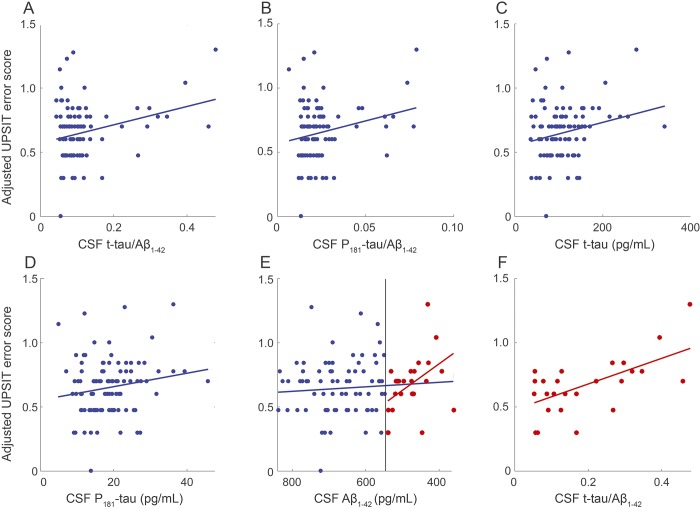
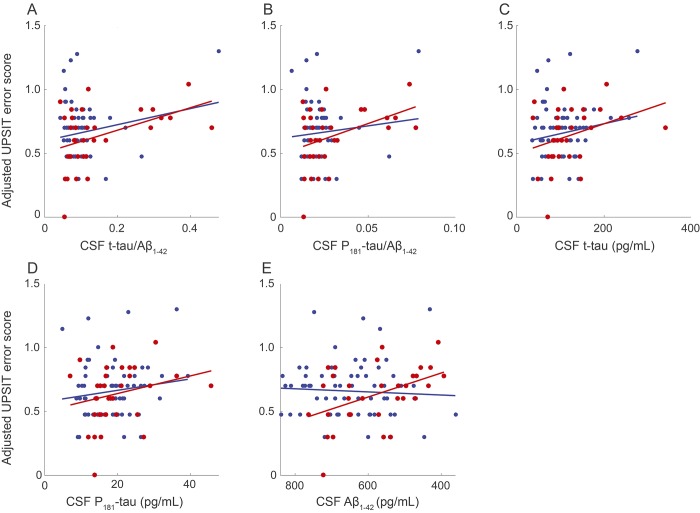
Verification
Claims the paper makes
The claims and statistics of this paper haven’t been checked yet.
Run the check — free, no account needed. It reads the open-access text and checks the sources it cites.
Claims other papers make about this one
Each is checked against this paper’s own text: does it say what the citing paper says it does?
The source backs part of the claim, not all of it — or backs it for a different population, condition or comparison.
In the citing paper
“the connection to the entorhinal cortex, the olfactory bulb, is directly affected by changes in the perforant pathway, and one of the earliest pathological changes in AD”
From AAVrh.10-Mediated APOE2 Central Nervous System Gene Therapy for APOE4-Associated Alzheimer's Disease (2018) · cites this paper as [43]
Experimental — accuracy not yet measuredThe source backs part of the claim, not all of it — or backs it for a different population, condition or comparison.
In the citing paper
“the amyloid deposition spreads, and the disease pathogenesis progressively involves a broad region of the brain”
From AAVrh.10-Mediated APOE2 Central Nervous System Gene Therapy for APOE4-Associated Alzheimer's Disease (2018) · cites this paper as [43]
Experimental — accuracy not yet measured
Self-check
Percentages, sums and reported differences re-computed from the paper’s own numbers.
The self-check needs the paper’s full text.
Citations
Cites
The Montreal Cognitive Assessment, MoCA: a brief screening tool for mild cognitive impairment
Nasreddine, Z. S., Phillips, N. A., Bédirian, V., Charbonneau, S., Whitehead, V., Collin, I., Cummings, J. L., & Chertkow, H. (2005) · Journal of the American Geriatrics Society · doi:10.1111/j.1532-5415.2005.53221.x · Cited by 25,553
Hirono, N., Mori, E., Ikejiri, Y., Imamura, T., Shimomura, T., Hashimoto, M., Yamashita, H., & Ikeda, M. (1997) · PubMed · Cited by 21,012
A New Clinical Scale for the Staging of Dementia
Hughes, C. P., Berg, L., Danziger, W., Coben, L. A., & Martin, R. L. (1982) · British Journal of Psychiatry · doi:10.1192/bjp.140.6.566 · Cited by 7,056
Randolph, C., Tierney, M. C., Mohr, E., & Chase, T. N. (1998) · Journal of Clinical and Experimental Neuropsychology · doi:10.1076/jcen.20.3.310.823 · Cited by 2,519 · cited 1×
“Assessments included a health history and review of systems, a standardized neurologic examination, and a cognitive examination with version A of the Repeatable Battery for Assessment of Neuropsychological Status (RBANS).(21)”
MethodDoty, R. L., Shaman, P., & Dann, M. (1984) · Physiology & Behavior · doi:10.1016/0031-9384(84)90269-5 · Cited by 1,854 · cited 1×
“We assessed OI abilities using the 40-item University of Pennsylvania Smell Identification Test (UPSIT).(23) This test includes a simple scratch-and-sniff booklet along with multiple-choice response forms for OI.”
MethodThe influences of age on olfaction: a review
Doty, R. L., & Kamath, V. J. (2014) · Frontiers in Psychology · doi:10.3389/fpsyg.2014.00020 · Cited by 681
Roberts, R. O., Christianson, T. J. H., Kremers, W. K., Mielke, M. M., Machulda, M. M., Vassilaki, M. E., Alhurani, R. E., Geda, Y. E., Knopman, D. S., & Petersen, R. C. (2015) · JAMA Neurology · doi:10.1001/jamaneurol.2015.2952 · Cited by 437
Devanand, D. P., Liu, X., Tabert, M. H., Pradhaban, G., Cuasay, K., Bell, K. L., de Leon, M. J., Doty, R. L., Stern, Y., & Pelton, G. H. (2008) · Biological Psychiatry · doi:10.1016/j.biopsych.2008.06.020 · Cited by 413
Olfaction in patients with mild cognitive impairment and Alzheimer's disease
Djordjevic, J., Jones‐Gotman, M., Sousa, K. D., & Chertkow, H. M. (2007) · Neurobiology of Aging · doi:10.1016/j.neurobiolaging.2006.11.014 · Cited by 365
Olfactory deficits predict cognitive decline and Alzheimer dementia in an urban community
Devanand, D. P., Lee, S., Manly, J. J., Andrews, H., Schupf, N., Doty, R. L., Stern, Y., Zahodne, L. B., Louis, E. D., & Mayeux, R. P. (2014) · Neurology · doi:10.1212/wnl.0000000000001132 · Cited by 351
Cited by
Sorted by citations
Items 101–146 of 146
Masala, C., Solla, P., & Loy, F. (2023) · Biology · doi:10.3390/biology12040586 · Cited by 3
Odor identification dysfunction in late-life depression with suicidal ideation
Xu, D., Chen, B., Yang, M., Lin, G., Zhang, M., Wu, Z., Zhou, H., Shi, X., Peng, Q., Zeng, Y., et al. (2024) · Journal of Affective Disorders · doi:10.1016/j.jad.2024.08.227 · Cited by 3
Yu, C., Yang, H., Zhang, B., Chen, S., Yang, S., Li, F., Zhu, W., Zhai, B., Wu, T., Zhao, S., et al. (2025) · BMJ Open · doi:10.1136/bmjopen-2024-095382 · Cited by 2
Stigliano, E., Tocci, A., Florio, R., Arena, V., & Amadoro, G. (2026) · Cells · doi:10.3390/cells15020176 · Cited by 2
Olfactory decline tracks central‐to‐peripheral spread of tau pathology in Alzheimer's disease
Bouchoucha, K., Collin, L., Coquette, C., Colmant, L., Boyer, E., Huyghe, L., Quenon, L., Gérard, T., Salman, Y., Hox, V., et al. (2026) · Alzheimer's & Dementia · doi:10.1002/alz.71402 · Cited by 1
Darnell, E. P., Wroblewski, K., Pagel, K. L., Kern, D. W., McClintock, M. K., & Pinto, J. M. (2020) · Chemical Senses · doi:10.1093/chemse/bjaa029 · Cited by 2
Berry, J. K., & Cox, D. L. (2021) · Physical review. E · doi:10.1103/physreve.104.024405 · Cited by 2
“In AD, loss of olfaction occurs as early as 2-5 years before diagnosis and can predict more serious cognitive decline[2, 4, 5].”
BackgroundNeurological and Neuropsychiatric Disorders in Relation to Olfactory Dysfunction
Bhatia‐Dey, N., & Heinbockel, T. (2020) · IntechOpen eBooks · doi:10.5772/intechopen.93888 · Cited by 2
García-Betances, R. I. (2017) · UPM Digital Archive (Technical University of Madrid) · doi:10.20868/upm.thesis.48687 · Cited by 2
Open science datasets from PREVENT-AD, a longitudinal cohort of pre-symptomatic Alzheimer's disease
Tremblay‐Mercier, J., Madjar, C., Das, S., Binette, A. P., Dyke, S. O. M., Etienne, P. E., Lafaille‐Magnan, M., Remz, J., Bellec, P., Collins, D. L., et al. (2023) · doi:10.32920/24438034 · Cited by 2
Self-citationAROMHA Brain Health Test: A Remote Olfactory Assessment as a Screen for Cognitive ImpairmentPreprint
Jobin, B., Magdamo, C., Delphus, D., Runde, A., Reineke, S., Soto, A. A., Ergun, B., Albers, A. D., & Albers, M. W. (2024) · medRxiv · doi:10.1101/2024.08.03.24311283 · Cited by 2
Olfactory dysfunction in Alzheimer's disease
Strumentova, E. S., Лобзин, С. В., Lobzin, V. Y., Викторовна, Ч. И., Zuev, A. A., Alizade, M., & Zyryanova, A. A. (2021) · Medical alphabet · doi:10.33667/2078-5631-2021-22-7-11 · Cited by 1
Chen, H.-C., Ma, Y., Cao, J., Zhang, Y.-S., Zhang, L., Gao, L., & Jing, Y. (2022) · Neuropeptides · doi:10.1016/j.npep.2022.102268 · Cited by 1
Liu, Y., He, B., Du, K., Zheng, J., Ke, D., Mo, W., Li, Y., Jiang, T., Xiong, R., Sun, F., et al. (2024) · Journal of Alzheimer s Disease · doi:10.3233/jad-240455 · Cited by 1
Li, X., Zhang, Y., Bi, Y., Lu, J., Zhang, Z., Ji, C., Zhang, B., Li, Q., Wang, S., Chen, J., et al. (2025) · Diabetes Obesity and Metabolism · doi:10.1111/dom.70132 · Cited by 1
Association Between Poor Olfaction and Lower Pulmonary Function in Older Adults
Ding, G., Xia, J., Pinto, J. M., Esber, Z., Yuan, Y., Li, C., Tian, Q., Kucharska‐Newton, A., Simonsick, E. M., & Chen, H. (2025) · CHEST Journal · doi:10.1016/j.chest.2025.08.041 · Cited by 1
Li, X., Cedrés, N., Olofsson, J., & Persson, J. (2025) · Human Brain Mapping · doi:10.1002/hbm.70375 · Cited by 1
“Therefore, objective and subjective changes in the sense of smell have been pointed to as risk factors and early detection markers for those at risk for dementia (Cedres and Olofsson 2024; Lafaille-Magnan et al. 2017).”
Saak, T. M., Tervo, J. P., Motter, J. N., & Overdevest, J. B. (2025) · Journal of Alzheimer s Disease · doi:10.1177/13872877251389113 · Cited by 1
Huang, J.-L., Zhou, C., Wang, M., Yang, H., & Yang, G. (2026) · Frontiers in Public Health · doi:10.3389/fpubh.2025.1724647 · Cited by 1
The first quick olfactory test specific for Alzheimer’s disease and French culture
Feing-Kwong-Chan, A., Manera, V., Payne, M., Derreumaux, A., Lemaire, J., Sacco, G., Mouton, A., Plonka, A., Fernàndez, X., Vandersteen, C., et al. (2023) · European Archives of Oto-Rhino-Laryngology · doi:10.1007/s00405-023-08217-0 · Cited by 1
“Thus OID has been described as a practical and affordable biomarker by many author [2, 7–9] The diagnosis of AD currently relies on functional and cognitive assessment, blood sampling, medical imaging, and its pathophysiological process may be confirmed by lumbar puncture [10].”
Baranwal, A., Gadhvi, M. A., & Dixit, A. (2024) · The Journal of Laryngology & Otology · doi:10.1017/s0022215124001658 · Cited by 1
Author response: Odor identification as a biomarker of preclinical AD in older adults at risk
Lafaille‐Magnan, M., & Breitner, J. C. S. (2018) · Neurology · doi:10.1212/wnl.0000000000004959 · Cited by 1
Self-citationOpen science datasets from PREVENT-AD, a longitudinal cohort of pre-symptomatic Alzheimer's disease
Tremblay‐Mercier, J., Madjar, C., Das, S., Binette, A. P., Dyke, S. O. M., Etienne, P. E., Lafaille‐Magnan, M., Remz, J., Bellec, P., Collins, D. L., et al. (2023) · doi:10.32920/24438034.v1 · Cited by 2
Self-citationReader response: Odor identification as a biomarker of preclinical AD in older adults at risk
Bohnen, N. I., & Müller, M. L. T. M. (2018) · Neurology · doi:10.1212/wnl.0000000000004957
Hategan, A., Bourgeois, J. A., Cheng, T. Z., & Young, J. A. (2018) · Springer eBooks · doi:10.1007/978-3-319-77128-1_9
García-Betances, R. I., Cabrera-Umpiérrez, M. F., & Arredondo, M. T. (2019) · PsyArXiv (OSF Preprints) · doi:10.31234/osf.io/ca836
Biljman, K., Gozes, I., Lam, J. C. K., & Li, V. O. K. (2024) · Journal of Alzheimer s Disease Reports · doi:10.1177/25424823241307617
Lozano-Ureña, A., Llabrés-Mas, A. M., Ramón‐Landreau, M., Fraj, A., Sánchez‐Puelles, C., Garrido‐García, A., Cano‐Daganzo, V., Valdés-Lora, L., & Frade, J. M. (2024) · bioRxiv (Cold Spring Harbor Laboratory) · doi:10.1101/2024.12.17.628978
Tervo, J. P., Jacobson, P. T., Vilarello, B. J., Saak, T. M., Caruana, F. F., Gallagher, L. W., Gary, J. B., Gudis, D. A., Joseph, P. V., Choo, T.-H. J., et al. (2025) · World Journal of Otorhinolaryngology - Head and Neck Surgery · doi:10.1002/wjo2.70002
“…been shown to correlate with performance in each of the TDI domains in patients with chronic rhinosinusitis [10], and there are many reports of impairment in olfactory identification as a sign of mild cognitive impairment (MCI), Alzheimer disease (AD), and/or Parkinson's disease (PD) [11 – 13].”
Loss of responses to odorants and pheromones in mPRγ (paqr5b)-knockout zebrafish
Hasan, M. E., Ahamed, S., Hassan, M. M., Amin, M. T., Mustary, U. H., & Tokumoto, T. (2025) · Fish Physiology and Biochemistry · doi:10.1007/s10695-025-01563-2
Chen, M., Chen, Y., Huo, Q., Wang, L., Tan, S., Misrani, A., Jiang, J., Chen, J., Chen, S., Zhang, J., et al. (2021) · Figshare · doi:10.6084/m9.figshare.14167894
Chen, M., Chen, Y., Huo, Q., Wang, L., Tan, S., Misrani, A., Jiang, J., Chen, J., Chen, S., Zhang, J., et al. (2021) · Figshare · doi:10.6084/m9.figshare.14167891
Shahbaz, M. A., Kuivanen, S. H., Lampinen, R., Mussalo, L., Hron, T., Závodná, T., Ojha, R., Krejčík, Z., Saveleva, L., Tahir, N. A., et al. (2024) · Figshare · doi:10.6084/m9.figshare.26654236
Chen, M., Chen, Y., Huo, Q., Wang, L., Tan, S., Misrani, A., Jiang, J., Chen, J., Chen, S., Zhang, J., et al. (2021) · Figshare · doi:10.6084/m9.figshare.14167897
Chen, M., Chen, Y., Huo, Q., Wang, L., Tan, S., Misrani, A., Jiang, J., Chen, J., Chen, S., Zhang, J., et al. (2021) · Figshare · doi:10.6084/m9.figshare.14167882
Chen, M., Chen, Y., Huo, Q., Wang, L., Tan, S., Misrani, A., Jiang, J., Chen, J., Chen, S., Zhang, J., et al. (2021) · Figshare · doi:10.6084/m9.figshare.14167879
Shahbaz, M. A., Kuivanen, S. H., Lampinen, R., Mussalo, L., Hron, T., Závodná, T., Ojha, R., Krejčík, Z., Saveleva, L., Tahir, N. A., et al. (2024) · Figshare · doi:10.6084/m9.figshare.26654230
Shahbaz, M. A., Kuivanen, S. H., Lampinen, R., Mussalo, L., Hron, T., Závodná, T., Ojha, R., Krejčík, Z., Saveleva, L., Tahir, N. A., et al. (2024) · Figshare · doi:10.6084/m9.figshare.26654233
Chen, M., Chen, Y., Huo, Q., Wang, L., Tan, S., Misrani, A., Jiang, J., Chen, J., Chen, S., Zhang, J., et al. (2021) · Figshare · doi:10.6084/m9.figshare.14167885
Chen, M., Chen, Y., Huo, Q., Wang, L., Tan, S., Misrani, A., Jiang, J., Chen, J., Chen, S., Zhang, J., et al. (2021) · Figshare · doi:10.6084/m9.figshare.14167888
Shahbaz, M. A., Kuivanen, S. H., Lampinen, R., Mussalo, L., Hron, T., Závodná, T., Ojha, R., Krejčík, Z., Saveleva, L., Tahir, N. A., et al. (2024) · Figshare · doi:10.6084/m9.figshare.26654242
Shahbaz, M. A., Kuivanen, S. H., Lampinen, R., Mussalo, L., Hron, T., Závodná, T., Ojha, R., Krejčík, Z., Saveleva, L., Tahir, N. A., et al. (2024) · Figshare · doi:10.6084/m9.figshare.26654239
Chen, B., Liang, S., Su, T., Zheng, Y., He, W., Zhou, H., Wang, Q., Yang, M., Lin, G., Xu, D., et al. (2026) · Psychoradiology · doi:10.1093/psyrad/kkag002
Han, X., Cao, X., Liu, L., Wang, Z., Gao, D., Lv, H., Yang, H., Wang, Y., Cui, C., Li, S., et al. (2026) · Frontiers in Aging Neuroscience · doi:10.3389/fnagi.2026.1778960
Amedei, A., & Parolini, C. (2026) · Frontiers in Pharmacology · doi:10.3389/fphar.2026.1905572
Metadata
- Authors
- Lafaille-Magnan, M.-E., Poirier, J., Etienne, P., Tremblay-Mercier, J., Frenette, J., Rosa-Neto, P., Breitner, J. C. S., & For the PREVENT-AD Research Group
- Affiliations
- From the Centre for Studies on Prevention of AD (M.-E.L.-M., J.P., P.E., J.T.-M., J.F., P.R.-N., J.C.S.B.) and McGill Centre for Studies in Aging (P.R.-N.), Douglas Mental Health University Institute, McGill University, Faculty of Medicine, Montreal, Quebec, Canada.
- Douglas Mental Health University Institute (CA)
- Venue
- Neurology
- Published
- 2017-07-25
- Volume
- 89
- Issue
- 4
- Pages
- 327-335
- ISSN
- 0028-3878 (ISSN-L)
- 1526-632X
- PMC
- PMC5574678
- OpenAlex
- W2732607734
- Cited by
- 145
- References
- 38
- Citations by year
- 2026: 6 · 2025: 15 · 2024: 18 · 2023: 16 · 2022: 12 · 2021: 21 · 2020: 20 · 2019: 13 · 2018: 21 · 2017: 3
- FWCI
- 12.81
- Type
- journal article
- Language
- en
- Open access
- hybrid
- doi.org
- Licence
- cc-by-nc-nd
- Locations
- Neurology (publishedVersion, cc-by-nc-nd)
- Europe PMC (PubMed Central) (publishedVersion, cc-by-nc-nd)
- PubMed Central (publishedVersion, cc-by-nc-nd)
- PubMed (publishedVersion)
- Funders
- Eli Lilly and Company
- Pfizer
- McGill University
- Weston Brain Institute
- Consortium canadien en neurodégénérescence associée au vieillissement
- TauRx Pharmaceuticals
- Government of Canada
- Pfizer Canada
- Canadian Institutes of Health Research
- Topics
- Health Sciences › Medicine › Psychiatry and Mental health › Dementia and Cognitive Impairment Research
- Life Sciences › Neuroscience › Cellular and Molecular Neuroscience › Alzheimer's disease research and treatments
- Life Sciences › Neuroscience › Sensory Systems › Olfactory and Sensory Function Studies
- Keywords
- odor identification, smell impairment, preclinical Alzheimer's disease, Alzheimer's disease biomarkers, cerebrospinal fluid tau, phosphorylated tau, amyloid-beta 42, APOE ε4, cognitively normal older adults, high-risk families, olfaction, cognitive aging
- MeSH terms
- Aged, Aged, 80 and over, Aging, Alzheimer Disease, Cognition, Cross-Sectional Studies, Female, Humans, Male, Middle Aged, Peptide Fragments, Phosphorylation, Risk, Cohort Studies, Biomarkers, Amyloid beta-Peptides, tau Proteins, Recognition, Psychology, Pattern Recognition, Physiological, Apolipoprotein E4, Olfactory Perception, Prodromal Symptoms
About these checks
Registry, retraction, Cites and statistics results are computed, not judged, with one exception: a printed reference that no index lists is read once by a model before it counts as a citation error. Claims are extracted by a model and kept only when their quote appears verbatim in the text; each cited source is then checked, with a model’s help, for whether it says what the claim relies on. Those verdicts can be wrong — read the claim’s quote and the cited source before relying on one.
Statistics and arithmetic are recomputed, not judged.
Confidence bands are shown only for fields calibrated on our annotated test set. None is calibrated yet, so no band is shown.
What counts as a claim ›How we measure confidence ›How we check this ›
Are you an author, or do you see a problem with this page? Request a review
