

The DOI matches its Crossref record; 38 of the 38 references it cites were found in a registry or an index.
Alemtuzumab CARE-MS II 5-year follow-up: Efficacy and safety findings
Open accessAbstract
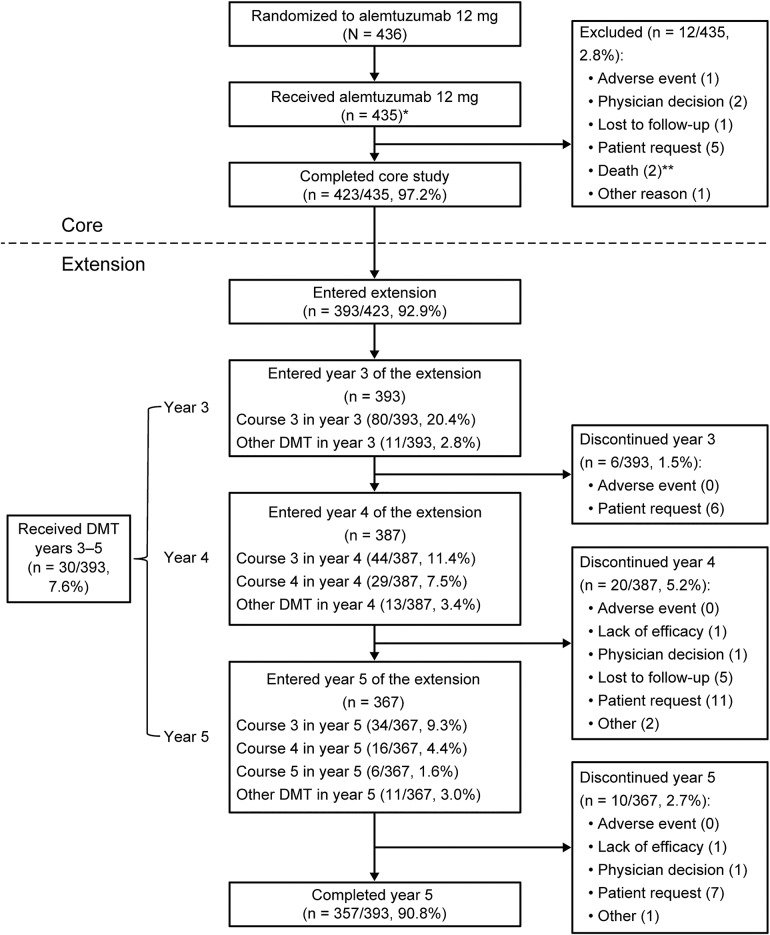
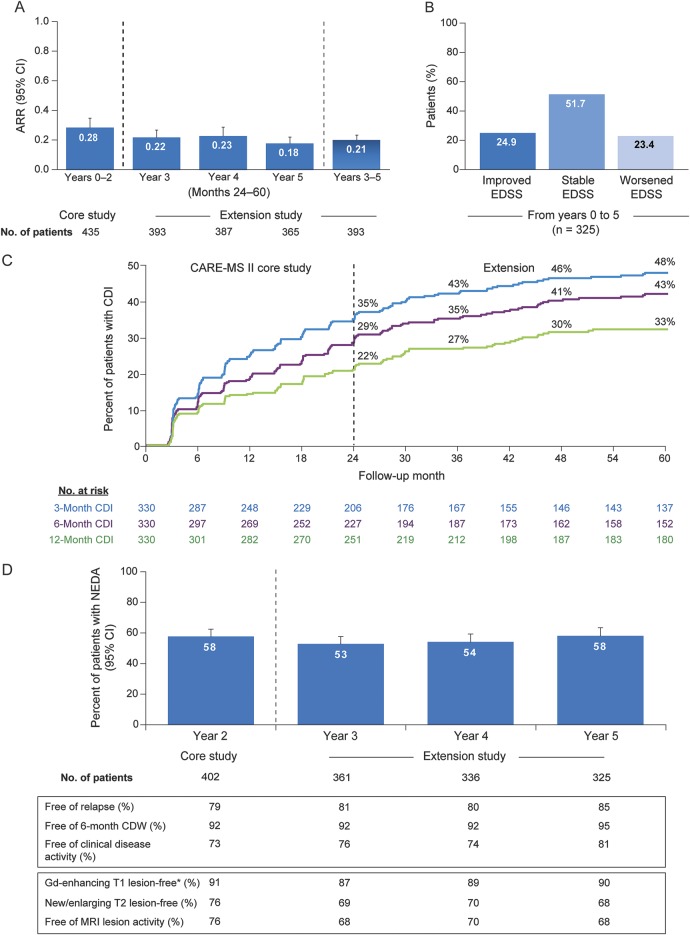
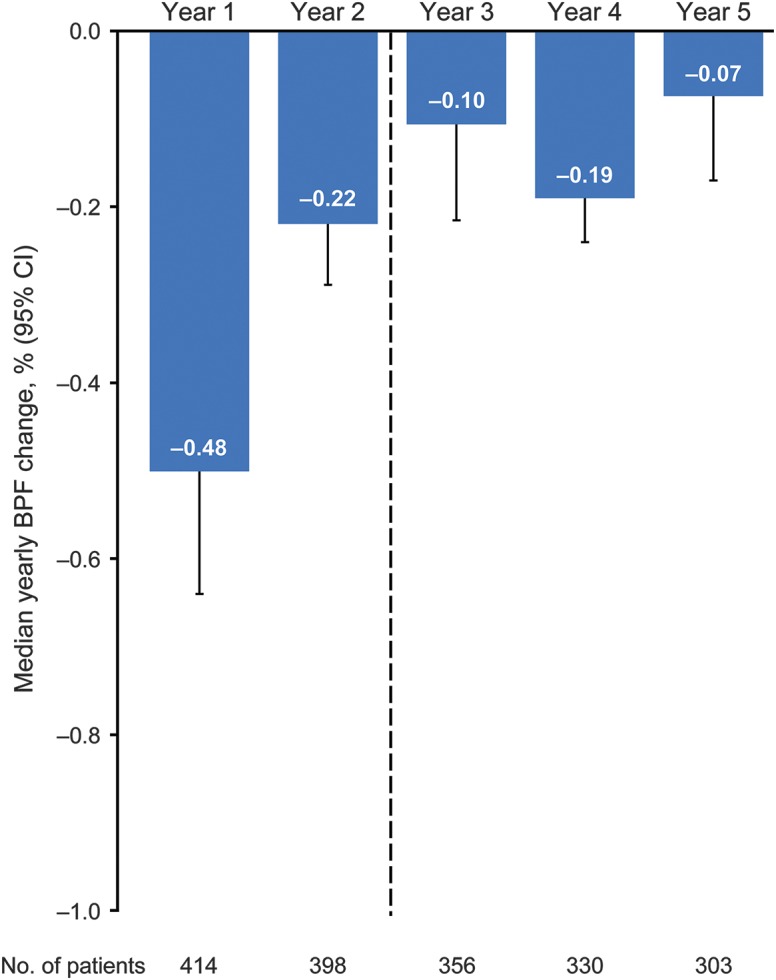
OBJECTIVE: To evaluate 5-year efficacy and safety of alemtuzumab in patients with active relapsing-remitting multiple sclerosis and inadequate response to prior therapy. METHODS: In the 2-year Comparison of Alemtuzumab and Rebif Efficacy in Multiple Sclerosis (CARE-MS) II study (NCT00548405), alemtuzumab-treated patients received 2 courses (baseline and 12 months later). Patients could enter an extension (NCT00930553), with as-needed alemtuzumab retreatment for relapse or MRI activity. Annualized relapse rate (ARR), 6-month confirmed disability worsening (CDW; ≥1-point Expanded Disability Status Scale [EDSS] score increase [≥1.5 if baseline EDSS = 0]), 6-month confirmed disability improvement (CDI; ≥1-point EDSS decrease [baseline score ≥2.0]), no evidence of disease activity (NEDA), brain volume loss (BVL), and adverse events (AEs) were assessed. RESULTS: Most alemtuzumab-treated patients (92.9%) who completed CARE-MS II entered the extension; 59.8% received no alemtuzumab retreatment. ARR was low in each extension year (years 3-5: 0.22, 0.23, 0.18). Through 5 years, 75.1% of patients were free of 6-month CDW; 42.9% achieved 6-month CDI. In years 3, 4, and 5, proportions with NEDA were 52.9%, 54.2%, and 58.2%, respectively. Median yearly BVL remained low in the extension (years 1-5: -0.48%, -0.22%, -0.10%, -0.19%, -0.07%). AE exposure-adjusted incidence rates in the extension were lower than in the core study. Thyroid disorders peaked at year 3, declining thereafter. CONCLUSIONS: Alemtuzumab provides durable efficacy through 5 years in patients with an inadequate response to prior therapy in the absence of continuous treatment. CLASSIFICATION OF EVIDENCE: This study provides Class III evidence that alemtuzumab provides efficacy and slowing of brain atrophy through 5 years.
Overview
The claims and statistics of this paper haven’t been checked yet.
Run the check — free, no account needed. It reads the open-access text and checks the sources it cites.
Integrity signals
Registry
Cites
Statistics
Figures
Verification
Claims the paper makes
The claims and statistics of this paper haven’t been checked yet.
Run the check — free, no account needed. It reads the open-access text and checks the sources it cites.
Claims other papers make about this one
Each is checked against this paper’s own text: does it say what the citing paper says it does?
In the citing paper
“In the 5-year follow-up extension studies, no increase in thyroid cancer was observed [57, 58].”
From 2019 European Thyroid Association Guidelines on the Management of Thyroid Dysfunction following Immune Reconstitution Therapy (2019) · cites this paper as [58]
In the citing paper
“In the extension studies of alemtuzumab for MS (5 years follow-up), TD peaked at year 3, declining thereafter [57, 58].”
From 2019 European Thyroid Association Guidelines on the Management of Thyroid Dysfunction following Immune Reconstitution Therapy (2019) · cites this paper as [58]
Self-check
Percentages, sums and reported differences re-computed from the paper’s own numbers.
The self-check needs the paper’s full text.
Citations
Cites
Compston, A., & Coles, A. J. (2008) · The Lancet · doi:10.1016/s0140-6736(08)61620-7 · Cited by 4,699
Self-citationNomenclature Revision for Encapsulated Follicular Variant of Papillary Thyroid Carcinoma
Nikiforov, Y. E., Seethala, R. R., Tallini, G., Baloch, Z. W., Basolo, F., Thompson, L. D. �., Barletta, J. A., Wenig, B. M., Ghuzlan, A. A., Kakudo, K., et al. (2016) · JAMA Oncology · doi:10.1001/jamaoncol.2016.0386 · Cited by 1,410
Risk of Natalizumab-Associated Progressive Multifocal Leukoencephalopathy
Bloomgren, G., Richman, S., Hotermans, C., Subramanyam, M., Goelz, S. E., Natarajan, A., Lee, S., Plavina, T., Scanlon, J. V., Sandrock, A. W., et al. (2012) · New England Journal of Medicine · doi:10.1056/nejmoa1107829 · Cited by 1,260
Korea's Thyroid-Cancer “Epidemic” — Screening and Overdiagnosis
Ahn, H. S., Kim, H. J., & Welch, H. G. (2014) · New England Journal of Medicine · doi:10.1056/nejmp1409841 · Cited by 1,238
Cohen, J. A., Coles, A. J., Arnold, D. L., Confavreux, C., Fox, E. J., Hartung, H.-P., Havrdova, E., Selmaj, K. W., Weiner, H. L., Fisher, E., et al. (2012) · The Lancet · doi:10.1016/s0140-6736(12)61769-3 · Cited by 1,205
Self-citationColes, A. J., Twyman, C. L., Arnold, D. L., Cohen, J. A., Confavreux, C., Fox, E. J., Hartung, H.-P., Havrdova, E., Selmaj, K. W., Weiner, H. L., et al. (2012) · The Lancet · doi:10.1016/s0140-6736(12)61768-1 · Cited by 1,198
Self-citationAlemtuzumab vs. Interferon Beta-1a in Early Multiple Sclerosis
The CAMMS Trial Investigators (2008) · New England Journal of Medicine · doi:10.1056/nejmoa0802670 · Cited by 1,021
Will the real multiple sclerosis please stand up?
Stys, P. K., Zamponi, G. W., van Minnen, J., & Geurts, J. J. G. (2012) · Nature Reviews Neuroscience · doi:10.1038/nrn3275 · Cited by 475
Zivadinov, R. (2001) · Journal of Neurology Neurosurgery & Psychiatry · doi:10.1136/jnnp.70.6.773 · Cited by 388
Brain atrophy and lesion load predict long term disability in multiple sclerosis
Popescu, V., Agosta, F., Hulst, H. E., Sluimer, I. C., Knol, D. L., Sormani, M. P., Enzinger, C., Ropele, S., Alonso, J., Sastre‐Garriga, J., et al. (2013) · Journal of Neurology Neurosurgery & Psychiatry · doi:10.1136/jnnp-2012-304094 · Cited by 330
Research works printed but not linked: 2
- LEMTRADA [summary of product characteristics] [online]. Available at: ema.europa.eu/docs/en_GB/document_library/EPAR_-_Product_Information/human/003718/WC500150521.pdf. Accessed May 30, 2014.
- LEMTRADA (Alemtuzumab), for Intravenous Injection [prescribing information]. Cambridge, MA: Genzyme Corporation; 2014.
Cited by
Sorted by citations
Alemtuzumab-Induced Thyroid Dysfunction Exhibits Distinctive Clinical and Immunological Features
Pariani, N., Willis, M., Muller, I., Healy, S., Nasser, T., McGowan, A., Lyons, G., Jones, J., Chatterjee, K., Dayan, C., et al. (2018) · The Journal of Clinical Endocrinology & Metabolism · doi:10.1210/jc.2018-00359 · Cited by 84
Self-citationMuller, I., Moran, C., Lecumberri, B., Decallonne, B., Robertson, N., Jones, J., & Dayan, C. M. (2019) · European Thyroid Journal · doi:10.1159/000500881 · Cited by 78
Anti-CD52 Therapy for Multiple Sclerosis: An Update in the COVID Era
Kasarello, K., & Mirowska-Guzel, D. (2021) · ImmunoTargets and Therapy · doi:10.2147/itt.s240890 · Cited by 11
Metadata
- Authors
- Coles, A. J., Cohen, J. A., Fox, E. J., Giovannoni, G., Hartung, H.-P., Havrdova, E., Schippling, S., Selmaj, K. W., Traboulsee, A., Compston, D. A. S., Margolin, D. H., Thangavelu, K., Chirieac, M. C., Jody, D., Xenopoulos, P., Hogan, R. J., Panzara, M. A., & Arnold, D. L.
- Affiliations
- Cleveland Clinic (US)
- From the Department of Clinical Neurosciences (A.J.C., D.A.S.C.), University of Cambridge, UK; Mellen Center (J.A.C.), Cleveland Clinic, OH; MS Clinic of Central Texas (E.J.F.), Central Texas Neurology Consultants, Round Rock; Queen Mary University of London (G.G.), Barts and the London School of Medicine, UK; Department of Neurology and Center for Neuropsychiatry (H.-P.H.), Medical Faculty, Heinrich-Heine University, Düsseldorf, Germany; Department of Neurology and Center for Clinical Neuroscience ...
- Corresponding author
- Coles, Alasdair J.
- ORCID
- Venue
- Neurology
- Published
- 2017-09-12
- Volume
- 89
- Issue
- 11
- Pages
- 1117-1126
- ISSN
- 0028-3878 (ISSN-L)
- 1526-632X
- PMC
- PMC5595276
- OpenAlex
- W2746924405
- Cited by
- 277
- References
- 38
- Citations by year
- 2026: 8 · 2025: 19 · 2024: 28 · 2023: 22 · 2022: 20 · 2021: 42 · 2020: 46 · 2019: 47 · 2018: 40 · 2017: 4
- FWCI
- 29.43
- Type
- journal article
- Language
- en
- Open access
- hybrid
- doi.org
- Licence
- cc-by-nc-nd
- Locations
- Neurology (publishedVersion, cc-by-nc-nd)
- PubMed Central (publishedVersion, cc-by-nc-nd)
- PubMed (publishedVersion)
- Research Publications (Maastricht University) (publishedVersion, cc-by-nc-nd)
- Zurich Open Repository and Archive (University of Zurich) (acceptedVersion, other-oa)
- Queen Mary Research Online (Queen Mary University of London) (submittedVersion, cc-by-nc-nd)
- Apollo (University of Cambridge) (submittedVersion, cc-by-nc-nd)
- Research Publications (Maastricht University) (submittedVersion, other-oa)
- Apollo (cc-by-nc-nd)
- Zurich Open Repository and Archive (University of Zurich)
- Funders
- Sanofi
- Cleveland Clinic
- Bayer HealthCare
- Sanofi Genzyme
- Topics
- Health Sciences › Medicine › Clinical Neurology › Multiple Sclerosis Research Studies
- Health Sciences › Medicine › Oncology › Polyomavirus and related diseases
- Health Sciences › Medicine › Hematology › Chronic Lymphocytic Leukemia Research
- Keywords
- alemtuzumab, relapsing-remitting multiple sclerosis, annualized relapse rate, disability progression, disability improvement, no evidence of disease activity, brain atrophy, adverse events, thyroid dysfunction, long-term efficacy and safety
- MeSH terms
- Alemtuzumab, Atrophy, Brain, Disability Evaluation, Follow-Up Studies, Humans, Immunologic Factors, Organ Size, Time Factors, Treatment Outcome, Multiple Sclerosis, Relapsing-Remitting, Kaplan-Meier Estimate, Antibodies, Monoclonal, Humanized
About these checks
Registry, retraction, Cites and statistics results are computed, not judged, with one exception: a printed reference that no index lists is read once by a model before it counts as a citation error. Claims are extracted by a model and kept only when their quote appears verbatim in the text; each cited source is then checked, with a model’s help, for whether it says what the claim relies on. Those verdicts can be wrong — read the claim’s quote and the cited source before relying on one.
Statistics and arithmetic are recomputed, not judged.
Confidence bands are shown only for fields calibrated on our annotated test set. None is calibrated yet, so no band is shown.
What counts as a claim ›How we measure confidence ›How we check this ›
Are you an author, or do you see a problem with this page? Request a review
