

The DOI matches its Crossref record; 14 of the 14 references it cites were found in a registry or an index.
Accuracy of identifying incident stroke cases from linked health care data in UK Biobank
Open accessAbstract
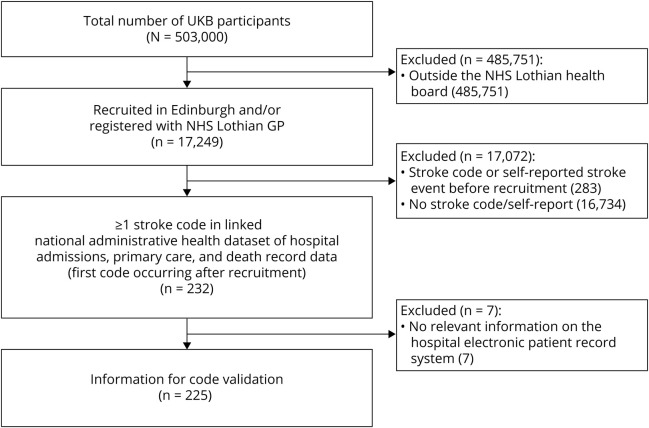
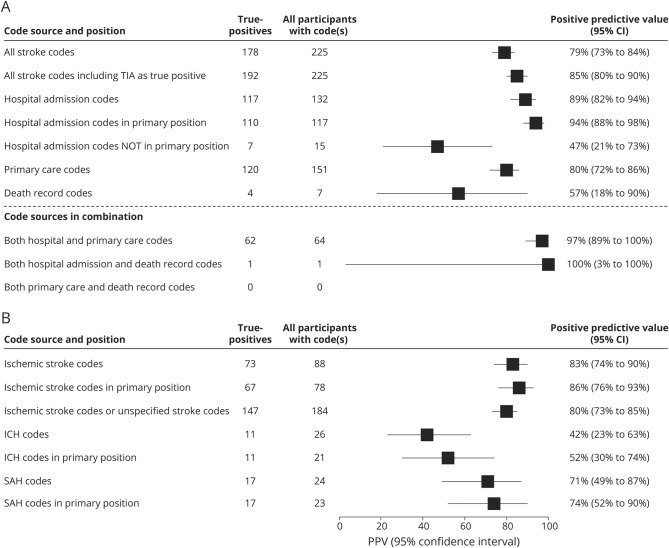
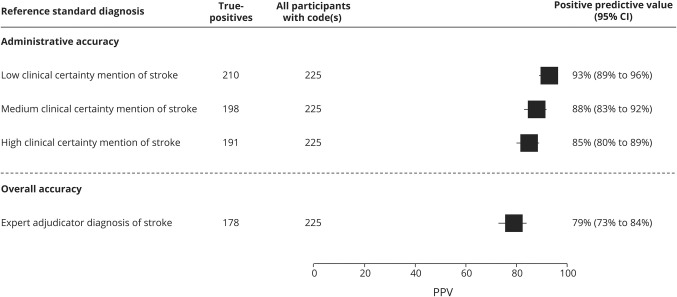
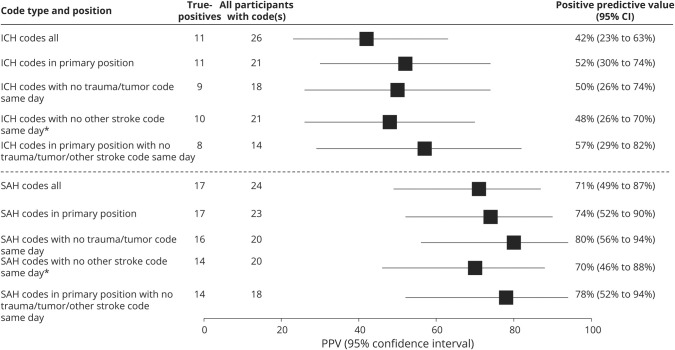
OBJECTIVE: In UK Biobank (UKB), a large population-based prospective study, cases of many diseases are ascertained through linkage to routinely collected, coded national health datasets. We assessed the accuracy of these for identifying incident strokes. METHODS: In a regional UKB subpopulation (n = 17,249), we identified all participants with ≥1 code signifying a first stroke after recruitment (incident stroke-coded cases) in linked hospital admission, primary care, or death record data. Stroke physicians reviewed their full electronic patient records (EPRs) and generated reference standard diagnoses. We evaluated the number and proportion of cases that were true-positives (i.e., positive predictive value [PPV]) for all codes combined and by code source and type. RESULTS: Of 232 incident stroke-coded cases, 97% had EPR information available. Data sources were 30% hospital admission only, 39% primary care only, 28% hospital and primary care, and 3% death records only. While 42% of cases were coded as unspecified stroke type, review of EPRs enabled a pathologic type to be assigned in >99%. PPVs (95% confidence intervals) were 79% (73%-84%) for any stroke (89% for hospital admission codes, 80% for primary care codes) and 83% (74%-90%) for ischemic stroke. PPVs for small numbers of death record and hemorrhagic stroke codes were low but imprecise. CONCLUSIONS: Stroke and ischemic stroke cases in UKB can be ascertained through linked health datasets with sufficient accuracy for many research studies. Further work is needed to understand the accuracy of death record and hemorrhagic stroke codes and to develop scalable approaches for better identifying stroke types.
Overview
The claims and statistics of this paper haven’t been checked yet.
Run the check — free, no account needed. It reads the open-access text and checks the sources it cites.
Integrity signals
Registry
Cites
Statistics
Figures
Verification
Claims the paper makes
The claims and statistics of this paper haven’t been checked yet.
Run the check — free, no account needed. It reads the open-access text and checks the sources it cites.
Self-check
Percentages, sums and reported differences re-computed from the paper’s own numbers.
The self-check needs the paper’s full text.
Citations
Cites
Lozano, R., Naghavi, M., Foreman, K., Lim, S., Shibuya, K., Aboyans, V., Abraham, J., Adair, T., Aggarwal, R., Ahn, S. Y., et al. (2012) · The Lancet · doi:10.1016/s0140-6736(12)61728-0 · Cited by 14,070
Sudlow, C., Gallacher, J., Allen, N., Beral, V., Burton, P., Danesh, J., Downey, P., Elliott, P., Green, J., Landray, M., et al. (2015) · PLOS Medicine · doi:10.1371/journal.pmed.1001779 · Cited by 12,728
Self-citation(2005) · PubMed · Cited by 7,011
WHO MONICA Project Principal Invest (1988) · Journal of Clinical Epidemiology · doi:10.1016/0895-4356(88)90084-4 · Cited by 1,846
The SAIL Databank: building a national architecture for e-health research and evaluation
Ford, D. V., Jones, K. H., Verplancke, J.-P., Lyons, R. A., John, G., Brown, G., Brooks, C. J., Thompson, S., Bodger, O. G., Couch, T., et al. (2009) · BMC Health Services Research · doi:10.1186/1472-6963-9-157 · Cited by 563
Validity of Stroke Diagnoses in a National Register of Patients
Krarup, L.-H., Boysen, G., Janjua, H. G. R., Prescott, E., & Truelsen, T. C. (2007) · Neuroepidemiology · doi:10.1159/000102143 · Cited by 366
Burton, P. R., Hansell, A., Fortier, I., Manolio, T. A., Khoury, M. J., Little, J., & Elliott, P. (2008) · International Journal of Epidemiology · doi:10.1093/ije/dyn147 · Cited by 266
Tradeoffs between accuracy measures for electronic health care data algorithms
Chubak, J., Pocobelli, G. S., & Weiss, N. S. (2011) · Journal of Clinical Epidemiology · doi:10.1016/j.jclinepi.2011.09.002 · Cited by 221
Johnsen, S. P., Overvad, K., Sørensen, H. T., Tjønneland, A. M., & Husted, S. (2002) · Journal of Clinical Epidemiology · doi:10.1016/s0895-4356(02)00391-8 · Cited by 174
Woodfield, R., Grant, I., UK Biobank Stroke Outcomes Group, UK Biobank Follow-Up and Outcomes Working Group, & Sudlow, C. L. M. (2015) · PLOS ONE · doi:10.1371/journal.pone.0140533 · Cited by 145
Self-citation
Cited by
Sorted by citations
Acosta, J. N., Falcone, G. J., Rajpurkar, P., & Topol, E. J. (2022) · Nature Medicine · doi:10.1038/s41591-022-01981-2 · Cited by 1,365
Metadata
- Authors
- Rannikmäe, K., Ngoh, K., Bush, K., Al-Shahi Salman, R., Doubal, F., Flaig, R., Henshall, D. E., Hutchison, A., Nolan, J., Osborne, S., Samarasekera, N., Schnier, C., Whiteley, W., Wilkinson, T., Wilson, K., Woodfield, R., Zhang, Q., Allen, N., & Sudlow, C. L. M.
- Affiliations
- University of Oxford (GB)
- From the Centre for Medical Informatics, Usher Institute of Population Health Sciences and Informatics (K.R., K.B., R.F., A.H., J.N., C.S., T.W., K.W., Q.Z., C.L.M.S.), and Centre for Clinical Brain Sciences (R.A.-S.S., F.D., N.S., W.W., R.W.), University of Edinburgh; UK Biobank (K.R., K.B., R.F., A.H., J.N., C.S., T.W., K.W., R.W., Q.Z., N.A., C.L.M.S.), Stockport; University of Edinburgh Medical School (K.N., D.E.H., S.O.); and Nuffield Department of Population Health (N.A.), University of Oxford...
- Corresponding author
- Rannikmäe, Kristiina
- ORCID
- Venue
- Neurology
- Published
- 2020-08-11
- Volume
- 95
- Issue
- 6
- Pages
- e697-e707
- ISSN
- 0028-3878 (ISSN-L)
- 1526-632X
- PMC
- PMC7455356
- OpenAlex
- W3038575402
- Cited by
- 61
- References
- 14
- Citations by year
- 2026: 11 · 2025: 13 · 2024: 10 · 2023: 10 · 2022: 8 · 2021: 7 · 2020: 1
- FWCI
- 5.71
- Type
- journal article
- Language
- en
- Open access
- hybrid
- doi.org
- Licence
- cc-by
- Locations
- Neurology (publishedVersion, cc-by)
- PubMed Central (publishedVersion, cc-by)
- PubMed (publishedVersion)
- Edinburgh Research Explorer (University of Edinburgh) (submittedVersion, other-oa)
- Zenodo (CERN European Organization for Nuclear Research) (submittedVersion, public-domain)
- DRYAD (public-domain)
- Funders
- British Heart Foundation (SP/12/2/29422)
- Scottish Funding Council
- University of Oxford
- University of Edinburgh
- Dementias Platform UK
- Medical Research Council (MC_PC_17228, MR/P001823/1, MR/S004130/1)
- Topics
- Health Sciences › Health Professions › Health Information Management › Medical Coding and Health Information
- Health Sciences › Medicine › Clinical Neurology › Acute Ischemic Stroke Management
- Physical Sciences › Mathematics › Statistics and Probability › Statistical Methods in Epidemiology
- Keywords
- incident stroke, positive predictive value, electronic health records, death records, ischemic stroke, hemorrhagic stroke, UK Biobank
- MeSH terms
- Adult, Aged, Brain Ischemia, Data Collection, Death Certificates, Female, United Kingdom, Hospitalization, Humans, Male, Middle Aged, Patient Admission, Primary Health Care, Prospective Studies, Incidence, Stroke, International Classification of Diseases, Datasets as Topic
About these checks
Registry, retraction, Cites and statistics results are computed, not judged, with one exception: a printed reference that no index lists is read once by a model before it counts as a citation error. Claims are extracted by a model and kept only when their quote appears verbatim in the text; each cited source is then checked, with a model’s help, for whether it says what the claim relies on. Those verdicts can be wrong — read the claim’s quote and the cited source before relying on one.
Statistics and arithmetic are recomputed, not judged.
Confidence bands are shown only for fields calibrated on our annotated test set. None is calibrated yet, so no band is shown.
What counts as a claim ›How we measure confidence ›How we check this ›
Are you an author, or do you see a problem with this page? Request a review
