

The DOI matches its Crossref record; the references it cites are not checked yet.
β-Amyloid, Tau, Neurodegeneration Classification and Eligibility for Anti-amyloid Treatment in a Memory Clinic Population
Open accessAbstract
BACKGROUND AND OBJECTIVES: ATN (β-amyloid [Aβ], tau, neurodegeneration) system categorizes individuals based on their core Alzheimer disease (AD) biomarkers. An important potential future use for ATN is therapeutic decision-making in clinical practice once disease-modifying treatments (e.g., anti-amyloid), become widely available. In this cross-sectional study, we applied ATN and estimated potential eligibility for anti-amyloid treatment in a real-life memory clinic with biomarker assessments integrated into the routine diagnostic procedure and all specialized resources available for the implementation of novel treatments. METHODS: We included all consecutive patients at the Karolinska University Hospital Memory clinic in Solna, Stockholm, Sweden, who had their first diagnostic visit in April 2018-February 2021, informed consent for the clinic research database, and available clinical and biomarker (CSF and imaging) data. ATN classification was based on CSF Aβ42 (or Aβ42/40; A), CSF phosphorylated tau (T), and medial temporal lobe atrophy (N). For CSF markers, we applied laboratory cutoffs and data-driven cutoffs for comparison (determined with Gaussian mixture modeling). Eligibility for anti-amyloid treatment was assessed following the published recommendations for aducanumab (AD dementia or mild cognitive impairment [MCI] with no evidence of non-AD etiology, appropriate level of cognition, and AD-consistent CSF profile). RESULTS: The study population consisted of 410 patients (52% subjective cognitive impairment, 23% MCI, and 25% any dementia; age 59 ± 7 years, 56% women). Regardless of biomarker cutoffs, most patients were A-T-N- (54%-57%). A+ prevalence was 17%-30% (higher with data-driven cutoffs). Up to 13% of all patients (27% of those with MCI and 28% of those with dementia) were potentially eligible for anti-amyloid treatment when AD-consistent CSF was defined as any A+ profile. When A+T+ profile was required, treatment was targeted more to the dementia than MCI stage (eligibility up to 14% in MCI and 22% in dementia). The opposite applied to earlier-stage intervention (A+T-N-; eligibility up to 12% in MCI and 2% in dementia). DISCUSSION: In a memory clinic setting with all necessary infrastructure and national guidelines in place for dementia diagnostic examination (best-case scenario), most of the patients did not meet the eligibility criteria for anti-amyloid treatment. Continuing the development of disease-modifying treatments with different mechanisms of action is a priority.
Overview
The claims and statistics of this paper haven’t been checked yet.
Run the check — free, no account needed. It reads the open-access text and checks the sources it cites.
Integrity signals
Registry
Cites
Statistics
Figures
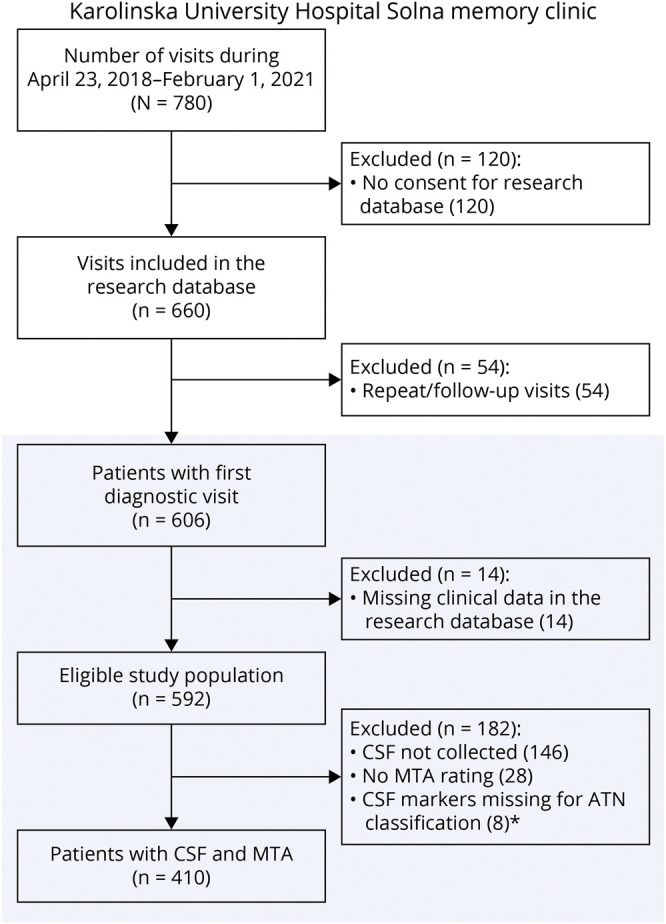
Verification
Claims the paper makes
The claims and statistics of this paper haven’t been checked yet.
Run the check — free, no account needed. It reads the open-access text and checks the sources it cites.
Claims other papers make about this one
Each is checked against this paper’s own text: does it say what the citing paper says it does?
The source backs part of the claim, not all of it — or backs it for a different population, condition or comparison.
In the citing paper
“Alzheimer's disease (AD) is a progressive neurodegenerative disorder characterized by two core biomarkers: amyloid beta (Aβ) plaques and tau neurofibrillary tangles.”
From Unique transcriptomic alterations in 5XFAD;PS19 mouse model identify glial lipid dysregulation and coordinated microglial–oligodendrocyte responses (2026) · cites this paper as [1]
Experimental — accuracy not yet measured
Self-check
Percentages, sums and reported differences re-computed from the paper’s own numbers.
The self-check needs the paper’s full text.
Citations
The citation lists haven’t been fetched yet
References 50 · Cited by 70
Research works printed but not linked: 40
- 10.1212/WNL.0000000000002923 · DOI · Paper page
- 10.1212/WNL.0000000000005476 · DOI
- 10.1159/000515322 · DOI
- 10.1002/alz.12292 · DOI
- 10.1038/s41598-018-26151-8 · DOI
- 10.14283/jpad.2019.25 · DOI
- 10.1186/s13195-021-00799-3 · DOI
- 10.1001/jama.2019.7437 · DOI · Paper page
- 10.1212/WNL.0000000000007248 · DOI
- 10.1212/WNL.0000000000008361 · DOI
- 10.3233/JAD-191227 · DOI
- 10.1212/WNL.0000000000009724 · DOI · Paper page
- 10.1186/s13195-020-00621-6 · DOI
- 10.1002/dad2.12026 · DOI
- 10.1002/dad2.12031 · DOI
- 10.14283/jpad.2021.41 · DOI · Paper page
- 10.1016/0022-3956(75)90026-6 · DOI · Paper page
- 10.1111/j.1532-5415.2005.53221.x · DOI · Paper page
- 10.1007/978-0-387-79948-3_4454 · DOI
- 10.1007/978-0-387-79948-3_1153 · DOI
- 10.1007/978-0-387-79948-3_1399 · DOI
- 10.1186/s13195-019-0550-8 · DOI
- 10.3389/fnagi.2021.604119 · DOI
- 10.1007/BF00868807 · DOI
- 10.1159/000117270 · DOI
- 10.1007/s00330-011-2205-4 · DOI
- 10.2214/ajr.149.2.351 · DOI
- 10.1007/s00330-019-06067-1 · DOI
- 10.3389/fnagi.2017.00117 · DOI
- 10.1373/clinchem.2017.281055 · DOI
- 10.1186/s13195-020-00713-3 · DOI
- 10.1212/WNL.0000000000009485 · DOI · Paper page
- 10.1001/jama.2021.15286 · DOI
- 10.1016/j.ijcard.2017.07.012 · DOI
- 10.1038/s41582-021-00520-w · DOI
- 10.1186/s13195-019-0485-0 · DOI · Paper page
- 10.1186/s13195-018-0362-2 · DOI
- 10.3233/jad-210236 · DOI
- 10.1186/s13195-015-0114-5 · DOI
- 10.1001/jama.2015.4668 · DOI · Paper page
Metadata
- Authors
- Rosenberg, A., Öhlund-Wistbacka, U., Hall, A., Bonnard, A., Hagman, G., Rydén, M., Thunborg, C., Wiggenraad, F., Sandebring-Matton, A., Solomon, A., & Kivipelto, M.
- Affiliations
- Karolinska University Hospital (SE)
- From the Division of Clinical Geriatrics (A.R., U.Ö.-W., C.T., A.S.-M., A.S., M.K.), Centre for Alzheimer Research, Department of Neurobiology, Care Sciences and Society, Karolinska Institutet, Stockholm, Sweden; Department of Neurology (A.R., A.H., A.S, M.K.), Institute of Clinical Medicine, University of Eastern Finland, Kuopio; Medical Unit Aging (U.Ö.-W., A.B., G.H., M.R., F.W., M.K.), Karolinska University Hospital, Stockholm, Sweden; Division of Neurogeriatrics (A.S.M.), Centre for Alzheimer...
- Corresponding author
- Rosenberg, Anna
- Venue
- Neurology
- Published
- 2022-11-08
- Volume
- 99
- Issue
- 19
- Pages
- e2102-e2113
- ISSN
- 0028-3878 (ISSN-L)
- 1526-632X
- PMC
- PMC9651451
- OpenAlex
- W4296714032
- Cited by
- 70
- References
- 50
- Citations by year
- 2026: 19 · 2025: 21 · 2024: 23 · 2023: 7
- FWCI
- 8.31
- Type
- journal article
- Language
- en
- Open access
- hybrid
- doi.org
- Licence
- cc-by
- Locations
- Neurology (publishedVersion, cc-by)
- PubMed Central (publishedVersion, cc-by)
- PubMed (publishedVersion)
- Funders
- H2020 European Research Council (804371)
- Topics
- Health Sciences › Medicine › Psychiatry and Mental health › Dementia and Cognitive Impairment Research
- Life Sciences › Neuroscience › Cellular and Molecular Neuroscience › Alzheimer's disease research and treatments
- Health Sciences › Medicine › Clinical Neurology › Cerebrospinal fluid and hydrocephalus
- Keywords
- Alzheimer's disease, aducanumab, amyloid-beta, phosphorylated tau, medial temporal lobe atrophy, cerebrospinal fluid biomarkers, mild cognitive impairment, dementia, memory clinic patients, biomarker cut-off values, disease-modifying therapy, early intervention, Gaussian mixture model, amyloid PET, FDG-PET
- MeSH terms
- Aged, Alzheimer Disease, Amyloidosis, Cross-Sectional Studies, Female, Humans, Male, Middle Aged, Peptide Fragments, Biomarkers, Amyloid beta-Peptides, tau Proteins, Disease Progression, Cognitive Dysfunction
About these checks
Registry, retraction, Cites and statistics results are computed, not judged, with one exception: a printed reference that no index lists is read once by a model before it counts as a citation error. Claims are extracted by a model and kept only when their quote appears verbatim in the text; each cited source is then checked, with a model’s help, for whether it says what the claim relies on. Those verdicts can be wrong — read the claim’s quote and the cited source before relying on one.
Statistics and arithmetic are recomputed, not judged.
Confidence bands are shown only for fields calibrated on our annotated test set. None is calibrated yet, so no band is shown.
What counts as a claim ›How we measure confidence ›How we check this ›
Are you an author, or do you see a problem with this page? Request a review
How to cite
Cite CoChat for the checks on this page, and the paper for its own findings.
- This page
- CoChat. (2026). Citation check: β-Amyloid, Tau, Neurodegeneration Classification and Eligibility for Anti-amyloid Treatment in a Memory Clinic Population. https://app.cochat.ai/papers/10.1212/wnl.0000000000201043
- The paper
- Rosenberg, A., Öhlund-Wistbacka, U., Hall, A., Bonnard, A., Hagman, G., Rydén, M., Thunborg, C., Wiggenraad, F., Sandebring-Matton, A., Solomon, A., & Kivipelto, M. (2022). β-Amyloid, Tau, Neurodegeneration Classification and Eligibility for Anti-amyloid Treatment in a Memory Clinic Population. Neurology. https://doi.org/10.1212/wnl.0000000000201043
