

The DOI matches its Crossref record; 1 of the 1 references it cites were found in a registry or an index.
Adverse Events Associated With Disease-Modifying Drugs for Multiple Sclerosis: A Multiregional Population-Based Study
Open accessAbstract
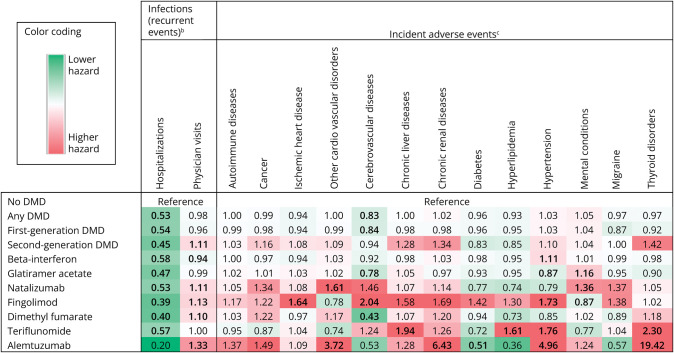
BACKGROUND AND OBJECTIVES: It is not possible to fully establish the safety of a disease-modifying drug (DMD) for multiple sclerosis (MS) from randomized controlled trials as only very common adverse events occurring over the short-term can be captured, and the quality of reporting has been variable. We examined the relationship between the DMDs for MS and potential adverse events in a multiregion population-based study. METHODS: We identified people with MS using linked administrative health data from 4 Canadian provinces. MS cases were followed from the most recent of first MS or related demyelinating disease event on January 1, 1996, until the earliest of emigration, death, or December 31, 2017. DMD exposure primarily comprised β-interferon, glatiramer acetate, natalizumab, fingolimod, dimethyl fumarate, teriflunomide, and alemtuzumab. We examined associations between DMD exposure and infection-related hospitalizations and physician visits using recurrent events proportional means models and between DMD exposure and 15 broad categories of incident adverse events using stratified multivariate Cox proportional hazard models. RESULTS: We identified 35,894 people with MS. While virtually all DMDs were associated with a 42%-61% lower risk of infection-related hospitalizations, there was a modest increase in infection-related physician visits by 10%-33% for select DMDs. For incident adverse events, most elevated risks involved a second-generation DMD, with alemtuzumab's hazard of thyroid disorders being 19.42 (95% CI 9.29-36.51), hypertension 4.96 (95% CI 1.78-13.84), and cardiovascular disease 3.72 (95% CI 2.12-6.53). Natalizumab's highest risk was for cardiovascular disease (adjusted hazard ratio [aHR] 1.61; 95% CI 1.24-2.10). For the oral DMDs, fingolimod was associated with higher hazards of cerebrovascular (aHR 2.04; 95% CI 1.27-3.30) and ischemic heart diseases (aHR 1.64; 95% CI 1.10-2.44) and hypertension (aHR 1.73; 95% CI 1.30-2.31); teriflunomide with higher hazards of thyroid disorders (aHR 2.30; 95% CI 1.11-4.74), chronic liver disease (aHR 1.94; 95% CI 1.19-3.18), hypertension (aHR 1.76; 95% CI 1.32-2.37), and hyperlipidemia (aHR 1.61; 95% CI 1.07-2.44); and from complementary analyses (in 1 province), dimethyl fumarate with acute liver injury (aHR 6.55; 95% CI 1.96-21.87). DISCUSSION: Our study provides an extensive safety profile of several different DMDs used to treat MS in the real-world setting. Our findings not only complement those observed in short-term clinical trials but also provide new insights that help inform the risk-benefit profile of the DMDs used to treat MS in clinical practice. The results of this study highlight the continued need for long-term, independent safety studies of the DMDs used to treat MS. CLASSIFICATION OF EVIDENCE: This study provides Class III evidence that for patients with MS, while DMD exposure reduces the risk of infection-related hospitalizations, there are increased risks of infection-related physician visits and incident adverse events for select DMDs.
Overview
The claims and statistics of this paper haven’t been checked yet.
Run the check — free, no account needed. It reads the open-access text and checks the sources it cites.
Integrity signals
Registry
Cites
Statistics
Figures
Verification
Claims the paper makes
The claims and statistics of this paper haven’t been checked yet.
Run the check — free, no account needed. It reads the open-access text and checks the sources it cites.
Claims other papers make about this one
Each is checked against this paper’s own text: does it say what the citing paper says it does?
The source backs part of the claim, not all of it — or backs it for a different population, condition or comparison.
In the citing paper
“Patients were also at risk of additional adverse events from these therapies, including flu-like symptoms, hepatotoxicity, autoimmune complications, recurrent infections, and in rare cases, progressive multifocal leukoencephalopathy.10,12,13”
From Multiple Sclerosis Misdiagnosis in Cerebral Autosomal Dominant Arteriopathy With Subcortical Infarcts and Leukoencephalopathy (2026) · cites this paper as [13]
Experimental — accuracy not yet measured
Self-check
Percentages, sums and reported differences re-computed from the paper’s own numbers.
The self-check needs the paper’s full text.
Citations
Cites
Sensitivity analysis in observational research: Introducing the E-value
VanderWeele, T. J., & Ding, P. (2017) · Annals of Internal Medicine · doi:10.7326/m16-2607 · Cited by 6,350
Research works printed but not linked: 42
- 10.1016/j.msard.2019.06.036 · DOI
- 10.1080/14740338.2020.1807002 · DOI
- 10.1016/j.msard.2020.102566 · DOI
- 10.1002/14651858.CD011381.pub2 · DOI
- 10.1212/WNL.0000000000002471 · DOI
- 10.1212/WNL.0000000000004037 · DOI
- 10.1136/jnnp-2019-322326 · DOI
- 10.1007/s00415-019-09211-5 · DOI
- 10.1371/journal.pone.0267346 · DOI
- 10.1177/1756286419835077 · DOI
- 10.1007/s40263-018-0564-y · DOI
- 10.1136/jnnp-2013-307238 · DOI
- 10.1007/s00415-011-5929-9 · DOI
- 10.1002/ana.25701 · DOI
- 10.1212/NXI.0000000000200005 · DOI
- 10.1080/14737175.2021.1847085 · DOI
- 10.1212/WNL.0b013e3181cf6ec0 · DOI · Paper page
- 10.1212/WNL.0000000000000495 · DOI
- 10.1177/13524585211063403 · DOI
- 10.1177/1352458520910500 · DOI
- 10.3390/jcm11216248 · DOI
- 10.2147/CIA.S99097 · DOI
- 10.1136/jnnp-2017-317493 · DOI
- 10.1097/EDE.0000000000001032 · DOI
- National Institute for Health and Care Excellence (NICE). NICE real-world evidence framework: methods for real-world studies of comparative studies. 2022. Accessed July 6 2023. nice.org.uk/corporate/ecd9/chapter/methods-for-real-world-studies-of-comparative-effects.
- 10.1093/ofid/ofy174 · DOI
- 10.1001/jamaneurol.2019.3365 · DOI · Paper page
- 10.3389/fphar.2022.808370 · DOI
- 10.2165/00002018-200629050-00003 · DOI
- 10.1177/1352458518799598 · DOI
- 10.1177/1352458518761185 · DOI
- 10.1177/1352458516688351 · DOI
- 10.1016/j.ahj.2014.06.028 · DOI
- 10.3389/fimmu.2021.795574 · DOI
- 10.1177/1756286420982134 · DOI
- 10.1111/ene.14633 · DOI
- 10.1177/1352458519851219 · DOI
- 10.1016/j.msard.2018.09.008 · DOI
- 10.1177/1756285614563522 · DOI
- 10.1016/j.clinthera.2010.10.006 · DOI
- 10.1136/bmj.m160 · DOI
- 10.1371/journal.pmed.1004208 · DOI
Cited by
Sorted by citations
Mendis, D. D., Vallamchetla, S. K., Marin Collazo, I. V., Sandhu, S. J. S., & Meschia, J. F. (2026) · Neurology Genetics · doi:10.1212/nxg.0000000000200430
Metadata
- Authors
- Ng, H. S., Zhu, F., Zhao, Y., Yao, S., Lu, X., Ekuma, O., Evans, C., Fisk, J. D., Marrie, R. A., & Tremlett, H.
- Affiliations
- Dalhousie University (CA)
- Corresponding author
- Tremlett, Helen
- ORCID
- Venue
- Neurology
- Published
- 2024-02-13
- Volume
- 102
- Issue
- 3
- Pages
- e208006-e208006
- ISSN
- 0028-3878 (ISSN-L)
- 1526-632X
- PMC
- PMC11097763
- OpenAlex
- W4390629241
- Cited by
- 31
- References
- 1
- Citations by year
- 2026: 10 · 2025: 14 · 2024: 7
- FWCI
- 9.43
- Type
- journal article
- Language
- en
- Open access
- hybrid
- doi.org
- Licence
- cc-by-nc-nd
- Locations
- Neurology (publishedVersion, cc-by-nc-nd)
- PubMed Central (publishedVersion, cc-by-nc-nd)
- PubMed (publishedVersion)
- Funders
- Nova Scotia Department of Health and Wellness
- Dalhousie University
- Department of Health, Western Cape Government
- Ministry of Health, Saskatchewan
- Canadian Institutes of Health Research (156363_1)
- Topics
- Health Sciences › Medicine › Clinical Neurology › Multiple Sclerosis Research Studies
- Life Sciences › Pharmacology, Toxicology and Pharmaceutics › Toxicology › Pharmacovigilance and Adverse Drug Reactions
- Health Sciences › Medicine › Ophthalmology › Drug-Induced Ocular Toxicity
- Keywords
- multiple sclerosis, disease-modifying drugs, adverse events, drug safety, infection-related hospitalization, natalizumab, fingolimod, alemtuzumab, glatiramer acetate, dimethyl fumarate, teriflunomide, interferon-beta, cardiovascular disease
- MeSH terms
- Fingolimod Hydrochloride, Natalizumab, Dimethyl Fumarate, Alemtuzumab, Canada, Cardiovascular Diseases, Crotonates, Humans, Hydroxybutyrates, Hypertension, Multiple Sclerosis, Nitriles, Toluidines
About these checks
Registry, retraction, Cites and statistics results are computed, not judged, with one exception: a printed reference that no index lists is read once by a model before it counts as a citation error. Claims are extracted by a model and kept only when their quote appears verbatim in the text; each cited source is then checked, with a model’s help, for whether it says what the claim relies on. Those verdicts can be wrong — read the claim’s quote and the cited source before relying on one.
Statistics and arithmetic are recomputed, not judged.
Confidence bands are shown only for fields calibrated on our annotated test set. None is calibrated yet, so no band is shown.
What counts as a claim ›How we measure confidence ›How we check this ›
Are you an author, or do you see a problem with this page? Request a review
