

The Physician Anesthesia Workforce in Canada From 1996 to 2018: A Longitudinal Analysis of Health Administrative Data
Open accessThe DOI matches its Crossref record; 12 of the 12 references it cites were found in a registry or an index.
Abstract
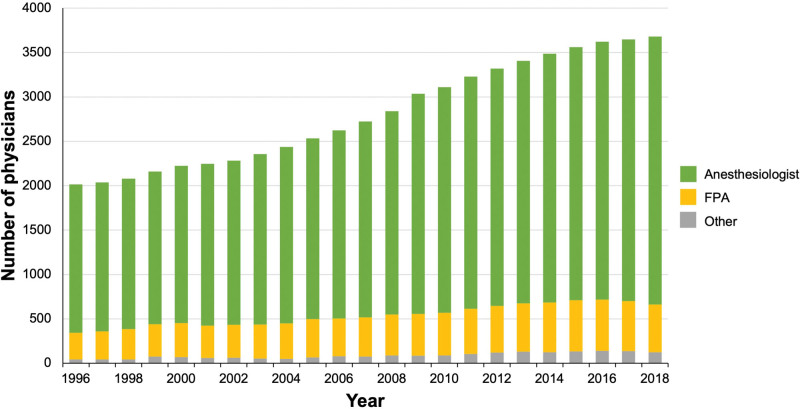
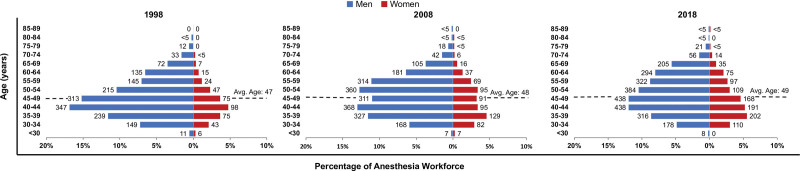
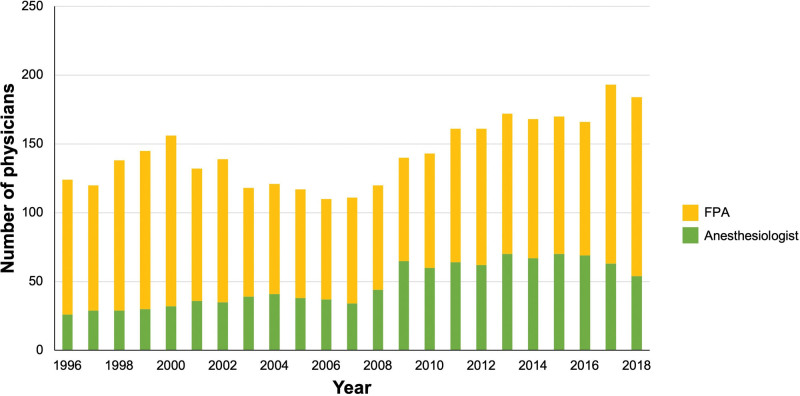
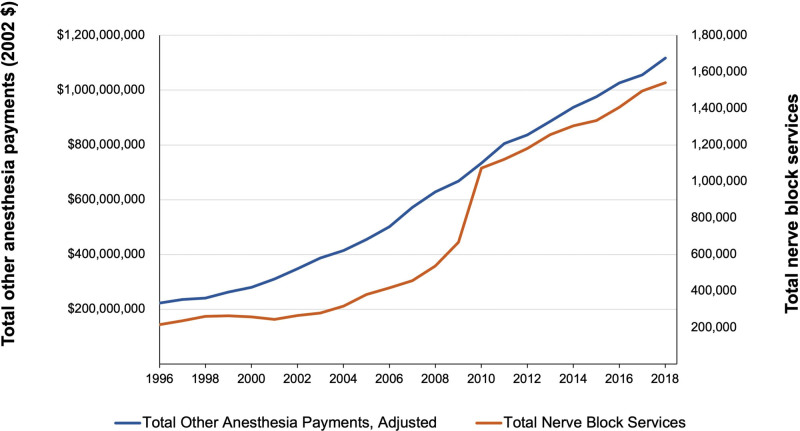
BACKGROUND: A robust anesthesia workforce is essential to the provision of safe surgical, obstetrical, and critical care but information describing the physician anesthesia workforce and volume of clinical services delivered in Canada is limited. This study examines the Canadian physician anesthesia workforce, exploring trends in physician characteristics and activity levels over time. Practice patterns of specialist anesthesiologists and family physician anesthetists (FPAs) working in urban and rural communities were of particular interest. METHODS: Physicians who provided anesthesia care between 1996 and 2018 were identified using health administrative data from the Canadian Institute of Health Information (CIHI). In addition, data from the Canadian Post-MD Education Registry (CAPER) were used to characterize physicians pursuing postgraduate anesthesia training (1996–2019). Descriptive analyses of physician demographics, training, location, specialty designations, and volume of clinical services were undertaken. RESULTS: Between 1996 and 2018, the anesthesia workforce grew 1.8-fold to 3681 physicians, including 536 FPAs. Over the same time, nerve block services increased 7-fold, and payments for other anesthesia services increased 5-fold. The average age of the anesthesiology workforce increased by 2.3 years and the annual retirement rate was 3%. The workforce has become more gender balanced but remains predominantly male (73% in 2018). The proportion of physicians who were trained internationally (about 30%; 38% in rural areas) remained stable (and higher than that in the overall physician workforce). FPAs provided most anesthesia care in rural Canada and their attrition rate was generally 2- to 3-fold higher than specialists. Physicians in the rural anesthesia workforce provided anesthesia services more intensively over time. Relatively few FPAs who left the anesthesia workforce entered full retirement and they instead contributed other medical services to their communities. CONCLUSIONS: This study provides foundational information regarding anesthesia workforce capacity over a 22-year period, including insights into demographics, locations of practice, and clinical volumes. The results do not quantify the gap between service capacity and need; however, they support the need for a national workforce strategy to achieve equitable access to sustainable anesthesia services in Canada, particularly for rural communities.
Overview
The claims and statistics of this paper haven’t been checked yet.
Free: it reads the open-access text and checks the first 5 claims that cite a source we can check. Create a free account to check every claim.
Integrity signals
Registry
Cites
Statistics
Figures
Verification
Claims the paper makes
The claims and statistics of this paper haven’t been checked yet.
Free: it reads the open-access text and checks the first 5 claims that cite a source we can check. Create a free account to check every claim.
Claims other papers make about this one
Each is checked against this paper’s own text: does it say what the citing paper says it does?
The source backs part of the claim, not all of it — or backs it for a different population, condition or comparison.
In the citing paper
“Similarly, between 1996 and 2018, the total number of nerve blocks and total payments for anesthesia services increased by seven-fold and five-fold, respectively.20”
From The anesthesia human resources crisis in Canada (2024) · cites this paper as [20]
Experimental — accuracy not yet measuredThe cited source says what the claim attributes to it.
In the citing paper
“Anesthesia has never been safer, 19 and the number of anesthesia service providers has actually increased 1.8-fold from 1996 to 2018.20”
From The anesthesia human resources crisis in Canada (2024) · cites this paper as [20]
The cited source says what the claim attributes to it.
In the citing paper
“Currently, a significant proportion of anesthesia in rural Canada is provided by FPAs and has remained a relatively small workforce not exceeding 200 physicians as of 2018.20”
From The anesthesia human resources crisis in Canada (2024) · cites this paper as [20]
The check wasn’t confident either way, so it gives no verdict — never disputed.
In the citing paper
“In a recent longitudinal analysis by Bourgeault's group and the Canadian Health Workforce Network, it is reported that, in 2018, FPAs contributed 75% of the Yukon's, 15-18% of Alberta's, British Columbia's, and Ontario's, and close to 10% of Saskatchewan's and Manitoba's anesthesia workforce.20”
From The anesthesia human resources crisis in Canada (2024) · cites this paper as [20]
Experimental — accuracy not yet measuredIn the citing paper
“In rural communities, FPAs provide most of the anesthesia care whereas another one third of care is provided by internationally trained anesthesiologists.14”
From No community left behind: advancing rural anesthesia, surgery, and obstetric care in Canada. (2022) · cites this paper as [14]
Self-check
Percentages, sums and reported differences re-computed from the paper’s own numbers.
The self-check needs the paper’s full text.
Citations
Cites
The WFSA global anesthesia workforce survey
Kempthorne, P., Morriss, W. W., Mellin-Olsen, J., & Gore-Booth, J. (2017) · Anesthesia & Analgesia · doi:10.1213/ane.0000000000002258 · Cited by 313
Growth of Nonoperating Room Anesthesia Care in the United States: A Contemporary Trends Analysis
Nagrebetsky, A., Gabriel, R. A., Dutton, R. P., & Urman, R. D. (2017) · Anesthesia & Analgesia · doi:10.1213/ane.0000000000001734 · Cited by 195
Canada needs a national strategy for anesthesia services in rural and remote regions
Orser, B. A., & Wilson, C. R. (2020) · Canadian Medical Association Journal · doi:10.1503/cmaj.200215 · Cited by 35
Self-citationBourgeault, I. L., Chamberland-Rowe, C., & Simkin, S. (2021) · Human Resources for Health · doi:10.1186/s12960-021-00578-z · Cited by 23 · cited 1×
“18 The CIHI National Grouping System offers an opportunity to capture the nature, scope, and outcomes of physician anesthesia practice with more granularity and facilitate needs-based assessments of the sufficiency of the workforce in a subsequent module.”
BackgroundSelf-citationA demand-based assessment of the Canadian anesthesia workforce — 2002 through 2007
Engen, D. A., Morewood, G. H., Ghazar, N. J., Ashbury, T., Van Den Kerkhof, E. G., & Wang, L. (2005) · Canadian Journal of Anesthesia · doi:10.1007/bf03018575 · Cited by 20 · cited 1×
“Past anesthesia workforce planning efforts focused on sufficiency have adopted utilization-based metrics 10,16 as well as survey-based vacancy rates 17 as indices of demand for anesthesia services.”
BackgroundA physician workforce planning model applied to Canadian anesthesiology: assessment of needs
Byrick, R. J., Craig, D. B., & Carli, F. (2002) · Canadian Journal of Anesthesia/Journal canadien d anesthésie · doi:10.1007/bf03017442 · Cited by 20 · cited 1×
“Past anesthesia workforce planning efforts focused on sufficiency have adopted utilization-based metrics 10,16 as well as survey-based vacancy rates 17 as indices of demand for anesthesia services.”
BackgroundAnesthesia physician resources — time to change the focus
Donen, N., & Hardy, J. (2005) · Canadian Journal of Anesthesia/Journal canadien d anesthésie · doi:10.1007/bf03018572 · Cited by 19
Consequences of inadequate Canadian physician resource planning
Byrick, R. J., & Craig, D. B. (1999) · Canadian Journal of Anesthesia/Journal canadien d anesthésie · doi:10.1007/bf03013123 · Cited by 9
Simkin, S., Orser, B. A., Wilson, C. R., & Bourgeault, I. L. (2023) · Human Resources for Health · doi:10.1186/s12960-023-00820-w · Cited by 7
Self-citationAnesthesia Services: A Workforce Model and Projections of Demand and Supply
Negrusa, S., Hogan, P., Cintina, I., Quaraish, J., Hoyem, R. L., Jordan, L. M., & Zhou, M. (2021) · Nursing Economic$ · doi:10.62116/nec.2021.39.6.275 · Cited by 6
Research works printed but not linked: 3
- Bourgeault IL. A path to improved health workforce planning, policy & management in Canada: the critical coordinating and convening roles for the federal government to play in addressing 8% of its GDP. School Public Policy Pub. 2021; 14.
- Bourgeault IL Chamberland-Rowe C. Introduction to the health workforce in Canada. In Bourgeault IL ed. Introduction to the Health Workforce in Canada Ottawa. Canadian Health Workforce Network; 2023: 3– 33. Accessed April 23, 2023. Available at: https://www.hhr-rhs.ca/images/Intro_to_the_ Health_Workforce_in_Canada_Chapters/02_Introduction.pdf.
- Orser BA Wilson RC (Co-Chairs). Symposium on Anesthesia Care and Pain Medicine in Rural and Remote Regions of Canada; Nov 20–21, 2020. Department of Anesthesiology and Pain Medicine Temetry Faculty of Medicine, University of Toronto; 2021. Accessed May 2, 2023. Available at: https://anesthesia.utoronto.ca/sites/default/files/anesthesia_symposium_report_2020_final_report_posted_on_website.pdf.
Cited by
The anesthesia human resources crisis in Canada
Leir, S. A., Law, T. J., & Bould, M. D. (2024) · Canadian Journal of Anesthesia/Journal canadien d'anesthésie · doi:10.1007/s12630-024-02869-0 · Cited by 8
No community left behind: advancing rural anesthesia, surgery, and obstetric care in Canada.
McVicar, J. A., Orser, B. A., & Wilson, C. R. (2022) · Canadian Journal of Anesthesia/Journal canadien d'anesthésie · doi:10.1007/s12630-022-02340-y · Cited by 8
Self-citationFactors influencing the availability of anesthesiologists: a scoping review
Keyvanlo, Z., Kokabisaghi, F., Yousefi, M., Sedaghat, A., & Ebrahimipour, H. (2025) · Human Resources for Health · doi:10.1186/s12960-025-01021-3 · Cited by 7
“With the increased workload, especially among elderly professionals, the probability of medical error increases, and the quality of services decreases (33, 34, 36, 61, 76–83).”
Strategies to increase access to physician-led anesthesia care in Canada
Orser, B. A., Wilson, C. R., & Jivraj, N. K. (2024) · Canadian Journal of Anesthesia/Journal canadien d anesthésie · doi:10.1007/s12630-024-02874-3 · Cited by 5
“9 Rather than developing new CRNA training programs in Canada, we recommend using our limited provincial, territorial, and hospital-based resources to expand existing training programs and care models, including an expansion of AAs into ACTs.”
Self-citationGodiér, A., Gouél‐Cheron, A., & Lukaszewicz, A. (2025) · Anaesthesia Critical Care & Pain Medicine · doi:10.1016/j.accpm.2025.101612 · Cited by 4
Metadata
- Authors
- Simkin, S., Orser, B. A., Wilson, C. R., McVicar, J. A., Crozier, M., & Bourgeault, I. L.
- Affiliations
- University of Ottawa (CA)
- Sunnybrook Health Science Centre (CA)
- Queen's University (CA)
- Corresponding author
- Simkin, Sarah
- Crozier, Mitchell
- ORCID
- Venue
- Anesthesia & Analgesia
- Published
- 2023-11-16
- Volume
- 137
- Issue
- 6
- Pages
- 1128-1134
- ISSN
- 0003-2999 (ISSN-L)
- PMC
- PMC10629603
- OpenAlex
- W4387092890
- Cited by
- 14
- References
- 12
- Citations by year
- 2026: 4 · 2025: 5 · 2024: 3 · 2023: 1
- FWCI
- 4.37
- Type
- journal article
- Language
- en
- Open access
- hybrid
- doi.org
- Licence
- Locations
- Anesthesia & Analgesia (publishedVersion, cc-by-nc-nd)
- PubMed Central (publishedVersion, cc-by-nc-nd)
- PubMed (publishedVersion)
- Funders
- Canadian Anesthesiologists' Society
- University of Toronto
- Topics
- Health Sciences › Medicine › Public Health, Environmental and Occupational Health › Global Health Workforce Issues
- Social Sciences › Gender Studies › Diversity and Career in Medicine
- Health Sciences › Medicine › Public Health, Environmental and Occupational Health › Global Health and Surgery
- Keywords
- anesthesiology workforce, rural health workforce, employee attrition, physician demographics, gender balance, workforce strategy, Canada
- MeSH terms
- Workforce, Routinely Collected Health Data, Anesthesia, Anesthesiology, Canada, Child, Preschool, Female, Humans, Male, Physicians
About these checks
Registry, retraction, Cites and statistics results are computed, not judged, with one exception: a printed reference that no index lists is read once by a model before it counts as a citation error. Claims are extracted by a model and kept only when their quote appears verbatim in the text; each cited source is then checked, with a model’s help, for whether it says what the claim relies on. Those verdicts can be wrong — read the claim’s quote and the cited source before relying on one.
Statistics and arithmetic are recomputed, not judged.
Confidence bands are shown only for fields calibrated on our annotated test set. None is calibrated yet, so no band is shown.
What counts as a claim ›How we measure confidence ›How we check this ›
Are you an author, or do you see a problem with this page? Request a review
How to cite
Cite CoChat for the checks on this page, and the paper for its own findings.
- This page
- CoChat. (2026). Citation check: The Physician Anesthesia Workforce in Canada From 1996 to 2018: A Longitudinal Analysis of Health Administrative Data. https://app.cochat.ai/papers/10.1213/ane.0000000000006650
- The paper
- Simkin, S., Orser, B. A., Wilson, C. R., McVicar, J. A., Crozier, M., & Bourgeault, I. L. (2023). The Physician Anesthesia Workforce in Canada From 1996 to 2018: A Longitudinal Analysis of Health Administrative Data. Anesthesia & Analgesia. https://doi.org/10.1213/ane.0000000000006650
Data sources
Bibliographic data: Semantic Scholar, OpenAlex, Crossref.
Contains information from the Semantic Scholar Academic Graph Datasets, made available under the ODC Attribution License (ODC-BY 1.0).
Semantic Scholar’s data is described in: Kinney, R., et al. (2023). The Semantic Scholar Open Data Platform. arXiv:2301.10140.
