Cited by 48

The DOI matches its Crossref record.

Apobec1 complementation factor (A1CF) and RBM47 interact in tissue-specific regulation of C to U RNA editing in mouse intestine and liver

Blanc, Valerie, Xie, Yan, Kennedy, Susan, Riordan, Jesse D., Rubin, Deborah C., Madison, Blair B., Mills, Jason C., Nadeau, Joseph H., Davidson, Nicholas O.·2019·RNA

Abstract

Mammalian C to U RNA is mediated by APOBEC1, the catalytic deaminase, together with RNA binding cofactors (including A1CF and RBM47) whose relative physiological requirements are unresolved. Although A1CF complements APOBEC1 for in vitro RNA editing, A1cf–/– mice exhibited no change in apolipoproteinB (apoB) RNA editing, while Rbm47 mutant mice exhibited impaired intestinal RNA editing of apoB as well as other targets. Here we examined the role of A1CF and RBM47 in adult mouse liver and intestine, following deletion of either one or both gene products and also following forced (liver or intestinal) transgenic A1CF expression. There were minimal changes in hepatic and intestinal apoB RNA editing in A1cf–/– mice and no changes in either liver- or intestine-specific A1CF transgenic mice. Rbm47 liver-specific knockout (Rbm47LKO) mice demonstrated reduced editing in a subset (11 of 20) of RNA targets, including apoB. By contrast, apoB RNA editing was virtually eliminated (<6% activity) in intestine-specific (Rbm47IKO) mice with only five of 53 targets exhibiting C-to-U RNA editing. Double knockout of A1cf and Rbm47 in liver (ARLKO) eliminated apoB RNA editing and reduced editing in the majority of other targets, with no changes following adenoviral APOBEC1 administration. Intestinal double knockout mice (ARIKO) demonstrated further reduced editing (<10% activity) in four of five of the residual APOBEC1 targets identified in ARIKO mice. These data suggest that A1CF and RBM47 each function independently, yet interact in a tissue-specific manner, to regulate the activity and site selection of APOBEC1 dependent C-to-U RNA editing.

Overview

The claims and statistics of this paper haven’t been checked yet.

Run the check — free, no account needed. It reads the open-access text and checks the sources it cites.

A few free checks a day · papers already verified open instantly · results are public

Integrity signals

Registry

Crossref · 10.1261/rna.068395.118

Cites

Statistics

Figures

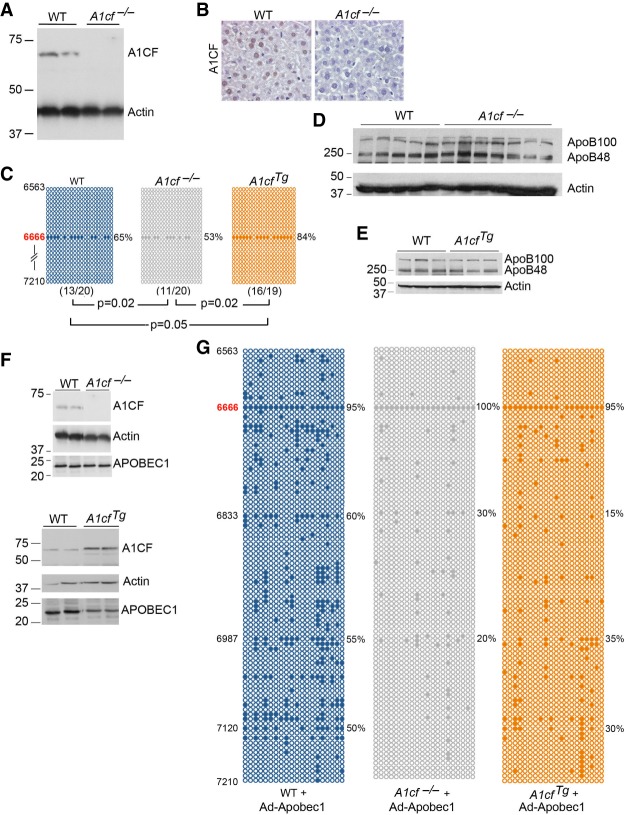
FIGURE 1. Alterations in hepatic A1CF expression produces only subtle changes in apoB RNA editing. (A) Hepatic expression of A1CF in wild-type (WT) and A1cf−/− mice. Actin was used as loading control. Molecular weights (kDa) are shown to the left. (B). Immunohistochemical detection of A1CF in WT livers showing nuclear localization of ACF and loss in A1cf−/− livers. (C) Hepatic apoB RNA editing by genotype. The region of apoB sequenced spans nucleotides 6563 to 7210. The data represent the average from three to four mice per genotype. Twenty clones were sequenced for each mouse. Positions of the edited cytidines are indicated on the left. Every circle represents a sequenced clone. Solid circles indicate C to U editing at the specified cytidine base, position indicated on the left. In all three genotypes, C to U editing is detected only at apoB canonical site C6666. Editing frequency (% edited clones at cytidine 6666) is indicated to the right. The numbers in parentheses under each panel represent the number of edited clones versus the total number of sequenced clones. The P-value under each panel indicates that editing at the canonical site of ApoB is statistically significant between A1cf−/− and WT liver; between A1cf−/− and A1cfTg; between A1cfTg and WT liver. Editing frequency at canonical C6666 editing site as mean ± SE: WT: 64 ± 4.2; A1cf−/− 53 ± 1.8; A1cfTg 84.5 ± 1.8. (D) Western blot detection of ApoB100 and ApoB48 in WT and A1cf−/− livers. Detection of Actin is used as loading control (n = 5–7 per genotype). (E) Western blot analysis of apoB100:B48 ratio in WT and transgenic A1CF liver (n = 3 per genotype). Actin is used as loading control. (F) A1CF and APOBEC1 expression in WT, A1cf−/−, and AcfTg mice injected with adenovirus-Apobec-1. Actin is used as loading control. (G) Hyperediting profile of hepatic ApoB RNA following adenoviral-expression of Apobec-1 in WT, A1cf−/− and A1cfTg mice. Representative data from three to four mice per genotype. Twenty clones per mouse were sequenced. Positions of the edited cytidines are indicated on the left. Editing frequencies at specific cytidine positions are shown to the right.
FIGURE 1. Alterations in hepatic A1CF expression produces only subtle changes in apoB RNA editing. (A) Hepatic expression of A1CF in wild-type (WT) and A1cf−/− mice. Actin was used as loading control. Molecular weights (kDa) are shown to the left. (B). Immunohistochemical detection of A1CF in WT livers showing nuclear localization of ACF and loss in A1cf−/− livers. (C) Hepatic apoB RNA editing by genotype. The region of apoB sequenced spans nucleotides 6563 to 7210. The data represent the average from three to four mice per genotype. Twenty clones were sequenced for each mouse. Positions of the edited cytidines are indicated on the left. Every circle represents a sequenced clone. Solid circles indicate C to U editing at the specified cytidine base, position indicated on the left. In all three genotypes, C to U editing is detected only at apoB canonical site C6666. Editing frequency (% edited clones at cytidine 6666) is indicated to the right. The numbers in parentheses under each panel represent the number of edited clones versus the total number of sequenced clones. The P-value under each panel indicates that editing at the canonical site of ApoB is statistically significant between A1cf−/− and WT liver; between A1cf−/− and A1cfTg; between A1cfTg and WT liver. Editing frequency at canonical C6666 editing site as mean ± SE: WT: 64 ± 4.2; A1cf−/− 53 ± 1.8; A1cfTg 84.5 ± 1.8. (D) Western blot detection of ApoB100 and ApoB48 in WT and A1cf−/− livers. Detection of Actin is used as loading control (n = 5–7 per genotype). (E) Western blot analysis of apoB100:B48 ratio in WT and transgenic A1CF liver (n = 3 per genotype). Actin is used as loading control. (F) A1CF and APOBEC1 expression in WT, A1cf−/−, and AcfTg mice injected with adenovirus-Apobec-1. Actin is used as loading control. (G) Hyperediting profile of hepatic ApoB RNA following adenoviral-expression of Apobec-1 in WT, A1cf−/− and A1cfTg mice. Representative data from three to four mice per genotype. Twenty clones per mouse were sequenced. Positions of the edited cytidines are indicated on the left. Editing frequencies at specific cytidine positions are shown to the right.CC BY-NC · PubMed Central
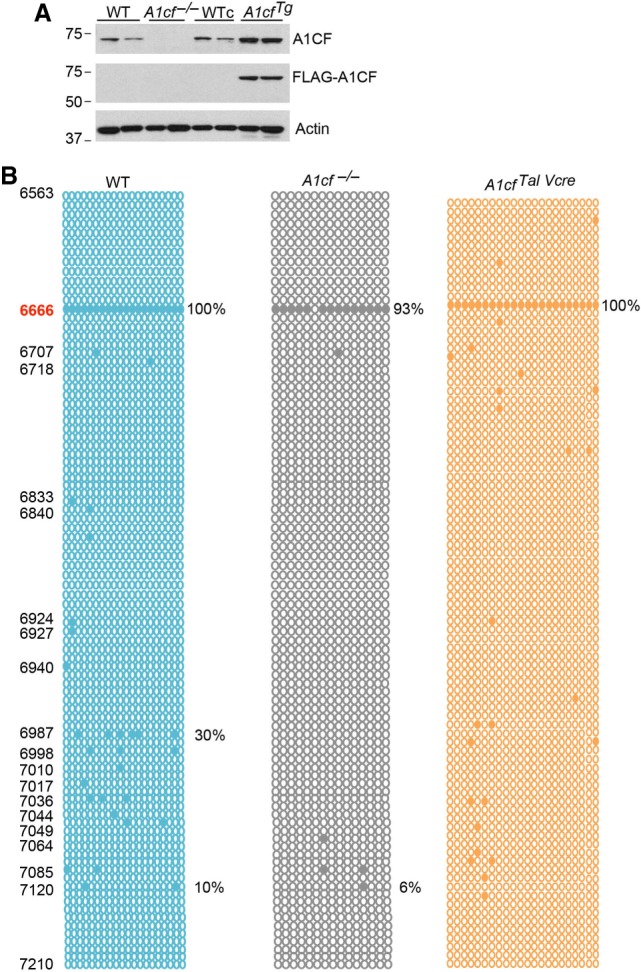
FIGURE 2. Neither A1cf deletion or overexpression in intestinal transgenic A1CF mice alter intestinal ApoB RNA editing. (A) Intestinal A1CF expression in WT, A1cf−/−, AcfTg and littermate controls (WTc). Transgenic A1CF expression detected using both anti-A1CF and anti-FLAG antibody. Detection of Actin is used as loading control. (B) Intestinal apoB RNA editing profile. The data represent the average from three mice per genotype, 15–22 clones were sequenced for each genotype. Solid circles identify clone with editing at the site indicated to the left.
FIGURE 2. Neither A1cf deletion or overexpression in intestinal transgenic A1CF mice alter intestinal ApoB RNA editing. (A) Intestinal A1CF expression in WT, A1cf−/−, AcfTg and littermate controls (WTc). Transgenic A1CF expression detected using both anti-A1CF and anti-FLAG antibody. Detection of Actin is used as loading control. (B) Intestinal apoB RNA editing profile. The data represent the average from three mice per genotype, 15–22 clones were sequenced for each genotype. Solid circles identify clone with editing at the site indicated to the left.CC BY-NC · PubMed Central
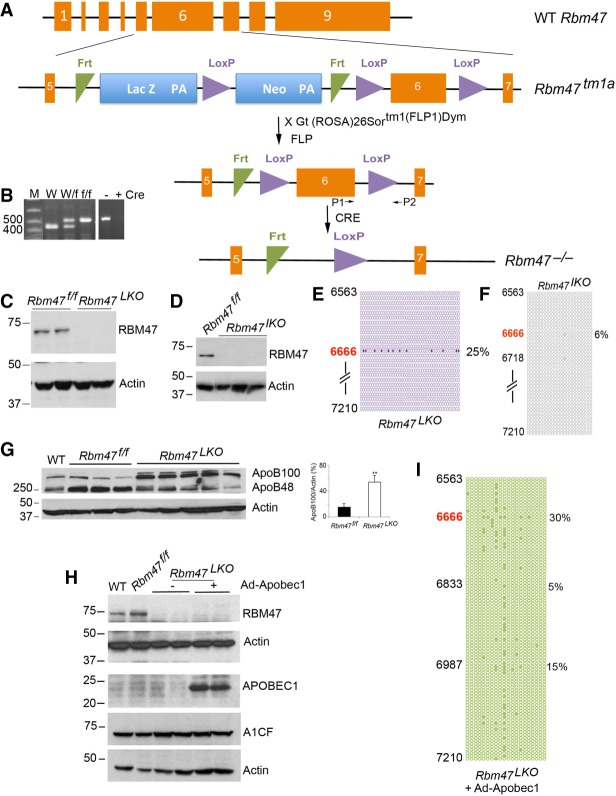
FIGURE 3. Generation and characterization of conditional Rbm47 knockout mice. (A) Endogenous mouse Rbm47 gene and targeting construct. Schematic illustration of genomic structure of Rbm47 allele containing nine exons (orange boxes). Schematic of Rbm47tm1a composition. (Numbered oranges boxes) Rbm47 exons; (blue boxes) Lac Z and neo cassettes; (green triangles) FRT sites; (purple triangles) LoxP sites. FLP recombination eliminates the LacZ and neo cassettes. Exon 6 containing transcriptional start codon and sequences encoding RNA recognition motifs was targeted for Cre-dependent homologous recombination. (B) Representative DNA electrophoresis showing genotype of WT and targeted alleles using primers P1 and P2 surrounding the 3′arm LoxP site. Analysis of the WT allele results in a 490 bp PCR product (lane 1) whereas recombination at the floxed allele generates a 530 bp product (f/f) (lane 3). Cre activation resuts in the loss of exon 6, evidenced by the absence of PCR amplification (lane 5). Molecular weights (bp) are indicated to the left. (C) Western blot detection of RBM47 in liver of floxed and Rbm47 liver-specific knockout (Rbm47LKO) mice with Actin used as loading control. (D) Western blot analysis of RBM47 in Rbm47IKO mice showing no detectable protein in intestinal nuclear extract. (E) Hepatic apoB RNA editing profile in Rbm47LKO mice, representative of three individual livers. Forty-two clones were sequenced, with each clone represented by a circle. Solid circles indicate editing at the specified position. We examined an apoB region encompassing nucleotides 6563–7210, with editing only at the canonical cytidine (6666) detected. (F) Intestinal apoB RNA editing profile in Rbm47IKO mice. Representative distribution of RNA editing sites from the same region (6563–7210) revealing only 2/19 clones exhibiting RNA editing. (G) Western blot analysis of hepatic apoB100 and apoB48 isoforms (three to five mice per genotype) with actin as loading control. (Panel to the right ) Quantitation of apoB100 isoform as a fraction of total apoB showing significant increase of apoB100 in liver of Rbm47LKO mice. (H) Western blot analysis of RBM47 and A1CF in Rbm47LKO mice at baseline and following adenoviral APOBEC1 overexpression. (I) Editing and hyperediting profile of hepatic apoB RNA following adenoviral overexpression of APOBEC1 in two Rbm47LKO mice. Representative distribution of edited sites from nucleotide 6563 to nucleotide 7210.
FIGURE 3. Generation and characterization of conditional Rbm47 knockout mice. (A) Endogenous mouse Rbm47 gene and targeting construct. Schematic illustration of genomic structure of Rbm47 allele containing nine exons (orange boxes). Schematic of Rbm47tm1a composition. (Numbered oranges boxes) Rbm47 exons; (blue boxes) Lac Z and neo cassettes; (green triangles) FRT sites; (purple triangles) LoxP sites. FLP recombination eliminates the LacZ and neo cassettes. Exon 6 containing transcriptional start codon and sequences encoding RNA recognition motifs was targeted for Cre-dependent homologous recombination. (B) Representative DNA electrophoresis showing genotype of WT and targeted alleles using primers P1 and P2 surrounding the 3′arm LoxP site. Analysis of the WT allele results in a 490 bp PCR product (lane 1) whereas recombination at the floxed allele generates a 530 bp product (f/f) (lane 3). Cre activation resuts in the loss of exon 6, evidenced by the absence of PCR amplification (lane 5). Molecular weights (bp) are indicated to the left. (C) Western blot detection of RBM47 in liver of floxed and Rbm47 liver-specific knockout (Rbm47LKO) mice with Actin used as loading control. (D) Western blot analysis of RBM47 in Rbm47IKO mice showing no detectable protein in intestinal nuclear extract. (E) Hepatic apoB RNA editing profile in Rbm47LKO mice, representative of three individual livers. Forty-two clones were sequenced, with each clone represented by a circle. Solid circles indicate editing at the specified position. We examined an apoB region encompassing nucleotides 6563–7210, with editing only at the canonical cytidine (6666) detected. (F) Intestinal apoB RNA editing profile in Rbm47IKO mice. Representative distribution of RNA editing sites from the same region (6563–7210) revealing only 2/19 clones exhibiting RNA editing. (G) Western blot analysis of hepatic apoB100 and apoB48 isoforms (three to five mice per genotype) with actin as loading control. (Panel to the right ) Quantitation of apoB100 isoform as a fraction of total apoB showing significant increase of apoB100 in liver of Rbm47LKO mice. (H) Western blot analysis of RBM47 and A1CF in Rbm47LKO mice at baseline and following adenoviral APOBEC1 overexpression. (I) Editing and hyperediting profile of hepatic apoB RNA following adenoviral overexpression of APOBEC1 in two Rbm47LKO mice. Representative distribution of edited sites from nucleotide 6563 to nucleotide 7210.CC BY-NC · PubMed Central
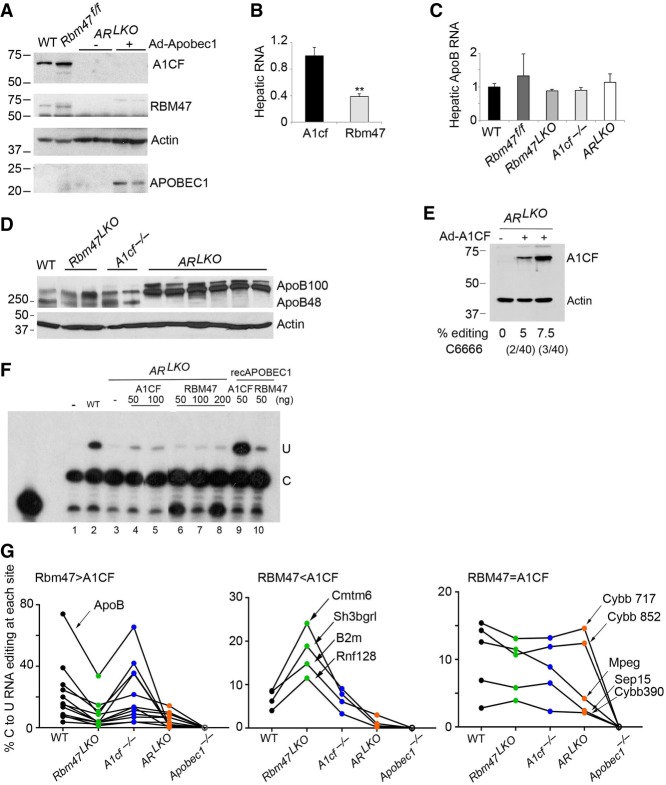
FIGURE 4. Combined hepatic deletion of A1cf and Rbm47 in double knockout (ARLKO) liver eliminates apoB RNA editing. (A) Western blot analysis of A1CF, RBM47, and APOBEC1 in livers of ARLKO mice, with or without Ad-Apobec1. Actin was used as a loading control. (B) Quantitative PCR analysis of hepatic A1cf and Rbm47 RNAs demonstrating greater A1cf mRNA abundance versus Rbm47 RNA. Data represents mean ± SE of four to five mice per genotype. (**) P-value < 0.01. (C) Quantitative PCR analysis of hepatic apoB RNA, showing no differences by genotype (mean ± SE of three to four mice per genotype). (D) Western blot of hepatic apoB protein in Rbm47LKO, A1cf−/−, and ARLKO mice. Actin was used as a loading control. (E) Western blot detection of FLAG-A1CF following adenovirus A1CF administration to ARLKO mice. The calculated percent C-to-U apoB RNA editing indicates apoB editing frequency at the canonical site C6666. Parentheses indicate number of clones containing the edited site vs. the total number of sequenced clones. (F) In vitro apoB RNA editing assay using liver S100 extracts (lane 1 negative control contains primer and bovine serum albumin only) prepared from either WT mice (lane 2), or from ARLKO mice (lanes 3–8), or using recombinant (rec) APOBEC1 (lanes 9,10), supplemented where indicated with recombinant A1CF (lanes 4,5) or RBM47 (lanes 6–8). ApoB RNA editing was determined by poison primer extension (Materials and Methods). The relative mobility of the unedited (C) and the edited (U) C6666 is indicated to the right. Representative of three independent assays. (G) Baseline hepatic editing efficiency of 3′UTR APOBEC1 RNA targets and hierarchy of RNA binding complementation factors (see Table 1 for data). Wild-type (black dots), Rbm47LKO (green dots), A1cf−/− (blue dots), ARLKO (orange dots), and Apobec1−/− (white dots). RNAs preferentially edited by RBM47 show decreased editing efficiency in Rbm47LKO and ARLKO and no change in A1cf−/−. In contrast, RNAs preferentially edited by A1CF show no change in the absence of A1CF but increased editing frequency in the absence of RBM47 and almost complete loss of editing in the absence of both A1CF and RBM47.
FIGURE 4. Combined hepatic deletion of A1cf and Rbm47 in double knockout (ARLKO) liver eliminates apoB RNA editing. (A) Western blot analysis of A1CF, RBM47, and APOBEC1 in livers of ARLKO mice, with or without Ad-Apobec1. Actin was used as a loading control. (B) Quantitative PCR analysis of hepatic A1cf and Rbm47 RNAs demonstrating greater A1cf mRNA abundance versus Rbm47 RNA. Data represents mean ± SE of four to five mice per genotype. (**) P-value < 0.01. (C) Quantitative PCR analysis of hepatic apoB RNA, showing no differences by genotype (mean ± SE of three to four mice per genotype). (D) Western blot of hepatic apoB protein in Rbm47LKO, A1cf−/−, and ARLKO mice. Actin was used as a loading control. (E) Western blot detection of FLAG-A1CF following adenovirus A1CF administration to ARLKO mice. The calculated percent C-to-U apoB RNA editing indicates apoB editing frequency at the canonical site C6666. Parentheses indicate number of clones containing the edited site vs. the total number of sequenced clones. (F) In vitro apoB RNA editing assay using liver S100 extracts (lane 1 negative control contains primer and bovine serum albumin only) prepared from either WT mice (lane 2), or from ARLKO mice (lanes 3–8), or using recombinant (rec) APOBEC1 (lanes 9,10), supplemented where indicated with recombinant A1CF (lanes 4,5) or RBM47 (lanes 6–8). ApoB RNA editing was determined by poison primer extension (Materials and Methods). The relative mobility of the unedited (C) and the edited (U) C6666 is indicated to the right. Representative of three independent assays. (G) Baseline hepatic editing efficiency of 3′UTR APOBEC1 RNA targets and hierarchy of RNA binding complementation factors (see Table 1 for data). Wild-type (black dots), Rbm47LKO (green dots), A1cf−/− (blue dots), ARLKO (orange dots), and Apobec1−/− (white dots). RNAs preferentially edited by RBM47 show decreased editing efficiency in Rbm47LKO and ARLKO and no change in A1cf−/−. In contrast, RNAs preferentially edited by A1CF show no change in the absence of A1CF but increased editing frequency in the absence of RBM47 and almost complete loss of editing in the absence of both A1CF and RBM47.CC BY-NC · PubMed Central
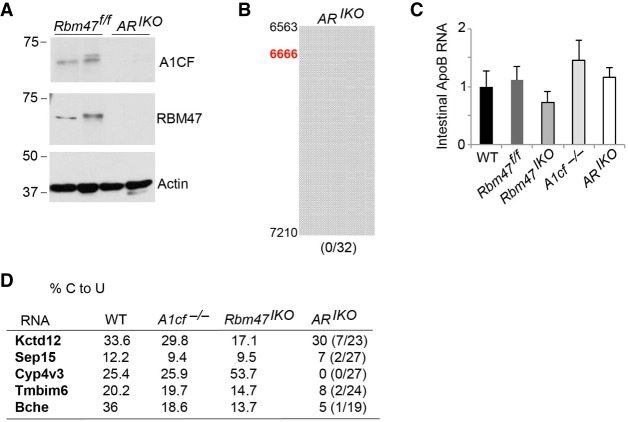
FIGURE 5. Combined intestinal deletion of A1cf and Rbm47 in double knockout (ARIKO) mice eliminates apoB RNA editing and reduces C-to-U editing activity in four of five residual targets from Rbm47IKO mice. (A) Western blot analysis of intestinal A1CF and RBM47 in ARIKO mice. Actin was used as a loading control. (B) Intestinal apoB RNA editing is eliminated in ARIKO mice. Data are representative of four individual animals. Open circles represent individual clones (total of 32 clones sequenced) in the region spanning nucleotides 6563 to 7210. (C) Quantitative PCR analysis of intestinal apoB RNA showing no differences by genotype, from representative mice (n = 3–4 per genotype). (D) Baseline editing efficiency of the subset of intestine 3′UTR APOBEC1 RNA targets that revealed residual editing activity in Rbm47IKO mice. Data are indicated as percentage of edited clones with numbers in parentheses indicating edited versus total number of sequenced clones.
FIGURE 5. Combined intestinal deletion of A1cf and Rbm47 in double knockout (ARIKO) mice eliminates apoB RNA editing and reduces C-to-U editing activity in four of five residual targets from Rbm47IKO mice. (A) Western blot analysis of intestinal A1CF and RBM47 in ARIKO mice. Actin was used as a loading control. (B) Intestinal apoB RNA editing is eliminated in ARIKO mice. Data are representative of four individual animals. Open circles represent individual clones (total of 32 clones sequenced) in the region spanning nucleotides 6563 to 7210. (C) Quantitative PCR analysis of intestinal apoB RNA showing no differences by genotype, from representative mice (n = 3–4 per genotype). (D) Baseline editing efficiency of the subset of intestine 3′UTR APOBEC1 RNA targets that revealed residual editing activity in Rbm47IKO mice. Data are indicated as percentage of edited clones with numbers in parentheses indicating edited versus total number of sequenced clones.CC BY-NC · PubMed Central

Verification

Claims the paper makes

The claims and statistics of this paper haven’t been checked yet.

Run the check — free, no account needed. It reads the open-access text and checks the sources it cites.

A few free checks a day · papers already verified open instantly · results are public

Claims other papers make about this one

Each is checked against this paper’s own text: does it say what the citing paper says it does?

Self-check

Percentages, sums and reported differences re-computed from the paper’s own numbers.

The self-check needs the paper’s full text.

Citations

Cites

No references could be resolved yet.

Research works printed but not linked: 45

  1. 10.1016/S0079-6603(03)75001-6 · DOI
  2. 10.1002/wsbm.82 · DOI
  3. 10.1007/978-1-61779-018-8_7 · DOI
  4. 10.1074/jbc.M107654200 · DOI
  5. 10.1128/MCB.25.16.7260-7269.2005 · DOI
  6. 10.1074/jbc.M110.115147 · DOI
  7. 10.1186/gb-2014-15-6-r79 · DOI
  8. 10.1126/science.3659919 · DOI
  9. 10.1261/rna.7490704 · DOI
  10. 10.1073/pnas.1710493114 · DOI
  11. 10.1128/MCB.13.12.7288 · DOI
  12. 10.1002/gene.20042 · DOI
  13. 10.15252/embr.201438450 · DOI · Paper page
  14. 10.1016/j.molmed.2018.01.002 · DOI
  15. 10.1016/j.bbrc.2009.11.116 · DOI
  16. 10.1016/j.bbrc.2010.06.021 · DOI
  17. 1995, Developmental regulation of the catalytic subunit of the apolipoprotein B mRNA editing enzyme (APOBEC-1) in human small intestine, J Lipid Res, 36, 1664, 10.1016/S0022-2275(20)41486-5 · DOI
  18. 10.1074/jbc.271.17.9887 · DOI
  19. 1992, Apolipoprotein B messenger RNA editing in rat liver: Developmental and hormonal modulation is divergent from apolipoprotein A-IV gene expression despite increased hepatic lipogenesis, J Lipid Res, 33, 1843, 10.1016/S0022-2275(20)41342-2 · DOI
  20. 1994, REPR and complementation factor(s) interact to modulate rat apolipoprotein B mRNA editing in response to alterations in cellular cholesterol flux, J Lipid Res, 35, 1477, 10.1016/S0022-2275(20)40089-6 · DOI
  21. 10.1261/rna.060921.117 · DOI
  22. 10.1089/hum.1996.7.8-943 · DOI
  23. 1995, Ethanol modulates apolipoprotein B mRNA editing in the rat, J Lipid Res, 36, 2069
  24. 10.1093/nar/gkl417 · DOI
  25. 10.1074/jbc.M001786200 · DOI · Paper page
  26. 10.1038/srep20460 · DOI
  27. 10.1242/dev.063867 · DOI
  28. 10.1017/S1355838202015649 · DOI
  29. 10.1128/MCB.20.5.1846-1854.2000 · DOI
  30. 10.1128/MCB.00937-13 · DOI
  31. 10.1074/jbc.271.42.25981 · DOI
  32. 10.1146/annurev-biochem-060208-105251 · DOI · Paper page
  33. 10.1074/jbc.274.1.305 · DOI · Paper page
  34. 10.1016/0092-8674(87)90510-1 · DOI
  35. 10.1073/pnas.1714227114 · DOI
  36. 10.1007/s10162-003-4042-x · DOI
  37. 10.1038/nsmb.1975 · DOI · Paper page
  38. 10.1074/jbc.M116.719955 · DOI · Paper page
  39. 10.1261/rna.058818.116 · DOI
  40. 10.1074/jbc.271.6.3011 · DOI · Paper page
  41. 1996, Determinants involved in regulating the proportion of edited apolipoprotein B RNAs, RNA, 2, 274
  42. 10.18632/oncotarget.25469 · DOI
  43. 10.1016/S0006-291X(05)81023-X · DOI
  44. 1990, Apolipoprotein B messenger RNA editing is developmentally regulated and widely expressed in human tissues, J Biol Chem, 265, 20616, 10.1016/S0021-9258(17)30547-1 · DOI
  45. 10.1074/jbc.271.19.11506 · DOI

Cited by

Sorted by citations

Metadata

Authors
Blanc, V., Xie, Y., Kennedy, S., Riordan, J. D., Rubin, D. C., Madison, B. B., Mills, J. C., Nadeau, J. H., & Davidson, N. O.
Venue
RNA
Published
2018-10-11
Volume
25
Issue
1
Pages
70-81
ISSN
  • 1355-8382
  • 1469-9001
Cited by
48
References
0
Language
en
Funders
  • N.O.D (HL-38180, DK-56260, DK-112378)
  • D.C.R. (DK-106382 and, DK-112378)
  • Alvin J. Siteman Cancer Center (DK094989, DK105129, DK110406)
  • Barnes Jewish Hospital Foundation Cancer Frontier Fund
  • National Institutes of Health NCI (P30 CA091842)
  • The Barnard Trust (DK-093885, DK-108764, DK-052574)
  • Siteman Cancer Center
  • Cancer Research Foundation (DP 1HD-075624, F32 DK-109651)
  • Washington University DDRCC (DK-52574)

About these checks

Registry, retraction, Cites and statistics results are computed, not judged, with one exception: a printed reference that no index lists is read once by a model before it counts as a citation error. Claims are extracted by a model and kept only when their quote appears verbatim in the text; each cited source is then checked, with a model’s help, for whether it says what the claim relies on. Those verdicts can be wrong — read the claim’s quote and the cited source before relying on one.

Statistics and arithmetic are recomputed, not judged.

Confidence bands are shown only for fields calibrated on our annotated test set. None is calibrated yet, so no band is shown.

What counts as a claim ›How we measure confidence ›How we check this ›

Are you an author, or do you see a problem with this page? Request a review