

The DOI matches its Crossref record; 5 of the 5 references it cites were found in a registry or an index.
Endosomal escape of RNA therapeutics: How do we solve this rate-limiting problem?
Abstract
With over 15 FDA approved drugs on the market and numerous ongoing clinical trials, RNA therapeutics, such as small interfering RNAs (siRNAs) and antisense oligonucleotides (ASOs), have shown great potential to treat human disease. Their mechanism of action is based entirely on the sequence of validated disease-causing genes without the prerequisite knowledge of protein structure, activity or cellular location. In contrast to small molecule therapeutics that passively diffuse across the cell membrane's lipid bilayer, RNA therapeutics are too large, too charged, and/or too hydrophilic to passively diffuse across the cellular membrane and instead are taken up into cells by endocytosis. However, endosomes are also composed of a lipid bilayer barrier that results in endosomal capture and retention of 99% of RNA therapeutics with 1% or less entering the cytoplasm. Although this very low level of endosomal escape has proven sufficient for liver and some CNS disorders, it is insufficient for the vast majority of extra-hepatic diseases. Unfortunately, there are currently no acceptable solutions to the endosomal escape problem. Consequently, before RNA therapeutics can be used to treat widespread human disease, the rate-limiting delivery problem of endosomal escape must be solved in a nontoxic manner.
Overview
The claims and statistics of this paper haven’t been checked yet.
Run the check — free, no account needed. It reads the open-access text and checks the sources it cites.
Integrity signals
Registry
Cites
Statistics
Figures
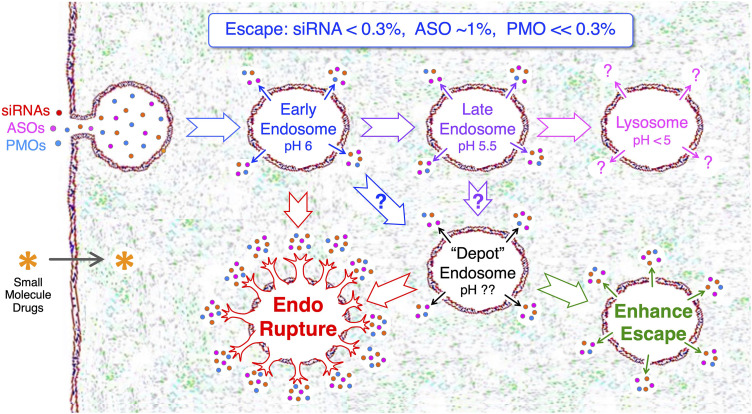
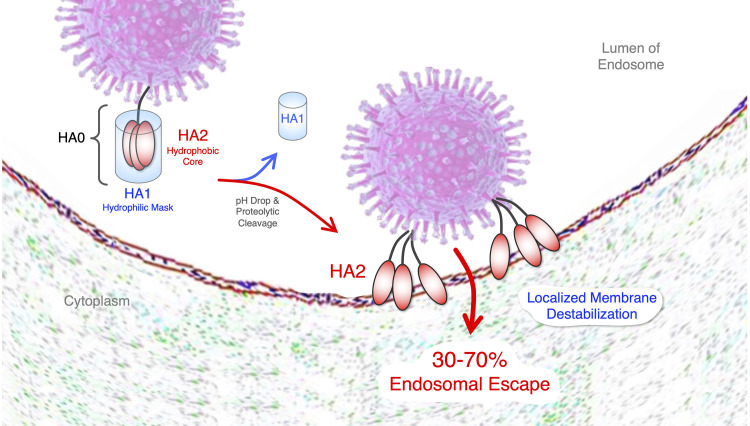
Verification
Claims the paper makes
The claims and statistics of this paper haven’t been checked yet.
Run the check — free, no account needed. It reads the open-access text and checks the sources it cites.
Claims other papers make about this one
Each is checked against this paper’s own text: does it say what the citing paper says it does?
In the citing paper
“which in turn is only possible if endocytosed miRNAs have crossed the endosomal lipid bilayer barrier to enter the cytoplasm, which is considered a major hurdle [88].”
From Neurodegenerative disease-associated microRNAs acting as signaling molecules modulate CNS neuron structure and viability (2025) · cites this paper as [88]
Self-check
Percentages, sums and reported differences re-computed from the paper’s own numbers.
The self-check needs the paper’s full text.
Citations
Cites
Wadia, J. S., Stan, R. V., & Dowdy, S. F. (2004) · Nature Medicine · doi:10.1038/nm996 · Cited by 1,647
Self-citationOvercoming cellular barriers for RNA therapeutics
Dowdy, S. F. (2017) · Nature Biotechnology · doi:10.1038/nbt.3802 · Cited by 1,139
Self-citationA highly durable RNAi therapeutic inhibitor of PCSK9
Fitzgerald, K., White, S., Borodovsky, A., Bettencourt, B. R., Strahs, A., Clausen, V., Wijngaard, P., Horton, J. D., Taubel, J., Brooks, A., et al. (2017) · New England Journal of Medicine · doi:10.1056/nejmoa1609243 · Cited by 768
Visualizing lipid-formulated siRNA release from endosomes and target gene knockdown
Wittrup, A., Ai, A., Liu, X., Hamar, P., Trifonova, R., Charisse, K., Manoharan, M., Kirchhausen, T., & Lieberman, J. (2015) · Nature Biotechnology · doi:10.1038/nbt.3298 · Cited by 693
Expanding RNAi therapeutics to extrahepatic tissues with lipophilic conjugates
Brown, K. M., Nair, J. K., Janas, M. M., Anglero-Rodriguez, Y. I., Dang, L. T. H., Peng, H., Theile, C. S., Castellanos-Rizaldos, E., Brown, C., Foster, D., et al. (2022) · Nature Biotechnology · doi:10.1038/s41587-022-01334-x · Cited by 258 · cited 2×
“The conjugation ofmore hydrophobicity to both ASOs and siRNAs, such as cholesterol or lipids, results in both semiselective delivery to tissues, especially the liver and neurons of the CNS likely due to insertion into LDL particles, and an enhanced endosomal escape (Soutschek et al. 2004; Biscans et al. 2019; Wang et…”
Background
Research works printed but not linked: 25
- 10.1093/nar/gky1239 · DOI
- 10.1093/nar/gkaa670 · DOI · Paper page
- 10.1093/nar/gky1158 · DOI · Paper page
- 10.1016/j.bpj.2016.02.006 · DOI
- 10.1089/nat.2021.0085 · DOI
- 10.1038/s41573-021-00162-z · DOI · Paper page
- 10.1089/nat.2022.0004 · DOI
- 10.1073/pnas.94.20.10699 · DOI
- 10.1016/j.omtn.2022.08.019 · DOI
- 10.1073/pnas.1605731113 · DOI
- 10.15252/emmm.202013243 · DOI
- 10.1093/nar/gkaa1112 · DOI
- 2001, Synthetic protein transduction domains: enhanced transduction potential in vitro and in vivo, Cancer Res, 61, 474
- 10.1016/j.biotechadv.2015.05.005 · DOI
- 10.1089/nat.2018.0727 · DOI
- 10.3390/biomedicines9050512 · DOI
- 10.1093/nar/gkx1320 · DOI
- 10.1038/nbt.3765 · DOI · Paper page
- 10.1016/j.bpj.2011.12.037 · DOI
- 10.1016/j.ddtec.2004.11.007 · DOI
- 10.1038/srep32301 · DOI
- 10.1074/jbc.M200429200 · DOI
- 10.1038/nature03121 · DOI
- 10.1242/jcs.216259 · DOI
- 10.1089/nat.2019.0794 · DOI
Cited by
Sorted by citations
Kumbol, V., Ivanov, A., McGurran, H., Schüler, J., Zhai, Y., Ludwik, K., Hinkelmann, L., Brehm, M., Krüger, C., Küchler, J., et al. (2025) · Cell Communication and Signaling · doi:10.1186/s12964-025-02199-8 · Cited by 8
Metadata
- Authors
- Dowdy, S. F.
- Venue
- RNA
- Publisher
- Cold Spring Harbor Laboratory
- Published
- 2023-01-20
- Volume
- 29
- Issue
- 4
- Pages
- 396-401
- ISSN
- 1355-8382
- 1469-9001
- PMC
- PMC10019367
- Cited by
- 171
- References
- 5
- Language
- en
- Funders
- ASAP
- National Institutes of Health
- an Epstein Family Alzheimer’ Research Collaboration Award
About these checks
Registry, retraction, Cites and statistics results are computed, not judged, with one exception: a printed reference that no index lists is read once by a model before it counts as a citation error. Claims are extracted by a model and kept only when their quote appears verbatim in the text; each cited source is then checked, with a model’s help, for whether it says what the claim relies on. Those verdicts can be wrong — read the claim’s quote and the cited source before relying on one.
Statistics and arithmetic are recomputed, not judged.
Confidence bands are shown only for fields calibrated on our annotated test set. None is calibrated yet, so no band is shown.
What counts as a claim ›How we measure confidence ›How we check this ›
Are you an author, or do you see a problem with this page? Request a review
