

Inhibition of Proliferation of Colorectal Cancer Cells by Phenolic Extracts of Mandarin (Citrus reticulate) and Lime (Citrus aurantifolia) Fruit Waste
Open accessThe DOI matches its Crossref record; 19 of the 19 references it cites were found in a registry or an index.
Abstract
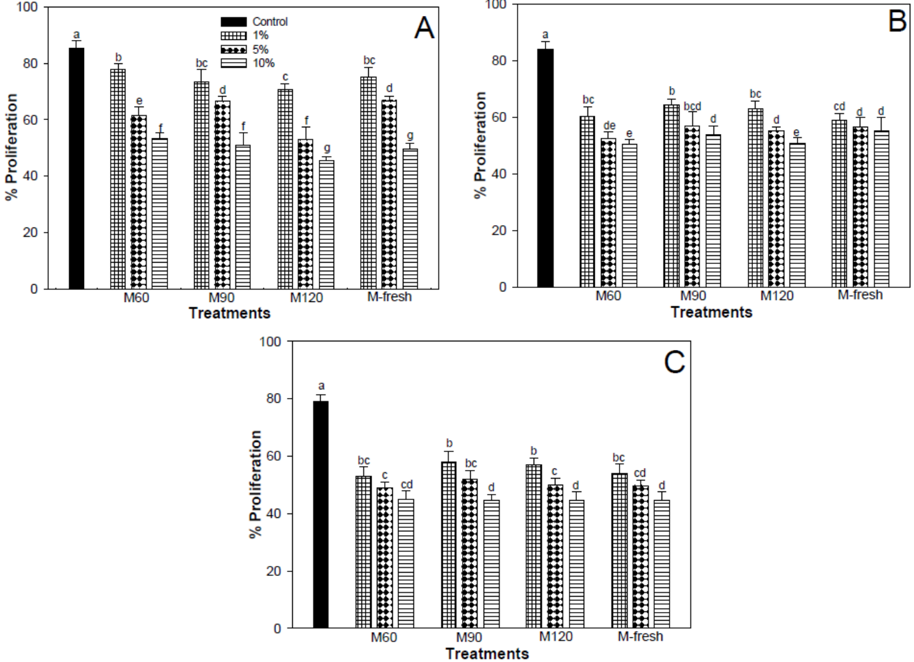
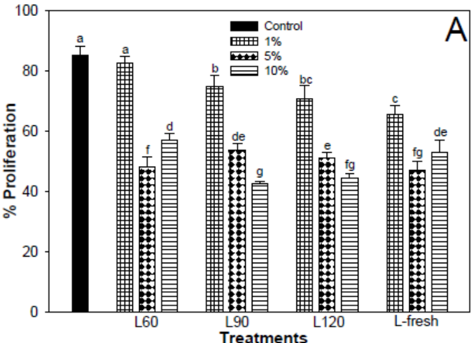
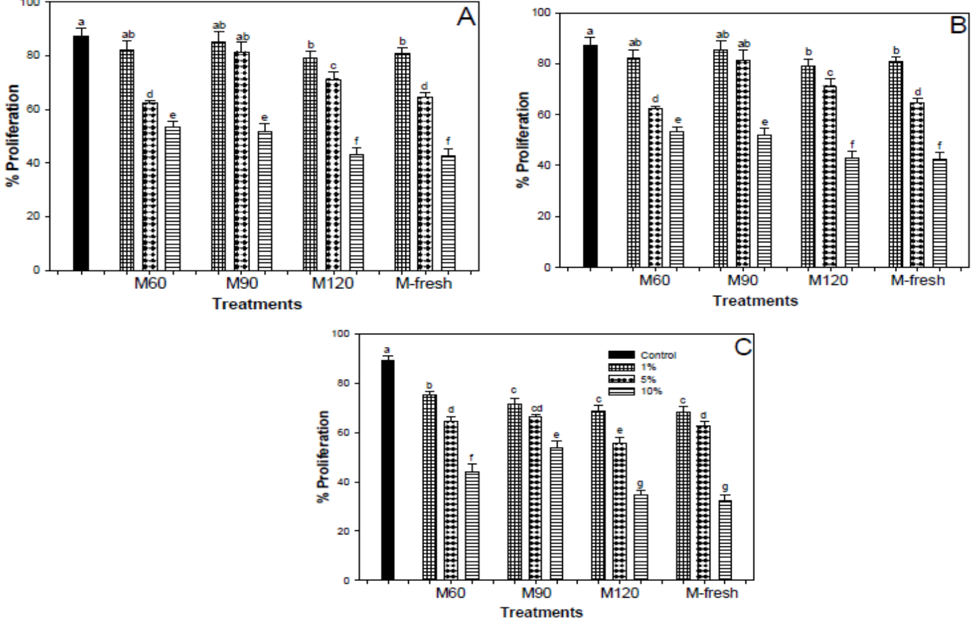
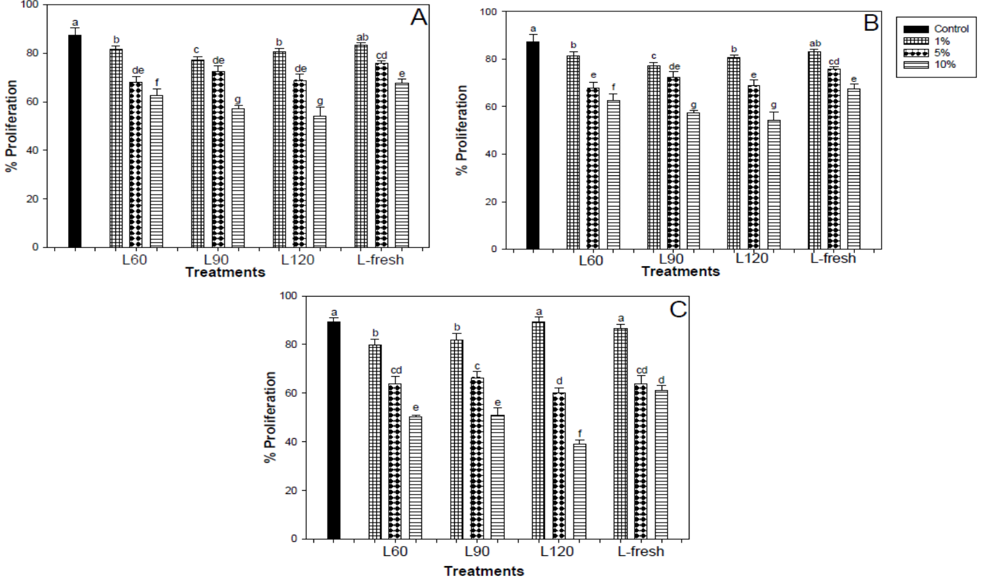
Several epidemiological studies have suggested that phenolics have antineoplastic activities. The objective of this study was to determine the antiproliferative effect of rich phenolics extracts of mandarin (Citrus reticulate) and lime (Citrus aurantifolia) fruit waste in colorectal cancer cells, RKO (carcinom) and HT-29 (adenocarcinom). Antiproliferative effect was evaluated using the methylthiazolydiphenyl-tetrazolium bromide (MTT) assay and testing phenolics extracts from different mandarin and lime fruit waste drying temperatures (fresh, 60, 90, 120ºC), at different times (24, 48 and 72 h). Mandarin and lime phenolics extracts inhibit cell viability of colon cancer cell lines, HT-29 and RKO, at 24 h to 72 h. Results suggested that phenolics extracts had different action mechanisms on each type of cells and therefore, more studies were required to elucidate such mechanisms.
Overview
The claims and statistics of this paper haven’t been checked yet.
Free: it reads the open-access text and checks the first 5 claims that cite a source we can check. Create a free account to check every claim.
Integrity signals
Registry
Cites
Statistics
Figures
Verification
Claims the paper makes
The claims and statistics of this paper haven’t been checked yet.
Free: it reads the open-access text and checks the first 5 claims that cite a source we can check. Create a free account to check every claim.
Claims other papers make about this one
Each is checked against this paper’s own text: does it say what the citing paper says it does?
The source backs part of the claim, not all of it — or backs it for a different population, condition or comparison.
In the citing paper
“Numerous other studies have focused on the valorisation of TPW, PPW and BPW for the production of value-added products (essential oil, enzymes, food, medical and cosmetic products) [[27], [28], [29], [30], [31], [32], [33], [34], [35], [36], [37]]”
From Tangerine, banana and pomegranate peels valorisation for sustainable environment: A review (2021) · cites this paper as [29]
Experimental — accuracy not yet measuredThe source backs part of the claim, not all of it — or backs it for a different population, condition or comparison.
In the citing paper
“Phenolic extract of TPW inhibits proliferation of colorectal cancer cells [29].”
From Tangerine, banana and pomegranate peels valorisation for sustainable environment: A review (2021) · cites this paper as [29]
Experimental — accuracy not yet measured
Self-check
Percentages, sums and reported differences re-computed from the paper’s own numbers.
The self-check needs the paper’s full text.
Citations
Cites
Prooxidant States and Tumor Promotion
Cerutti, P. A. (1985) · Science · doi:10.1126/science.2981433 · Cited by 2,497 · cited 1×
“These antioxidants induce cell differentiation, repair damaged DNA, inhibit gene mutation, and activate tumor-suppressive genes [9].”
BackgroundDietary flavonoids: Effects on xenobiotic and carcinogen metabolism
Moon, Y. J., Wang, X., & Morris, M. E. (2006) · Toxicology in Vitro · doi:10.1016/j.tiv.2005.06.048 · Cited by 869
Reactive oxygen species, aging and antioxidative nutraceuticals
Lee, J., Koo, N., & Min, D. B. (2004) · Comprehensive Reviews in Food Science and Food Safety · doi:10.1111/j.1541-4337.2004.tb00058.x · Cited by 864 · cited 1×
“Recent research studies established that if oxidative stress, generated by an overproduction of free radicals, is excessive, and DNA repairing systems are surpassed, a mutagenesis and carcinogenesis could be promoted [2].”
BackgroundDietary Antioxidants and Human Cancer
Borek, C. (2004) · Integrative Cancer Therapies · doi:10.1177/1534735404270578 · Cited by 302 · cited 1×
“The beneficial effect of diets rich in fruits and vegetables is attributed mainly to bioactive components (BC), such as carotenoids, phenolic compounds, flavonoids, vitamins C and E, that increases antioxidant, antimicrobial and antineoplastic capacities [5,6,7].”
BackgroundApoptotic effect of hesperidin through caspase3 activation in human colon cancer cells, SNU-C4
Park, H. J., Kim, M.-J., Ha, E., & Chung, J.-H. (2008) · Phytomedicine · doi:10.1016/j.phymed.2007.07.061 · Cited by 227
Corral-Aguayo, R. D., Yahia, E. M., Carrillo-Lopez, A., & González-Aguilar, G. (2008) · Journal of Agricultural and Food Chemistry · doi:10.1021/jf801983r · Cited by 224 · cited 1×
“The kind and concentrations of phenolics in the extracts were determined previously according to method [16] and published previously by Esparza-Martínez [17].”
MethodQuantitation of bioactive compounds in citrus fruits cultivated in Taiwan
Wang, Y.-C., Chuang, Y.-C., & Ku, Y.-H. (2007) · Food Chemistry · doi:10.1016/j.foodchem.2006.06.057 · Cited by 217 · cited 1×
“Mandarin and lime are not climacteric tropical fruits that has diverse BC that give the fruit several antioxidant properties [11].”
BackgroundSakata, K., Hirose, Y., Zheng, Q., Tanaka, T., & Mori, H. (2003) · Cancer Letters · doi:10.1016/s0304-3835(03)00386-0 · Cited by 146 · cited 1×
“In a study [20], they found that hesperidin as a COX-2 and iNOS inhibitor, which might be related to the anti-tumorigenic efficacies.”
BackgroundREDOX REGULATION BY INTRINSIC SPECIES AND EXTRINSIC NUTRIENTS IN NORMAL AND CANCER CELLS
McEligot, A. J., Yang, S., & Meyskens, Jr. (2005) · Annual Review of Nutrition · doi:10.1146/annurev.nutr.25.050304.092633 · Cited by 144 · cited 1×
“The beneficial effect of diets rich in fruits and vegetables is attributed mainly to bioactive components (BC), such as carotenoids, phenolic compounds, flavonoids, vitamins C and E, that increases antioxidant, antimicrobial and antineoplastic capacities [5,6,7].”
BackgroundThe Contribution of Fruit and Vegetable Consumption to Human Health
Yahia, E. M. (2009) · Fruit and Vegetable Phytochemicals · doi:10.1002/9780813809397.ch1 · Cited by 116 · cited 1×
“Several studies have suggested that the consumption of fruits and vegetables could reduce the risk of many chronic diseases and have a protective effect against certain types of cancer [3].”
BackgroundPoulose, S. M., Harris, E. D., & Patil, B. S. (2006) · Nutrition and Cancer · doi:10.1207/s15327914nc5601_14 · Cited by 112 · cited 1×
“Additionally, a panel of experts concluded that an inverse association of phenolics with the risk of colorectal cancer is possible due to their antioxidant properties [10].”
BackgroundIdentification of bioactive composition and antioxidant activity in young mandarin fruits
Ye, X., Chen, J., Liu, D., Jiang, P., Shi, J., Xue, S. J., Wu, D., Xu, J., & Kakuda, Y. (2010) · Food Chemistry · doi:10.1016/j.foodchem.2010.08.013 · Cited by 94 · cited 1×
“After incubation, the samples were centrifuged at 5000 rpm for 10 min [14].”
MethodEffect of flavonone hesperidin on the apoptosis of human mammary carcinoma cell line MCF-7
Nandakumar, N., Thamaraiselvan, R., Haribabu, L., Srinivasan, P., & Balasubramanian, M. P. (2011) · Biomedicine & Preventive Nutrition · doi:10.1016/j.bionut.2011.07.001 · Cited by 82 · cited 1×
“[19], purified hesperidin orange peel and it showed that there was inhibition of cell proliferation of MCF-7 breast cancer, they used concentrations of 20, 40, 60, 80 and 100 mM of the purified hesperidin and placed in interaction by a dose-response and found they had a median lethal dose of 80 mM at 24 h and 60 mM fo…”
MethodPatil, J. R., Jayaprakasha, G. K., Murthy, K. N. C., Chetti, M. B., & Patil, B. S. (2009) · Microchemical Journal · doi:10.1016/j.microc.2009.09.008 · Cited by 76 · cited 1×
“[21] demonstrated that apoptosis is a major cause for inhibition of proliferation of pancreatic cancer cell line Pac-28 a flavanone (Limonin) in Citrus aurantifolia using a concentration of 6.”
García‐Solís, P., Yahia, E. M., Morales‐Tlalpan, V., & Díaz‐Muñoz, M. (2009) · International Journal of Food Sciences and Nutrition · doi:10.1080/09637480802312922 · Cited by 67 · cited 1×
“The antiproliferative activity of phenolics extracts of MW and LW at four different dryer temperatures in RKO and in HT-29 cells, was measured using 3-(4, 5dimethylthiazol-2-yl)-2, 5-diphenyltetrazolium bromide (MTT) assay, as previously described [15], with some modifications.”
MethodEsparza-Martínez, F. J., Miranda‐López, R., & Guzmán-Maldonado, S. H. (2016) · Industrial Crops and Products · doi:10.1016/j.indcrop.2016.01.043 · Cited by 65 · cited 2×
“Keywords: antiproliferative activity, colorectal cancer, phenolic compounds Cite This Article: Francisco J Esparza-Martínez, Pablo García Solis, Rita Miranda-López, and Vicente Peña-Caballero, “Inhibition of Proliferation of Colorectal Cancer Cells by Phenolic Extracts of Mandarin (Citrus reticulate) and Lime (Citrus…”
MethodSelf-citationAntioxidative and anti-inflammatory properties of Citrus sulcata extracts
Wang, A.-Y., Zhou, M.-Y., & Lin, W.-C. (2010) · Food Chemistry · doi:10.1016/j.foodchem.2010.07.035 · Cited by 61 · cited 1×
“[23], used peel of Citrus sulcata where extracted naringin and hesperidin, identified inhibition of proliferation with a median lethal dose at a concentration of 250 μM, the extract was tested on a lung cancer cell line A549, they attribute to hesperidin and naringin positively regulate many genes involved in the cell…”
MethodSequetto, P. L., de Oliveira, T. T., Maldonado, I. R. S. C., Augusto, L. E. F., de Mello, V. J., Pizziolo, V. R., de Almeida, M. R., Silva, M. E., & Novaes, R. D. (2013) · Food and Chemical Toxicology · doi:10.1016/j.fct.2013.11.032 · Cited by 43 · cited 1×
“These include d-limonene [25], naringin, diosmin [26], and limonin [27].”
BackgroundMurakami, A., Wada, K., Ueda, N., Sasaki, K., Haga, M., Kuki, W., Takahashi, Y., Yonei, H., Koshimįzu, K., & Ohigashi, H. (2000) · Nutrition and Cancer · doi:10.1207/s15327914nc3602_8 · Cited by 36 · cited 1×
“Some of these can modify activities and expression of the detoxifying enzymes and CYPs [28].”
Background
Research works printed but not linked: 5
- Gonzalez-Aguilar, G.A., Celis, J., Sotelo-Mundo, R.R., De La Rosa, L.A., Rodrigo-García, J. and Alvarez-Parrilla, E. "Physiological and Biochemical Changes of Different Fresh-Cut Mango Cultivars Stored at 5˚C, International Journal of Food Science and Technology, 43, 91-101. 2008.
- Yang, C.S., Landau, J.M., Huang, M.T. and Newmark, H.L. "Inhibition of Carcinogenesis by dietary polyphenolic compounds", Annual Review of Nutrition, 21, 381-406. 2001.
- Tanaka, T., Tanaka, T., Tanaka, M. and Kuno, T. "Cancer Chemoprevention by Citrus Pulp and juice Containing High Amounts of β-Cryptoxanthin and Hesperidin", Journal of Biomedicine and Biotechnology, 1, 1-10. 2012.
- Tanaka, T., Maeda, M., Kohno, H., Murakami, M., Kagami, S., Miyake, M. and Wada, K. "Inhibition of azoxymethane-induced colon carcinogenesis in male F344 rats by the citrus limonoides, obacunone and limonin", Carcinogenesis, 22 (1), 193-198. 2000.
- Tanaka, T., Tanaka, T., Tanaka, M. and Keno, T. "Cancer Chemoprevention by Citrus Pulp and Juices Containing High Amounts of β-Cryptoxanthin and Hesperidin", Journal of Biomedicine and Biotechnology, 1, 1-10. 2012.
Cited by
Tangerine, banana and pomegranate peels valorisation for sustainable environment: A review
El Barnossi, A., Moussaid, F., & Iraqi Housseini, A. (2021) · Biotechnology Reports · doi:10.1016/j.btre.2020.e00574 · Cited by 178
“Phenolic extract of TPW inhibits proliferation of colorectal cancer cells [29].”
BackgroundIndriyani, N. N., Anshori, J. A., Permadi, N., Nurjanah, S., & Julaeha, E. (2023) · Foods · doi:10.3390/foods12102036 · Cited by 113
Comprehensive analysis of polyphenols from hybrid Mandarin peels by SPE and HPLC-UV
Anticona, M., López-Malo, D., Frígola, A., Esteve, M. J., & Blesa, J. (2022) · LWT · doi:10.1016/j.lwt.2022.113770 · Cited by 36
Phytochemical Screening, Therapeutic Benefits, and Adverse Effects of Citrus aurantifolia - A Review
Chriscensia, E., Wibowo, E. C., Enriko, G., Wijaya, O. C., & Sahamastuti, A. A. T. (2020) · Indonesian Journal of Life Sciences · doi:10.54250/ijls.v2i2.41 · Cited by 18
“…doxorubicin, cisplatin) had gained resistance or have wide side effects, so natural and less toxic alternative is currently in need, and among these is the C. aurantifolia plant (WHO, 2019; J Esparza-Martínez et al., 2019; Şeker Karatoprak et al., 2020; Patil et al., 2009; Zhao et al., 2017).”
BackgroundMethodInfluentialFunctional properties of bioactive compounds contained in vegetables commonly consumed in Mexico
Alejandra, C.-H. L., Ibarra-Cantún, D., Diego, L.-V., José, L.-G. J., & Lorena, L.-G. M. (2023) · Studies in natural products chemistry · doi:10.1016/b978-0-443-18961-6.00016-0 · Cited by 7
Metadata
- Authors
- J Esparza-Martínez, F., García Solis, P., Miranda-López, R., & Peña-Caballero, V.
- Affiliations
- Universidad de Guanajuato (MX)
- Venue
- Journal of Food and Nutrition Research
- Published
- 2019-08-29
- Volume
- 7
- Issue
- 8
- Pages
- 560-567
- ISSN
- 2333-1119 (ISSN-L)
- OpenAlex
- W2971343439
- Cited by
- 6
- References
- 19
- Citations by year
- 2026: 1 · 2023: 2 · 2022: 1 · 2020: 2
- FWCI
- 0.45
- Type
- journal article
- Language
- en
- Open access
- diamond
- doi.org
- Licence
- cc-by
- Locations
- Journal of Food and Nutrition Research (publishedVersion, cc-by)
- Funders
- Universidad de Guanajuato
- Topics
- Health Sciences › Medicine › Biochemistry (medical) › Phytochemicals and Antioxidant Activities
- Life Sciences › Pharmacology, Toxicology and Pharmaceutics › Pharmacology › Bioactive Compounds in Plants
- Life Sciences › Agricultural and Biological Sciences › Plant Science › Medicinal Plant Research
- Keywords
- phenolic extracts, Citrus reticulata, colorectal cancer, antiproliferative activity, HT-29 cells, RKO cells, drying temperature, cell viability, food waste valorization
About these checks
Registry, retraction, Cites and statistics results are computed, not judged, with one exception: a printed reference that no index lists is read once by a model before it counts as a citation error. Claims are extracted by a model and kept only when their quote appears verbatim in the text; each cited source is then checked, with a model’s help, for whether it says what the claim relies on. Those verdicts can be wrong — read the claim’s quote and the cited source before relying on one.
Statistics and arithmetic are recomputed, not judged.
Confidence bands are shown only for fields calibrated on our annotated test set. None is calibrated yet, so no band is shown.
What counts as a claim ›How we measure confidence ›How we check this ›
Are you an author, or do you see a problem with this page? Request a review
Data sources
Bibliographic data: Semantic Scholar, OpenAlex, Crossref.
Contains information from the Semantic Scholar Academic Graph Datasets, made available under the ODC Attribution License (ODC-BY 1.0).
Semantic Scholar’s data is described in: Kinney, R., et al. (2023). The Semantic Scholar Open Data Platform. arXiv:2301.10140.
