

The DOI matches its Crossref record; 70 of the 71 references it cites were found in a registry or an index.
Pit Latrines and Their Impacts on Groundwater Quality: A Systematic Review
Open accessAbstract
Background: Pit latrines are one of the most common human excreta disposal systems in low-income countries, and their use is on the rise as countries aim to meet the sanitation-related target of the Millennium Development Goals. There is concern, however, that discharges of chemical and microbial contaminants from pit latrines to groundwater may negatively affect human health. Objectives: Our goals were to a) calculate global pit latrine coverage, b) systematically review empirical studies of the impacts of pit latrines on groundwater quality, c) evaluate latrine siting standards, and d) identify knowledge gaps regarding the potential for and consequences of groundwater contamination by latrines. Methods: We used existing survey and population data to calculate global pit latrine coverage. We reviewed the scientific literature on the occurrence of contaminants originating from pit latrines and considered the factors affecting transport of these contaminants. Data were extracted from peer-reviewed articles, books, and reports identified using Web of ScienceSM, PubMed, Google, and document reference lists. Discussion: We estimated that approximately 1.77 billion people use pit latrines as their primary means of sanitation. Studies of pit latrines and groundwater are limited and have generally focused on only a few indicator contaminants. Although groundwater contamination is frequently observed downstream of latrines, contaminant transport distances, recommendations based on empirical studies, and siting guidelines are variable and not well aligned with one another. Conclusions: In order to improve environmental and human health, future research should examine a larger set of contextual variables, improve measurement approaches, and develop better criteria for siting pit latrines.
Overview
The claims and statistics of this paper haven’t been checked yet.
Run the check — free, no account needed. It reads the open-access text and checks the sources it cites.
Integrity signals
Registry
Cites
Statistics
Figures
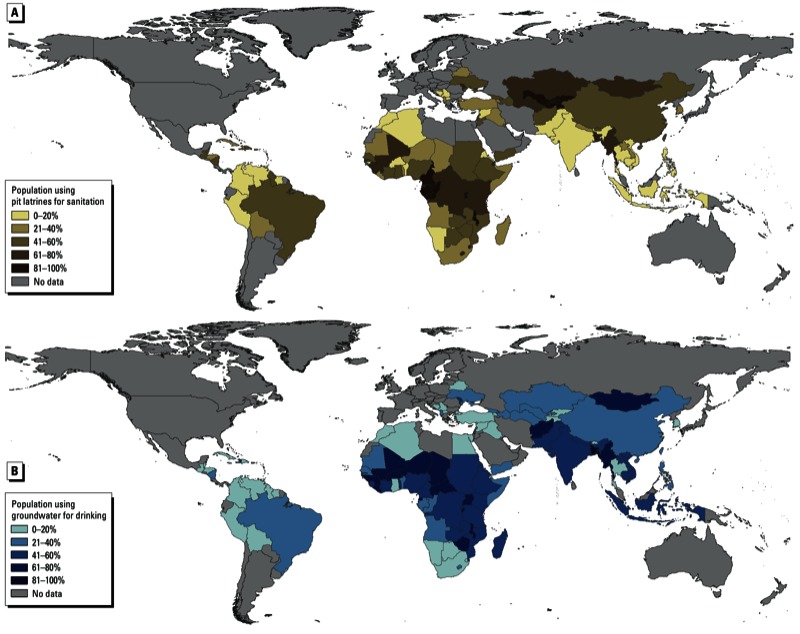
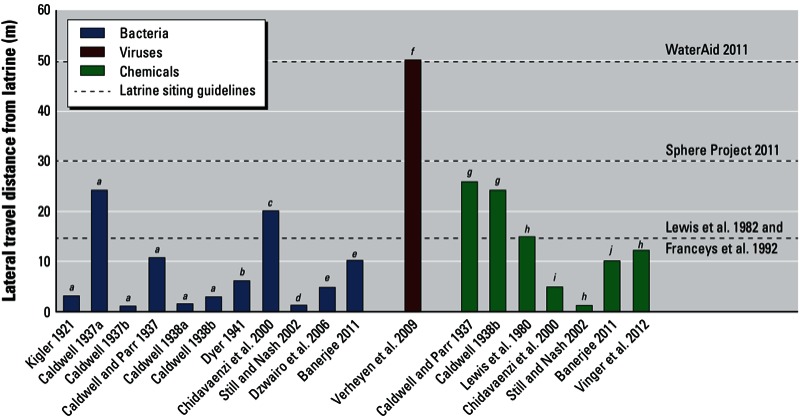
Verification
Claims the paper makes
The claims and statistics of this paper haven’t been checked yet.
Run the check — free, no account needed. It reads the open-access text and checks the sources it cites.
Claims other papers make about this one
Each is checked against this paper’s own text: does it say what the citing paper says it does?
The source backs part of the claim, not all of it — or backs it for a different population, condition or comparison.
In the citing paper
“Some field studies suggest that pit latrines, which are the most typical type of sanitation infrastructure in urban informal settlements, may be less likely to contaminate underlying groundwater when they are lined, particularly in rainy conditions 105 .”
From Urban informal settlements as hotspots of antimicrobial resistance and the need to curb environmental transmission. (2020) · cites this paper as [105]
Experimental — accuracy not yet measuredThe cited source says what the claim attributes to it.
In the citing paper
“Of the 2.7 billion people using on-site sanitation worldwide [6], an estimated 1.77 billion use some form of pit latrine as their primary means of excreta disposal [12].”
From Are pit latrines in urban areas of Sub-Saharan Africa performing? A review of usage, filling, insects and odour nuisances (2015) · cites this paper as [12]
Self-check
Percentages, sums and reported differences re-computed from the paper’s own numbers.
The self-check needs the paper’s full text.
Citations
Cites
Ecological and Evolutionary Forces Shaping Microbial Diversity in the Human Intestine
Ley, R. E., Peterson, D. A., & Gordon, J. I. (2006) · Cell · doi:10.1016/j.cell.2006.02.017 · Cited by 3,358
How long do nosocomial pathogens persist on inanimate surfaces? A systematic review
Krämer, A., Schwebke, I., & Kampf, G. (2006) · BMC Infectious Diseases · doi:10.1186/1471-2334-6-130 · Cited by 2,508
Arsenic mobility and groundwater extraction in Bangladesh
Harvey, C. F., Swartz, C. H., Badruzzaman, A. B. M., Keon-Blute, N., Yu, W., Ali, M. A., Jay, J., Beckie, R., Niedan, V., Brabander, D., et al. (2002) · Science · doi:10.1126/science.1076978 · Cited by 1,234 · cited 2×
“…of studies that detected total or fecal coliforms did not detect elevated nitrate concentrations in wells (Ahmed et al. 2002; Dzwairo et al. 2006; Howard et al. 2002; Padmasiri et al. 1992; Still and Nash 2002), other studies have reported nitrate concentrations > 100 mg/L (Banks et al. 2002;…”
BackgroundProgress on sanitation and drinking-water 2010 update
worl (2010) · Cited by 831
RNA Viral Community in Human Feces: Prevalence of Plant Pathogenic Viruses
Zhang, T., Breitbart, M., Lee, W. H., Run, J., Wei, C. L., Soh, S. W., Hibberd, M. L., Liu, E. T., Rohwer, F. L., & Ruan, Y. (2005) · PLoS Biology · doi:10.1371/journal.pbio.0040003 · Cited by 827
Water, sanitation and hygiene for the prevention of diarrhoea
Cairncross, S., Hunt, C., Boisson, S., Bostoen, K., Curtis, V., Fung, I. C., & Schmidt, W.-P. (2010) · International Journal of Epidemiology · doi:10.1093/ije/dyq035 · Cited by 667
Sanitation and disease: health aspects of excreta and wastewater management.
Feachem, R. G., Bradley, D. J., Garelick, H., & Mara, D. D. (1983) · Cited by 657
Drinking-Water Nitrate, Methemoglobinemia, and Global Burden of Disease: A Discussion
Fewtrell, L. (2004) · Environmental Health Perspectives · doi:10.1289/ehp.7216 · Cited by 653
Removal of Viruses by Soil Passage: Overview of Modeling, Processes, and Parameters
Schijven, J. F., & Hassanizadeh, S. M. (2000) · Critical Reviews in Environmental Science and Technology · doi:10.1080/10643380091184174 · Cited by 588 · cited 1×
“…contaminants in the sub surface have been the subject of several reviews (BGS 2002; Dillon 1997; Gerba et al. 1975; Lewis et al. 1982; WHO 2006), and there is extensive literature that more broadly quantifies contaminant transport processes in groundwater (e.g., Schijven and Hassanizadeh 2000).”
BackgroundHumanitarian Charter and Minimum Standards in Humanitarian Response
The Sphere Project (2011) · The Sphere Project eBooks · doi:10.3362/9781908176202 · Cited by 568
Research works printed but not linked: 2
- Padmasiri JP, Jayatilake GM, Kotuwegedara JPK, 1992, Groundwater pollution from double pit latrines. In: Water, Environment and Management: Proceedings of the 18th WEDC Conference, 30 August–3 September 1992, Kathmandu, Nepal. 239–241
- Still DA, Nash SR . 2002. Groundwater contamination due to pit latrines located in a sandy aquifer: a case study from Maputaland. In: Water Institute of Southern Africa Biennial Conference. Durban, South Africa:Water Institute of Southern Africa, 1–6.Available: http://www.sswm.info/sites/default/files/reference_attachments/STILL%20and%20NASH%202002%20Groundwater%20contamination%20due%20to%20pit%20latrines%20located%20in%20a%20sandy%20aquifer.pdf [accessed 29 March 2013].
Cited by
Sorted by citations
Pickering, A. J., Djebbari, H., López, C., Coulibaly, M., & Alzúa, M. L. (2015) · The Lancet Global Health · doi:10.1016/s2214-109x(15)00144-8 · Cited by 416
Global aquifers dominated by fossil groundwaters but wells vulnerable to modern contamination
Jasechko, S., Perrone, D., Befus, K. M., Cardenas, M. B., Ferguson, G., Gleeson, T., Luijendijk, E., McDonnell, J. J., Taylor, R. G., Wada, Y., et al. (2017) · Nature Geoscience · doi:10.1038/ngeo2943 · Cited by 363
Emerging contaminants in urban groundwater sources in Africa
Sorensen, J., Lapworth, D. J., Nkhuwa, D. C. W., Stuart, M. E., Gooddy, D. C., Bell, R. A., Chirwa, M., Kabika, J., Liemisa, M., Chibesa, M., et al. (2014) · Water Research · doi:10.1016/j.watres.2014.08.002 · Cited by 348
“…that the level of consumption of these products must be low, due to both low levels of income and poorer accessibility. wInsecticides and herbicides are common groundwater contaminants in the developed world (Hallberg, 1989; Stuart et al., 2012) as farmers strive to optimise crop yields and profits.”
Lapworth, D. J., Nkhuwa, D. C. W., Okotto-Okotto, J., Pedley, S., Stuart, M. E., Tijani, M. N., & Wright, J. (2017) · Hydrogeology Journal · doi:10.1007/s10040-016-1516-6 · Cited by 331
“Human faeces harbour a large number of microbes, including bacteria, archaea, microbial eukarya, viruses, protozoa, and helminths (Graham and Polizzotto 2013).”
BackgroundInfluentialOmarova, A. O., Tussupova, K., Berndtsson, R., Kalishev, M., & Sharapatova, K. (2018) · International Journal of Environmental Research and Public Health · doi:10.3390/ijerph15030495 · Cited by 252
“In some countries where pit latrines are common, greater than two billion people use groundwater as a source of drinking water [68].”
BackgroundInfluential
Metadata
- Authors
- Graham, J. P., & Polizzotto, M. L.
- Affiliations
- George Washington University (US)
- North Carolina State University (US)
- Corresponding author
- Graham, Jay P.
- Venue
- Environmental Health Perspectives
- Publisher
- American Chemical Society (ACS)
- Published
- 2013-03-22
- Volume
- 121
- Issue
- 5
- Pages
- 521-530
- ISSN
- 0091-6765 (ISSN-L)
- 1552-9924
- PMC
- PMC3673197
- OpenAlex
- W2084155931
- Cited by
- 431
- References
- 71
- Citations by year
- 2026: 41 · 2025: 20 · 2024: 36 · 2023: 44 · 2022: 37 · 2021: 49 · 2020: 42 · 2019: 34 · 2018: 35 · 2017: 44 · 2016: 20 · 2015: 15 · 2014: 11 · 2013: 3
- FWCI
- 1.60
- Type
- journal article
- Language
- en
- Open access
- gold
- doi.org
- Licence
- public-domain
- creativecommons.org/licenses/by/4.0/ (vor, 1743 d)
- Locations
- Environmental Health Perspectives (publishedVersion, public-domain)
- Europe PMC (PubMed Central) (publishedVersion, public-domain)
- PubMed Central (publishedVersion, public-domain)
- PubMed (publishedVersion)
- eScholarship (California Digital Library) (acceptedVersion)
- eScholarship (California Digital Library) (submittedVersion, public-domain)
- Topics
- Physical Sciences › Environmental Science › Water Science and Technology › Fecal contamination and water quality
- Physical Sciences › Environmental Science › Waste Management and Disposal › Wastewater Treatment and Reuse
- Physical Sciences › Environmental Science › Water Science and Technology › Water Quality and Pollution Assessment
- Keywords
- pit latrines, groundwater contamination, sanitation, microbial contaminants, chemical contaminants, contaminant transport, latrine coverage, low-income countries
- MeSH terms
- Ammonia, Chlorides, Humans, Nitrates, Sanitation, Toilet Facilities, Water Microbiology, Water Pollutants, Chemical, Water Pollution, Groundwater
About these checks
Registry, retraction, Cites and statistics results are computed, not judged, with one exception: a printed reference that no index lists is read once by a model before it counts as a citation error. Claims are extracted by a model and kept only when their quote appears verbatim in the text; each cited source is then checked, with a model’s help, for whether it says what the claim relies on. Those verdicts can be wrong — read the claim’s quote and the cited source before relying on one.
Statistics and arithmetic are recomputed, not judged.
Confidence bands are shown only for fields calibrated on our annotated test set. None is calibrated yet, so no band is shown.
What counts as a claim ›How we measure confidence ›How we check this ›
Are you an author, or do you see a problem with this page? Request a review
