

The DOI matches its Crossref record; 43 of the 43 references it cites were found in a registry or an index.
Phthalate Exposure and Allergy in the U.S. Population: Results from NHANES 2005–2006
Open accessAbstract
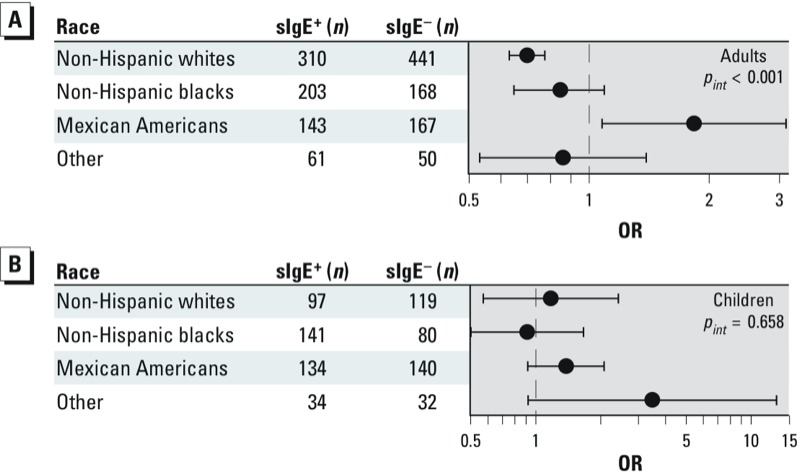
Background: Environmental exposures to phthalates, particularly high-molecular-weight (HMW) phthalates, are suspected to contribute to allergy. Objective: We assessed whether phthalate metabolites are associated with allergic symptoms and sensitization in a large nationally representative sample. Methods: We used data on urinary phthalate metabolites and allergic symptoms (hay fever, rhinitis, allergy, wheeze, asthma) and sensitization from participants ≥ 6 years of age in the National Health and Nutrition Examination Survey (NHANES) 2005–2006. Allergen sensitization was defined as a positive response to at least one of 19 specific IgE antigens (≥ 0.35 kU/L). Odds ratios (ORs) per one log10 unit change in phthalate concentration were estimated using logistic regression adjusting for age, race, body mass index, gender, creatinine, and cotinine. Separate analyses were conducted for children (6–17 years of age) and adults. Results: The HMW phthalate metabolite monobenzyl phthalate (MBzP) was the only metabolite positively associated with current allergic symptoms in adults (wheeze, asthma, hay fever, and rhinitis). Mono-(3-carboxypropyl) phthalate and the sum of diethylhexyl phthalate metabolites (both representing HMW phthalate exposures) were positively associated with allergic sensitization in adults. Conversely, in children, HMW phthalate metabolites were inversely associated with asthma and hay fever. Of the low-molecular-weight phthalate metabolites, monoethyl phthalate was inversely associated with allergic sensitization in adults (OR = 0.79; 95% CI: 0.70, 0.90). Conclusion: In this cross-sectional analysis of a nationally representative sample, HMW phthalate metabolites, particularly MBzP, were positively associated with allergic symptoms and sensitization in adults, but there was no strong evidence for associations between phthalates and allergy in children 6–17 years of age. Citation: Hoppin JA, Jaramillo R, London SJ, Bertelsen RJ, Salo PM, Sandler DP, Zeldin DC. 2013. Phthalate exposure and allergy in the U.S. population: results from NHANES 2005–2006. Environ Health Perspect 121:1129–1134; http://dx.doi.org/10.1289/ehp.1206211 [Online 25 June 2013].
Overview
The claims and statistics of this paper haven’t been checked yet.
Run the check — free, no account needed. It reads the open-access text and checks the sources it cites.
Integrity signals
Registry
Cites
Statistics
Figures
Verification
Claims the paper makes
The claims and statistics of this paper haven’t been checked yet.
Run the check — free, no account needed. It reads the open-access text and checks the sources it cites.
Claims other papers make about this one
Each is checked against this paper’s own text: does it say what the citing paper says it does?
The source backs part of the claim, not all of it — or backs it for a different population, condition or comparison.
In the citing paper
“DEHP and BzBP and their monoesters are regarded as allergens, and exposure to them has been associated with asthma and wheezing in adults [200,201].”
From A Review of Biomonitoring of Phthalate Exposures (2019) · cites this paper as [201]
Experimental — accuracy not yet measuredThe source backs part of the claim, not all of it — or backs it for a different population, condition or comparison.
In the citing paper
“Exposure to high molecular weight phthalates are is associated with allergies and asthma [200,201].”
From A Review of Biomonitoring of Phthalate Exposures (2019) · cites this paper as [201]
Experimental — accuracy not yet measured
Self-check
Percentages, sums and reported differences re-computed from the paper’s own numbers.
The self-check needs the paper’s full text.
Citations
Cites
Estimation of Average Concentration in the Presence of Nondetectable Values
Hornung, R. W., & Reed, L. D. (1990) · Applied Occupational and Environmental Hygiene · doi:10.1080/1047322x.1990.10389587 · Cited by 3,495
Assessment of Child and Adolescent Overweight and Obesity
Krebs, N. F., Himes, J. H., Jacobson, D. M., Nicklas, T. A., Guilday, P., & Styne, D. M. (2007) · PEDIATRICS · doi:10.1542/peds.2007-2329d · Cited by 1,007
Silva, M. J., Barr, D. B., Reidy, J. A., Malek, N. A., Hodge, C. C., Caudill, S. P., Brock, J. W., Needham, L. L., & Calafat, A. M. (2003) · Environmental Health Perspectives · doi:10.1289/ehp.6723 · Cited by 968
Hauser, R., & Calafat, A. M. (2005) · Occupational and Environmental Medicine · doi:10.1136/oem.2004.017590 · Cited by 941
Bornehag, C., Sundell, J., Weschler, C. J., Sigsgaard, T., Lundgren, B., Hasselgren, M., & Hagerhed‐Engman, L. (2004) · Environmental Health Perspectives · doi:10.1289/ehp.7187 · Cited by 878
Rudel, R. A., Gray, J., Engel, C. L., Rawsthorne, T. W., Dodson, R. E., Ackerman, J. M., Rizzo, J., Nudelman, J. L., & Brody, J. G. (2011) · Environmental Health Perspectives · doi:10.1289/ehp.1003170 · Cited by 594
Endocrine Disruptors and Asthma-Associated Chemicals in Consumer Products
Dodson, R. E., NISHIOKA, M. G., Standley, L. J., Perovich, L. J., Brody, J. G., & Rudel, R. A. (2012) · Environmental Health Perspectives · doi:10.1289/ehp.1104052 · Cited by 568
Temporal Variability of Urinary Phthalate Metabolite Levels in Men of Reproductive Age
Hauser, R. B., Meeker, J. D., Park, S., Silva, M. J., & Calafat, A. M. (2004) · Environmental Health Perspectives · doi:10.1289/ehp.7212 · Cited by 475
Jaakkola, J. J. K., & Knight, T. L. (2008) · Environmental Health Perspectives · doi:10.1289/ehp.10846 · Cited by 333
Reproducibility of urinary phthalate metabolites in first morning urine samples.
Hoppin, J. A., Brock, J. W., Davis, B. J., & Baird, D. D. (2002) · Environmental Health Perspectives · doi:10.1289/ehp.02110515 · Cited by 331
Self-citation
Cited by
Sorted by citations
A Review of Biomonitoring of Phthalate Exposures
Wang, Y., Zhu, H., & Kannan, K. (2019) · Toxics · doi:10.3390/toxics7020021 · Cited by 755
Phthalates impact human health: Epidemiological evidences and plausible mechanism of action
Benjamin, S., Masai, E., Kamimura, N., Takahashi, K., Anderson, R. C., & Faisal, P. A. (2017) · Journal of Hazardous Materials · doi:10.1016/j.jhazmat.2017.06.036 · Cited by 776
Ahmad, M. F., Ahmad, F. A., Alsayegh, A. A., Zeyaullah, M., AlShahrani, A. M., Muzammil, K., Saati, A. A., Wahab, S., Elbendary, E. Y., Kambal, N., et al. (2024) · Heliyon · doi:10.1016/j.heliyon.2024.e29128 · Cited by 764
RetractedA global assessment of phthalates burden and related links to health effects
Katsikantami, I., Sifakis, S., Tzatzarakis, M. N., Vakonaki, E., Kalantzi, O., Tsatsakis, A. M., & Rizos, A. K. (2016) · Environment International · doi:10.1016/j.envint.2016.09.013 · Cited by 471
The effects of phthalate ester exposure on human health: A review
Chang, W., Herianto, S., Lee, C.-C., Hung, H. Y., & Chen, H. (2021) · The Science of The Total Environment · doi:10.1016/j.scitotenv.2021.147371 · Cited by 409
Metadata
- Authors
- Hoppin, J. A., Jaramillo, R., London, S. J., Bertelsen, R. J., Salo, P. M., Sandler, D. P., & Zeldin, D. C.
- Affiliations
- National Institutes of Health (US)
- SRA International (United States) (US)
- United States Department of Health and Human Services (US)
- Corresponding author
- Hoppin, Jane A.
- ORCID
- Venue
- Environmental Health Perspectives
- Publisher
- American Chemical Society (ACS)
- Published
- 2013-06-25
- Volume
- 121
- Issue
- 10
- Pages
- 1129-1134
- ISSN
- 0091-6765 (ISSN-L)
- 1552-9924
- PMC
- PMC3801456
- OpenAlex
- W2037740273
- Cited by
- 151
- References
- 43
- Citations by year
- 2026: 4 · 2025: 17 · 2024: 9 · 2023: 10 · 2022: 18 · 2021: 15 · 2020: 13 · 2019: 10 · 2018: 8 · 2017: 9 · 2016: 9 · 2015: 14 · 2014: 14 · 2013: 1
- FWCI
- 9.31
- Type
- journal article
- Language
- en
- Open access
- gold
- doi.org
- Licence
- public-domain
- creativecommons.org/licenses/by/4.0/ (vor, 1648 d)
- Locations
- Environmental Health Perspectives (publishedVersion, public-domain)
- Europe PMC (PubMed Central) (publishedVersion, public-domain)
- PubMed Central (publishedVersion, public-domain)
- PubMed (publishedVersion)
- NORA - Norwegian Open Research Archives (submittedVersion, other-oa)
- Funders
- National Institutes of Health
- National Institute of Environmental Health Sciences (Z01ES025041)
- Topics
- Physical Sciences › Environmental Science › Health, Toxicology and Mutagenesis › Effects and risks of endocrine disrupting chemicals
- Health Sciences › Medicine › Pulmonary and Respiratory Medicine › Asthma and respiratory diseases
- Health Sciences › Medicine › Public Health, Environmental and Occupational Health › Occupational exposure and asthma
- Keywords
- phthalates, high molecular weight phthalates, allergen sensitization, allergic symptoms, monobenzyl phthalate, mono-3-carboxypropyl phthalate, DEHP, monoethyl phthalate, urinary phthalate metabolites, asthma, allergic rhinitis, rhinitis, wheezing, children, adults, environmental exposure
- MeSH terms
- Adolescent, Adult, Child, Cross-Sectional Studies, Environmental Exposure, Female, Humans, Hypersensitivity, Immune System, Male, Phthalic Acids, United States, Logistic Models, Young Adult
About these checks
Registry, retraction, Cites and statistics results are computed, not judged, with one exception: a printed reference that no index lists is read once by a model before it counts as a citation error. Claims are extracted by a model and kept only when their quote appears verbatim in the text; each cited source is then checked, with a model’s help, for whether it says what the claim relies on. Those verdicts can be wrong — read the claim’s quote and the cited source before relying on one.
Statistics and arithmetic are recomputed, not judged.
Confidence bands are shown only for fields calibrated on our annotated test set. None is calibrated yet, so no band is shown.
What counts as a claim ›How we measure confidence ›How we check this ›
Are you an author, or do you see a problem with this page? Request a review
