

The DOI matches its Crossref record; 43 of the 45 references it cites were found in a registry or an index.
Differences in Birth Weight Associated with the 2008 Beijing Olympics Air Pollution Reduction: Results from a Natural Experiment
Open accessAbstract
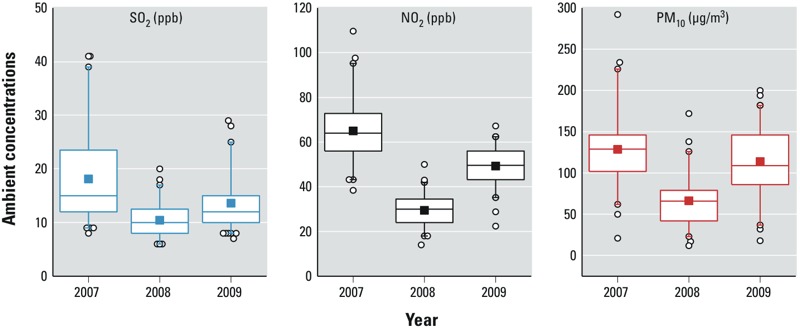
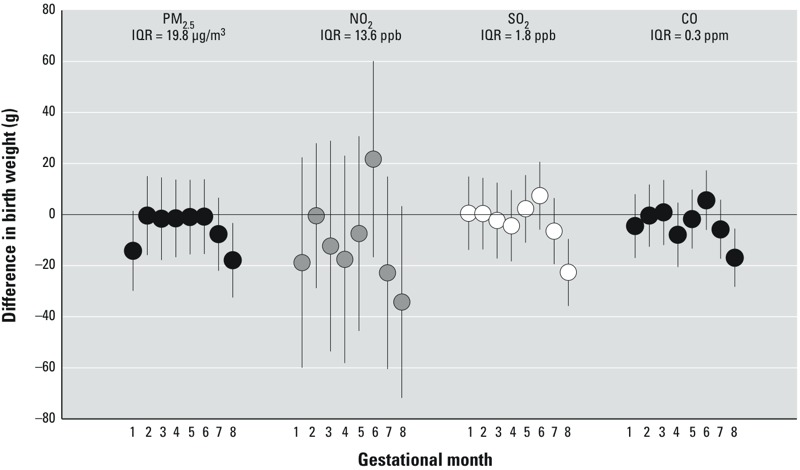
Background: Previous studies have reported decreased birth weight associated with increased air pollutant concentrations during pregnancy. However, it is not clear when during pregnancy increases in air pollution are associated with the largest differences in birth weight. Objectives: Using the natural experiment of air pollution declines during the 2008 Beijing Olympics, we evaluated whether having specific months of pregnancy (i.e., 1st…8th) during the 2008 Olympics period was associated with larger birth weights, compared with pregnancies during the same dates in 2007 or 2009. Methods: Using n = 83,672 term births to mothers residing in four urban districts of Beijing, we estimated the difference in birth weight associated with having individual months of pregnancy during the 2008 Olympics (8 August–24 September 2008) compared with the same dates in 2007 and 2009. We also estimated the difference in birth weight associated with interquartile range (IQR) increases in mean ambient particulate matter ≤ 2.5 μm in aerodynamic diameter (PM2.5), sulfur dioxide (SO2), nitrogen dioxide (NO2), and carbon monoxide (CO) concentrations during each pregnancy month. Results: Babies whose 8th month of gestation occurred during the 2008 Olympics were, on average, 23 g larger (95% CI: 5 g, 40 g) than babies whose 8th month occurred during the same calendar dates in 2007 or 2009. IQR increases in PM2.5 (19.8 μg/m3), CO (0.3 ppm), SO2 (1.8 ppb), and NO2 (13.6 ppb) concentrations during the 8th month of pregnancy were associated with 18 g (95% CI: –32 g, –3 g), 17 g (95% CI: –28 g, –6 g), 23 g (95% CI: –36 g, –10 g), and 34 g (95% CI: –70 g, 3 g) decreases in birth weight, respectively. We did not see significant associations for months 1–7. Conclusions: Short-term decreases in air pollution late in pregnancy in Beijing during the 2008 Summer Olympics, a normally heavily polluted city, were associated with higher birth weight. Citation: Rich DQ, Liu K, Zhang J, Thurston SW, Stevens TP, Pan Y, Kane C, Weinberger B, Ohman-Strickland P, Woodruff TJ, Duan X, Assibey-Mensah V, Zhang J. 2015. Differences in birth weight associated with the 2008 Beijing Olympics air pollution reduction: results from a natural experiment. Environ Health Perspect 123:880–887; http://dx.doi.org/10.1289/ehp.1408795
Overview
The claims and statistics of this paper haven’t been checked yet.
Run the check — free, no account needed. It reads the open-access text and checks the sources it cites.
Integrity signals
Registry
Cites
Statistics
Figures
Verification
Claims the paper makes
The claims and statistics of this paper haven’t been checked yet.
Run the check — free, no account needed. It reads the open-access text and checks the sources it cites.
Claims other papers make about this one
Each is checked against this paper’s own text: does it say what the citing paper says it does?
The cited source says what the claim attributes to it.
In the citing paper
“In an observational natural experiment, infants whose 8th month of gestation occurred during the 2008 Beijing Olympics, when air pollution levels drastically deceased, were born 23 g heavier on average compared to infants whose 8th month occurred over the same dates the year prior (2007) or after (2009) [16].”
From Air pollution and children’s health—a review of adverse effects associated with prenatal exposure from fine to ultrafine particulate matter (2021) · cites this paper as [16]
Self-check
Percentages, sums and reported differences re-computed from the paper’s own numbers.
The self-check needs the paper’s full text.
Citations
Cites
Births: preliminary data for 2012.
Hamilton, B. E., Martin, J. A., & Ventura, S. J. (2013) · PubMed · Cited by 1,509
Exposure measurement error in time-series studies of air pollution: concepts and consequences
Zeger, S. L., Thomas, D., Dominici, F., Samet, J. M., Schwartz, J., Dockery, D., & Cohen, A. (2000) · Environmental Health Perspectives · doi:10.1289/ehp.00108419 · Cited by 1,156
Ambient air pollution, birth weight and preterm birth: A systematic review and meta-analysis
Stieb, D. M., Chen, L., Eshoul, M., & Judek, S. (2012) · Environmental Research · doi:10.1016/j.envres.2012.05.007 · Cited by 849
Ambient air pollution and low birthweight: a European cohort study (ESCAPE)
Pedersen, M., Giorgis-Allemand, L., Bernard, C., Aguilera, I., Andersen, A. N., Ballester, F., Beelen, R. M. J., Chatzi, L., Cirach, M., Danilevičiūtė, A., et al. (2013) · The Lancet Respiratory Medicine · doi:10.1016/s2213-2600(13)70192-9 · Cited by 651
Analysis of a winter regional haze event and its formation mechanism in the North China Plain
Zhao, X., Zhao, P., Xu, J., Meng, W., Pu, W., Dong, F., He, D., & Shi, Q. F. (2013) · Atmospheric chemistry and physics · doi:10.5194/acp-13-5685-2013 · Cited by 622
Friedman, M. S. (2001) · JAMA · doi:10.1001/jama.285.7.897 · Cited by 588
Respiratory disease associated with community air pollution and a steel mill, Utah Valley.
Pope, C. A. (1989) · American Journal of Public Health · doi:10.2105/ajph.79.5.623 · Cited by 574
Effect of air-pollution control on death rates in Dublin, Ireland: an intervention study
Clancy, L., Goodman, P., Sinclair, H., & Dockery, D. W. (2002) · The Lancet · doi:10.1016/s0140-6736(02)11281-5 · Cited by 523
Environmental health in China: progress towards clean air and safe water
Zhang, J. J., Mauzerall, D. L., Zhu, T., Liang, S., Ezzati, M., & Remais, J. V. (2010) · The Lancet · doi:10.1016/s0140-6736(10)60062-1 · Cited by 465
Self-citationPrevalence of Smoking in China in 2010
Li, Q., Hsia, J., & Yang, G. (2011) · New England Journal of Medicine · doi:10.1056/nejmc1102459 · Cited by 454
Cited by
Sorted by citations
Thurston, G. D., Kipen, H. M., Annesi‐Maesano, I., Balmes, J. R., Brook, R. D., Cromar, K. R., Matteis, S. D., Forastiere, F., Forsberg, B., Frampton, M. W., et al. (2016) · European Respiratory Journal · doi:10.1183/13993003.00419-2016 · Cited by 569
Self-citationCosta, L. G., Cole, T. B., Dao, K., Chang, Y. C., Coburn, J. L., & Garrick, J. M. (2020) · Pharmacology & Therapeutics · doi:10.1016/j.pharmthera.2020.107523 · Cited by 511
Johnson, N. M., Hoffmann, A. R., Behlen, J. C., Lau, C., Pendleton, D., Harvey, N., Shore, R., Li, Y., Chen, J., Tian, Y., et al. (2021) · Environmental Health and Preventive Medicine · doi:10.1186/s12199-021-00995-5 · Cited by 339
“Beijing Olympics, when air pollution levels drastically deceased, were born 23 g heavier on average compared to infants whose 8th month occurred over the same dates the year prior (2007) or after (2009) [16].”
BackgroundRenzo, G. C. D., Conry, J. A., Blake, J. M., DeFrancesco, M. S., DeNicola, N. G., Martin, J. N., Jr., McCue, K., Richmond, D., Shah, A., Sutton, P., et al. (2015) · International Journal of Gynecology & Obstetrics · doi:10.1016/j.ijgo.2015.09.002 · Cited by 343
Self-citationAir pollutants and early origins of respiratory diseases
Kim, D., Chen, Z., Zhou, L., & Huang, S. (2018) · Chronic Diseases and Translational Medicine · doi:10.1016/j.cdtm.2018.03.003 · Cited by 319
Metadata
- Authors
- Rich, D. Q., Liu, K., Zhang, J., Thurston, S. W., Stevens, T. P., Pan, Y., Kane, C., Weinberger, B., Ohman-Strickland, P., Woodruff, T. J., Duan, X., Assibey-Mensah, V., & Zhang, J.
- Affiliations
- University of Rochester Medicine (US)
- Capital Medical University (CN)
- Duke University (US)
- Department of Biostatistics and Computational Biology, and
- Rutgers, The State University of New Jersey (US)
- Department of Biostatistics, School of Public Health, Rutgers University, Piscataway, New Jersey, USA
- University of California, San Francisco (US)
- Chinese Research Academy of Environmental Sciences (CN)
- Department of Public Health Sciences, School of Medicine and Dentistry, University of Rochester, Rochester, New York, USA
- Corresponding author
- Rich, David Q.
- ORCID
- Venue
- Environmental Health Perspectives
- Publisher
- American Chemical Society (ACS)
- Published
- 2015-04-28
- Volume
- 123
- Issue
- 9
- Pages
- 880-887
- ISSN
- 0091-6765 (ISSN-L)
- 1552-9924
- PMC
- PMC4559955
- OpenAlex
- W1992296920
- Cited by
- 174
- References
- 45
- Citations by year
- 2026: 2 · 2025: 7 · 2024: 12 · 2023: 13 · 2022: 21 · 2021: 24 · 2020: 13 · 2019: 23 · 2018: 16 · 2017: 24 · 2016: 14 · 2015: 4
- FWCI
- 12.13
- Type
- journal article
- Language
- en
- Open access
- gold
- doi.org
- Licence
- public-domain
- creativecommons.org/licenses/by/4.0/ (vor, 976 d)
- Locations
- Environmental Health Perspectives (publishedVersion, public-domain)
- Europe PMC (PubMed Central) (publishedVersion, public-domain)
- PubMed Central (publishedVersion, public-domain)
- PubMed (publishedVersion)
- eScholarship (California Digital Library) (submittedVersion)
- Funders
- National Institutes of Health (7r01es015864-04)
- National Institute of Environmental Health Sciences (R01-ES019165-01, R01-ES015864, R01ES019165, P30ES001247)
- Topics
- Physical Sciences › Environmental Science › Health, Toxicology and Mutagenesis › Air Quality and Health Impacts
- Health Sciences › Medicine › Pediatrics, Perinatology and Child Health › Birth, Development, and Health
- Social Sciences › Sociology and Political Science › Environmental Justice and Health Disparities
- Keywords
- birth weight, air pollution, 2008 Beijing Olympics, air pollution reduction, late pregnancy, PM2.5, nitrogen dioxide, sulfur dioxide, carbon monoxide, prenatal exposure, term birth
- MeSH terms
- Beijing, Air Pollutants, Air Pollution, Birth Weight, Carbon Monoxide, Environmental Exposure, Female, Humans, Infant, Newborn, Male, Nitrogen Dioxide, Pregnancy, Sulfur Dioxide, Maternal Exposure, Particulate Matter
About these checks
Registry, retraction, Cites and statistics results are computed, not judged, with one exception: a printed reference that no index lists is read once by a model before it counts as a citation error. Claims are extracted by a model and kept only when their quote appears verbatim in the text; each cited source is then checked, with a model’s help, for whether it says what the claim relies on. Those verdicts can be wrong — read the claim’s quote and the cited source before relying on one.
Statistics and arithmetic are recomputed, not judged.
Confidence bands are shown only for fields calibrated on our annotated test set. None is calibrated yet, so no band is shown.
What counts as a claim ›How we measure confidence ›How we check this ›
Are you an author, or do you see a problem with this page? Request a review
