

The DOI matches its Crossref record; 2 of the 2 references it cites were found in a registry or an index.
Whole-Body Lifetime Occupational Lead Exposure and Risk of Parkinson’s Disease
Abstract
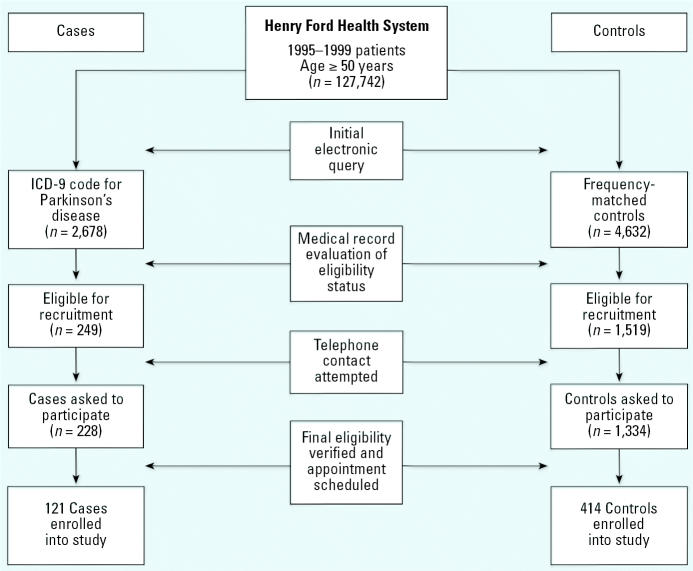
Background: Several epidemiologic studies have suggested an association between Parkinson’s disease (PD) and exposure to heavy metals using subjective exposure measurements. Objectives: We investigated the association between objective chronic occupational lead exposure and the risk of PD. Methods: We enrolled 121 PD patients and 414 age-, sex-, and race-, frequency-matched controls in a case–control study. As an indicator of chronic Pb exposure, we measured concentrations of tibial and calcaneal bone Pb stores using 109Cadmium excited K-series X-ray fluorescence. As an indicator of recent exposure, we measured blood Pb concentration. We collected occupational data on participants from 18 years of age until the age at enrollment, and an industrial hygienist determined the duration and intensity of environmental Pb exposure. We employed physiologically based pharmacokinetic modeling to combine these data, and we estimated whole-body lifetime Pb exposures for each individual. Logistic regression analysis produced estimates of PD risk by quartile of lifetime Pb exposure. Results: Risk of PD was elevated by > 2-fold [odds ratio = 2.27 (95% confidence interval, 1.13–4.55); p = 0.021] for individuals in the highest quartile for lifetime lead exposure relative to the lowest quartile, adjusting for age, sex, race, smoking history, and coffee and alcohol consumption. The associated risk of PD for the second and third quartiles were elevated but not statistically significant at the α = 0.05 level. Conclusions: These results provide an objective measure of chronic Pb exposure and confirm our earlier findings that occupational exposure to Pb is a risk factor for PD.
Overview
The claims and statistics of this paper haven’t been checked yet.
Run the check — free, no account needed. It reads the open-access text and checks the sources it cites.
Integrity signals
Registry
Cites
Statistics
Figures
Verification
Claims the paper makes
The claims and statistics of this paper haven’t been checked yet.
Run the check — free, no account needed. It reads the open-access text and checks the sources it cites.
Claims other papers make about this one
Each is checked against this paper’s own text: does it say what the citing paper says it does?
In the citing paper
“Lead is predominantly stored in bone, replacing calcium. When the bone is remodeled, lead is released into the bloodstream, thus serving as a long‐term endogenous exposure source many years or decades after the original inhalation or ingestion events.”
From Risk factors for amyotrophic lateral sclerosis: A regional United States case‐control study (2021) · cites this paper as [39]
Self-check
Percentages, sums and reported differences re-computed from the paper’s own numbers.
The self-check needs the paper’s full text.
Citations
Cites
An Algorithm for Least-Squares Estimation of Nonlinear Parameters
Marquardt, D. W. (1963) · Journal of the Society for Industrial and Applied Mathematics · doi:10.1137/0111030 · Cited by 30,728
Kok, J. S., Berg, I. J., & Scherder, E. J. A. (2013) · Dementia and Geriatric Cognitive Disorders Extra · doi:10.1159/000353441 · Cited by 20,589
Research works printed but not linked: 19
- Anthony, 1982, Limits of the ‘Mini-Mental State’ as a screening test for dementia and delirium among hospital patients, Psychol Med, 12, 397, 10.1017/S0033291700046730 · DOI
- Aquilonius, 1986, A Swedish county with unexpectedly high utilization of anti-parkinsonian drugs, Acta Neurol Scand, 74, 379, 10.1111/j.1600-0404.1986.tb03529.x · DOI
- Bradbury, 1993, Permeability of the blood-brain barrier to lead, Neurotoxicology, 14, 131
- Folstein, 1975, “Mini-mental state”: a practical method for grading the cognitive state of patients for the clinician”, J Psychiatr Res, 12, 189, 10.1016/0022-3956(75)90026-6 · DOI · Paper page
- Gorell, 1997, Occupational exposures to metals as risk factors for Parkinson’s disease, Neurology, 48, 650, 10.1212/WNL.48.3.650 · DOI
- Hu, 1991, The use of K X-ray fluorescence for measuring lead burden in epidemiological studies: high and low lead burdens and measurement uncertainty, Environ Health Perspect, 94, 107
- Hu, 1998, Bone lead as a biological marker in epidemiologic studies of chronic toxicity: conceptual paradigms, Environ Health Perspect, 106, 1, 10.1289/ehp.981061 · DOI
- Kosnett, 1994, Factors influencing bone lead concentration in a suburban community assessed by noninvasive K X-ray fluorescence, JAMA, 271, 197, 10.1001/jama.1994.03510270043037 · DOI
- Leggett, 1993, An age-specific kinetic model of lead metabolism in humans, Environ Health Perspect, 101, 598, 10.1289/ehp.93101598 · DOI
- Miller, 1987, Determination of lead in blood using electrothermal atomisation atomic absorption spectrometry with a L’vov platform and matrix modifier, Analyst, 112, 1701, 10.1039/an9871201701 · DOI
- Popenoe, 1979, Interaction of human DNA polymerase beta with ions of copper, lead, and cadmium, Arch Biochem Biophys, 196, 109, 10.1016/0003-9861(79)90557-5 · DOI
- Quinlan, 1988, Action of lead(II) and aluminium (III) ions on iron-stimulated lipid peroxidation in liposomes, erythrocytes and rat liver microsomal fractions, Biochim Biophys Acta, 962, 196, 10.1016/0005-2760(88)90159-2 · DOI
- Roccaforte, 1992, Validation of a telephone version of the Mini-Mental State Examination, J Am Geriatr Soc, 40, 697, 10.1111/j.1532-5415.1992.tb01962.x · DOI
- Rybicki, 1993, Parkinson’s disease mortality and the industrial use of heavy metals in Michigan, Mov Disord, 8, 87, 10.1002/mds.870080116 · DOI
- Sandhir, 1994, Lipoperoxidative damage on lead exposure in rat brain and its implications on membrane bound enzymes, Pharmacol Toxicol, 74, 66, 10.1111/j.1600-0773.1994.tb01077.x · DOI
- Sharp, 1991, Lead use in California industry: its prevalence and health implications, Am Ind Hyg Assoc J, 52, 409, 10.1080/15298669191364956 · DOI
- Tanner, 1989, Environmental factors and Parkinson’s disease: a case-control study in China, Neurology, 39, 660, 10.1212/WNL.39.5.660 · DOI
- Todd, 1994, In vivo X-ray fluorescence of lead in bone: review and current issues, Environ Health Perspect, 102, 172, 10.1289/ehp.94102172 · DOI
- Uversky, 2001, Metal-triggered structural transformations, aggregation, and fibrillation of human alpha-synuclein. A possible molecular NK between Parkinson’s disease and heavy metal exposure, J Biol Chem, 276, 44284, 10.1074/jbc.M105343200 · DOI · Paper page
Cited by
Sorted by citations
Epidemiology and etiology of Parkinson's disease: a review of the evidence
Wirdefeldt, K., Adami, H.-O., Cole, P., Trichopoulos, D., & Mandel, J. (2011) · European Journal of Epidemiology · doi:10.1007/s10654-011-9581-6 · Cited by 1,199
Neuromelanin of the Human Substantia Nigra: An Update
Zucca, F. A., Basso, E., Cupaioli, F. A., Ferrari, E., Sulzer, D., Casella, L., & Zecca, L. (2014) · Neurotoxicity Research · doi:10.1007/s12640-013-9435-y · Cited by 243
Zecca, L., Bellei, C., Costi, P., Albertini, A., Monzani, E., Casella, L., Gallorini, M., Bergamaschi, L., Moscatelli, A., Turro, N. J., et al. (2008) · Proceedings of the National Academy of Sciences · doi:10.1073/pnas.0808768105 · Cited by 240
Parkinson’s disease as a result of aging
Rodriguez, M., Rodriguez‐Sabate, C., Morales, I., Sanchez, A., & Sabate, M. (2015) · Aging Cell · doi:10.1111/acel.12312 · Cited by 214
The Synaptic Vesicle Glycoprotein 2: Structure, Function, and Disease Relevance
Stout, K. A., Dunn, A. R., Hoffman, C., & Miller, G. W. (2019) · ACS Chemical Neuroscience · doi:10.1021/acschemneuro.9b00351 · Cited by 112
Risk factors for amyotrophic lateral sclerosis: A regional United States case‐control study
Andrew, A. S., Bradley, W. G., Peipert, D., Butt, T., Amoako, K., Pioro, E. P., Tandan, R., Novak, J., Quick, A., Pugar, K. D., et al. (2021) · Muscle & Nerve · doi:10.1002/mus.27085 · Cited by 54
Capucciati, A., Zucca, F. A., Monzani, E., Zecca, L., Casella, L., & Hofer, T. (2021) · Antioxidants · doi:10.3390/antiox10060824 · Cited by 36
Metadata
- Authors
- Coon, S., Stark, A., Peterson, E., Gloi, A., Kortsha, G., Pounds, J., Chettle, D., & Gorell, J.
- Affiliations
- Department of Biostatistics and Research Epidemiology and
- Department of Pathology, Henry Ford Health System, Detroit, Michigan, USA
- Department of Radiology, St. Vincent Hospital, Green Bay, Wisconsin, USA
- Department of Neurology, Henry Ford Health System, Detroit, Michigan, USA
- Department of Molecular Biosciences, Pacific Northwest National Laboratory, Richland, Washington, USA
- Medical Physics and Applied Radiation Sciences Department, McMaster University, Hamilton, Ontario, Canada
- Venue
- Environmental Health Perspectives
- Publisher
- American Chemical Society (ACS)
- Published
- 2006-08-18
- Volume
- 114
- Issue
- 12
- Pages
- 1872-1876
- ISSN
- 0091-6765
- 1552-9924
- PMC
- PMC1764163
- Cited by
- 161
- References
- 2
- Language
- en
About these checks
Registry, retraction, Cites and statistics results are computed, not judged, with one exception: a printed reference that no index lists is read once by a model before it counts as a citation error. Claims are extracted by a model and kept only when their quote appears verbatim in the text; each cited source is then checked, with a model’s help, for whether it says what the claim relies on. Those verdicts can be wrong — read the claim’s quote and the cited source before relying on one.
Statistics and arithmetic are recomputed, not judged.
Confidence bands are shown only for fields calibrated on our annotated test set. None is calibrated yet, so no band is shown.
What counts as a claim ›How we measure confidence ›How we check this ›
Are you an author, or do you see a problem with this page? Request a review
