

The DOI matches its Crossref record; 2 of the 2 references it cites were found in a registry or an index.
Course Dropout Intention Scale: Development and Validation of a New Brief Measure in Academic College Context
Open accessAbstract
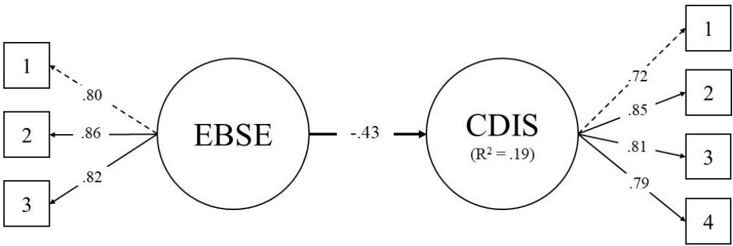
University students may encounter situations where they perform poorly in a course and contemplate dropping out. This intention to drop out of a course manifests not only in thoughts or ideas but also in a cognitive self-evaluation of their performance and skills, enabling them to reflect on the possibility of dropping out. In this sense, there is a shortage of instruments that evaluate the intention to drop out of a course, so the aim was to develop and validate the Course Dropout Intention Scale (CDIS). Data from two samples (N1 = 198; N2 = 675) were used; the first was for the EFA, and the second was for the CFA, GRM, and SEM. The one-factor model was derived from the EFA and confirmed in the second sample, exhibiting appropriate goodness-of-fit indices. Similarly, the GRM obtained adequate fit indices; all items discriminated adequately, and the difficulty parameter had a monotonic increase. The SEM model of the effect of satisfaction with studies on the CDIS showed a negative and statistically significant effect. Thus, it was demonstrated that the CDIS is a robust instrument in its psychometric properties and empirical evidence with other variables.
Overview
The claims and statistics of this paper haven’t been checked yet.
Run the check — free, no account needed. It reads the open-access text and checks the sources it cites.
Integrity signals
Registry
Cites
Statistics
Figures
Verification
Claims the paper makes
The claims and statistics of this paper haven’t been checked yet.
Run the check — free, no account needed. It reads the open-access text and checks the sources it cites.
Claims other papers make about this one
Each is checked against this paper’s own text: does it say what the citing paper says it does?
The source backs part of the claim, not all of it — or backs it for a different population, condition or comparison.
In the citing paper
“la adicción al móvil puede disminuir la participación estudiantil, el esfuerzo cognitivo y la construcción de un ambiente de aprendizaje cooperativo y de apoyo en el aula, lo que se traduce en menor interés por los estudios y en sentimientos de descontento que favorecen la intención de abandono (Kokoc y Göktas ˛, 2025; Soomro et al. , 2019; YupanquiLorenzo et al. , 2023).”
From Adicción al smartphone, nomofobia, rendimiento académico e intención de abandonar los estudios: un modelo estructural en estudiantes universitarios peruanos (2025) · cites this paper as Yupanqui-Lorenzo et al., 2023
Experimental — accuracy not yet measured
Self-check
Percentages, sums and reported differences re-computed from the paper’s own numbers.
The self-check needs the paper’s full text.
Citations
Cites
Un sistema de clasificación de los diseños de investigación en psicología
Ato, M., López-García, J. J., & Benavente, A. (2013) · Anales de Psicología · doi:10.6018/analesps.29.3.178511 · Cited by 2,254
Dropping Out: Why Students Drop Out of High School and What Can Be Done About It
Rumberger, R. W. (2011) · Harvard University Press eBooks · doi:10.4159/harvard.9780674063167 · Cited by 499
Research works printed but not linked: 45
- Alves, S. A., Sinval, J., Neto, L. L., Marôco, J., Gonçalves Ferreira, A., & Oliveira, P. (2022). Burnout and dropout intention in medical students: The protective role of academic engagement. BMC Medical Education, 22, Article 83. https://doi.org/10.1186/s12909-021-03094-9 · DOI
- Aiken, L. R. (1980). Content validity and reliability of single items or questionnaires. Educational and Psychological Measurement, 40(4), 955–959. https://doi.org/10.1177/001316448004000419 · DOI · Paper page
- Ajzen, I. (1985). From intentions to actions: A theory of planned behavior. In J. Kuhl & J. Beckmann (Eds)., Action control (pp. 11–39). Springer. https://doi.org/10.1007/978-3-642-69746-3_2 · DOI · Paper page
- Ajzen, I. (2005). Attitudes, personality, and behavior (2nd ed.). Open University Press.
- Allen, J., & Robbins, S. B. (2008). Prediction of college major persistence based on vocational interests, academic preparation, and first-year academic performance. Research in Higher Education, 49, 62–79. https://doi.org/10.1007/s11162-007-9064-5 · DOI
- American Educational Research Association, American Psychological Association, & National Council on Measurement in Education. (Eds.). (2014). Standards for educational and psychological testing. AERA Publications Sales.
- Bardach, L., Lüftenegger, M., Oczlon, S., Spiel, C., & Schober, B. (2020). Context-related problems and university students’ dropout intentions—the buffering effect of personal best goals. European Journal of Psychology of Education, 35, 477–493. https://doi.org/10.1007/s10212-019-00433-9 · DOI
- Beaujean, A. A. (2019). Sample size determination for regression models using Monte Carlo methods in R. Practical Assessment, Research, and Evaluation, 19, Article 12. https://doi.org/10.7275/d5pv-8v28 · DOI
- Browne, M. W., & Cudeck, R. (1992). Alternative ways of assessing model fit. Sociological Methods & Research, 21(2), 230–258. https://doi.org/10.1177/0049124192021002005 · DOI · Paper page
- Burisch, M. (1984). You don’t always get what you pay for: Measuring depression with short and simple versus long and sophisticated scales. Journal of Research in Personality, 18(1), 81–98. https://doi.org/10.1016/0092-6566(84)90040-0 · DOI
- Cai, L., Chung, S. W., & Lee, T. (2023). Incremental model fit assessment in the case of categorical data: Tucker–Lewis index for item response theory modeling. Prevention Science, 24, 455–466. https://doi.org/10.1007/s11121-021-01253-4 · DOI
- Cai, L., & Monroe, S. (2013). IRT model fit evaluation from theory to practice: Progress and some unanswered questions. Measurement: Interdisciplinary Research and Perspective, 11(3), 102–106. https://doi.org/10.1080/15366367.2013.835172 · DOI
- Choi, J., Fan, W., & Hancock, G. R. (2009). A note on confidence intervals for two-group latent mean effect size measures. Multivariate Behavioral Research, 44(3), 396–406. https://doi.org/10.1080/00273170902938902 · DOI
- Cohen, J. (1988). Statistical power analysis for the behavioral sciences (2nd ed.). Lawrence Erlbaum Associates. https://doi.org/10.4324/9780203771587 · DOI · Paper page
- DeVellis, R. F., & Thorpe, C. T. (2021). Scale development: Theory and applications (5th ed.). SAGE Publishing.
- Díaz Mujica, A. E., Pérez Villalobos, M. V., Bernardo Gutiérrez, A. B., Fernández-Castañón, A. C., & González-Pienda, J. A. (2019). Affective and cognitive variables involved in structural prediction of university droput. Psicothema, 31(4), 429–436. https://doi.org/10.7334/psicothema2019.124 · DOI
- Dominguez-Lara, S. A. (2018). Propuesta de puntos de corte para cargas factoriales: Una perspectiva de fiabilidad de constructo [Proposal cut-offs for factor loadings: A construct reliability perspective]. Enfermería Clínica, 28(6), 401–402. https://doi.org/10.1016/j.enfcli.2018.06.002 · DOI
- Duque, L. C., Duque, J. C., & Suriñach, J. (2013). Learning outcomes and dropout intentions: an analytical model for spanish universities. Educational Studies, 39(3), 261–284. https://doi.org/10.1080/03055698.2012.724353 · DOI
- Edelen, M. O., & Reeve, B. B. (2007). Applying item response theory (IRT) modeling to questionnaire development, evaluation, and refinement. Quality of Life Research, 16(S1), 5–18. https://doi.org/10.1007/s11136-007-9198-0 · DOI
- Finney, S. J., & DiStefano, C. (2013). Nonnormal and categorical data in structural equation modeling. In G. R. Hancock & R. O. Mueller (Eds.), Structural equation modeling: A second course (2nd ed., pp. 439–492). IAP Information Age Publishing.
- Fishbein, M., & Ajzen, I. (2009). Predicting and changing behavior. Psychology Press. https://doi.org/10.4324/9780203838020 · DOI · Paper page
- Gorsuch, R. L. (1997). Exploratory factor analysis: Its role in item analysis. Journal of Personality Assessment, 68(3), 532–560. https://doi.org/10.1207/s15327752jpa6803_5 · DOI
- Hambleton, R. K., van der Linden, W. J., & Wells, C. S. (2010). IRT models for the analysis of polytomously scored data: brief and selected history of modelbuilding advances. In M. L. Nering & R. Ostini (Eds.), Handbook of polytomous item response models (pp. 21–42). Routledge.
- Hom, P. W., Caranikas-Walker, F., Prussia, G. E., & Griffeth, R. W. (1992). A meta-analytical structural equations analysis of a model of employee turnover. Journal of Applied Psychology, 77(6), 890–909. https://doi.org/10.1037/0021-9010.77.6.890 · DOI
- Kline, R. B. (2016). Principles and practice of structural equation modeling (4th ed.). The Guilford Press.
- Litalien, D., & Guay, F. (2015). Dropout intentions in PhD studies: A comprehensive model based on interpersonal relationships and motivational resources. Contemporary Educational Psychology, 41, 218–231. https://doi.org/10.1016/j.cedpsych.2015.03.004 · DOI
- Marôco, J., Assunção, H., Harju-Luukkainen, H., Lin, S.-W., Sit, P.-S., Cheung, K.-C., Maloa, B., Ilic, I. S., Smith, T. J., & Campos, J. A. D. B. (2020). Predictors of academic efficacy and dropout intention in university students: Can engagement suppress burnout? PLOS ONE, 15(10), e0239816. https://doi.org/10.1371/journal.pone.0239816 · DOI
- Marsh, H. W., Hau, K.-T., & Wen, Z. (2004). In search of golden rules: Comment on hypothesis-testing approaches to setting cutoff values for fit indexes and dangers in overgeneralizing Hu and Bentler’s (1999) findings. Structural Equation Modeling: A Multidisciplinary Journal, 11(3), 320–341. https://doi.org/10.1207/s15328007sem1103_2 · DOI · Paper page
- Mashburn, A. J. (2000). A psychological process of college student dropout. Journal of College Student Retention: Research, Theory & Practice, 2(3), 173–190. https://doi.org/10.2190/U2QB-52J9-GHGP-6LEE · DOI
- Maydeu-Olivares, A., & Joe, H. (2014). Assessing approximate fit in categorical data analysis. Multivariate Behavioral Research, 49(4), 305–328. https://doi.org/10.1080/00273171.2014.911075 · DOI
- McDonald, R. P. (1999). Test theory: A unified treatment. Taylor & Francis. https://doi.org/10.4324/9781410601087 · DOI
- Merino-Soto, C., Dominguez-Lara, S., & Fernández-Arata, M. (2017). Validación inicial de una Escala Breve de Satisfacción con los Estudios en estudiantes universitarios de Lima [Initial validation of a Brief Satisfaction with Studies Scale in university students in Lima]. Educación Médica, 18(1), 74–77. https://doi.org/10.1016/j.edumed.2016.06.016 · DOI
- Meyer, G. J., Finn, S. E., Eyde, L. D., Kay, G. G., Moreland, K. L., Dies, R. R., Eisman, E. J., Kubiszyn, T. W., & Reed, G. M. (2001). Psychological testing and psychological assessment: A review of evidence and issues. American Psychologist, 56(2), 128–165. https://doi.org/10.1037/0003-066X.56.2.128 · DOI · Paper page
- Noman, M., Kaur, A., & Nafees, N. (2021). Covid-19 fallout: Interplay between stressors and support on academic functioning of Malaysian university students. Children and Youth Services Review, 125, 106001. https://doi.org/10.1016/j.childyouth.2021.106001 · DOI
- Raykov, T., & Hancock, G. R. (2005). Examining change in maximal reliability for multiple-component measuring instruments. British Journal of Mathematical and Statistical Psychology, 58(1), 65–82. https://doi.org/10.1348/000711005X38753 · DOI
- Rhemtulla, M., Brosseau-Liard, P. É., & Savalei, V. (2012). When can categorical variables be treated as continuous? A comparison of robust continuous and categorical SEM estimation methods under suboptimal conditions. Psychological Methods, 17(3), 354–373. https://doi.org/10.1037/a0029315 · DOI · Paper page
- Ryan, R. M., & Deci, E. L. (2017). Self-determination Theory: Basic psychological needs in motivation, development, and wellness. Guilford Press. https://doi.org/10.1521/978.14625/28806 · DOI · Paper page
- Samejima, F. (1997). Graded response model. In W. J. van der Linden & R. K. Hambleton (Eds). Handbook of modern item response theory (pp. 85–100). Springer. https://doi.org/10.1007/978-1-4757-2691-6_5 · DOI
- Samuel, R., & Burger, K. (2020). Negative life events, self-efficacy, and social support: Risk and protective factors for school dropout intentions and dropout. Journal of Educational Psychology, 112(5), 973–986. https://doi.org/10.1037/edu0000406 · DOI
- Schreiber, J. B., Nora, A., Stage, F. K., Barlow, E. A., & King, J. (2006). Reporting structural equation modeling and confirmatory factor analysis results: A review. The Journal of Educational Research, 99(6), 323–338. https://doi.org/10.3200/JOER.99.6.323-338 · DOI · Paper page
- Schumacker, R. E., & Lomax, R. G. (2015). A beginner’s guide to structural equation modeling (4th ed.). Routledge. https://doi.org/10.4324/9781315749105 · DOI · Paper page
- Tayebi, A., Gomez, J., & Delgado, C. (2021). Analysis on the lack of motivation and dropout in engineering students in spain. IEEE Access, 9, 66253–66265. https://doi.org/10.1109/ACCESS.2021.3076751 · DOI
- Tinto, V. (1994). Leaving college: Rethinking the causes and cures of student attrition (2nd ed.). University of Chicago Press. https://doi.org/10.7208/chicago/9780226922461.001.0001 · DOI
- Woodard, D. B., Mallory, S. L., & De Luca, A. M. (2001). Retention and institutional effort: A self-study framework. NASPA Journal, 39(1), 53–83. https://doi.org/10.2202/1949-6605.1159 · DOI
- Yuan, K.-H., & Bentler, P. M. (2000). Three likelihood-based methods for mean and covariance structure analysis with nonnormal missing data. Sociological Methodology, 30(1), 165–200. https://doi.org/10.1111/0081-1750.00078 · DOI
Cited by
Felices-Yupari, A., Mendoza-Fernandez, L., Orellana, M. E., & Loayza-Rivas, J. (2025) · Aloma: Revista de Psicologia, Ciències de l'Educació i de l'Esport · doi:10.51698/aloma.2025.43.2.22-31
“– Escala de intención de abandono de curso (CDIS; Yupanqui-Lorenzo et al. , 2024).”
Influential
Metadata
- Authors
- Yupanqui-Lorenzo, D. E., Jara-Osorio, L. A., Carbajal-León, C., Caycho-Rodríguez, T., Sernaqué, M. A. C., & Quispe, K. S. D.
- Affiliations
- Peruvian University of Applied Sciences (PE)
- Venue
- European Journal of Educational Research
- Published
- 2024-01-15
- Volume
- volume-13-2024
- Issue
- volume-13-issue-1-january-2024
- Pages
- 103-113
- ISSN
- 2165-8714 (ISSN-L)
- OpenAlex
- W4387427118
- Cited by
- 4
- References
- 2
- Citations by year
- 2026: 2 · 2025: 1 · 2024: 1
- FWCI
- 1.16
- Type
- journal article
- Language
- en
- Open access
- gold
- dx.doi.org
- Licence
- cc-by
- Locations
- European Journal of Educational Research (publishedVersion, cc-by)
- LA Referencia (Red Federada de Repositorios Institucionales de Publicaciones Científicas) (submittedVersion, cc-by-nc-sa)
- Topics
- Social Sciences › Education › Evasion and Academic Success Factors
- Social Sciences › Education › Educational Outcomes and Influences
- Social Sciences › Education › Higher Education Research Studies
- Keywords
- scale development, psychometric validation, university students, student attrition
About these checks
Registry, retraction, Cites and statistics results are computed, not judged, with one exception: a printed reference that no index lists is read once by a model before it counts as a citation error. Claims are extracted by a model and kept only when their quote appears verbatim in the text; each cited source is then checked, with a model’s help, for whether it says what the claim relies on. Those verdicts can be wrong — read the claim’s quote and the cited source before relying on one.
Statistics and arithmetic are recomputed, not judged.
Confidence bands are shown only for fields calibrated on our annotated test set. None is calibrated yet, so no band is shown.
What counts as a claim ›How we measure confidence ›How we check this ›
Are you an author, or do you see a problem with this page? Request a review
How to cite
Cite CoChat for the checks on this page, and the paper for its own findings.
- This page
- CoChat. (2026). Citation check: Course Dropout Intention Scale: Development and Validation of a New Brief Measure in Academic College Context. https://app.cochat.ai/papers/10.12973/eu-jer.13.1.103
- The paper
- Yupanqui-Lorenzo, D. E., Jara-Osorio, L. A., Carbajal-León, C., Caycho-Rodríguez, T., Sernaqué, M. A. C., & Quispe, K. S. D. (2024). Course Dropout Intention Scale: Development and Validation of a New Brief Measure in Academic College Context. European Journal of Educational Research. https://doi.org/10.12973/eu-jer.13.1.103
