

The DOI matches its Crossref record.
Liderazgo de Base Segura: Teoría e Investigación
Abstract
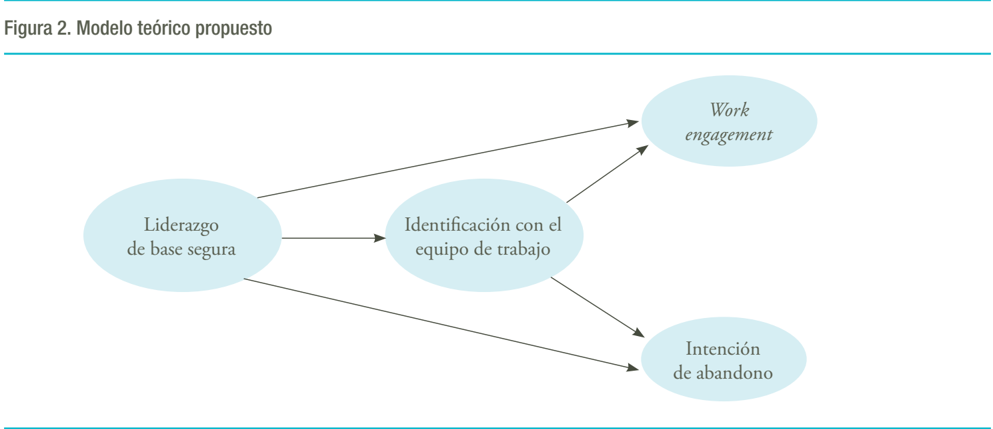
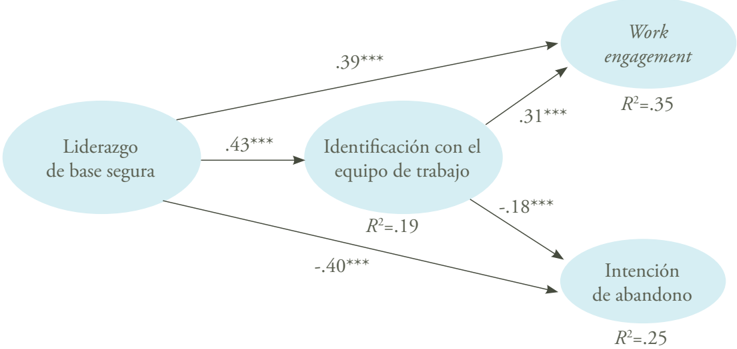
El liderazgo de base segura, fundamentado en la teoría del apego, emerge como un nuevo enfoque para comprender y mejorar las interacciones líder-subordinado, estableciendo vínculos significativos con otros constructos psicosociales en el ámbito de las organizaciones. Específicamente, este estudio explora empíricamente la relación positiva entre el estilo de liderazgo de base segura y el work engagement de los seguidores, así como la relación negativa entre este estilo de liderazgo y la intención de abandono organizacional, tanto de forma directa como mediada por la identificación con el equipo de trabajo. Un total de 483 empleados (59,4% mujeres; M = 36,9 años, DT = 11,5) cumplimentaron un cuestionario online. Se realizó un modelado de ecuaciones estructurales empleando la técnica de mínimos cuadrados parciales análisis. Los resultados indicaron que la identificación con el equipo media parcialmente las relaciones entre el liderazgo de base segura y el engagement y la intención de abandono. El liderazgo como base segura constituye un tipo de recurso laboral que puede potenciar los resultados positivos en el trabajo, como el engagement, a la vez que prevenir los resultados negativos, como el abandono. Por tanto, el liderazgo de base segura juega un papel crucial en el bienestar de los empleados.
Overview
The claims and statistics of this paper haven’t been checked yet.
Run the check — free, no account needed. It reads the open-access text and checks the sources it cites.
Integrity signals
Registry
Cites
Statistics
Figures
Verification
Claims the paper makes
The claims and statistics of this paper haven’t been checked yet.
Run the check — free, no account needed. It reads the open-access text and checks the sources it cites.
Claims other papers make about this one
Each is checked against this paper’s own text: does it say what the citing paper says it does?
In the citing paper
“complementaria, Laguía et al. (2025) profundizan esta perspectiva al plantear que el liderazgo de base segura, sustentado en la confianza, el apoyo emocional y la seguridad psicológica, fortalece el compromiso y el bienestar de los equipos de trabajo, configurando un modelo de liderazgo relacional que favorece la construcción de organizaciones que aprenden desde la transcomplejidad humana.”
From Del liderazgo a la organización que aprende: una revisión sistemática desde la transcomplejidad en educación superior (2026) · cites this paper as Laguía et al. (2025)
Self-check
Percentages, sums and reported differences re-computed from the paper’s own numbers.
The self-check needs the paper’s full text.
Citations
Cites
No references could be resolved yet.
Research works printed but not linked: 41
- Ainsworth, M. D. S. (1991). Attachment and other affection- al bonds across the life cycle. En C. M. Parkes, J. Steven- son-Hinde y P. Marris (eds.), Attachment across the life cycle (pp. 33-51). Routledge.
- Arnold, K. A. (2017). Transformational leadership and em- ployee psychological well-being: A review and directions for future research. Journal of Occupational Health Psychology, 22(3), 381-393. https://doi.org/10.1037/ocp0000062. · DOI
- Azanza, G., Gorgievski, M. J., Moriano, J. A., & Molero, F. (2018). Influencing salespeople's work outcomes through authentic leadership. Leadership & Organization Develop- ment Journal, 39(7), 926-944. https://doi.org/10.1108/ LODJ-05-2017-0113. · DOI
- Azanza, G., Moriano, J. A., Molero, F., & Lévy Mangin, J. P. (2015). The effects of authentic leadership on turnover inten- tion. Leadership & Organization Development Journal, 36(8), 955-971. https://doi.org/10.1108/LODJ-03-2014-0056. · DOI
- Bolt, E. E. T., Winterton, J., & Cafferkey, K. (2022). A cen- tury of labour turnover research: A systematic literature re- view. International Journal of Management Reviews, 24(4), 555-576. https://doi.org/10.1111/ijmr.12294. · DOI · Paper page
- Bowlby, J. (1982). Attachment and loss: Vol.1. Attachment (2.ªed.). Basic Books. (Obra original publicada en 1969).
- Bowlby, J. (1988). A secure-base: Clinical applications of attach- ment theory. Routledge.
- Davidovitz, R., Mikulincer, M., Shaver, P.R., Izsak, R., & Popper, M. (2007). Leaders as attachment figures: Leaders' attachment orientations predict leadership-related men- tal representations and followers' performance and mental health. Journal of Personality and Social Psychology, 93, 632- 650. https://doi.org/10.1037/0022-3514.93.4.632. · DOI
- Eagly, A. H., & Antonakis, J. (2015). Leadership. En M. Mi- kulincer, P. R. Shaver, E. Borgida, & J. A. Bargh (eds.), APA handbook of personality and social psychology (vol. 1: Attitudes and social cognition, pp. 571-592). American Psychological Association. https://doi.org/10.1037/14341-018. · DOI
- Edú-Valsania, S., Laguía, A., & Moriano, J.A. (2023). Vali- dation and adaptation of the multidimensional servant leadership scale in Spanish population. Current Psychology, 42, 13050-13060. https://doi.org/10.1007/s12144-021- 02522-9. · DOI
- Edú-Valsania, S., Moriano, J. A., & Molero, F. (2016). Au- thentic leadership and intrapreneurial behavior: Cross-level analysis of the mediator effect of organizational identifica- tion and empowerment. International Entrepreneurship and Management Journal, 12, 131-152. https://doi.org/10.1007/ s11365-014-0333-4. · DOI
- Fornell, C. G. & Larcker, D. F. (1981). Evaluating structural equation models with unobservable variables and measure- ment error. Journal of Marketing Research, 18(1), 39-50. https://doi.org/10.2307/3151312. · DOI · Paper page
- Gil, F., Alcover, C.M., Rico, R., & Sánchez-Manzanares, M. (2011). Nuevas formas de liderazgo en equipos de trabajo. Papeles del Psicólogo, 32(1), 38-47.
- Gonçalves Oliveira, L., & Sala Escarrabill, R. (2022). Resil- iencia organizacional sanitaria antes de la pandemia por COVID-19. Anuario de Psicología, 52(3), 269-278. https:// doi.org/10.1344/ANPSIC2022.52/3. · DOI
- Greškovičová, K., & Lisá, E. (2023). Beyond the global at- tachment model: Domain-and relationship-specific at- tachment models at work and their functions. Frontiers in Psychology, 14, 1158992. https://doi.org/10.3389/ fpsyg.2023.1158992. · DOI
- Hair, J. F., Hult, G. T. M., Ringle, C. M., & Sarstedt, M. (2017). A primer on Partial Least Squares Structural Equa- tion Modeling (PLS-SEM) (2.ª ed.). Sage.
- Harms, P. D., Credé, M., Tynan, M., Leon, M., & Jeung, W. (2017). Leadership and stress: A meta-analytic review. Lead- ership Quarterly, 28, 178-194. https://doi.org/10.1016/j. leaqua.2016.10.006. · DOI · Paper page
- Haslam, S. A., Reicher, S. D., & Platow, M. J. (2015). Lead- ership: Theory and practice. En M. Mikulincer, P. R. Shav- er, J. F. Dovidio y J. A. Simpson (eds.), APA handbook of personality and social psychology (vol. 2: Group processes, pp. 67-94). American Psychological Association. https://doi. org/10.1037/14342-003. · DOI
- Hinojosa, A. S., Shaine, M. J. D., & McCauley, K.D. (2020). A strange situation indeed: Fostering leader-follower attach- ment security during unprecedented crisis. Management Decision, 58(10), 2099-2115. https://doi.org/10.1108/ MD-08-2020-1142. · DOI
- Laguía, A., Moriano, J. A., Molero, F., García-Ael, C., & Van Dick, R. (2021). Liderazgo basado en la identidad y work engagement en España: Una adaptación transcultural del Inventario de Liderazgo Identitario (ILI). Universitas Psy- chologica, 20. https://doi.org/10.11144/Javeriana.upsy20. ilwe. · DOI
- Laguía, A., Navas-Jiménez, M. C., Schettini, R., Rodrí- guez-Batalla, F., Guillén, D., & Moriano, J.A. (2024). Ef- fects of secure base leadership vs. avoidant leadership on job performance. Businesses, 4(3), 438-452. https://doi. org/10.3390/businesses4030027. · DOI
- Lee, E.-S., Park, T.-Y., & Koo, B. (2015). Identifying organi- zational identification as a basis for attitudes and behaviors: A meta-analytic review. Psychological Bulletin, 141(5), 1049- 1080. https://doi.org/10.1037/bul0000012. · DOI
- Lisá, E., Greškovičová, K., & Krizova, K. (2021). The percep- tion of the leader as an attachment figure: Can it mediate the relationship between work engagement and general/cit- izenship performance? BMC Psychology, 9(1), 196. https:// doi.org/10.1186/s40359-021-00700-9. · DOI
- Lisá, E., Výboh, M., Mrázková, K., & Duriš, L. (2024). As safe figures, leaders encourage a focus on work performance in tram drivers. SAGE Open, 14(1), 21582440241239500. https://doi.org/10.1177/21582440241239500. · DOI
- Lobato, P., Moriano, J. A., Laguía, A., Molero, F., & Mikulinc- er, M. (2024). Security providing leadership and work stress in Spanish Air Force. Military Psychology, 36(5), 504-515. https://doi.org/10.1080/08995605.2023.2218785. · DOI
- Mael, F. & Ashforth, B. E. (1992). Alumni and their alma ma- ter: A partial test of the reformulated model of organization- al identification. Journal of Organizational Behavior, 13(2), 103-123. https://doi.org/10.1002/job.4030130202. · DOI
- Meyer, J. P., Allen, N. J. & Smith, C. A. (1993). Commitment to organizations and occupations: Extension and test of a three-component conceptualization. Journal of Applied Psy- chology, 78(4), 538-551.
- Mobley, W. H., Griffeth, R. W., Hand, H. H., & Meglino, B.M. (1979). Review and conceptual analysis of the employ- ee turnover process. Psychological Bulletin, 86(3), 493-522.
- Molero, F., Mikulincer, M., Shaver, P. R., Laguía, A., & Mo- riano, J. A. (2019). The development and validation of the leader as security provider scale. Journal of Work and Organizational Psychology, 35(3), 183-193. https://doi. org/10.5093/jwop2019a20. · DOI
- Moriano, J. A., Molero, F., Laguía, A., Mikulincer, M., & Shaver, P. R. (2021). Security providing leadership: A job resource to prevent employees' burnout. International Jour- nal of Environmental Research and Public Health, 18, 12551. https://doi.org/10.3390/ijerph182312551. · DOI
- Mrázková, K., & Lisá, E. (2022). Convergent validity of Work- place Attachment Style Questionnaire and Leader as Securi- ty Provider Scale in Slovak sample. BPA-Applied Psychology Bulletin (Bollettino di Psicologia Applicata), 293, 43-57.
- Navas-Jiménez, M. C., Laguía, A., Recio, P., García-Guiu, C., Pastor, A., Edú-Valsania, S., Molero, F., Mikulincer, M., & Moriano J.A. (2024). Secure base leadership in military training: Enhancing organizational identification and re- silience through work engagement. Frontiers in Psychology, 15,1401574. https://doi.org/10.3389/fpsyg.2024.1401574. · DOI
- Navas-Jiménez, M. C., Laguía, A., Schettini, R., Rodrí- guez-Batalla, F., Guillén-Corchado, D., & Moriano, J.A. (2025). When leaders are safe havens: How secure base lead- ership buffers the impact of emotional demands on exhaus- tion. Merits, 5, 3. https://doi.org/10.3390/merits5010003. · DOI
- Peiró, J. M., & Rodríguez, I. (2008). Estrés laboral, liderazgo y salud organizacional. Papeles del Psicólogo, 29(1), 68-82.
- Reicher, S., Haslam, S. A., & Hopkins, N. (2005). Social iden- tity and the dynamics of leadership: Leaders and followers as collaborative agents in the transformation of social re- ality. The Leadership Quarterly, 16, 547-568. https://doi. org/10.1016/j.leaqua.2005.06.007. · DOI · Paper page
- Schaufeli, W. B., Salanova, M., González-Romá, V., & Bakker, A. (2002). The measurement of burnout and engagement: A confirmatory factor analytic approach. Journal of Happi- ness Studies, 3, 71-92.
- Schaufeli, W. B., Shimazu, A., Hakanen, J., Salanova, M., & De Witte, H. (2019). An ultra-short measure for work en- gagement: The UWES-3 validation across five countries. European Journal of Psychological Assessment, 35(4), 577- 591. https://doi.org/10.1027/1015-5759/a000430. · DOI
- Skakon, J., Nielsen, K., Borg, V., & Guzman, J. (2010). Are leaders' well-being, behaviours and style associated with the affective well-being of their employees? A systematic review of three decades of research. Work & Stress, 24(2), 107-139. https://doi.org/10.1080/02678373.2010.495262. · DOI
- Steffens, N. K., Haslam, S. A., Schuh, S. C., Jetten, J., & Van Dick, R. (2017). A meta-analytic review of social identi- fication and health in organizational contexts. Personality and Social Psychology Review, 21(4), 303-335. https://doi. org/10.1177/1088868316656701. · DOI · Paper page
- Topa Cantisano, G., Moriano León, J. A., & Morales Domín- guez, J. (2008). Identidad social y apoyo percibido en las organizaciones: sus efectos sobre las conductas de ciudada- nía. Revista Interamericana de Psicología/Interamerican Jour- nal of Psychology, 42(2), 363-370. https://www.redalyc.org/ pdf/284/28442217.pdf.
- Tummers, L. G., & Bakker, A. B. (2021). Leadership and job de- mands-resources theory: A systematic review. Frontiers in Psychol- ogy, 12, 722080. https://doi.org/10.3389/fpsyg.2021.722080. · DOI
Cited by
GARCIA, M. A. (2026) · Espacios · doi:10.48082/espacios-a26v47n01r04 · Cited by 2
Metadata
- Authors
- Laguia, A., Edú-Valsania, S., Navas-Jiménez, M. D. C., Molero, F., & Moriano, J.
- Venue
- Anuario de Psicología/The UB Journal of Psychology
- Published
- 2025-07-22
- Volume
- 55
- Issue
- 2
- ISSN
- 1988-5253
- 0066-5126
- Cited by
- 5
- References
- 0
About these checks
Registry, retraction, Cites and statistics results are computed, not judged, with one exception: a printed reference that no index lists is read once by a model before it counts as a citation error. Claims are extracted by a model and kept only when their quote appears verbatim in the text; each cited source is then checked, with a model’s help, for whether it says what the claim relies on. Those verdicts can be wrong — read the claim’s quote and the cited source before relying on one.
Statistics and arithmetic are recomputed, not judged.
Confidence bands are shown only for fields calibrated on our annotated test set. None is calibrated yet, so no band is shown.
What counts as a claim ›How we measure confidence ›How we check this ›
Are you an author, or do you see a problem with this page? Request a review
Data sources
Bibliographic data: Semantic Scholar, OpenAlex, Crossref.
Contains information from the Semantic Scholar Academic Graph Datasets, made available under the ODC Attribution License (ODC-BY 1.0).
Semantic Scholar’s data is described in: Kinney, R., et al. (2023). The Semantic Scholar Open Data Platform. arXiv:2301.10140.
