

The DOI matches its Crossref record; 28 of the 28 references it cites were found in a registry or an index.
Mental Training Affects Distribution of Limited Brain Resources
Open accessAbstract
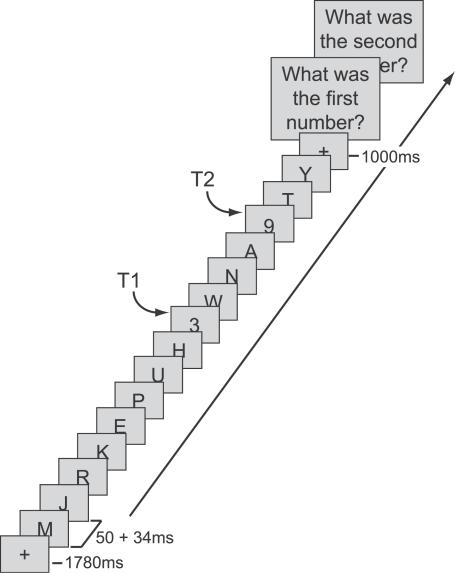
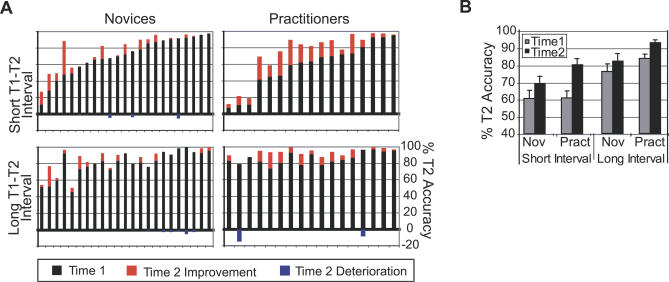
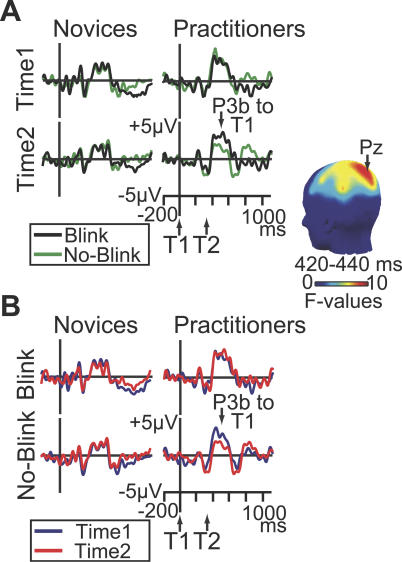
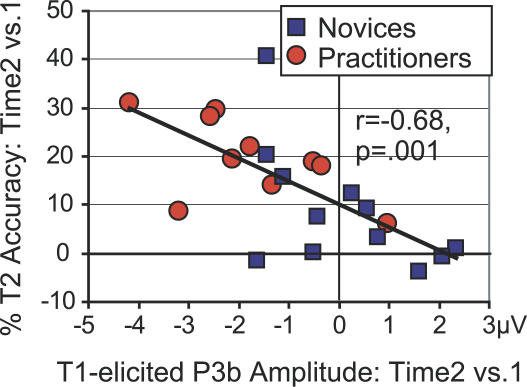
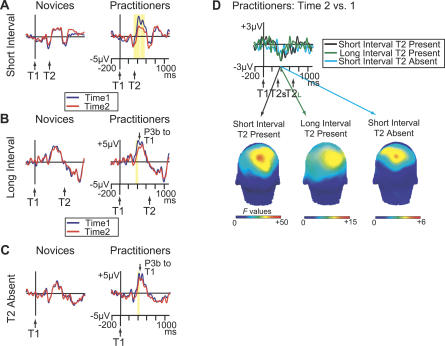
The information processing capacity of the human mind is limited, as is evidenced by the so-called "attentional-blink" deficit: When two targets (T1 and T2) embedded in a rapid stream of events are presented in close temporal proximity, the second target is often not seen. This deficit is believed to result from competition between the two targets for limited attentional resources. Here we show, using performance in an attentional-blink task and scalp-recorded brain potentials, that meditation, or mental training, affects the distribution of limited brain resources. Three months of intensive mental training resulted in a smaller attentional blink and reduced brain-resource allocation to the first target, as reflected by a smaller T1-elicited P3b, a brain-potential index of resource allocation. Furthermore, those individuals that showed the largest decrease in brain-resource allocation to T1 generally showed the greatest reduction in attentional-blink size. These observations provide novel support for the view that the ability to accurately identify T2 depends upon the efficient deployment of resources to T1. The results also demonstrate that mental training can result in increased control over the distribution of limited brain resources. Our study supports the idea that plasticity in brain and mental function exists throughout life and illustrates the usefulness of systematic mental training in the study of the human mind.
Overview
The claims and statistics of this paper haven’t been checked yet.
Run the check — free, no account needed. It reads the open-access text and checks the sources it cites.
Integrity signals
Registry
Cites
Statistics
Figures
Verification
Claims the paper makes
The claims and statistics of this paper haven’t been checked yet.
Run the check — free, no account needed. It reads the open-access text and checks the sources it cites.
Claims other papers make about this one
Each is checked against this paper’s own text: does it say what the citing paper says it does?
The source backs part of the claim, not all of it — or backs it for a different population, condition or comparison.
In the citing paper
“Mindfulness meditation has been independently found to improve all three of these psychological barriers.”
From Effects of Mindfulness Training on Body Awareness to Sexual Stimuli: Implications for Female Sexual Dysfunction (2011) · cites this paper as [18]
Experimental — accuracy not yet measuredThe cited source says what the claim attributes to it.
In the citing paper
“A considerable number of studies have empirically documented better performance during attentional tasks in meditators compared to controls [25–28].”
From Mindful emotion regulation: Exploring the neurocognitive mechanisms behind mindfulness (2015) · cites this paper as [26]
Self-check
Percentages, sums and reported differences re-computed from the paper’s own numbers.
The self-check needs the paper’s full text.
Citations
Cites
Delorme, A., & Makeig, S. (2004) · Journal of Neuroscience Methods · doi:10.1016/j.jneumeth.2003.10.009 · Cited by 24,371
Removing electroencephalographic artifacts by blind source separation
Jung, T., Makeig, S., Humphries, C., Lee, T.-W., McKeown, M. J., Iragui, V. J., & B, T. J. S. A. (2000) · Psychophysiology · doi:10.1111/1469-8986.3720163 · Cited by 3,342
Navigation-related structural change in the hippocampi of taxi drivers
Maguire, E. A., Gadian, D. G., Johnsrude, I. S., Good, C. D., Ashburner, J., Frackowiak, R. S. J., & Frith, C. D. (2000) · Proceedings of the National Academy of Sciences · doi:10.1073/pnas.070039597 · Cited by 3,225
Action video game modifies visual selective attention
Green, C. S., & Bavelier, D. (2003) · Nature · doi:10.1038/nature01647 · Cited by 2,540
Temporary suppression of visual processing in an RSVP task: An attentional blink?
Raymond, J. E., Shapiro, K. L., & Arnell, K. M. (1992) · Journal of Experimental Psychology Human Perception & Performance · doi:10.1037//0096-1523.18.3.849 · Cited by 2,286
Control of Cognitive Processes
Monsell, S., & Driver, J. (2000) · The MIT Press eBooks · doi:10.7551/mitpress/1481.001.0001 · Cited by 1,650
A two-stage model for multiple target detection in rapid serial visual presentation.
Chun, M. M., & Potter, M. C. (1995) · Journal of Experimental Psychology Human Perception & Performance · doi:10.1037//0096-1523.21.1.109 · Cited by 1,465
Control of Cognitive Processes: Attention and Performance XVIII
Monsell, S., & Driver, J. (2000) · UCL Discovery (University College London) · Cited by 1,451
Long-term meditators self-induce high-amplitude gamma synchrony during mental practice
Lutz, A., Greischar, L. L., Rawlings, N. B., Ricard, M., & Davidson, R. J. (2004) · Proceedings of the National Academy of Sciences · doi:10.1073/pnas.0407401101 · Cited by 1,328 · cited 3×
“On the basis of previous findings in expert meditators [6, 7 ], we hypothesized that 3 mo of intensive Vipassana”
BackgroundResultInfluentialSelf-citationThe musician's brain as a model of neuroplasticity
Münte, T. F., ALTENMÜLLER, E. O., & Jäncke, L. (2002) · Nature reviews. Neuroscience · doi:10.1038/nrn843 · Cited by 1,001
Research works printed but not linked: 26
- Marois, 2005, Trends Cogn Sci, 9, 296
- Raymond, 1992, J Exp Psychol Hum Percept Perform, 18, 849
- Ward, 1996, Cogn Psychol, 30, 79
- Shapiro, 1997, Trends Cogn Sci, 1, 291
- Martens, 2006, J Cogn Neurosci, 18, 1423
- Carter, 2005, Curr Biol, 15, R412
- Lutz, 2004, Proc Natl Acad Sci U S A, 101, 16369
- Maguire, 2000, Proc Natl Acad Sci U S A, 97, 4398
- Munte, 2002, Nat Rev Neurosci, 6, 473
- Green, 2003, Nature, 423, 534
- Wickens, 1983, Science, 221, 1080
- Fahle, 2005, Curr Opin Neurobiol, 15, 154
- Shapiro, 2006, Neuroreport, 17, 163
- Vogel, 2002, Psych Bull Rev, 9, 739
- Vogel, 1998, J Exp Psychol Hum Percept Perform, 24, 1656
- Sergent, 2005, Nat Neurosci, 8, 1391
- Olivers, 2005, Psych Sci, 16, 265
- Chun, 1995, J Exp Psychol Hum Percept Perform, 21, 109
- Duncan, 1994, Nature, 369, 313
- Shapiro, 1994, J Exp Psychol Hum Percept Perform, 20, 357
- Martens, 2007, Acta Psychol (Amst), 123, 204
- Bledowski, 2004, J Neurosci, 24, 9353
- Hommel, 2005, Psych Res, 70, 425
- Sergent, 2004, Psych Sci, 15, 720
- Delorme, 2004, J Neurosci Methods, 134, 9
- Jung, 2000, Psychophysiology, 37, 163
Cited by
Sorted by citations
Hölzel, B. K., Lazar, S. W., Gard, T., Schuman-Olivier, Z., Vago, D. R., & Ott, U. (2011) · Perspectives on Psychological Science · doi:10.1177/1745691611419671 · Cited by 3,024
The Neuroscience of Mindfulness Meditation
Tang, Y.-Y., Hölzel, B. K., & Posner, M. I. (2015) · Nature reviews. Neuroscience · doi:10.1038/nrn3916 · Cited by 2,889
Attention regulation and monitoring in meditation
Lutz, A., Slagter, H. A., Dunne, J. D., & Davidson, R. J. (2008) · Trends in Cognitive Sciences · doi:10.1016/j.tics.2008.01.005 · Cited by 2,659
Self-citationThe cognitive benefits of interacting with nature.
Berman, M. G., Jonides, J., & Kaplan, S. (2008) · Psychological Science · doi:10.1111/j.1467-9280.2008.02225.x · Cited by 2,535
Mindfulness practice leads to increases in regional brain gray matter density
Hölzel, B. K., Carmody, J., Vangel, M., Congleton, C., Yerramsetti, S. M., Gard, T., & Lazar, S. W. (2011) · Psychiatry Research: Neuroimaging · doi:10.1016/j.pscychresns.2010.08.006 · Cited by 1,914
Metadata
- Authors
- Slagter, H. A., Lutz, A., Greischar, L. L., Francis, A. D., Nieuwenhuis, S., Davis, J. M., & Davidson, R. J.
- Affiliations
- University of Wisconsin–Madison (US)
- Leiden University (NL)
- Corresponding author
- Davidson, Richard J
- Venue
- PLoS Biology
- Publisher
- Public Library of Science (PLoS)
- Published
- 2007-05-08
- Volume
- 5
- Issue
- 6
- Pages
- e138
- ISSN
- 1544-9173 (ISSN-L)
- 1545-7885
- PMC
- PMC1865565
- OpenAlex
- W1987937684
- Cited by
- 757
- References
- 27
- Citations by year
- 2026: 19 · 2025: 19 · 2024: 17 · 2023: 34 · 2022: 27 · 2021: 32 · 2020: 40 · 2019: 46 · 2018: 41 · 2017: 55 · 2016: 53 · 2015: 57 · 2014: 58 · 2013: 44 · 2012: 43
- FWCI
- 40.63
- Type
- journal article
- Language
- en
- Open access
- gold
- doi.org
- Locations
- PLoS Biology (publishedVersion, cc-by)
- Europe PMC (PubMed Central) (publishedVersion, cc-by)
- PubMed Central (publishedVersion, cc-by)
- PubMed (publishedVersion)
- RePEc: Research Papers in Economics (submittedVersion)
- DOAJ (DOAJ: Directory of Open Access Journals) (submittedVersion, cc-by-sa)
- Funders
- Mind and Life Institute
- National Institutes of Health (5u01at002114-03)
- National Institute of Mental Health (P50-MH069315-03, P50MH069315, MH069315)
- National Institute on Drug Abuse (K23DA022471)
- National Center for Complementary and Alternative Medicine (U01AT002114-01A1)
- National Center for Complementary and Integrative Health (U01-AT002114, U01AT002114-01A1)
- Topics
- Social Sciences › Psychology › Clinical Psychology › Mindfulness and Compassion Interventions
- Life Sciences › Neuroscience › Cognitive Neuroscience › Neural and Behavioral Psychology Studies
- Life Sciences › Neuroscience › Cognitive Neuroscience › Visual perception and processing mechanisms
- Keywords
- attentional blink, mental training, meditation, P3b, event-related potentials, attentional competition, cognitive plasticity, information processing capacity
- MeSH terms
- Adult, Brain, Evoked Potentials, Visual, Female, Humans, Male, Middle Aged, Case-Control Studies, Meditation, Attentional Blink
About these checks
Registry, retraction, Cites and statistics results are computed, not judged, with one exception: a printed reference that no index lists is read once by a model before it counts as a citation error. Claims are extracted by a model and kept only when their quote appears verbatim in the text; each cited source is then checked, with a model’s help, for whether it says what the claim relies on. Those verdicts can be wrong — read the claim’s quote and the cited source before relying on one.
Statistics and arithmetic are recomputed, not judged.
Confidence bands are shown only for fields calibrated on our annotated test set. None is calibrated yet, so no band is shown.
What counts as a claim ›How we measure confidence ›How we check this ›
Are you an author, or do you see a problem with this page? Request a review
