

Sensitivity Analysis of Intracellular Signaling Pathway Kinetics Predicts Targets for Stem Cell Fate Control
Open accessThe DOI matches its Crossref record; 46 of the 46 references it cites were found in a registry or an index.
Abstract
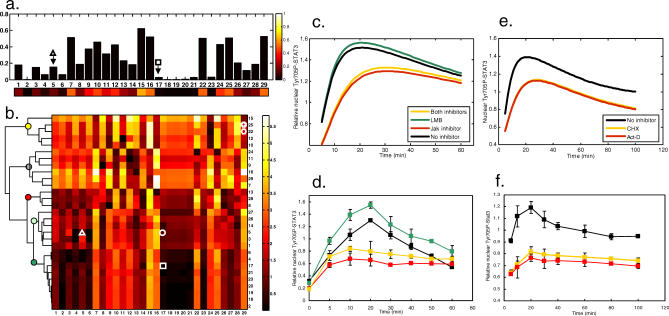
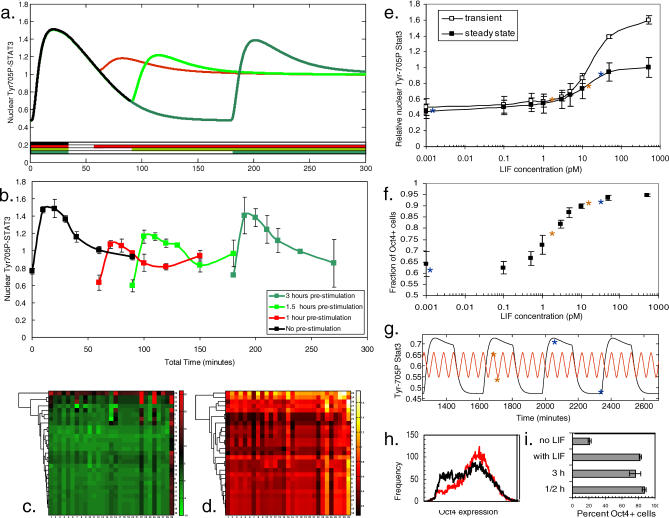
Directing stem cell fate requires knowledge of how signaling networks integrate temporally and spatially segregated stimuli. We developed and validated a computational model of signal transducer and activator of transcription-3 (Stat3) pathway kinetics, a signaling network involved in embryonic stem cell (ESC) self-renewal. Our analysis identified novel pathway responses; for example, overexpression of the receptor glycoprotein-130 results in reduced pathway activation and increased ESC differentiation. We used a systematic in silico screen to identify novel targets and protein interactions involved in Stat3 activation. Our analysis demonstrates that signaling activation and desensitization (the inability to respond to ligand restimulation) is regulated by balancing the activation state of a distributed set of parameters including nuclear export of Stat3, nuclear phosphatase activity, inhibition by suppressor of cytokine signaling, and receptor trafficking. This knowledge was used to devise a temporally modulated ligand delivery strategy that maximizes signaling activation and leads to enhanced ESC self-renewal.
Overview
The claims and statistics of this paper haven’t been checked yet.
Free: it reads the open-access text and checks the first 5 claims that cite a source we can check. Create a free account to check every claim.
Integrity signals
Registry
Cites
Statistics
Figures
Verification
Claims the paper makes
The claims and statistics of this paper haven’t been checked yet.
Free: it reads the open-access text and checks the first 5 claims that cite a source we can check. Create a free account to check every claim.
Claims other papers make about this one
Each is checked against this paper’s own text: does it say what the citing paper says it does?
The cited source says what the claim attributes to it.
In the citing paper
“For example, for the signal transduction and activation of transcription‐3 (Stat3), two important parameter interactions, i.e., the nuclear export and docking of Stat‐3 to the activated receptor, were identified using sensitivity analysis.52”
From Sobol Sensitivity Analysis: A Tool to Guide the Development and Evaluation of Systems Pharmacology Models (2015) · cites this paper as [52]
Self-check
Percentages, sums and reported differences re-computed from the paper’s own numbers.
The self-check needs the paper’s full text.
Citations
Cites
Efficient selection for high-expression transfectants with a novel eukaryotic vector
Hitoshi, N., Ken-ichi, Y., & Jun-ichi, M. (1991) · Gene · doi:10.1016/0378-1119(91)90434-d · Cited by 5,134
Principles of interleukin (IL)-6-type cytokine signalling and its regulation
HEINRICH, P. C., BEHRMANN, I., HAAN, S., HERMANNS, H. M., MÜLLER-NEWEN, G., & SCHAPER, F. (2003) · Biochemical Journal · doi:10.1042/bj20030407 · Cited by 3,272 · cited 1×
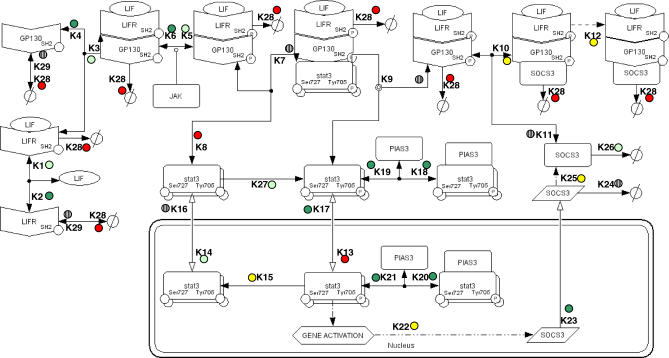
“In this model, we assumed pre-association of Jak with the receptors according to literature [21,22], and we have assumed reversible kinetics as shown by double arrows in Figure 1 [20].”
MethodDerivation of completely cell culture-derived mice from early-passage embryonic stem cells.
Nagy, A., Rossant, J., Nagy, R., Abramow-Newerly, W., & Roder, J. C. (1993) · Proceedings of the National Academy of Sciences · doi:10.1073/pnas.90.18.8424 · Cited by 2,329 · cited 1×
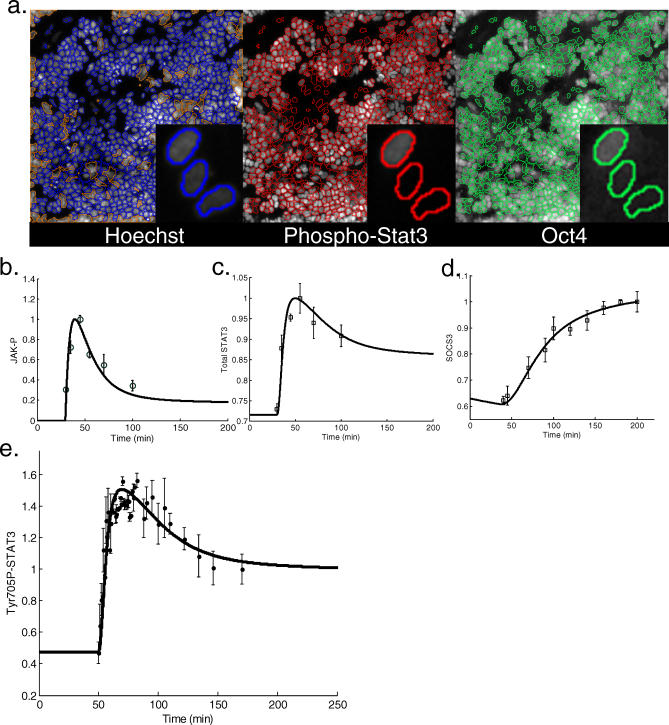
“Model consistency with experimental output was determined by quantitative image analysis of mouse ESCs [1].”
Myeloid leukaemia inhibitory factor maintains the developmental potential of embryonic stem cells
Williams, R. L., Hilton, D. J., Pease, S., Willson, T. A., Stewart, C. L., Gearing, D. P., Wagner, E. F., Metcalf, D., Nicola, N. A., & Gough, N. M. (1988) · Nature · doi:10.1038/336684a0 · Cited by 1,997 · cited 1×
“Jak/Stat3 (Janus kinase / signal transducer and activator of transcription-3) pathway [5].”
BackgroundSelf-renewal of pluripotent embryonic stem cells is mediated via activation of STAT3
Niwa, H., Burdon, T., Chambers, I., & Smith, A. (1998) · Genes & Development · doi:10.1101/gad.12.13.2048 · Cited by 1,549 · cited 1×
“in mouse ESCs [6–8].”
A Road Map for Those Who Don't Know JAK-STAT
Aaronson, D. S., & Horvath, C. M. (2002) · Science · doi:10.1126/science.1071545 · Cited by 1,337 · cited 7×
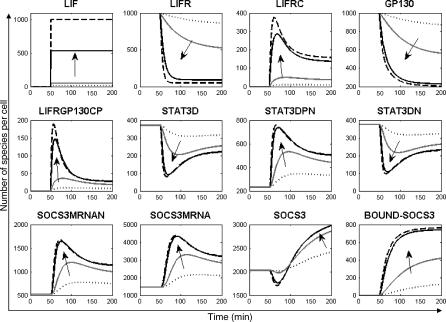
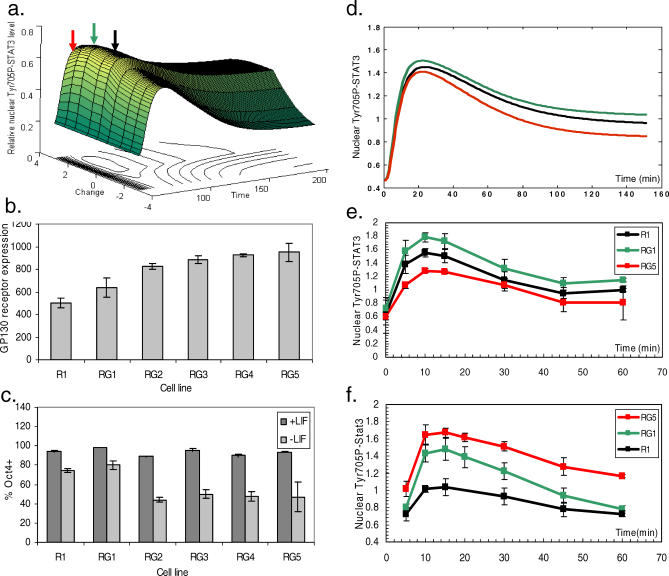
“In silico analysis suggested that transient formation of LIFR and GP130 nonsignaling receptor heterodimers, and sequestering of LIFR by GP130 in the overexpressing cells, is responsible for the observed results, which is consistent with previous reports [28].”
BackgroundInfluentialA comprehensive pathway map of epidermal growth factor receptor signaling
Oda, K., Matsuoka, Y., Funahashi, A., & Kitano, H. (2005) · Molecular Systems Biology · doi:10.1038/msb4100014 · Cited by 1,158
Dissecting self-renewal in stem cells with RNA interference
Ivanova, N., Dobrin, R., Lu, R., Kotenko, I., Levorse, J., DeCoste, C., Schafer, X., Lun, Y., & Lemischka, I. R. (2006) · Nature · doi:10.1038/nature04915 · Cited by 959
Schoeberl, B., Eichler-Jonsson, C., Gilles, E. D., & Müller, G. (2002) · Nature Biotechnology · doi:10.1038/nbt0402-370 · Cited by 950 · cited 2×
“Trafficking was assumed to be similar for all surface receptors [38].”
BackgroundResultSTAT3 activation is sufficient to maintain an undifferentiated state of mouse embryonic stem cells
Matsuda, T. (1999) · The EMBO Journal · doi:10.1093/emboj/18.15.4261 · Cited by 895 · cited 1×
“in mouse ESCs [6–8].”
Cited by
Zhang, X., Trame, M., Lesko, L., & Schmidt, S. (2015) · CPT: Pharmacometrics & Systems Pharmacology · doi:10.1002/psp4.6 · Cited by 467
“, the nuclear export and docking of Stat-3 to the activated receptor, were identified using sensitivity analysis.(52) Although most of the sensitivity analysis focused on the intracellular signaling pathway at a single scale, more and more multiscale systems pharmacology models are developed to understand the drug act…”
BackgroundChen, W. W., Schoeberl, B., Jasper, P. J., Niepel, M., Nielsen, U. B., Lauffenburger, D. A., & Sorger, P. K. (2009) · Molecular Systems Biology · doi:10.1038/msb.2008.74 · Cited by 391
“This method of calculating average local sensitivity has been discussed previously (Cukier et al , 1973; Bentele, 2004; Mahdavi, 2007) and has two advantages over simple sensitivity: (i) it accounts for the possibility that a fit does not precisely hit a nearby minimum due to problems with…”
MethodThe Systematic Production of Cells for Cell Therapies
Kirouac, D. C., & Zandstra, P. W. (2008) · Cell Stem Cell · doi:10.1016/j.stem.2008.09.001 · Cited by 301
“As a recent concrete example of the usefulness of such analysis, we have devised a temporal ligand delivery strategy to maximize ESC selfrenewal via modulating JAK-STAT3 pathway kinetics based purely on in silico analysis (Mahdavi et al., 2007).”
MethodSelf-citationBraun, D. A., Fribourg, M., & Sealfon, S. C. (2013) · Journal of Biological Chemistry · doi:10.1074/jbc.m112.386573 · Cited by 168
“These models build on previously developed JAK/STAT models (17–19) and used parameter values frompreviousmodels of STAT3 signaling (17).”
MethodGraf, U., Casanova, E. A., & Cinelli, P. (2011) · Genes · doi:10.3390/genes2010280 · Cited by 109
“[9] [10] [15] [13]”
Metadata
- Authors
- Mahdavi, A., Davey, R. E., Bhola, P., Yin, T., & Zandstra, P. W.
- Affiliations
- University of Toronto (CA)
- Corresponding author
- Zandstra, Peter W
- Venue
- PLoS Computational Biology
- Publisher
- Public Library of Science (PLoS)
- Published
- 2007-07-06
- Volume
- 3
- Issue
- 7
- Pages
- e130
- ISSN
- 1553-734X (ISSN-L)
- 1553-7358
- PMC
- PMC1913098
- OpenAlex
- W2015711590
- Cited by
- 65
- References
- 46
- Citations by year
- 2023: 2 · 2020: 1 · 2019: 1 · 2018: 3 · 2017: 1 · 2016: 2 · 2015: 4 · 2014: 3 · 2013: 8 · 2012: 9
- FWCI
- 4.20
- Type
- journal article
- Language
- en
- Open access
- gold
- doi.org
- Locations
- PLoS Computational Biology (publishedVersion, cc-by)
- Europe PMC (PubMed Central) (publishedVersion, cc-by)
- PubMed Central (publishedVersion, cc-by)
- PubMed (publishedVersion)
- DOAJ (DOAJ: Directory of Open Access Journals) (submittedVersion, cc-by-sa)
- Figshare (submittedVersion, cc-by)
- Funders
- Stem Cell Network
- Topics
- Life Sciences › Immunology and Microbiology › Immunology › Cytokine Signaling Pathways and Interactions
- Life Sciences › Biochemistry, Genetics and Molecular Biology › Molecular Biology › Gene Regulatory Network Analysis
- Life Sciences › Biochemistry, Genetics and Molecular Biology › Molecular Biology › Pluripotent Stem Cells Research
- Keywords
- STAT3 signaling, embryonic stem cell self-renewal, stem cell fate control, receptor tyrosine kinase signaling, gp130, suppressor of cytokine signaling, receptor trafficking, signaling network modeling
- MeSH terms
- Animals, Cell Differentiation, Computer Simulation, Enzyme Activation, Gene Expression Regulation, Kinetics, Ligands, Models, Biological, Sensitivity and Specificity, Stem Cells, Time Factors, Signal Transduction, Gene Expression, Cytokines, Active Transport, Cell Nucleus, STAT3 Transcription Factor, Cytokine Receptor gp130, Mice
About these checks
Registry, retraction, Cites and statistics results are computed, not judged, with one exception: a printed reference that no index lists is read once by a model before it counts as a citation error. Claims are extracted by a model and kept only when their quote appears verbatim in the text; each cited source is then checked, with a model’s help, for whether it says what the claim relies on. Those verdicts can be wrong — read the claim’s quote and the cited source before relying on one.
Statistics and arithmetic are recomputed, not judged.
Confidence bands are shown only for fields calibrated on our annotated test set. None is calibrated yet, so no band is shown.
What counts as a claim ›How we measure confidence ›How we check this ›
Are you an author, or do you see a problem with this page? Request a review
How to cite
Cite CoChat for the checks on this page, and the paper for its own findings.
- This page
- CoChat. (2026). Citation check: Sensitivity Analysis of Intracellular Signaling Pathway Kinetics Predicts Targets for Stem Cell Fate Control. https://app.cochat.ai/papers/10.1371/journal.pcbi.0030130
- The paper
- Mahdavi, A., Davey, R. E., Bhola, P., Yin, T., & Zandstra, P. W. (2007). Sensitivity Analysis of Intracellular Signaling Pathway Kinetics Predicts Targets for Stem Cell Fate Control. PLoS Computational Biology. https://doi.org/10.1371/journal.pcbi.0030130
Data sources
Bibliographic data: Semantic Scholar, OpenAlex, Crossref.
Contains information from the Semantic Scholar Academic Graph Datasets, made available under the ODC Attribution License (ODC-BY 1.0).
Semantic Scholar’s data is described in: Kinney, R., et al. (2023). The Semantic Scholar Open Data Platform. arXiv:2301.10140.
