

The DOI matches its Crossref record; 53 of the 55 references it cites were found in a registry or an index.
Geometric De-noising of Protein-Protein Interaction Networks
Open accessAbstract
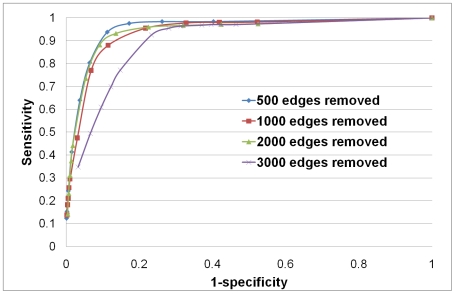
Understanding complex networks of protein-protein interactions (PPIs) is one of the foremost challenges of the post-genomic era. Due to the recent advances in experimental bio-technology, including yeast-2-hybrid (Y2H), tandem affinity purification (TAP) and other high-throughput methods for protein-protein interaction (PPI) detection, huge amounts of PPI network data are becoming available. Of major concern, however, are the levels of noise and incompleteness. For example, for Y2H screens, it is thought that the false positive rate could be as high as 64%, and the false negative rate may range from 43% to 71%. TAP experiments are believed to have comparable levels of noise.We present a novel technique to assess the confidence levels of interactions in PPI networks obtained from experimental studies. We use it for predicting new interactions and thus for guiding future biological experiments. This technique is the first to utilize currently the best fitting network model for PPI networks, geometric graphs. Our approach achieves specificity of 85% and sensitivity of 90%. We use it to assign confidence scores to physical protein-protein interactions in the human PPI network downloaded from BioGRID. Using our approach, we predict 251 interactions in the human PPI network, a statistically significant fraction of which correspond to protein pairs sharing common GO terms. Moreover, we validate a statistically significant portion of our predicted interactions in the HPRD database and the newer release of BioGRID. The data and Matlab code implementing the methods are freely available from the web site: http://www.kuchaev.com/Denoising.
Overview
The claims and statistics of this paper haven’t been checked yet.
Run the check — free, no account needed. It reads the open-access text and checks the sources it cites.
Integrity signals
Registry
Cites
Statistics
Figures
Verification
Claims the paper makes
The claims and statistics of this paper haven’t been checked yet.
Run the check — free, no account needed. It reads the open-access text and checks the sources it cites.
Claims other papers make about this one
Each is checked against this paper’s own text: does it say what the citing paper says it does?
In the citing paper
“Yeast two hybrid (Y2H), affinity-purification mass spectrometry (APMS), and other high-throughput experimental approaches have identified many pairs of interacting proteins in yeast and other organisms (1–5), but there are discrepancies between sets generated using the different methods and considerable false positive and false negative rates (6–8).”
From Computed structures of core eukaryotic protein complexes (2021) · cites this paper as [6]
Self-check
Percentages, sums and reported differences re-computed from the paper’s own numbers.
The self-check needs the paper’s full text.
Citations
Cites
Gene Ontology: tool for the unification of biology
Ashburner, M., Ball, C. A., Blake, J. A., Botstein, D., Butler, H., Cherry, J. M., Davis, A. P., Dolinski, K., Dwight, S. S., Eppig, J. T., et al. (2000) · Nature Genetics · doi:10.1038/75556 · Cited by 43,206
Emergence of Scaling in Random Networks
Barabási, A.-L., & Albert, R. (1999) · Science · doi:10.1126/science.286.5439.509 · Cited by 36,135
Golub, G. (2012) · doi:10.56021/9781421407944 · Cited by 34,505
Book Review: Pattern Recognition and Machine Learning
Nasrabadi, N. M. (2007) · Journal of Electronic Imaging · doi:10.1117/1.2819119 · Cited by 22,066
Pattern Recognition and Machine Learning
(2006) · doi:10.1007/978-0-387-45528-0 · Cited by 9,824
KEGG for linking genomes to life and the environment
Kanehisa, M. I., Araki, M., Goto, S., Hattori, M., Hirakawa, M., Itoh, M., Katayama, T., Kawashima, S., Okuda, S., Tokimatsu, T., et al. (2007) · Nucleic Acids Research · doi:10.1093/nar/gkm882 · Cited by 6,828
Erdős, P., & Rényi, A. (2022) · Publicationes Mathematicae Debrecen · doi:10.5486/pmd.1959.6.3-4.12 · Cited by 5,337
A comprehensive analysis of protein–protein interactions in Saccharomyces cerevisiae
Uetz, P., Giot, L., Cagney, G., Mansfield, T. A., Judson, R. S., Knight, J. R., Lockshon, D., Narayan, V., Srinivasan, M., Pochart, P., et al. (2000) · Nature · doi:10.1038/35001009 · Cited by 4,706
BioGRID: a general repository for interaction datasets
Stark, C. (2006) · Nucleic Acids Research · doi:10.1093/nar/gkj109 · Cited by 3,960
Systematic identification of protein complexes in Saccharomyces cerevisiae by mass spectrometry
Ho, Y., Gruhler, A., Heilbut, A. M., Bader, G. D., Moore, L., Adams, S., Millar, A., Taylor, P. P., Bennett, K. L., Boutilier, K., et al. (2002) · Nature · doi:10.1038/415180a · Cited by 3,573
Cited by
Sorted by citations
Computed structures of core eukaryotic protein complexes
Humphreys, I. R., Pei, J., Baek, M., Krishnakumar, A., Anishchenko, I., Ovchinnikov, S., Zhang, J., Ness, T. J., Banjade, S., Bagde, S. R., et al. (2021) · Science · doi:10.1126/science.abm4805 · Cited by 542
Link prediction techniques, applications, and performance: A survey
Kumar, A., Singh, S. S., Singh, K., & Biswas, B. (2020) · Physica A Statistical Mechanics and its Applications · doi:10.1016/j.physa.2020.124289 · Cited by 549
Analyzing and interpreting genome data at the network level with ConsensusPathDB
Herwig, R., Hardt, C., Lienhard, M., & Kamburov, A. (2016) · Nature Protocols · doi:10.1038/nprot.2016.117 · Cited by 408
Cannistraci, C. V., Alanis‐Lobato, G., & Ravasi, T. (2013) · Scientific Reports · doi:10.1038/srep01613 · Cited by 403
Causal Network Inference by Optimal Causation Entropy
Sun, J., Taylor, D., & Bollt, E. M. (2015) · SIAM Journal on Applied Dynamical Systems · doi:10.1137/140956166 · Cited by 219
Metadata
- Authors
- Kuchaiev, O., Rašajski, M., Higham, D. J., & Pržulj, N.
- Affiliations
- University of California, Irvine (US)
- University of Strathclyde (GB)
- Corresponding author
- Pržulj, Nataša
- Venue
- PLoS Computational Biology
- Publisher
- Public Library of Science (PLoS)
- Published
- 2009-08-07
- Volume
- 5
- Issue
- 8
- Pages
- e1000454
- ISSN
- 1553-734X (ISSN-L)
- 1553-7358
- PMC
- PMC2711306
- OpenAlex
- W2050583899
- Cited by
- 180
- References
- 55
- Citations by year
- 2026: 1 · 2025: 4 · 2024: 4 · 2023: 7 · 2022: 9 · 2021: 11 · 2020: 13 · 2019: 10 · 2018: 9 · 2017: 8 · 2016: 11 · 2015: 18 · 2014: 13 · 2013: 17 · 2012: 24
- FWCI
- 6.03
- Type
- journal article
- Language
- en
- Open access
- gold
- doi.org
- Locations
- PLoS Computational Biology (publishedVersion, cc-by)
- PubMed Central (publishedVersion, cc-by)
- PubMed (publishedVersion)
- RePEc: Research Papers in Economics (submittedVersion)
- DOAJ (DOAJ: Directory of Open Access Journals) (submittedVersion, cc-by-sa)
- UCL Discovery (University College London) (submittedVersion)
- eScholarship (California Digital Library) (submittedVersion, cc-by)
- Figshare (submittedVersion, cc-by)
- Strathprints: The University of Strathclyde institutional repository (University of Strathclyde) (submittedVersion)
- Funders
- National Science Foundation (0644424, CAREER)
- Engineering and Physical Sciences Research Council (GR/S62383/01, EP/E049370/1)
- Topics
- Life Sciences › Biochemistry, Genetics and Molecular Biology › Molecular Biology › Bioinformatics and Genomic Networks
- Physical Sciences › Physics and Astronomy › Statistical and Nonlinear Physics › Complex Network Analysis Techniques
- Life Sciences › Biochemistry, Genetics and Molecular Biology › Molecular Biology › Gene Regulatory Network Analysis
- Keywords
- protein-protein interaction network, geometric graphs, interaction prediction, false positive interactions, BioGRID, Gene Ontology terms, HPRD
- MeSH terms
- Algorithms, Humans, Models, Biological, Proteins, ROC Curve, Sensitivity and Specificity, Reproducibility of Results, Signal Transduction, Computational Biology, Protein Interaction Mapping, Databases, Protein
About these checks
Registry, retraction, Cites and statistics results are computed, not judged, with one exception: a printed reference that no index lists is read once by a model before it counts as a citation error. Claims are extracted by a model and kept only when their quote appears verbatim in the text; each cited source is then checked, with a model’s help, for whether it says what the claim relies on. Those verdicts can be wrong — read the claim’s quote and the cited source before relying on one.
Statistics and arithmetic are recomputed, not judged.
Confidence bands are shown only for fields calibrated on our annotated test set. None is calibrated yet, so no band is shown.
What counts as a claim ›How we measure confidence ›How we check this ›
Are you an author, or do you see a problem with this page? Request a review
