

The DOI matches its Crossref record; 50 of the 52 references it cites were found in a registry or an index.
Risk, Unexpected Uncertainty, and Estimation Uncertainty: Bayesian Learning in Unstable Settings
Open accessAbstract
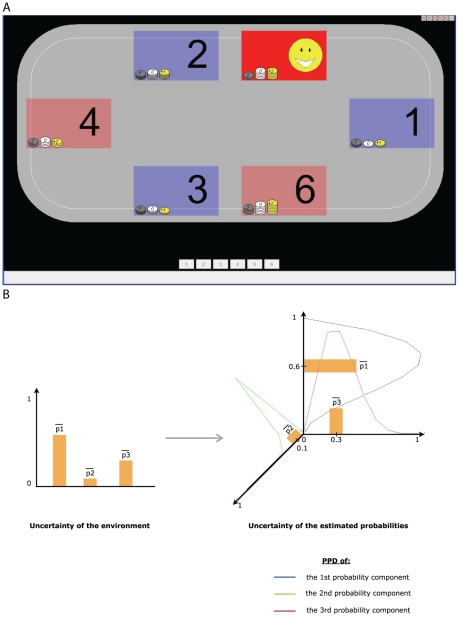
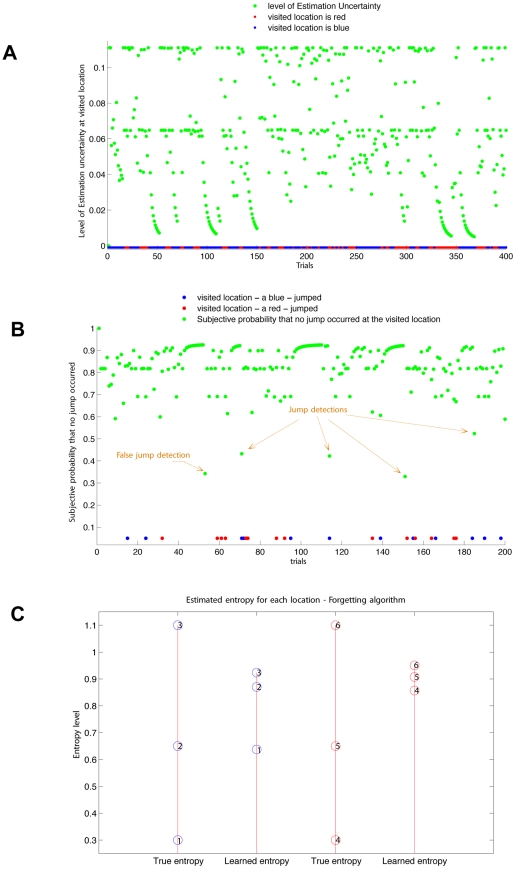
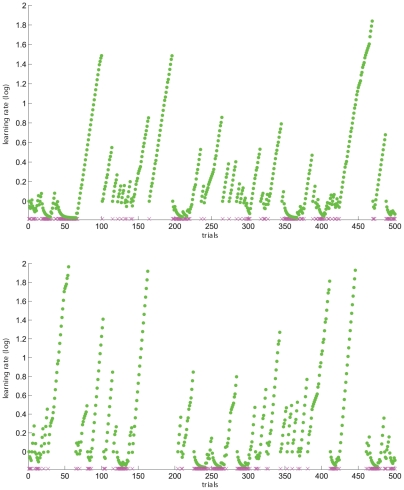
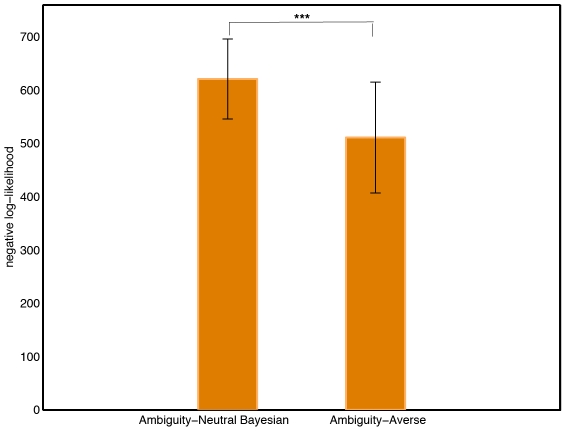
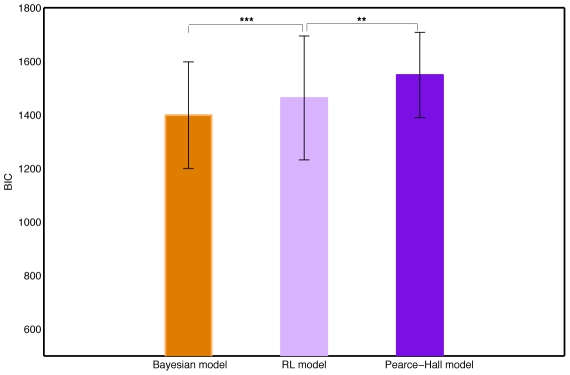
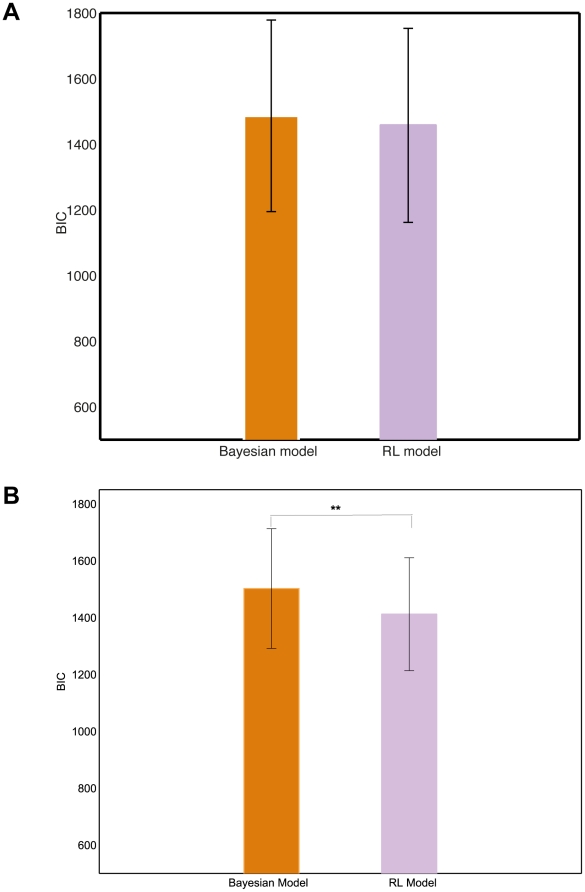
Recently, evidence has emerged that humans approach learning using Bayesian updating rather than (model-free) reinforcement algorithms in a six-arm restless bandit problem. Here, we investigate what this implies for human appreciation of uncertainty. In our task, a Bayesian learner distinguishes three equally salient levels of uncertainty. First, the Bayesian perceives irreducible uncertainty or risk: even knowing the payoff probabilities of a given arm, the outcome remains uncertain. Second, there is (parameter) estimation uncertainty or ambiguity: payoff probabilities are unknown and need to be estimated. Third, the outcome probabilities of the arms change: the sudden jumps are referred to as unexpected uncertainty. We document how the three levels of uncertainty evolved during the course of our experiment and how it affected the learning rate. We then zoom in on estimation uncertainty, which has been suggested to be a driving force in exploration, in spite of evidence of widespread aversion to ambiguity. Our data corroborate the latter. We discuss neural evidence that foreshadowed the ability of humans to distinguish between the three levels of uncertainty. Finally, we investigate the boundaries of human capacity to implement Bayesian learning. We repeat the experiment with different instructions, reflecting varying levels of structural uncertainty. Under this fourth notion of uncertainty, choices were no better explained by Bayesian updating than by (model-free) reinforcement learning. Exit questionnaires revealed that participants remained unaware of the presence of unexpected uncertainty and failed to acquire the right model with which to implement Bayesian updating.
Overview
The claims and statistics of this paper haven’t been checked yet.
Run the check — free, no account needed. It reads the open-access text and checks the sources it cites.
Integrity signals
Registry
Cites
Statistics
Figures
Verification
Claims the paper makes
The claims and statistics of this paper haven’t been checked yet.
Run the check — free, no account needed. It reads the open-access text and checks the sources it cites.
Claims other papers make about this one
Each is checked against this paper’s own text: does it say what the citing paper says it does?
The cited source says what the claim attributes to it.
In the citing paper
“Here, deviations from expected uncertainty (“unexpected uncertainty”) should increase learning rates.8,12,13,15–18”
From Serotonin neurons modulate learning rate through uncertainty (2022) · cites this paper as [15]
Self-check
Percentages, sums and reported differences re-computed from the paper’s own numbers.
The self-check needs the paper’s full text.
Citations
Cites
Kass, R. E., & Raftery, A. E. (1995) · Journal of the American Statistical Association · doi:10.1080/01621459.1995.10476572 · Cited by 12,558
Nudge: improving decisions about health, wealth, and happiness
(2008) · Choice Reviews Online · doi:10.5860/choice.46-0977 · Cited by 11,624
Knight, F. H. (1921) · Cited by 9,967
“Risk, Ambiguity, and the Savage Axioms.”
Ellsberg, D. (1961) · The Quarterly Journal of Economics · doi:10.2307/1884324 · Cited by 7,891
Statistical Decision Theory and Bayesian Analysis
Berger, J. O. (1985) · Springer Series in Statistics · doi:10.1007/978-1-4757-4286-2 · Cited by 7,722
Rescorla, R. A. (1972) · Medical Entomology and Zoology · Cited by 7,268
Nudge: Improving Decisions About Health, Wealth and Happiness
Adkisson, R. V. (2008) · The Social Science Journal · doi:10.1016/j.soscij.2008.09.003 · Cited by 5,706
Aston-Jones, G., & Cohen, J. D. (2005) · Annual Review of Neuroscience · doi:10.1146/annurev.neuro.28.061604.135709 · Cited by 4,472
Classical conditioning II: Current research and theory.
Black, A. H., & Prokasy, W. F. (1972) · Appleton-Century-Crofts eBooks · Cited by 4,449
Allais, M. (1953) · Econometrica · doi:10.2307/1907921 · Cited by 4,054
Cited by
Sorted by citations
Neural computations underlying arbitration between model-based and model-free learning
Lee, S. W., Shimojo, S., & O’Doherty, J. P. (2014) · Neuron · doi:10.1016/j.neuron.2013.11.028 · Cited by 642
Humans use directed and random exploration to solve the explore–exploit dilemma.
Wilson, R. C., Geana, A., White, J. M., Ludvig, E. A., & Cohen, J. D. (2014) · Journal of Experimental Psychology: General · doi:10.1037/a0038199 · Cited by 580
Uncertainty in perception and the Hierarchical Gaussian Filter
Mathys, C. D., Lomakina, E. I., Daunizeau, J., Iglesias, S., Brodersen, K. H., Friston, K. J., & Stephan, K. E. (2014) · Frontiers in Human Neuroscience · doi:10.3389/fnhum.2014.00825 · Cited by 465
PhysiCell: An open source physics-based cell simulator for 3-D multicellular systems
Ghaffarizadeh, A., Heiland, R. W., Friedman, S. H., Mumenthaler, S. M., & Macklin, P. (2018) · PLoS Computational Biology · doi:10.1371/journal.pcbi.1005991 · Cited by 486
Confidence as Bayesian probability: From neural origins to behavior
Meyniel, F., Sigman, M., & Mainen, Z. F. (2015) · Neuron · doi:10.1016/j.neuron.2015.09.039 · Cited by 349
Metadata
- Authors
- Payzan-LeNestour, E., & Bossaerts, P.
- Affiliations
- California Institute of Technology (US)
- ORCID
- Bossaerts, Peter
- Venue
- PLoS Computational Biology
- Publisher
- Public Library of Science (PLoS)
- Published
- 2011-01-20
- Volume
- 7
- Issue
- 1
- Pages
- e1001048
- ISSN
- 1553-734X (ISSN-L)
- 1553-7358
- PMC
- PMC3024253
- OpenAlex
- W2027554764
- Cited by
- 267
- References
- 52
- Citations by year
- 2026: 10 · 2025: 31 · 2024: 24 · 2023: 16 · 2022: 16 · 2021: 18 · 2020: 22 · 2019: 22 · 2018: 19 · 2017: 20 · 2016: 19 · 2015: 18 · 2014: 11 · 2013: 12 · 2012: 8
- FWCI
- 5.59
- Type
- journal article
- Language
- en
- Open access
- gold
- doi.org
- Locations
- PLoS Computational Biology (publishedVersion, cc-by)
- PubMed Central (publishedVersion, cc-by)
- PubMed (publishedVersion)
- Minerva Access (University of Melbourne) (submittedVersion, cc-by)
- CaltechAUTHORS (California Institute of Technology) (submittedVersion, cc-by)
- RePEc: Research Papers in Economics (submittedVersion)
- DOAJ (DOAJ: Directory of Open Access Journals) (submittedVersion, cc-by-sa)
- Figshare (submittedVersion, cc-by)
- Infoscience (Ecole Polytechnique Fédérale de Lausanne) (submittedVersion)
- Infoscience (Ecole Polytechnique Fédérale de Lausanne) (submittedVersion, cc-by-nc-nd)
- Funders
- National Science Foundation
- Swiss Finance Institute
- Schweizerischer Nationalfonds zur Förderung der Wissenschaftlichen Forschung
- Topics
- Social Sciences › Decision Sciences › General Decision Sciences › Decision-Making and Behavioral Economics
- Life Sciences › Neuroscience › Cognitive Neuroscience › Neural and Behavioral Psychology Studies
- Social Sciences › Decision Sciences › Management Science and Operations Research › Advanced Bandit Algorithms Research
- Keywords
- Bayesian learning, restless bandits, risk, estimation uncertainty, ambiguity, structural uncertainty, exploration, learning rate, model-free reinforcement learning, human decision-making, perceived uncertainty, ambiguity aversion
- MeSH terms
- Bayes Theorem, Probability, Risk, Uncertainty
About these checks
Registry, retraction, Cites and statistics results are computed, not judged, with one exception: a printed reference that no index lists is read once by a model before it counts as a citation error. Claims are extracted by a model and kept only when their quote appears verbatim in the text; each cited source is then checked, with a model’s help, for whether it says what the claim relies on. Those verdicts can be wrong — read the claim’s quote and the cited source before relying on one.
Statistics and arithmetic are recomputed, not judged.
Confidence bands are shown only for fields calibrated on our annotated test set. None is calibrated yet, so no band is shown.
What counts as a claim ›How we measure confidence ›How we check this ›
Are you an author, or do you see a problem with this page? Request a review
