

Ten simple rules for structuring papers
Open accessPublished version of a preprint
The DOI matches its Crossref record; 22 of the 23 references it cites were found in a registry or an index; 3 of the 7 sources its claims cite were checked for support.
Abstract
Good scientific writing is essential to career development and to the progress of science. A well-structured manuscript allows readers and reviewers to get excited about the subject matter, to understand and verify the paper's contributions, and to integrate these contributions into a broader context. However, many scientists struggle with producing high-quality manuscripts and are typically untrained in paper writing. Focusing on how readers consume information, we present a set of ten simple rules to help you communicate the main idea of your paper. These rules are designed to make your paper more influential and the process of writing more efficient and pleasurable.
Overview
CoChat Summary
TL;DR
This guideline article presents ten simple rules for structuring scientific papers, organized around reader-focused principles, the components of a paper, and the writing process. It argues that clear context-content-conclusion structure at multiple scales makes papers more credible, memorable, and influential.
Key findings
- The paper proposes ten rules, grouped into principles (Rules 1–4), components of a paper (Rules 5–8), and process (Rules 9–10).
- Rule 1 advises focusing on a single central contribution communicated in the title; papers that focus on multiple contributions tend to be less convincing about each and therefore less memorable.
- Rules 2–4 recommend writing for naïve readers, using the context-content-conclusion (C-C-C) scheme at multiple scales, and optimizing logical flow by avoiding zig-zag and using parallelism.
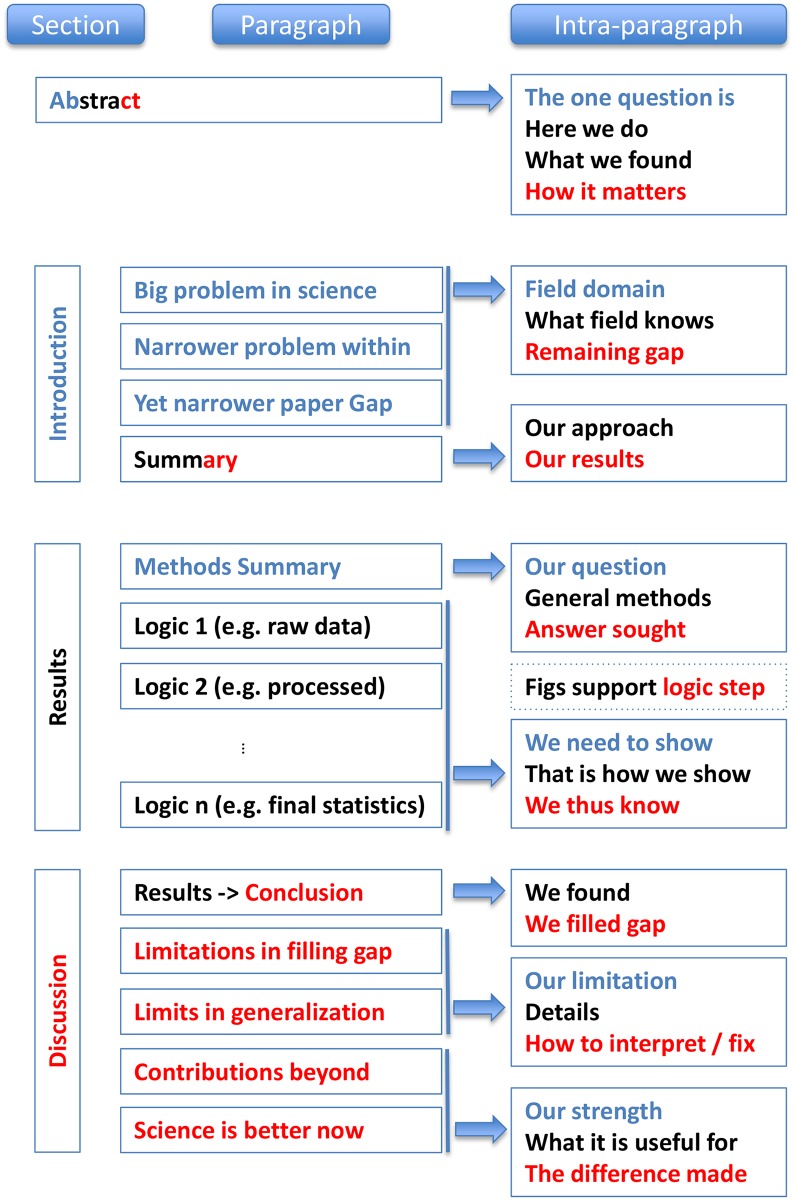
- Rules 5–8 describe specialized structures for the abstract, introduction, results, and discussion; Rules 9–10 advise allocating time to title, abstract, figures, and outlining, and getting feedback to iteratively improve the story.
Methods
- Design: The paper is a conceptual/guideline article that presents ten rules for structuring papers, divided into principles (Rules 1–4), components (Rules 5–8), and process (Rules 9–10).
- Data or sample: Not stated in the paper; no empirical dataset or sample is reported.
- Main analysis: Not stated in the paper; the text synthesizes writing guidance, examples, and a summary table of rule violations rather than reporting an empirical analysis.
Limitations
- The paper states that it “had to gloss over many finer points of writing, including word choice and grammar, the creative process, and collaboration,” and that “a paper about writing can never be complete.”
- The paper states that the advocated C-C-C scheme “may not optimally engage the impatient reader.”
- Evident from the text: the ten rules are prescriptive recommendations without empirical validation in this paper; no data are presented to test their effectiveness.
Model-written summary. Check it against the paper before relying on it.
Integrity signals
Registry
Cites
Statistics
Figures
Verification
Claims the paper makes
3 Valid · 0 Not valid · 4 Not checked · 38 Own results and interpretations
In the paper
“people have working memory constraints in that they can only remember a small number of items”
§ Ten simple rules for structuring papers > Principles (Rules 1–4) > Rule 2: Write for flesh-and-blood human beings who do not know your work
What the sources say
- Not checked — no full text of the sourcecites [5] BB Murdock Jr, 1968, Serial order effects in short-term memory, J Exp Psychol source
plain- Asserted: passes — The authors put it forward as true.
- Checkable: passes — It can be checked against evidence.
- Load-bearing: passes — The paper’s conclusions depend on it.
- Based: passes — The paper gives a reason why it holds.
In the paper
“are better at remembering the beginning and the end of a list than the middle [5]”
§ Ten simple rules for structuring papers > Principles (Rules 1–4) > Rule 2: Write for flesh-and-blood human beings who do not know your work
What the sources say
- Not checked — no full text of the sourcecites [5] BB Murdock Jr, 1968, Serial order effects in short-term memory, J Exp Psychol source
plainstates an association- Asserted: passes — The authors put it forward as true.
- Checkable: passes — It can be checked against evidence.
- Load-bearing: passes — The paper’s conclusions depend on it.
- Based: passes — The paper gives a reason why it holds.
1 reference still to check
A free account verifies the references that are still open.
- Probably not a substantial claim. 43
- It may state two separate claims as one. 5
Citations
Cites
An index to quantify an individual’s scientific research output
Hirsch, J. E. (2005) · Proceedings of the National Academy of Sciences · doi:10.1073/pnas.0507655102 · Cited by 11,669 · cited 1×
“Indeed, success at publishing is used to evaluate scientists [1] and can help predict their future success [2].”
BackgroundTufte, E. (1991) · Optometry and Vision Science · doi:10.1097/00006324-199104000-00013 · Cited by 3,963
Kemp, C. D., & Tufte, E. R. (1992) · Biometrics · doi:10.2307/2532323 · Cited by 2,713
The Visual Display of Quantitative Information.
Fayers, P., & Tufte, E. R. (1990) · Journal of the Royal Statistical Society. Series A (Statistics in Society) · doi:10.2307/2983122 · Cited by 1,936
How to write and publish a scientific paper
(1990) · Mathematics and Computers in Simulation · doi:10.1016/0378-4754(90)90195-o · Cited by 569
The Visual Display of Quantitative Information
Carr, D. (1987) · Technometrics · doi:10.1080/00401706.1987.10488194 · Cited by 541
Tufte, E. R. (1991) · Optometry and Vision Science · doi:10.1002/j.1538-9235.1991.tb02715.x · Cited by 482
The sense of style: the thinking person's guide to writing in the 21st century!
(2015) · Choice Reviews Online · doi:10.5860/choice.191126 · Cited by 481 · cited 1×
“A paper about writing can never be complete; as such there is a large literature dealing with issues of scientific writing [9,10,11,12,13,14,15,16,17].”
BackgroundThe Science of Scientific Writing
Gopen, G. D., & Swan, J. A. (1990) · American Scientist · Cited by 345
Acuna, D. E., Allesina, S., & Kording, K. P. (2012) · Nature · doi:10.1038/489201a · Cited by 249 · cited 1×
“Indeed, success at publishing is used to evaluate scientists [1] and can help predict their future success [2].”
BackgroundSelf-citationArticles with short titles describing the results are cited more often
Paiva, C. E., Lima, J. P. D. S. N., & Paiva, B. S. R. (2012) · Clinics · doi:10.6061/clinics/2012(05)17 · Cited by 196 · cited 1×
“The title is typically the first element a reader encounters, so its quality [3] determines whether the reader will invest time in reading the abstract.”
BackgroundSerial order effects in short-term memory
Murdock, B. B. (1968) · Journal of Experimental Psychology · doi:10.1037/h0025694 · Cited by 126 · cited 1×
“For example, people have working memory constraints in that they can only remember a small number of items and are better at remembering the beginning and the end of a list than the middle [5].”
Background(2011) · Cited by 90
How to Write and Publish a Scientific Paper
Lewis, E. P., & Day, R. A. (1984) · AJN American Journal of Nursing · doi:10.2307/3463326 · Cited by 89
Writing science: how to write papers that get cited and proposals that get funded
García‐Granda, S. (2013) · Crystallography Reviews · doi:10.1080/0889311x.2013.769529 · Cited by 72
The Compleat academic : a practical guide for the beginning social scientist
mark-p-zanna-and-john-m-darley (1986) · Cited by 70
How to Write and Publish a Scientific Paper
Salzberg, K. A., & Day, R. A. (1989) · Arctic and Alpine Research · doi:10.2307/1551638 · Cited by 62
Lester, J. D. (1999) · Cited by 45
Kabara, T. (2014) · Institutional Repositories DataBase (IRDB) · doi:10.18999/nuid.3.1.53 · Cited by 41
Zanna, M. P., & Darley, J. M. (2021) · Psychology Press eBooks · doi:10.4324/9781315808314 · Cited by 19
Jugdev, K., & Wyzalek, J. (2024) · Routledge eBooks · doi:10.4324/9781003469513-28 · Cited by 16
Designing Science Presentations: A Visual Guide to Figures, Papers, Slides, Posters, and More
Carter, M. (2012) · Cited by 15
Cited by
The use of artificial intelligence to improve the scientific writing of non-native english speakers
Giglio, A. D., & Costa, M. U. P. D. (2023) · Revista da Associação Médica Brasileira · doi:10.1590/1806-9282.20230560 · Cited by 158
New insights into GluT1 mechanics during glucose transfer
Galochkina, T., Ng Fuk Chong, M., Challali, L., Abbar, S., & Etchebest, C. (2019) · Scientific Reports · doi:10.1038/s41598-018-37367-z · Cited by 91
A representational similarity analysis of cognitive control during color-word Stroop
Freund, M. C., Bugg, J. M., & Braver, T. S. (2021) · Journal of Neuroscience · doi:10.1523/jneurosci.2956-20.2021 · Cited by 78
Boundary effects of expectation in human pain perception
Hird, E. J., Charalambous, C., El-Deredy, W., Jones, A. K. P., & Talmi, D. (2019) · Scientific Reports · doi:10.1038/s41598-019-45811-x · Cited by 68
Forest and land fires, toxic haze and local politics in Indonesia
Purnomo, H., Okarda, B., Shantiko, B., Achdiawan, R., Dermawan, A., Kartodihardjo, H., & Dewayani, A. A. (2019) · The International Forestry Review · doi:10.1505/146554819827906799 · Cited by 76
“This is the limitation of this article that should be stated explicitly, as suggested by Mensh and Kording (2017).”
Background
Metadata
- Authors
- Mensh, B., & Kording, K.
- Affiliations
- Howard Hughes Medical Institute (US)
- Northwestern University (US)
- Corresponding author
- Mensh, Brett
- Kording, Konrad
- Venue
- PLOS Computational Biology
- Publisher
- Public Library of Science (PLoS)
- Published
- 2017-09-28
- Volume
- 13
- Issue
- 9
- Pages
- e1005619
- ISSN
- 1553-734X (ISSN-L)
- 1553-7358
- PMC
- PMC5619685
- OpenAlex
- W2951545764
- Cited by
- 98
- References
- 23
- Citations by year
- 2026: 15 · 2025: 13 · 2024: 9 · 2023: 11 · 2022: 8 · 2021: 10 · 2020: 11 · 2019: 9 · 2018: 11 · 2017: 1
- Type
- journal article
- Language
- en
- Update notices
- correction (2017-11-09)
- Open access
- gold
- doi.org
- Licence
- Locations
- PLoS Computational Biology (publishedVersion, cc-by)
- bioRxiv (Cold Spring Harbor Laboratory) (submittedVersion, cc-by-nc)
- Europe PMC (PubMed Central) (publishedVersion, cc-by)
- PubMed Central (publishedVersion, cc-by)
- PubMed (publishedVersion)
- RePEc: Research Papers in Economics (submittedVersion)
- DOAJ (DOAJ: Directory of Open Access Journals) (submittedVersion, cc-by-sa)
- Topics
- Social Sciences › Library and Information Sciences › Academic Writing and Publishing
- Social Sciences › Library and Information Sciences › Academic Publishing and Open Access
- Social Sciences › Library and Information Sciences › Publishing and Scholarly Communication
- Keywords
- scientific writing, manuscript structure, writing rules, reader comprehension, science communication, peer review, writing efficiency
- MeSH terms
- Algorithms, Documentation, Periodicals as Topic, Research, Science, Writing
About these checks
Registry, retraction, Cites and statistics results are computed, not judged, with one exception: a printed reference that no index lists is read once by a model before it counts as a citation error. Claims are extracted by a model and kept only when their quote appears verbatim in the text; each cited source is then checked, with a model’s help, for whether it says what the claim relies on. Those verdicts can be wrong — read the claim’s quote and the cited source before relying on one.
The claim verdicts this report counts are experimental: their accuracy is not yet measured.
A language model drew the claims from the paper on 2026-10-10, under version 3 of the claim definition (model deepseek-v4.1-flash, prompt extract-v3).
A second model labelled each claim on 2026-10-10 (model jev-1.13-20260917, definition revision gold-guideline-v0.2).
Statistics and arithmetic are recomputed, not judged.
Confidence bands are shown only for fields calibrated on our annotated test set. None is calibrated yet, so no band is shown.
What counts as a claim ›How we measure confidence ›How we check this ›
Are you an author, or do you see a problem with this page? Request a review
Data sources
Bibliographic data: Semantic Scholar, OpenAlex, Crossref.
Contains information from the Semantic Scholar Academic Graph Datasets, made available under the ODC Attribution License (ODC-BY 1.0).
Semantic Scholar’s data is described in: Kinney, R., et al. (2023). The Semantic Scholar Open Data Platform. arXiv:2301.10140.
