

The DOI matches its Crossref record; 77 of the 77 references it cites were found in a registry or an index.
Mutual influence between language and perception in multi-agent communication games
Open accessAbstract
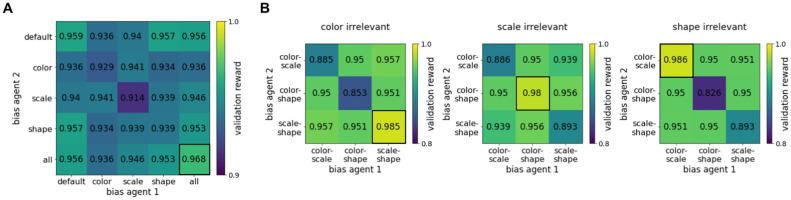
Language interfaces with many other cognitive domains. This paper explores how interactions at these interfaces can be studied with deep learning methods, focusing on the relation between language emergence and visual perception. To model the emergence of language, a sender and a receiver agent are trained on a reference game. The agents are implemented as deep neural networks, with dedicated vision and language modules. Motivated by the mutual influence between language and perception in cognition, we apply systematic manipulations to the agents’ (i) visual representations, to analyze the effects on emergent communication, and (ii) communication protocols, to analyze the effects on visual representations. Our analyses show that perceptual biases shape semantic categorization and communicative content. Conversely, if the communication protocol partitions object space along certain attributes, agents learn to represent visual information about these attributes more accurately, and the representations of communication partners align. Finally, an evolutionary analysis suggests that visual representations may be shaped in part to facilitate the communication of environmentally relevant distinctions. Aside from accounting for co-adaptation effects between language and perception, our results point out ways to modulate and improve visual representation learning and emergent communication in artificial agents.
Overview
The claims and statistics of this paper haven’t been checked yet.
Free: it reads the open-access text and checks the first 5 claims that cite a source we can check. Create a free account to check every claim.
Integrity signals
Registry
Cites
Statistics
Figures



Verification
Claims the paper makes
The claims and statistics of this paper haven’t been checked yet.
Free: it reads the open-access text and checks the first 5 claims that cite a source we can check. Create a free account to check every claim.
Claims other papers make about this one
Each is checked against this paper’s own text: does it say what the citing paper says it does?
The cited source says what the claim attributes to it.
In the citing paper
“Evidence for the efficient communication hypothesis has been found in the context of kinship [18] and color [22–25] systems.”
From The role of pragmatic mechanisms in referential communication and categorization: An emergent communication model (2026) · cites this paper as [24]
Self-check
Percentages, sums and reported differences re-computed from the paper’s own numbers.
The self-check needs the paper’s full text.
Citations
Cites
(2008) · Journal of Machine Learning Research · Cited by 33,051
Learning Phrase Representations using RNN Encoder–Decoder for Statistical Machine Translation
Cho, K., van Merrienboer, B., Gulcehre, C., Bahdanau, D., Bougares, F., Schwenk, H., & Bengio, Y. (2014) · Proceedings of the 2014 Conference on Empirical Methods in Natural Language Processing (EMNLP) · doi:10.3115/v1/d14-1179 · Cited by 25,545 · cited 1×
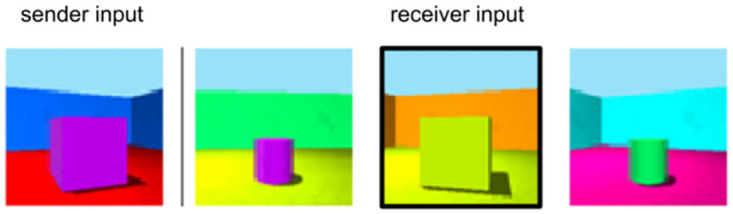
“The language module, l ( · ) , consists Figure 1: Schematic visualization of sender and receiver architecture and their interaction in one round of the reference game.”
Language Models are Few-Shot Learners
Brown, T. B., Mann, B., Ryder, N., Subbiah, M., Kaplan, J., Dhariwal, P., Neelakantan, A., Shyam, P., Sastry, G., Askell, A., et al. (2020) · arXiv · doi:10.48550/arxiv.2005.14165 · Cited by 23,372
Intriguing properties of neural networks
Szegedy, C., Zaremba, W., Sutskever, I., Bruna, J., Erhan, D., Goodfellow, I., & Fergus, R. (2013) · arXiv · doi:10.48550/arxiv.1312.6199 · Cited by 8,143 · cited 1×
“For example, they are susceptible to adversarial attacks [62] and lack useful learning mechanisms observed in children [63].”
Asynchronous Methods for Deep Reinforcement Learning
Mnih, V., Badia, A. P., Mirza, M., Graves, A., Lillicrap, T. P., Harley, T., Silver, D., & Kavukcuoglu, K. (2016) · arXiv · doi:10.48550/arxiv.1602.01783 · Cited by 7,132 · cited 1×
“We add an entropy regularization term [48] of 0.”
Basic objects in natural categories
Rosch, E., Mervis, C. B., Gray, W. D., Johnson, D. M., & Boyes-Braem, P. (1976) · Cognitive Psychology · doi:10.1016/0010-0285(76)90013-x · Cited by 5,643 · cited 1×
“For example, objects that are grouped under the same psychological concept often have similar shapes [61].”
Evolutionary Games and Population Dynamics
Hofbauer, J., & Sigmund, K. (1998) · doi:10.1017/cbo9781139173179 · Cited by 5,502 · cited 1×
“While the concept of an ESS has first been introduced in the context of biological evolution, it is useful also for analyzing the stable rest points of non-biological evolutionary optimization processes The latter is made possible by the fact that ESSs are the (locally) asymptotically stable rest points of the replica…”
Strategic information transmission
Crawford, V. P., & Sobel, J. (1982) · Econometrica · doi:10.2307/1913390 · Cited by 4,293 · cited 1×
“Communication games have been used to study the emergence and evolution of language theoretically [29], experimentally [30, 31], and computationally [32].”
Evolutionary stable strategies and game dynamics
Taylor, P. D., & Jonker, L. B. (1978) · Mathematical Biosciences · doi:10.1016/0025-5564(78)90077-9 · Cited by 3,450 · cited 2×
“…introduced in the context of biological evolution, it is useful also for analyzing the stable rest points of non-biological evolutionary optimization processes The latter is made possible by the fact that ESSs are the (locally) asymptotically stable rest points of the replicator dynamic [52, 53].”
Simple Statistical Gradient-Following Algorithms for Connectionist Reinforcement Learning
Williams, R. J. (1992) · Machine Learning · doi:10.1007/bf00992696 · Cited by 3,416 · cited 1×
“The agents minimize the negative expected reward, − E [ r ] , and their trainable weights are updated using REINFORCE [47], which is a basic policy gradient algorithm.”
Research works printed but not linked: 17
- D Lewis, 1969, Convention
- HH Clark, 1992, Arenas of language use
- Ohmer X, König P, Franke M. Reinforcement of semantic representations in pragmatic agents leads to the emergence of a mutual exclusivity bias. In: Proceedings of the 42nd Annual Meeting of the Cognitive Science Society (CogSci); 2020. p. 1779–1785.
- Choi E, Lazaridou A, de Freitas N. Compositional obverter communication learning from raw visual input. In: Proceedings of the 6th International Conference on Learning Representations (ICLR); 2018. p. 1–18.
- Li F, Bowling M. Ease-of-teaching and language structure from emergent communication. In: Proceedings of the 33rd International Conference on Neural Information Processing Systems (NeurIPS); 2019. p. 1–11.
- Ren Y, Guo S, Labeau M, Cohen SB, Kirby S. Compositional languages emerge in a neural iterated learning model. In: Proceedings of the 8th International Conference on Learning Representations (ICLR); 2020. p. 1–22.
- G Lakoff, 1980, Metaphors we live by
- Havrylov S, Titov I. Emergence of language with multi-agent games: Learning to communicate with sequences of symbols. In: Proceedings of the 31st International Conference on Neural Information Processing Systems (NeurIPS); 2017. p. 2149–2159.
- Mikolov T, Joulin A, Baroni M. A Roadmap towards machine intelligence. arXiv preprint. 2015;arXiv:1511.08130. · arXiv
- Bleys J, Loetzsch M, Spranger M, Steels L. The grounded colour naming game. In: Proceedings of the 18th IEEE International Symposium on Robot and Human Interactive Communication (Ro-Man); 2009. p. 1–7.
- Lazaridou A, Peysakhovich A, Baroni M. Multi-agent cooperation and the emergence of (natural) language. In: Proceedings of the 5th International Conference on Learning Representations (ICLR); 2017. p. 1–11.
- Hill F, Clark S, Hermann KM, Blunsom P. Simulating early word learning in situated connectionist agents. In: Proceedings of the 42nd Annual Meeting of the Cognitive Science Society (CogSci); 2020. p. 875–881.
- Devlin J, Chang MW, Lee K, Toutanova K. BERT: Pre-training of deep bidirectional transformers for language understanding. In: Proceedings of the 2019 Conference of the North American Chapter of the Association for Computational Linguistics (NAACL); 2019. p. 4171–4186.
- Gandhi K, Lake BM. Mutual exclusivity as a challenge for neural networks. In: Proceedings of the 34th International Conference on Neural Information Processing Systems (NeurIPS); 2020. p. 14182–14192.
- Harnad S, Hanson SJ, Lubin J. Categorical perception and the evolution of supervised learning in neural nets. In: Powers DW, Reeker L, editors. Working Papers of the AAAI Spring Symposium on Machine Learning of Natural Language and Ontology; 1991. p. 65–74.
- A Noë, 2004, Action in perception
- KR Storrs, 2021, Diverse deep neural networks all predict human inferior temporal cortex well, after training and fitting, Journal of Cognitive Neuroscience, 33, 2044
Cited by
Emergent language: a survey and taxonomy
Peters, J., de Puiseau, C. W., Tercan, H., Gopikrishnan, A., de Carvalho, G. A. L., Bitter, C., & Meisen, T. (2025) · Autonomous Agents and Multi-Agent Systems · doi:10.1007/s10458-025-09691-y · Cited by 37
Zubek, J., Korbak, T., & Rączaszek‐Leonardi, J. (2024) · Artificial Intelligence Review · doi:10.1007/s10462-024-11048-y · Cited by 10
“Similar models were used to study how aspects such as innate perceptual biases (Baronchelli et al. 2015; Ohmer et al. 2022) or the topology of a social network (Centola and Baronchelli 2015; Zubek et al. 2017 ) affect the formation of categories.”
Signalling and social learning in swarms of robots
Cazenille, L., Toquebiau, M., Lobato‐Dauzier, N., Loi, A., Macabre, L., Aubert-Kato, N., Genot, A. J., & Bredèche, N. (2025) · Philosophical Transactions of the Royal Society A Mathematical Physical and Engineering Sciences · doi:10.1098/rsta.2024.0148 · Cited by 14
Horst, R., Dörner, R., Sinha, S. N., & Kühn, P. J. (2026) · Computers & Graphics · doi:10.1016/j.cag.2026.104683 · Cited by 2
Communication games: Modeling language evolution through dyadic agent interactionsPreprint
Ohmer, X. I., & Cuskley, C. F. (2023) · doi:10.31234/osf.io/mqzgr · Cited by 1
Self-citation
Metadata
- Authors
- Ohmer, X., Marino, M., Franke, M., & König, P.
- Affiliations
- Osnabrück University (DE)
- Corresponding author
- Ohmer, Xenia
- Venue
- PLOS Computational Biology
- Publisher
- Public Library of Science (PLoS)
- Published
- 2022-10-31
- Volume
- 18
- Issue
- 10
- Pages
- e1010658
- ISSN
- 1553-734X (ISSN-L)
- 1553-7358
- PMC
- PMC9648844
- OpenAlex
- W4307698991
- Cited by
- 6
- References
- 75
- Citations by year
- 2026: 1 · 2025: 3 · 2024: 1 · 2023: 1
- FWCI
- 6.32
- Type
- journal article
- Language
- en
- Update notices
- new_version (2022-11-10)
- Open access
- gold
- doi.org
- Licence
- Locations
- PLoS Computational Biology (publishedVersion, cc-by)
- PubMed Central (publishedVersion, cc-by)
- PubMed (publishedVersion)
- arXiv (Cornell University) (submittedVersion)
- DOAJ (DOAJ: Directory of Open Access Journals) (submittedVersion)
- arXiv (Cornell University) (cc-by)
- Funders
- Deutsche Forschungsgemeinschaft (GRK 2340)
- Topics
- Social Sciences › Cultural Studies › Language and cultural evolution
- Social Sciences › Psychology › Experimental and Cognitive Psychology › Categorization, perception, and language
- Social Sciences › Psychology › Developmental and Educational Psychology › Child and Animal Learning Development
- Keywords
- language emergence, visual perception, multi-agent communication, communication games, visual representation learning, communication protocols, semantic classification, perceptual bias, co-adaptation, evolutionary analysis, deep neural network
- MeSH terms
- Cognition, Communication, Language, Semantics, Visual Perception
About these checks
Registry, retraction, Cites and statistics results are computed, not judged, with one exception: a printed reference that no index lists is read once by a model before it counts as a citation error. Claims are extracted by a model and kept only when their quote appears verbatim in the text; each cited source is then checked, with a model’s help, for whether it says what the claim relies on. Those verdicts can be wrong — read the claim’s quote and the cited source before relying on one.
Statistics and arithmetic are recomputed, not judged.
Confidence bands are shown only for fields calibrated on our annotated test set. None is calibrated yet, so no band is shown.
What counts as a claim ›How we measure confidence ›How we check this ›
Are you an author, or do you see a problem with this page? Request a review
How to cite
Cite CoChat for the checks on this page, and the paper for its own findings.
- This page
- CoChat. (2026). Citation check: Mutual influence between language and perception in multi-agent communication games. https://app.cochat.ai/papers/10.1371/journal.pcbi.1010658
- The paper
- Ohmer, X., Marino, M., Franke, M., & König, P. (2022). Mutual influence between language and perception in multi-agent communication games. PLOS Computational Biology. https://doi.org/10.1371/journal.pcbi.1010658
Data sources
Bibliographic data: Semantic Scholar, OpenAlex, Crossref.
Contains information from the Semantic Scholar Academic Graph Datasets, made available under the ODC Attribution License (ODC-BY 1.0).
Semantic Scholar’s data is described in: Kinney, R., et al. (2023). The Semantic Scholar Open Data Platform. arXiv:2301.10140.
