

The DOI matches its Crossref record; 117 of the 117 references it cites were found in a registry or an index.
Genome-Wide Inference of Ancestral Recombination Graphs
Open accessAbstract
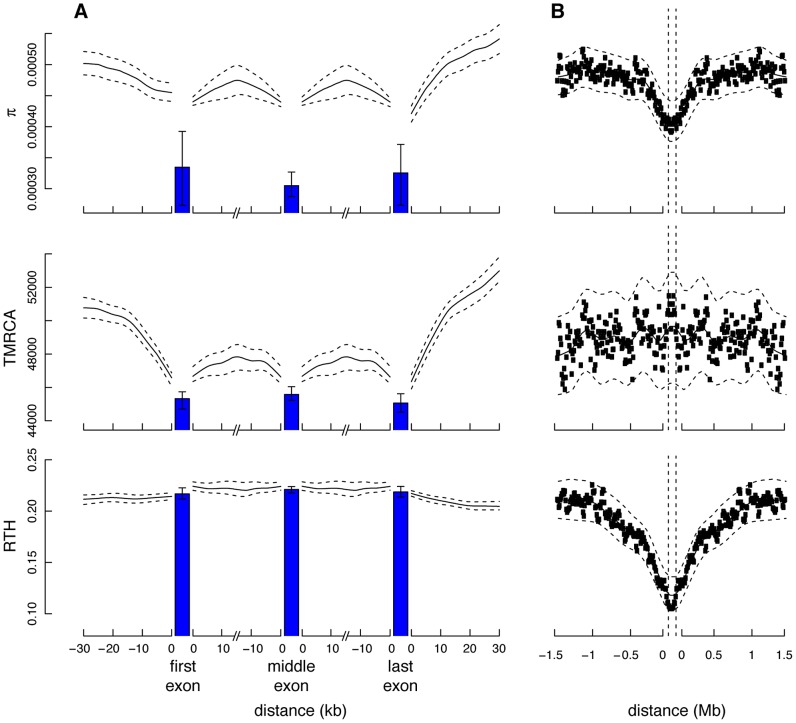
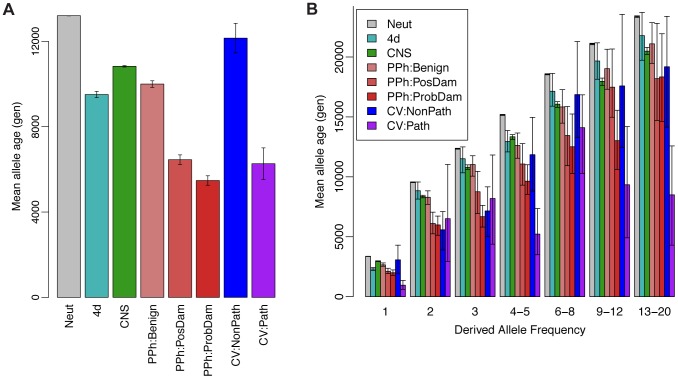
The complex correlation structure of a collection of orthologous DNA sequences is uniquely captured by the "ancestral recombination graph" (ARG), a complete record of coalescence and recombination events in the history of the sample. However, existing methods for ARG inference are computationally intensive, highly approximate, or limited to small numbers of sequences, and, as a consequence, explicit ARG inference is rarely used in applied population genomics. Here, we introduce a new algorithm for ARG inference that is efficient enough to apply to dozens of complete mammalian genomes. The key idea of our approach is to sample an ARG of [Formula: see text] chromosomes conditional on an ARG of [Formula: see text] chromosomes, an operation we call "threading." Using techniques based on hidden Markov models, we can perform this threading operation exactly, up to the assumptions of the sequentially Markov coalescent and a discretization of time. An extension allows for threading of subtrees instead of individual sequences. Repeated application of these threading operations results in highly efficient Markov chain Monte Carlo samplers for ARGs. We have implemented these methods in a computer program called ARGweaver. Experiments with simulated data indicate that ARGweaver converges rapidly to the posterior distribution over ARGs and is effective in recovering various features of the ARG for dozens of sequences generated under realistic parameters for human populations. In applications of ARGweaver to 54 human genome sequences from Complete Genomics, we find clear signatures of natural selection, including regions of unusually ancient ancestry associated with balancing selection and reductions in allele age in sites under directional selection. The patterns we observe near protein-coding genes are consistent with a primary influence from background selection rather than hitchhiking, although we cannot rule out a contribution from recurrent selective sweeps.
Overview
The claims and statistics of this paper haven’t been checked yet.
Run the check — free, no account needed. It reads the open-access text and checks the sources it cites.
Integrity signals
Registry
Cites
Statistics
Figures
Verification
Claims the paper makes
The claims and statistics of this paper haven’t been checked yet.
Run the check — free, no account needed. It reads the open-access text and checks the sources it cites.
Claims other papers make about this one
Each is checked against this paper’s own text: does it say what the citing paper says it does?
The source backs part of the claim, not all of it — or backs it for a different population, condition or comparison.
In the citing paper
“ArgWeaver (4), which is widely considered the gold standard in ARG inference, requires prior knowledge of demographic model parameters.”
From An ancestral recombination graph of human, Neanderthal, and Denisovan genomes (2021) · cites this paper as [4]
Experimental — accuracy not yet measuredThe source backs part of the claim, not all of it — or backs it for a different population, condition or comparison.
In the citing paper
“BEAGLE (3), ArgWeaver (4), and Rent+ (5) were designed for small datasets and require substantial time and/or memory to be used with large sequencing panels.”
From An ancestral recombination graph of human, Neanderthal, and Denisovan genomes (2021) · cites this paper as [4]
Experimental — accuracy not yet measuredIn the citing paper
“Based on these estimates, TCC → T rate acceleration seems to have occurred between 25,000 and 60,000 y ago, not long after Europeans diverged from Asians (SI Appendix, section 4).”
From Evidence for recent, population-specific evolution of the human mutation rate (2015) · cites this paper as [24]
In the citing paper
“In the last few years, a new class of methods has emerged, which base the population genetic inference on reconstructed coalescent information 23,33,34 .These methods manifested promising test power and resolution for inferring selection, as the genome-wide coalescent trees provide a complete record of genealogies, mutations, and recombination 33 .”
From A Chronological Atlas of Natural Selection in the Human Genome during the Past Half-million Years (2015) · cites this paper as [33]
Self-check
Percentages, sums and reported differences re-computed from the paper’s own numbers.
The self-check needs the paper’s full text.
Citations
Cites
A tutorial on hidden Markov models and selected applications in speech recognition
Rabiner, L. R. (1989) · Proceedings of the IEEE · doi:10.1109/5.18626 · Cited by 22,743
The genetical theory of natural selection
Fisher, R. A. (1930) · doi:10.5962/bhl.title.27468 · Cited by 17,617
Evolutionary trees from DNA sequences: A maximum likelihood approach.
Felsenstein, J. (1981) · Journal of Molecular Evolution · doi:10.1007/bf01734359 · Cited by 14,571
Evolution of Protein Molecules
JUKES, T. H., & CANTOR, C. R. (1969) · Mammalian Protein Metabolism · doi:10.1016/b978-1-4832-3211-9.50009-7 · Cited by 11,032
EVOLUTION IN MENDELIAN POPULATIONS
Wright, S. (1931) · Genetics · doi:10.1093/genetics/16.2.97 · Cited by 9,237
A second generation human haplotype map of over 3.1 million SNPs
The International HapMap Consortium (2007) · Nature · doi:10.1038/nature06258 · Cited by 4,438
Howie, B. N., Donnelly, P., & Marchini, J. (2009) · PLoS Genetics · doi:10.1371/journal.pgen.1000529 · Cited by 3,928
Biological sequence analysis probabilistic models of proteins and nucleic acids
Durbin, R. M., Eddy, S. R., Krogh, A., & Mitchison, G. (1998) · Cited by 3,565
The hitch-hiking effect of a favourable gene
Smith, J. M., & Haigh, J. (1974) · Genetical Research · doi:10.1017/s0016672300014634 · Cited by 3,415
Durbin, R. M., Eddy, S. R., Krogh, A., & Mitchison, G. (1998) · Cambridge University Press eBooks · doi:10.1017/cbo9780511790492 · Cited by 3,255
Cited by
Sorted by citations
Items 301–367 of 367
Dialdestoro, K., Sibbesen, J. A., Maretty, L., Raghwani, J., Gall, A., Kellam, P., Pybus, O. G., Hein, J., & Jenkins, P. A. (2015) · bioRxiv (Cold Spring Harbor Laboratory) · doi:10.1101/020552 · Cited by 1
Bourgeois, Y., Hazzouri, K. M., & Warren, B. H. (2016) · bioRxiv (Cold Spring Harbor Laboratory) · doi:10.1101/052761 · Cited by 1
Strong selective sweeps before 45,000BP displaced archaic admixture across the human X chromosomePreprint
Skov, L., Macià, M. C., Lucotte, E. A., Cavassim, M. I. A., Castellano, D., Mailund, T., Schierup, M. H., & Munch, K. (2018) · bioRxiv (Cold Spring Harbor Laboratory) · doi:10.1101/503995 · Cited by 2
Clark, A. G., Barbash, D. A., Lower, S. E., & Dion-Coté, A.-M. (2020) · MDPI eBooks · doi:10.3390/books978-3-03928-367-5 · Cited by 1
Brief Population Bottlenecks Are Beyond The Genetic StreetlightPreprint
Elliott-Higgins, J., & Swamidass, S. J. (2021) · Research Square · doi:10.21203/rs.3.rs-817056/v1 · Cited by 1
Diverse Functions Associate With Non-Coding Polymorphisms Shared Between Humans and ChimpanzeesPreprint
Velázquez-Arcelay, K., Benton, M. L., & Capra, J. A. (2022) · Research Square · doi:10.21203/rs.3.rs-1445890/v1 · Cited by 1
Patil, A. B., Kar, D., Datta, S., & Vijay, N. (2024) · Wiley eBooks · doi:10.1002/9781394209965.ch22 · Cited by 1
Revisiting the evidence for long-lived balancing selection in humansPreprint
Munby, H., & Przeworski, M. (2025) · bioRxiv (Cold Spring Harbor Laboratory) · doi:10.1101/2025.11.10.687682 · Cited by 3
The Spread of Buddhist Culture to China between the Third and Seventh Centuries
Deeg, M. (2018) · Empires and Exchanges in Eurasian Late Antiquity · doi:10.1017/9781316146040.018
Modeling of linkage disequilibrium in whole genome genetic association studies
Johnson, R. (2014) · theses.fr (ABES) · doi:10.70675/077a2830z02f9z4591za4e5z254e19208d13
A mixing tree-valued process arising under neutral evolution with recombination
Depperschmidt, A., Pardoux, É., & Pfaffelhuber, P. (2015) · Electronic Journal of Probability · doi:10.1214/ejp.v20-4286
Recent evolution of the mutation rate and spectrum in EuropeansPreprint
Harris, K. (2014) · bioRxiv (Cold Spring Harbor Laboratory) · doi:10.1101/010314
Efficient strategies for calculating blockwise likelihoods under the coalescentPreprint
Lohse, K., Chmelik, M., Martin, S. H., & Barton, N. (2015) · bioRxiv (Cold Spring Harbor Laboratory) · doi:10.1101/016469
Population Genetic Methods and Applications to Human Genomes
Gattepaille, L. M. (2015) · KTH Publication Database DiVA (KTH Royal Institute of Technology)
Scalable Algorithms for Population Genomic Inference
Sheehan, S. (2015) · eScholarship (California Digital Library)
Bayesian nonparametric models of genetic variation
Elliott, L. T. (2016)
Miroshnikov, A., & Steinrücken, M. (2016) · arXiv (Cornell University)
Wilton, P. (2016) · Digital Access to Scholarship at Harvard (DASH) (Harvard University)
Kane, J., Rusinko, J., & Thompson, K. L. (2017) · arXiv (Cornell University) · doi:10.48550/arxiv.1710.10326
Efficient Algorithms for Trees and Networks in Evolutionary Genomics
Mirzaei, S. (2018) · OpenCommons - UConn (University of Connecticut)
The spread of Buddhist culture to China between the Third and Seventh Century
Deeg, M. (2018) · ORCA Online Research @Cardiff (Cardiff University)
Long-term balancing selection in the genomes of humans and other great apes
Teixeira, J. C. (2016) · Qucosa (Saxon State and University Library Dresden)
Inferring the Allelic Series at QTL in Multiparental PopulationsPreprint
Crouse, W. L., Kelada, S. N. P., & Valdar, W. S. J. (2020) · bioRxiv (Cold Spring Harbor Laboratory) · doi:10.1101/2020.05.23.112326
Mutation, Gene Conversion, and Migration
Hartl, D. L. (2020) · doi:10.1093/oso/9780198862291.003.0004
Brown, P. G. M. (2018) · Cambridge University Press eBooks · doi:10.1017/9781316146040.009
Inference under the coalescent with recombination
Mahmoudi, A. (2020) · Minerva Access (University of Melbourne)
Evolutionary Effects of Hybridization
Edelman, N. B. (2020) · Digital Access to Scholarship at Harvard (DASH) (Harvard University)
Roulin, A. C. (2021) · Peer Community In Genomics · doi:10.24072/pci.genomics.100006
Cosmo, N. D., & Maas, M. (2018) · Cambridge University Press eBooks · doi:10.1017/9781316146040.003
(2018) · Cambridge University Press eBooks · doi:10.1017/9781316146040.032
Cosmo, N. D., & Maas, M. (2018) · Cambridge University Press eBooks · doi:10.1017/9781316146040.031
Cameron, A. (2018) · Cambridge University Press eBooks · doi:10.1017/9781316146040.030
Cosmo, N. D., & Maas, M. (2018) · Cambridge University Press eBooks · doi:10.1017/9781316146040.001
Inferring human evolutionary history
Rees, J., & Andrés, A. M. (2022) · Science · doi:10.1126/science.abo0498
Cosmo, N. D., & Maas, M. (2018) · Cambridge University Press eBooks · doi:10.1017/9781316146040.033
Cosmo, N. D., & Maas, M. (2018) · Cambridge University Press eBooks · doi:10.1017/9781316146040.002
Kondrashov, A. S. (2017) · Wiley eBooks · doi:10.1002/9781118952146.ch11
Griffiths, R. (2023) · doi:10.1093/obo/9780199941728-0143
Constructing ancestral recombination graphs through reinforcement learning
Raymond, M., Descary, M.-H., Beaulac, C., & Larribe, F. (2025) · Frontiers in Genetics · doi:10.3389/fgene.2025.1569358 · Cited by 1
Microbial Sequence Typing Strategies for Genetic and Genomic Data
Pérez‐Losada, M., Castro‐Nallar, E., & Arenas, M. (2024) · Elsevier eBooks · doi:10.1016/b978-0-443-28818-0.00023-9
Accurate and flexible estimation of effective population size historyPreprint
Huang, Z., Chan, Y.-B., & Balding, D. J. (2024) · bioRxiv (Cold Spring Harbor Laboratory) · doi:10.1101/2024.10.16.618650
The maize recombination landscape evolved during domesticationPreprint
Epstein, R., Wheeler, J., Hubisz, M. J., Sun, Q., Bukowski, R., Zhai, J., Lai, W., Buckler, E. S., & Pawlowski, W. P. (2024) · bioRxiv (Cold Spring Harbor Laboratory) · doi:10.1101/2024.11.04.621928
Self-citationCalvert, M. B., Chen, A., Gupta, A., Wu, L., & Wood, C. W. (2026) · Evolution Letters · doi:10.1093/evlett/qrag014
GHIST 2024: The 1st Genomic History Inference Strategies TournamentPreprint
Struck, T. J., Vaughn, A. H., Daigle, A., Ray, D. D., Noskova, E., Sequeira, J. J., Antonets, S., Alekseevskaya, E., Grigoreva, E., Raines, E., et al. (2025) · bioRxiv (Cold Spring Harbor Laboratory) · doi:10.1101/2025.08.05.668560
Self-citationEstimating haplotype values and mutation effects in the context of a local DNA treePreprint
Fortuna, G. M., Obšteter, J., Moškrič, A., & Gorjanc, G. (2025) · bioRxiv (Cold Spring Harbor Laboratory) · doi:10.1101/2025.11.08.687335 · Cited by 1
Distribution of time to the most recent pairwise genetic common ancestor of a set of genomes
Zhao, Z., Mehta, R. S., & Weissman, D. B. (2025) · Genetics · doi:10.1093/genetics/iyaf252
Velázquez-Arcelay, K., Benton, M. L., & Capra, J. A. (2022) · Figshare · doi:10.6084/m9.figshare.19860250
Epistemic-Based Ethics for Science and Technology
Oyekunle, A. A. (2025) · Phronimon · doi:10.25159/2413-3086/17029
Pope, N. S., Tallman, S., Jeffery, B., Mbuli-Robertson, D., Wong, Y., Karthikeyan, S., Ralph, P. L., & Kelleher, J. (2026) · bioRxiv (Cold Spring Harbor Laboratory) · doi:10.64898/2026.01.07.698223 · Cited by 2
ARGformer: learning on ancestral recombination graphs with transformers
Bonet, D., Shanks, C., Cara, M. C., Abante, J., & Ioannidis, A. G. (2026) · Bioinformatics · doi:10.1093/bioinformatics/btag438
Paleogenomic insights into the evolution of human complex traits
Gao, Y., ZHANG, C., Qi, Y., Zi, Y. I. N., & Ke, W. A. N. G. (2026) · Scientia Sinica Vitae · doi:10.1360/ssv-2025-0268
WITHDRAWN: GhostHunter: A Multi-Test Framework for Detecting Ghost IntrogressionPreprint
Wanjiku, M., & Sethuraman, A. (2026) · bioRxiv (Cold Spring Harbor Laboratory) · doi:10.64898/2026.04.24.720650
Mazzucco, R., & Schlötterer, C. (2026) · Genome Biology and Evolution · doi:10.1093/gbe/evag132
Methods for Detecting Adaptive Molecular Evolution
Kamath, P. L. (2026) · Oxford University Press eBooks · doi:10.1093/9780197858363.003.0164
McAllister, N. P., Zöllner, S., & Zhang, X. (2026) · bioRxiv (Cold Spring Harbor Laboratory) · doi:10.64898/2026.06.25.734355
Tao, T., Li, P., Zhu, Y., Zhang, S., Zhang, M., Lascoux, M., & Chen, J. (2026) · bioRxiv (Cold Spring Harbor Laboratory) · doi:10.64898/2026.06.24.734111
The rights and wrongs of rescaling in population genetics simulations
Johri, P., Pouyet, F., & Charlesworth, B. (2026) · PLoS Genetics · doi:10.1371/journal.pgen.1012261
Wei, Y., Sanaullah, A., Zhi, D., & Zhang, S. (2026) · Human Population Genetics and Genomics · doi:10.47248/hpgg2606030009
Evolution of maize recombination landscape during domestication
Epstein, R., Wheeler, J. J., Hubisz, M. J., Zhai, J., Lai, W., Fairbanks, R. A., Sun, Q., Buckler, E. S., & Pawlowski, W. P. (2026) · Proceedings of the National Academy of Sciences · doi:10.1073/pnas.2534336123
Self-citationGenomic insights into natural selection in recent human history
Skoglund, P., & Mathieson, I. (2026) · Nature Reviews Genetics · doi:10.1038/s41576-026-01010-9
Linking genomic variation to floral trait adaptation across species boundaries
Acoca‐Pidolle, S., Wessinger, C. A., & Hileman, L. C. (2026) · New Phytologist · doi:10.1111/nph.71605
Metadata
- Authors
- Rasmussen, M. D., Hubisz, M. J., Gronau, I., & Siepel, A.
- Affiliations
- Cornell University (US)
- European Bioinformatics Institute (GB)
- Corresponding author
- Rasmussen, Matthew D.
- Siepel, Adam
- Venue
- PLoS Genetics
- Publisher
- Public Library of Science (PLoS)
- Published
- 2014-05-15
- Volume
- 10
- Issue
- 5
- Pages
- e1004342
- ISSN
- 1553-7390 (ISSN-L)
- 1553-7404
- PMC
- PMC4022496
- OpenAlex
- W2137706757
- Semantic Scholar
- ba7a79e9daa8da0f51d5014c68d24f0962dd36ec
- Cited by
- 371
- References
- 115
- Citations by year
- 2026: 24 · 2025: 36 · 2024: 38 · 2023: 26 · 2022: 31 · 2021: 29 · 2020: 30 · 2019: 28 · 2018: 54 · 2017: 13 · 2016: 29 · 2015: 21 · 2014: 10
- FWCI
- 9.92
- Type
- journal article
- Language
- en
- Open access
- gold
- doi.org
- Locations
- PLoS Genetics (publishedVersion, cc-by)
- Europe PMC (PubMed Central) (publishedVersion, cc-by)
- PubMed Central (publishedVersion, cc-by)
- PubMed (publishedVersion)
- Cold Spring Harbor Laboratory Institutional Repository (Cold Spring Harbor Laboratory) (acceptedVersion)
- RePEc: Research Papers in Economics (submittedVersion)
- DOAJ (DOAJ: Directory of Open Access Journals) (submittedVersion, cc-by-sa)
- Figshare (submittedVersion, cc-by)
- Funders
- National Science Foundation (1053575)
- University of Texas at Austin
- European Bioinformatics Institute
- National Institutes of Health (OCI-1053575)
- National Institute of General Medical Sciences (R01GM102192, GM102192)
- Topics
- Life Sciences › Biochemistry, Genetics and Molecular Biology › Molecular Biology › Genomics and Phylogenetic Studies
- Life Sciences › Biochemistry, Genetics and Molecular Biology › Genetics › Forensic and Genetic Research
- Life Sciences › Biochemistry, Genetics and Molecular Biology › Genetics › Genetic diversity and population structure
- Keywords
- ancestral recombination graph, threading, hidden Markov models, orthologous sequences, human genome sequence, natural selection signatures, balancing selection, directional selection, background selection, hitchhiking, allele age, coalescence
- MeSH terms
- Algorithms, Computer Simulation, Humans, Markov Chains, Models, Genetic, Monte Carlo Method, Recombination, Genetic, Selection, Genetic, Genome, Human, Evolution, Molecular
About these checks
Registry, retraction, Cites and statistics results are computed, not judged, with one exception: a printed reference that no index lists is read once by a model before it counts as a citation error. Claims are extracted by a model and kept only when their quote appears verbatim in the text; each cited source is then checked, with a model’s help, for whether it says what the claim relies on. Those verdicts can be wrong — read the claim’s quote and the cited source before relying on one.
Statistics and arithmetic are recomputed, not judged.
Confidence bands are shown only for fields calibrated on our annotated test set. None is calibrated yet, so no band is shown.
What counts as a claim ›How we measure confidence ›How we check this ›
Are you an author, or do you see a problem with this page? Request a review
