

The DOI matches its Crossref record; 91 of the 91 references it cites were found in a registry or an index.
Exportin-mediated nucleocytoplasmic transport maintains Pch2 homeostasis during meiosis
Open accessPublished version of a preprint
Abstract
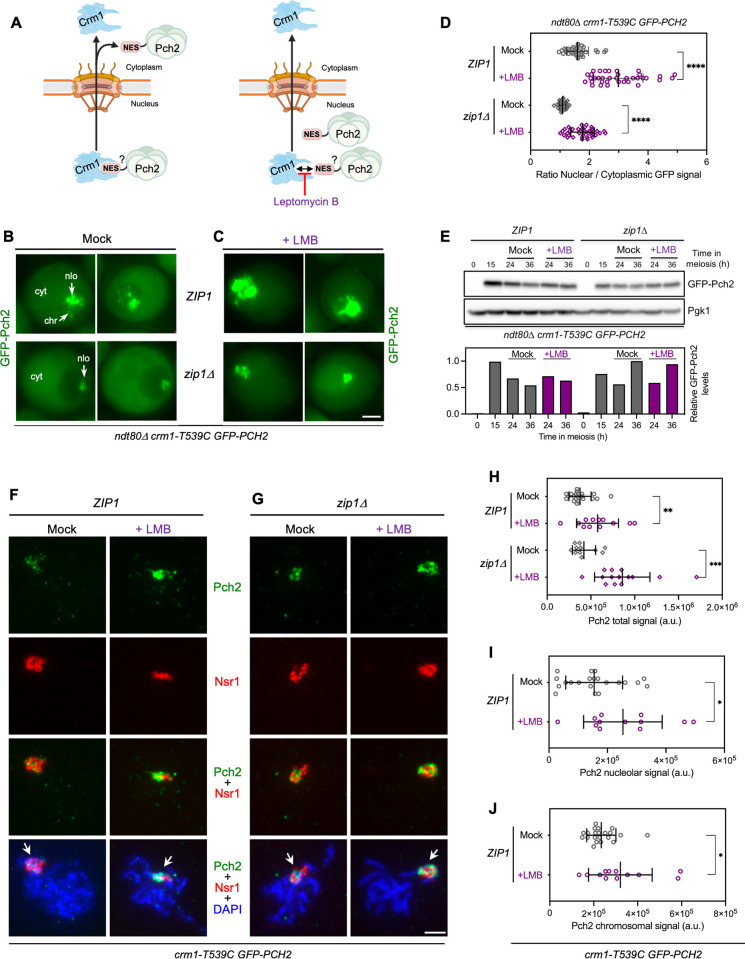
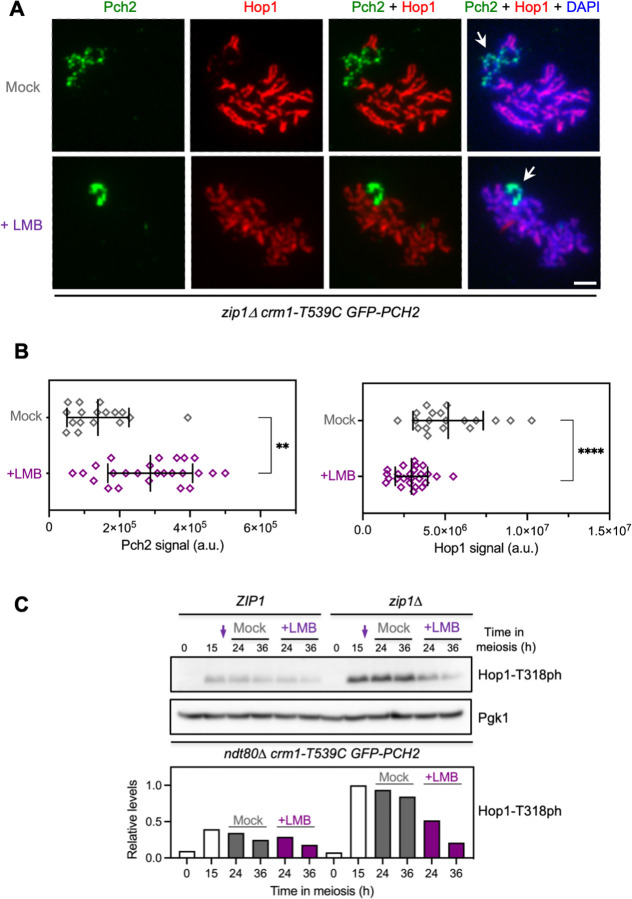
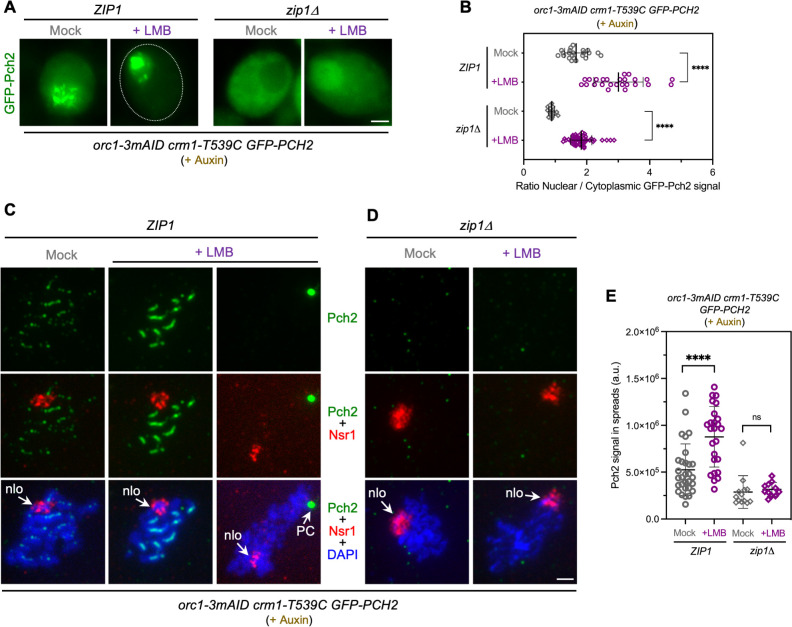
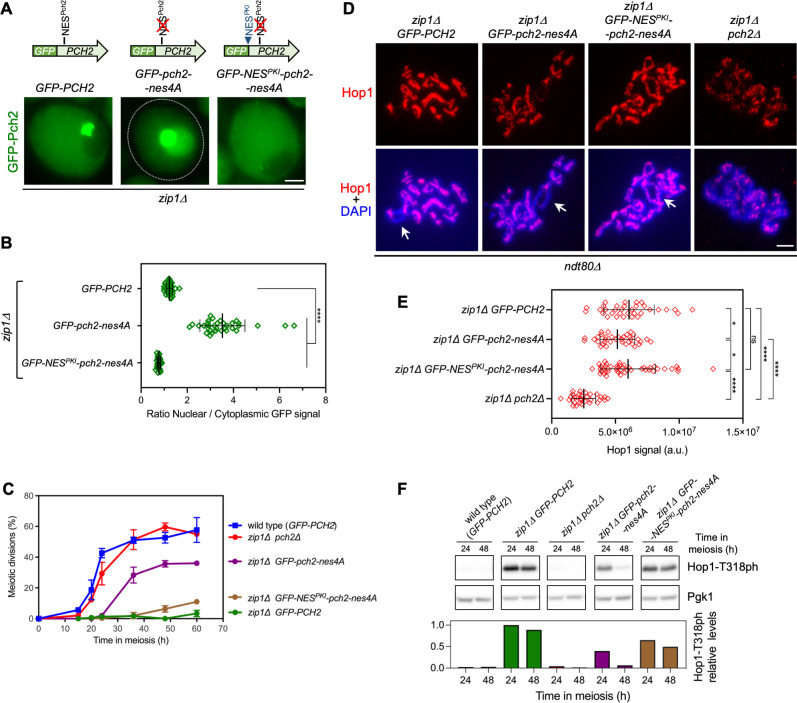
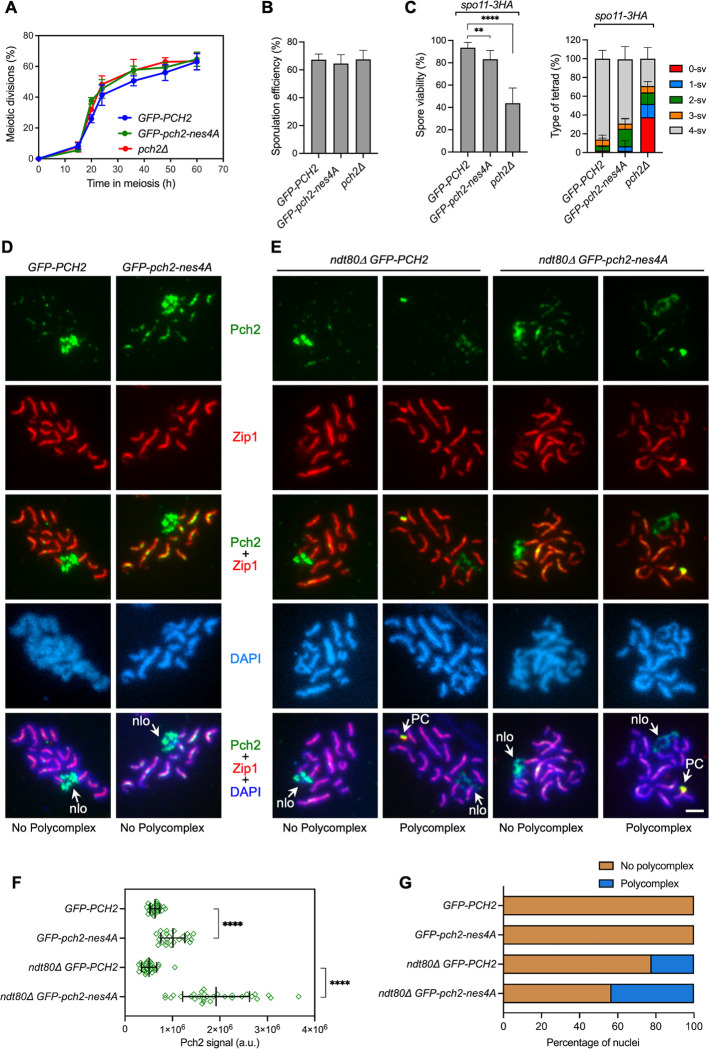
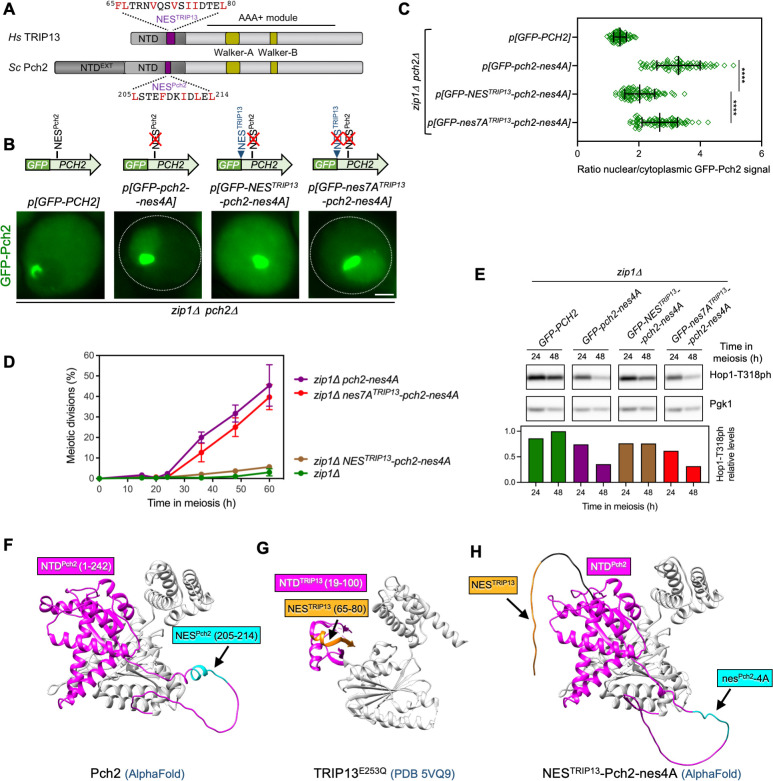
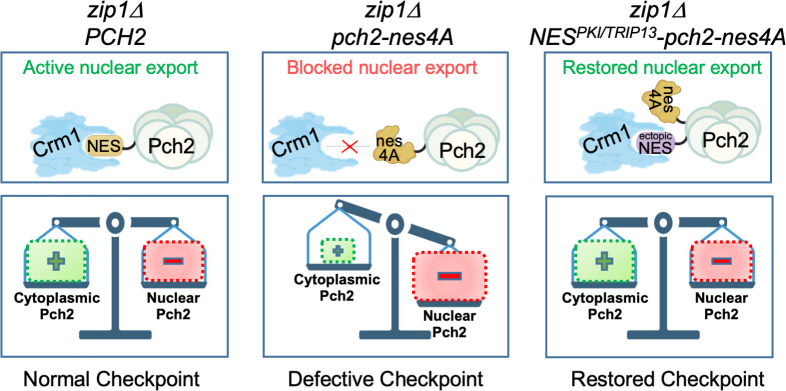
The meiotic recombination checkpoint reinforces the order of events during meiotic prophase I, ensuring the accurate distribution of chromosomes to the gametes. The AAA+ ATPase Pch2 remodels the Hop1 axial protein enabling adequate levels of Hop1-T318 phosphorylation to support the ensuing checkpoint response. While these events are localized at chromosome axes, the checkpoint activating function of Pch2 relies on its cytoplasmic population. In contrast, forced nuclear accumulation of Pch2 leads to checkpoint inactivation. Here, we reveal the mechanism by which Pch2 travels from the cell nucleus to the cytoplasm to maintain Pch2 cellular homeostasis. Leptomycin B treatment provokes the nuclear accumulation of Pch2, indicating that its nucleocytoplasmic transport is mediated by the Crm1 exportin recognizing proteins containing Nuclear Export Signals (NESs). Consistently, leptomycin B leads to checkpoint inactivation and impaired Hop1 axial localization. Pch2 nucleocytoplasmic traffic is independent of its association with Zip1 and Orc1. We also identify a functional NES in the non-catalytic N-terminal domain of Pch2 that is required for its nucleocytoplasmic trafficking and proper checkpoint activity. In sum, we unveil another layer of control of Pch2 function during meiosis involving nuclear export via the exportin pathway that is crucial to maintain the critical balance of Pch2 distribution among different cellular compartments.
Overview
The claims and statistics of this paper haven’t been checked yet.
Run the check — free, no account needed. It reads the open-access text and checks the sources it cites.
Integrity signals
Registry
Cites
Statistics
Figures
Verification
Claims the paper makes
The claims and statistics of this paper haven’t been checked yet.
Run the check — free, no account needed. It reads the open-access text and checks the sources it cites.
Self-check
Percentages, sums and reported differences re-computed from the paper’s own numbers.
The self-check needs the paper’s full text.
Citations
Cites
Fiji: an open-source platform for biological-image analysis
Schindelin, J., Arganda-Carreras, I., Frise, E., Kaynig, V., Longair, M., Pietzsch, T., Preibisch, S., Rueden, C., Saalfeld, S., Schmid, B., et al. (2012) · Nature Methods · doi:10.1038/nmeth.2019 · Cited by 66,890
Highly accurate protein structure prediction with AlphaFold
Jumper, J., Evans, R., Pritzel, A., Green, T., Figurnov, M., Ronneberger, O., Tunyasuvunakool, K., Bates, R., Žídek, A., Potapenko, A., et al. (2021) · Nature · doi:10.1038/s41586-021-03819-2 · Cited by 43,764
A subcellular map of the human proteome
Thul, P. J., Åkesson, L., Wiking, M., Mahdessian, D., Geladaki, A., Ait Blal, H., Alm, T., Asplund, A., Björk, L., Breckels, L. M., et al. (2017) · Science · doi:10.1126/science.aal3321 · Cited by 2,813
Three new dominant drug resistance cassettes for gene disruption in Saccharomyces cerevisiae
Goldstein, A. L., & McCusker, J. H. (1999) · Yeast · doi:10.1002/(sici)1097-0061(199910)15:14<1541::aid-yea476>3.0.co;2-k · Cited by 1,820
Identification of a signal for rapid export of proteins from the nucleus
Wen, W., Meinkotht, J. L., Tsien, R. Y., & Taylor, S. S. (1995) · Cell · doi:10.1016/0092-8674(95)90435-2 · Cited by 1,190
AAA+ proteins: have engine, will work
Hanson, P. I., & Whiteheart, S. W. (2005) · Nature Reviews Molecular Cell Biology · doi:10.1038/nrm1684 · Cited by 1,174
Exportin 1 (Crm1p) Is an Essential Nuclear Export Factor
Stade, K., Ford, C. S., Guthrie, C., & Weis, K. (1997) · Cell · doi:10.1016/s0092-8674(00)80370-0 · Cited by 1,141
Recombination, Pairing, and Synapsis of Homologs during Meiosis
Zickler, D., & Kleckner, N. (2015) · Cold Spring Harbor Perspectives in Biology · doi:10.1101/cshperspect.a016626 · Cited by 799
Meiotic Recombination: The Essence of Heredity
Hunter, N. (2015) · Cold Spring Harbor Perspectives in Biology · doi:10.1101/cshperspect.a016618 · Cited by 780
Tools for integrated sequence-structure analysis with UCSF Chimera
Meng, E. C., Pettersen, E. F., Couch, G. S., Huang, C. C., & Ferrin, T. E. (2006) · BMC Bioinformatics · doi:10.1186/1471-2105-7-339 · Cited by 732
Research works printed but not linked: 1
- K Mittal, 2022, Targeting TRIP13 in Wilms tumor with nuclear export inhibitors., bioRxiv, 2022.02.23.481521
Metadata
- Authors
- Herruzo, E., Sánchez-Díaz, E., González-Arranz, S., Santos, B., Carballo, J. A., & San-Segundo, P. A.
- Affiliations
- Consejo Superior de Investigaciones Científicas (ES)
- Corresponding author
- San-Segundo, Pedro A.
- ORCID
- Venue
- PLOS Genetics
- Publisher
- Public Library of Science (PLoS)
- Published
- 2023-11-10
- Volume
- 19
- Issue
- 11
- Pages
- e1011026
- ISSN
- 1553-7390 (ISSN-L)
- 1553-7404
- PMC
- PMC10688877
- OpenAlex
- W4388562972
- Cited by
- 2
- References
- 91
- Citations by year
- 2026: 1 · 2024: 1
- FWCI
- 0.18
- Type
- journal article
- Language
- en
- Update notices
- new_version (2023-11-30)
- Open access
- gold
- doi.org
- Licence
- Locations
- PLoS Genetics (publishedVersion, cc-by)
- bioRxiv (Cold Spring Harbor Laboratory) (acceptedVersion, cc-by-nc-nd)
- PubMed Central (publishedVersion, cc-by)
- PubMed (publishedVersion)
- DIGITAL.CSIC (Spanish National Research Council (CSIC)) (submittedVersion, cc-by)
- DOAJ (DOAJ: Directory of Open Access Journals) (submittedVersion, cc-by-sa)
- Funders
- Ministerio de Ciencia e Innovación (PID2021-125830NB-I00)
- Consejería de Educación, Junta de Castilla y León (CSI259P20)
- Topics
- Life Sciences › Biochemistry, Genetics and Molecular Biology › Molecular Biology › Nuclear Structure and Function
- Life Sciences › Biochemistry, Genetics and Molecular Biology › Molecular Biology › DNA Repair Mechanisms
- Life Sciences › Biochemistry, Genetics and Molecular Biology › Cell Biology › Microtubule and mitosis dynamics
- Keywords
- Pch2, nuclear transport, nuclear export signal, AAA+ ATPase, leptomycin B, nuclear accumulation, meiotic prophase I, nuclear export
- MeSH terms
- DNA-Binding Proteins, Homeostasis, Meiosis, Nuclear Proteins, Saccharomyces cerevisiae, Active Transport, Cell Nucleus, Karyopherins, Saccharomyces cerevisiae Proteins
About these checks
Registry, retraction, Cites and statistics results are computed, not judged, with one exception: a printed reference that no index lists is read once by a model before it counts as a citation error. Claims are extracted by a model and kept only when their quote appears verbatim in the text; each cited source is then checked, with a model’s help, for whether it says what the claim relies on. Those verdicts can be wrong — read the claim’s quote and the cited source before relying on one.
Statistics and arithmetic are recomputed, not judged.
Confidence bands are shown only for fields calibrated on our annotated test set. None is calibrated yet, so no band is shown.
What counts as a claim ›How we measure confidence ›How we check this ›
Are you an author, or do you see a problem with this page? Request a review
How to cite
Cite CoChat for the checks on this page, and the paper for its own findings.
- This page
- CoChat. (2026). Citation check: Exportin-mediated nucleocytoplasmic transport maintains Pch2 homeostasis during meiosis. https://app.cochat.ai/papers/10.1371/journal.pgen.1011026
- The paper
- Herruzo, E., Sánchez-Díaz, E., González-Arranz, S., Santos, B., Carballo, J. A., & San-Segundo, P. A. (2023). Exportin-mediated nucleocytoplasmic transport maintains Pch2 homeostasis during meiosis. PLOS Genetics. https://doi.org/10.1371/journal.pgen.1011026
Data sources
Bibliographic data: Semantic Scholar, OpenAlex, Crossref.
Contains information from the Semantic Scholar Academic Graph Datasets, made available under the ODC Attribution License (ODC-BY 1.0).
Semantic Scholar’s data is described in: Kinney, R., et al. (2023). The Semantic Scholar Open Data Platform. arXiv:2301.10140.
