

The DOI matches its Crossref record; 38 of the 38 references it cites were found in a registry or an index.
Impact of the COVID-19 pandemic on exercise habits and overweight status in Japan: A nation-wide panel survey
Open accessAbstract
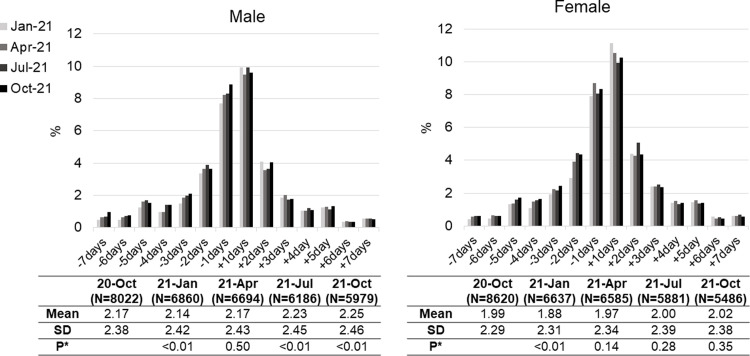
A catastrophic disaster may cause distant health impacts like immobility and obesity. The aim of this research was to analyse the association of the COVID-19 pandemic and lifestyle factors -exercise habit and overweight status in the Japanese population. Nation-wide online questionnaires were conducted five times from October 2020 to October 2021. The changes in exercise habit, body mass index (BMI) and overweight status (BMI >25kg/m 2 ) were compared between the first questionnaire and a questionnaire conducted a year later. Risk factors for losing exercise habit or becoming overweight were analysed using multiple regression. Data were obtained from 16,642 participants. In the early phase of the pandemic, people with high income and elderly females showed a higher risk for decreased exercise days. The proportion of overweight status increased from 22.2% to 26.6% in males and from 9.3% to 10.8% in females. Middle-aged males, elderly females, and males who experienced SARS-CoV-2 infection were at higher risk of becoming overweight. Our findings suggest that risks for immobility and overweight are homogeneous. Continuous intervention for elderly females and long-term intervention for males infected with SARS-CoV-2 might be especially needed. As most disasters can cause similar social transformation, research and evaluation of immobility and obesity should address future disaster preparation/mitigation plans.
Overview
The claims and statistics of this paper haven’t been checked yet.
Run the check — free, no account needed. It reads the open-access text and checks the sources it cites.
Integrity signals
Registry
Cites
Statistics
Figures
Verification
Claims the paper makes
The claims and statistics of this paper haven’t been checked yet.
Run the check — free, no account needed. It reads the open-access text and checks the sources it cites.
Claims other papers make about this one
Each is checked against this paper’s own text: does it say what the citing paper says it does?
The source backs part of the claim, not all of it — or backs it for a different population, condition or comparison.
In the citing paper
“It may also increase risks by changing population habits, for example, so people take less exercise or are more likely to be obese. (349)”
From Dementia prevention, intervention, and care: 2024 report of the Lancet standing Commission (2024) · cites this paper as [349]
Experimental — accuracy not yet measuredThe check wasn’t confident either way, so it gives no verdict — never disputed.
In the citing paper
“Long-term immune activation and systemic inflammation can also adversely affect brain capillaries, increasing BBB permeability and related entry of neurotoxic plasma components, blood cells, and pathogens into the brain. (356, 357)”
From Dementia prevention, intervention, and care: 2024 report of the Lancet standing Commission (2024) · cites this paper as [357]
Experimental — accuracy not yet measured
Self-check
Percentages, sums and reported differences re-computed from the paper’s own numbers.
The self-check needs the paper’s full text.
Citations
Cites
The PHQ-9: Validity of a brief depression severity measure
Kroenke, K., Spitzer, R. L., & Williams, J. B. W. (2001) · Journal of General Internal Medicine · doi:10.1046/j.1525-1497.2001.016009606.x · Cited by 44,910
A Brief Measure for Assessing Generalized Anxiety Disorder: The GAD-7
Spitzer, R. L., Kroenke, K., Williams, J. B. W., & Löwe, B. (2006) · Archives of Internal Medicine · doi:10.1001/archinte.166.10.1092 · Cited by 31,765
Eating habits and lifestyle changes during COVID-19 lockdown: an Italian survey.
Di Renzo, L., Gualtieri, P., Pivari, F., Soldati, L., Attinà, A., Cinelli, G., Leggeri, C., Caparello, G., Barrea, L., Scerbo, F., et al. (2020) · Journal of Translational Medicine · doi:10.1186/s12967-020-02399-5 · Cited by 2,234
Obesity in Adulthood and Its Consequences for Life Expectancy: A Life-Table Analysis
Peeters, A., Barendregt, J. J., Willekens, F., Mackenbach, J. P., Mamun, A. A., & Bonneux, L. (2003) · Annals of Internal Medicine · doi:10.7326/0003-4819-138-1-200301070-00008 · Cited by 1,494
The Stanford Hall consensus statement for post-COVID-19 rehabilitation
Barker-Davies, R. M., O’Sullivan, O., Senaratne, K. P. P., Baker, P., Cranley, M., Dharm-Datta, S., Ellis, H., Goodall, D., Gough, M. R. C., Lewis, S., et al. (2020) · British Journal of Sports Medicine · doi:10.1136/bjsports-2020-102596 · Cited by 780
Obesity, eating behavior and physical activity during COVID-19 lockdown: A study of UK adults
Robinson, E., Boyland, E. J., Chisholm, A., Harrold, J. A., Maloney, N. G., Marty, L., Mead, B. R., Noonan, R. J., & Hardman, C. A. (2020) · Appetite · doi:10.1016/j.appet.2020.104853 · Cited by 754
Global pandemics interconnected — obesity, impaired metabolic health and COVID-19
Stefan, N., Birkenfeld, A. L., & Schulze, M. B. (2021) · Nature Reviews Endocrinology · doi:10.1038/s41574-020-00462-1 · Cited by 452
Górnicka, M., Drywień, M. E., Zielinska-Pukos, M. A., & Hamułka, J. (2020) · Nutrients · doi:10.3390/nu12082324 · Cited by 429
Adiposity, Muscle Mass, and Muscle Strength in Relation to Functional Decline in Older Persons
Schaap, L. A., Koster, A., & Visser, M. (2013) · Epidemiologic Reviews · doi:10.1093/epirev/mxs006 · Cited by 423
Satoh, H., Ohira, T., Hosoya, M., Sakai, A., Watanabe, T., Ohtsuru, A., Kawasaki, Y., Suzuki, H., Takahashi, A., Kobashi, G., et al. (2015) · Journal of Diabetes Research · doi:10.1155/2015/415253 · Cited by 301
Research works printed but not linked: 1
- Y. Zhou, 2021, How Women Bear the Brunt of COVID-19’s Damage on Work, Japan Labor, 5, 7
Cited by
Sorted by citations
Dementia prevention, intervention, and care: 2024 report of the Lancet standing Commission
Livingston, G., Huntley, J., Liu, K. Y., Costafreda, S. G., Selbæk, G., Alladi, S., Ames, D., Banerjee, S., Burns, A., Brayne, C., et al. (2024) · The Lancet · doi:10.1016/s0140-6736(24)01296-0 · Cited by 3,860
Sandri, E., Werner, L. U., & Bernalte‐Martí, V. (2024) · Foods · doi:10.3390/foods13233962 · Cited by 5
Islam, Z., Yamamoto, S., Inoue, Y., Honda, T., Yamamoto, S., Nakagawa, T., Okazaki, H., Ide, H., Miyamoto, T., Kochi, T., et al. (2024) · Journal of Epidemiology & Community Health · doi:10.1136/jech-2024-222703 · Cited by 4
Okui, T., & Nakashima, N. (2024) · BMC Public Health · doi:10.1186/s12889-024-18905-z · Cited by 2
Ochi, S., So, M., Hashimoto, S., Hashimoto, Y., & Sekizawa, Y. (2023) · PLOS Global Public Health · doi:10.1371/journal.pgph.0002653 · Cited by 2
Self-citation
Metadata
- Authors
- Ochi, S., Mirai, S., Hashimoto, S., Hashimoto, Y., & Sekizawa, Y.
- Affiliations
- Jikei University School of Medicine (JP)
- Research Institute of Economy, Trade and Industry (JP)
- Corresponding author
- Ochi, Sae
- Venue
- PLOS Global Public Health
- Publisher
- Public Library of Science (PLoS)
- Published
- 2023-07-19
- Volume
- 3
- Issue
- 7
- Pages
- e0001732
- ISSN
- 2767-3375 (ISSN-L)
- PMC
- PMC10355423
- OpenAlex
- W4384818586
- Cited by
- 9
- References
- 38
- Citations by year
- 2026: 1 · 2025: 1 · 2024: 6 · 2023: 1
- FWCI
- 1.60
- Type
- journal article
- Language
- en
- Update notices
- correction (2023-11-15)
- Open access
- gold
- doi.org
- Licence
- Locations
- PLOS Global Public Health (publishedVersion, cc-by)
- PubMed Central (publishedVersion, cc-by)
- PubMed (publishedVersion)
- DOAJ (DOAJ: Directory of Open Access Journals) (submittedVersion, cc-by-sa)
- Funders
- Co-creation Center for Disaster Resilience, IRIDeS, Tohoku University
- Topics
- Health Sciences › Medicine › Public Health, Environmental and Occupational Health › Physical Activity and Health
- Health Sciences › Medicine › Public Health, Environmental and Occupational Health › Obesity, Physical Activity, Diet
- Health Sciences › Medicine › Public Health, Environmental and Occupational Health › Health and Lifestyle Studies
- Keywords
- COVID-19 pandemic, exercise habits, overweight, body mass index, immobility, obesity, lifestyle factors, elderly female, middle-aged men, disaster health effects, Japan
About these checks
Registry, retraction, Cites and statistics results are computed, not judged, with one exception: a printed reference that no index lists is read once by a model before it counts as a citation error. Claims are extracted by a model and kept only when their quote appears verbatim in the text; each cited source is then checked, with a model’s help, for whether it says what the claim relies on. Those verdicts can be wrong — read the claim’s quote and the cited source before relying on one.
Statistics and arithmetic are recomputed, not judged.
Confidence bands are shown only for fields calibrated on our annotated test set. None is calibrated yet, so no band is shown.
What counts as a claim ›How we measure confidence ›How we check this ›
Are you an author, or do you see a problem with this page? Request a review
