

The DOI matches its Crossref record; 18 of the 18 references it cites were found in a registry or an index.
Data Cleaning: Detecting, Diagnosing, and Editing Data Abnormalities
Open accessAbstract
Inlier: Data value falling within
Overview
The claims and statistics of this paper haven’t been checked yet.
Run the check — free, no account needed. It reads the open-access text and checks the sources it cites.
Integrity signals
Registry
Cites
Statistics
Figures
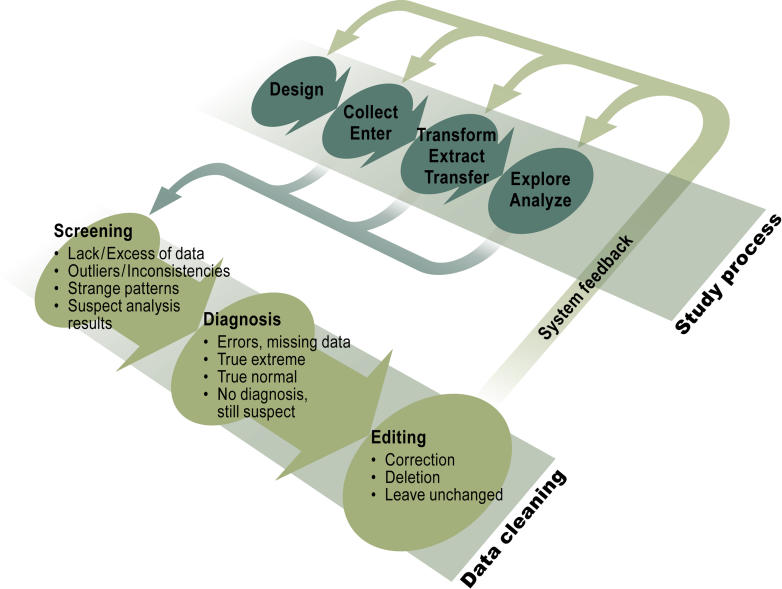
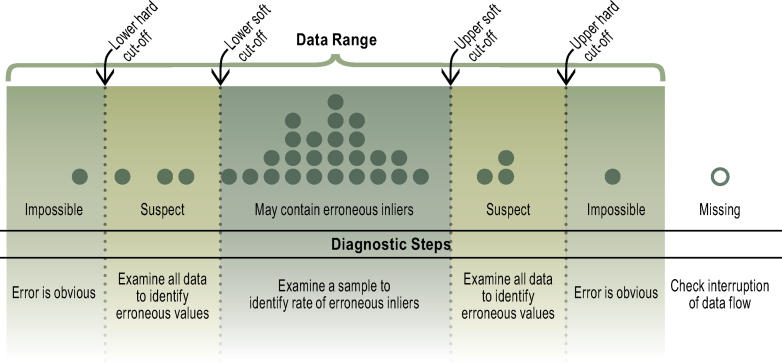
Verification
Claims the paper makes
The claims and statistics of this paper haven’t been checked yet.
Run the check — free, no account needed. It reads the open-access text and checks the sources it cites.
Claims other papers make about this one
Each is checked against this paper’s own text: does it say what the citing paper says it does?
The source backs part of the claim, not all of it — or backs it for a different population, condition or comparison.
In the citing paper
“Ambulatory data measured with wearable sensors, mobile phones, and surveys tend to be noisy.”
From Identifying Objective Physiological Markers and Modifiable Behaviors for Self-Reported Stress and Mental Health Status Using Wearable Sensors and Mobile Phones: Observational Study (2018) · cites this paper as [31]
Experimental — accuracy not yet measuredIn the citing paper
“A clear and transparent description of data cleaning methods is important, as choice of methods could affect study findings, repeatability of the study, and reproducibility of study findings [50].”
From The Reporting of Studies Conducted Using Observational Routinely-Collected Health Data (RECORD) statement. (2015) · cites this paper as [50]
Self-check
Percentages, sums and reported differences re-computed from the paper’s own numbers.
The self-check needs the paper’s full text.
Citations
Cites
Neural Networks: A Comprehensive Foundation
Haykin, S. (1998) · Cited by 30,070
Analysis of Incomplete Multivariate Data
Booth, D. E., & Schafer, J. L. (2000) · Technometrics · doi:10.2307/1271466 · Cited by 5,627
Classical and Modern Regression With Applications.
Steinhorst, R. K., & Myers, R. H. (1988) · Journal of the American Statistical Association · doi:10.2307/2288958 · Cited by 3,691
Hartigan, J. A., & Hartigan, P. M. (1985) · The Annals of Statistics · doi:10.1214/aos/1176346577 · Cited by 2,088
Smithson, M. J. (2000) · SAGE Publications Ltd eBooks · doi:10.4135/9781446218525 · Cited by 1,871
A product perspective on total data quality management
Wang, R. Y. (1998) · Communications of the ACM · doi:10.1145/269012.269022 · Cited by 911
Identifying Multiple Outliers in Multivariate Data
Hadi, A. S. (1992) · Journal of the Royal Statistical Society Series B (Statistical Methodology) · doi:10.1111/j.2517-6161.1992.tb01449.x · Cited by 775
How to Detect and Handle Outliers
Crosby, T. A., Iglewicz, B., & Hoaglin, D. C. (1994) · Technometrics · doi:10.2307/1269377 · Cited by 764
Post-randomisation exclusions: the intention to treat principle and excluding patients from analysis
Fergusson, D., Aaron, S. D., Guyatt, G., & Hébert, P. (2002) · BMJ · doi:10.1136/bmj.325.7365.652 · Cited by 708
Attrition in longitudinal studies
Twisk, J., & de Vente, W. (2002) · Journal of Clinical Epidemiology · doi:10.1016/s0895-4356(01)00476-0 · Cited by 527
Effect of Outliers and Nonhealthy Individuals on Reference Interval Estimation
Horn, P. S., Feng, L., Li, Y., & Pesce, A. J. (2001) · Clinical Chemistry · doi:10.1093/clinchem/47.12.2137 · Cited by 303
INFLUENCE FUNCTIONS AND REGRESSION DIAGNOSTICS
Welsch, R. E. (1982) · Elsevier eBooks · doi:10.1016/b978-0-12-438180-3.50014-1 · Cited by 101
(1999) · Wiley eBooks · doi:10.1002/0470846364 · Cited by 48
Wainer, H., & Schacht, S. (1978) · Psychometrika · doi:10.1007/bf02293863 · Cited by 46
Standards for Discussion and Presentation of Errors in Survey and Census Data
González, M. E., Ogus, J. L., Shapiro, G., & Tepping, B. J. (1975) · Journal of the American Statistical Association · doi:10.1080/01621459.1975.10481469 · Cited by 23
The impact of outlying subjects on decising of bioequivalence
Ki, F. Y. C., Liu, J., Wang, W., & Chow, S. (1995) · Journal of Biopharmaceutical Statistics · doi:10.1080/10543409508835099 · Cited by 15
Editing Data: What Difference Do Consistency Checks Make?
Bauer, U. E., & Johnson, T. M. (2000) · American Journal of Epidemiology · doi:10.1093/oxfordjournals.aje.a010296 · Cited by 13
Data Base Error Trapping and Prediction
West, M., & Winkler, R. L. (1991) · Journal of the American Statistical Association · doi:10.1080/01621459.1991.10475142 · Cited by 11
Research works printed but not linked: 1
- Gonzalez, 1975, J Am Stat Assoc, 70, 6
Cited by
Sorted by citations
Benchimol, E. I., Smeeth, L., Guttmann, A., Harron, K., Moher, D., Petersen, I., Sørensen, H. T., von Elm, E., Langan, S. M., & RECORD Working Committee (2015) · PLOS Medicine · doi:10.1371/journal.pmed.1001885 · Cited by 5,749
Generalized Out-of-Distribution Detection: A Survey
Yang, J., Zhou, K., Li, Y., & Liu, Z. (2024) · International Journal of Computer Vision · doi:10.1007/s11263-024-02117-4 · Cited by 884
Sano, A., Taylor, S., McHill, A. W., Phillips, A. J., Barger, L. K., Klerman, E., & Picard, R. (2018) · Journal of Medical Internet Research · doi:10.2196/jmir.9410 · Cited by 333
Estimation of the Serial Interval of Influenza
Cowling, B. J., Fang, V. J., Riley, S., Peiris, M. J. S., & Leung, G. M. (2009) · Epidemiology · doi:10.1097/ede.0b013e31819d1092 · Cited by 211
Thottakkara, P., Ozrazgat‐Baslanti, T., Hupf, B., Rashidi, P., Pardalos, P. M., Momčilović, P., & Bihorac, A. (2016) · PLoS ONE · doi:10.1371/journal.pone.0155705 · Cited by 202
Metadata
- Authors
- Van den Broeck, J., Argeseanu Cunningham, S., Eeckels, R., & Herbst, K.
- Affiliations
- University of Pennsylvania (US)
- ORCID
- Herbst, Kobus
- Venue
- PLoS Medicine
- Publisher
- Public Library of Science (PLoS)
- Published
- 2005-09-06
- Volume
- 2
- Issue
- 10
- Pages
- e267
- ISSN
- 1549-1277 (ISSN-L)
- 1549-1676
- PMC
- PMC1198040
- OpenAlex
- W1971935224
- Cited by
- 446
- References
- 18
- Citations by year
- 2026: 21 · 2025: 39 · 2024: 35 · 2023: 35 · 2022: 32 · 2021: 47 · 2020: 40 · 2019: 47 · 2018: 36 · 2017: 23 · 2016: 25 · 2015: 17 · 2014: 9 · 2013: 13 · 2012: 5
- FWCI
- 3.71
- Type
- journal article
- Language
- en
- Open access
- gold
- doi.org
- Locations
- PLoS Medicine (publishedVersion, cc-by)
- PubMed Central (publishedVersion, cc-by)
- PubMed (publishedVersion)
- RePEc: Research Papers in Economics (submittedVersion)
- DOAJ (DOAJ: Directory of Open Access Journals) (submittedVersion, cc-by-sa)
- Funders
- Wellcome Trust (063009)
- Topics
- Physical Sciences › Computer Science › Information Systems › Data Quality and Management
- Physical Sciences › Computer Science › Artificial Intelligence › Anomaly Detection Techniques and Applications
- Physical Sciences › Computer Science › Artificial Intelligence › Machine Learning and Data Classification
- Keywords
- data cleaning, data quality, data anomalies, outlier detection, data editing, data validation
- MeSH terms
- Ethics, Professional, Humans, Peer Review, Statistics as Topic, Reproducibility of Results, Epidemiologic Studies, Guidelines as Topic
About these checks
Registry, retraction, Cites and statistics results are computed, not judged, with one exception: a printed reference that no index lists is read once by a model before it counts as a citation error. Claims are extracted by a model and kept only when their quote appears verbatim in the text; each cited source is then checked, with a model’s help, for whether it says what the claim relies on. Those verdicts can be wrong — read the claim’s quote and the cited source before relying on one.
Statistics and arithmetic are recomputed, not judged.
Confidence bands are shown only for fields calibrated on our annotated test set. None is calibrated yet, so no band is shown.
What counts as a claim ›How we measure confidence ›How we check this ›
Are you an author, or do you see a problem with this page? Request a review
