

Evaluation of Coseasonality of Influenza and Invasive Pneumococcal Disease: Results from Prospective Surveillance
Open accessThe DOI matches its Crossref record; 41 of the 41 references it cites were found in a registry or an index.
Abstract
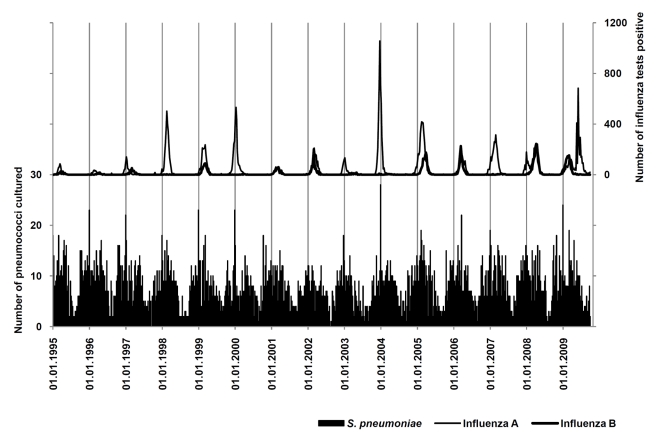
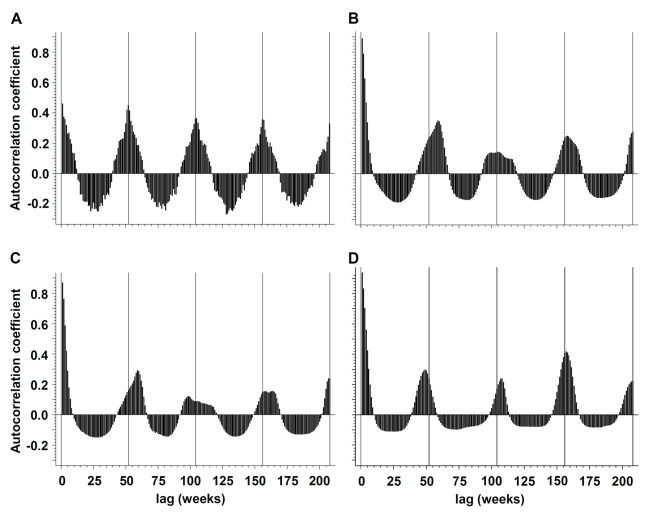
BACKGROUND: The wintertime co-occurrence of peaks in influenza and invasive pneumococcal disease (IPD) is well documented, but how and whether wintertime peaks caused by these two pathogens are causally related is still uncertain. We aimed to investigate the relationship between influenza infection and IPD in Ontario, Canada, using several complementary methodological tools. METHODS AND FINDINGS: We evaluated a total number of 38,501 positive influenza tests in Central Ontario and 6,191 episodes of IPD in the Toronto/Peel area, Ontario, Canada, between 1 January 1995 and 3 October 2009, reported through population-based surveillance. We assessed the relationship between the seasonal wave forms for influenza and IPD using fast Fourier transforms in order to examine the relationship between these two pathogens over yearly timescales. We also used three complementary statistical methods (time-series methods, negative binomial regression, and case-crossover methods) to evaluate the short-term effect of influenza dynamics on pneumococcal risk. Annual periodicity with wintertime peaks could be demonstrated for IPD, whereas periodicity for influenza was less regular. As for long-term effects, phase and amplitude terms of pneumococcal and influenza seasonal sine waves were not correlated and meta-analysis confirmed significant heterogeneity of influenza, but not pneumococcal phase terms. In contrast, influenza was shown to Granger-cause pneumococcal disease. A short-term association between IPD and influenza could be demonstrated for 1-week lags in both case-crossover (odds ratio [95% confidence interval] for one case of IPD per 100 influenza cases = 1.10 [1.02-1.18]) and negative binomial regression analysis (incidence rate ratio [95% confidence interval] for one case of IPD per 100 influenza cases = 1.09 [1.05-1.14]). CONCLUSIONS: Our data support the hypothesis that influenza influences bacterial disease incidence by enhancing short-term risk of invasion in colonized individuals. The absence of correlation between seasonal waveforms, on the other hand, suggests that bacterial disease transmission is affected to a lesser extent. Please see later in the article for the Editors' Summary.
Overview
The claims and statistics of this paper haven’t been checked yet.
Free: it reads the open-access text and checks the first 5 claims that cite a source we can check. Create a free account to check every claim.
Integrity signals
Registry
Cites
Statistics
Figures
Verification
Claims the paper makes
The claims and statistics of this paper haven’t been checked yet.
Free: it reads the open-access text and checks the first 5 claims that cite a source we can check. Create a free account to check every claim.
Claims other papers make about this one
Each is checked against this paper’s own text: does it say what the citing paper says it does?
The source backs part of the claim, not all of it — or backs it for a different population, condition or comparison.
In the citing paper
“Other factors such as reduced temperatures and daylight hours were important for the regular appearance of pneumococcal disease each winter.”
From Bacterial and viral infections associated with influenza (2013) · cites this paper as [40]
Experimental — accuracy not yet measuredThe cited source says what the claim attributes to it.
In the citing paper
“In Canada, a recent observational study showed that the seasonality and time lag of pneumococcal disease was only partially related to influenza seasonality.”
From Bacterial and viral infections associated with influenza (2013) · cites this paper as [40]
Self-check
Percentages, sums and reported differences re-computed from the paper’s own numbers.
The self-check needs the paper’s full text.
Citations
Cites
(1990) · Choice Reviews Online · doi:10.5860/choice.27-3338 · Cited by 35,305
Investigating causal relations by econometric models and cross-spectral methods
Granger, C. W. J. (1969) · Econometrica · doi:10.2307/1912791 · Cited by 22,989
Harrell, F. E. (2001) · Springer Series in Statistics · doi:10.1007/978-1-4757-3462-1 · Cited by 9,195
Kupper, L. L., Hosmer, D. W., & Lemeshow, S. (1990) · Journal of the American Statistical Association · doi:10.2307/2290035 · Cited by 7,599
Epidemiology: Study Design and Data Analysis
(2006) · Technometrics · doi:10.1198/tech.2006.s407 · Cited by 788
Janes, H., Sheppard, L., & Lumley, T. (2005) · Epidemiology · doi:10.1097/01.ede.0000181315.18836.9d · Cited by 771 · cited 1×
“Control periods were chosen by matching the hazard period by day of the week within the stratum, and could both precede, both follow, or straddle the hazard period [23,24].”
MethodReferent Selection in Case-Crossover Analyses of Acute Health Effects of Air Pollution
Levy, D., Lumley, T., Sheppard, L., Kaufman, J., & Checkoway, H. (2001) · Epidemiology · doi:10.1097/00001648-200103000-00010 · Cited by 494 · cited 3×
“Control periods were chosen by matching the hazard period by day of the week within the stratum, and could both precede, both follow, or straddle the hazard period [23,24].”
MethodAntiviral Therapy and Outcomes of Influenza Requiring Hospitalization in Ontario, Canada
McGeer, A., Green, K. A., Plevneshi, A., Shigayeva, A., Siddiqi, N., Raboud, J., Low, D. E., & Toronto Invasive Bacterial Diseases Network (2007) · Clinical Infectious Diseases · doi:10.1086/523584 · Cited by 398
Self-citationRole of Neuraminidase in Lethal Synergism between Influenza Virus and Streptococcus pneumoniae
McCullers, J. A., & Bartmess, K. C. (2003) · The Journal of Infectious Diseases · doi:10.1086/368163 · Cited by 386 · cited 1×
“We suggest that the mechanism for such an effect might be influenza-related alterations at the level of the respiratory epithelium [27].”
BackgroundLoeb, M., Russell, M. L., Moss, L., Fonseca, K., Fox, J., Earn, D. J. D., Aoki, F., Horsman, G., Van Caeseele, P., Chokani, K., et al. (2010) · JAMA · doi:10.1001/jama.2010.250 · Cited by 384 · cited 1×
“been borne out in at least one recent randomized trial [33,34].”
Background
Research works printed but not linked: 1
- White AN Ng V Spain CV Johnson CC Kinlin LM 2009 Let the sun shine in: effects of ultraviolet radiation on invasive pneumococcal disease risk in Philadelphia, Pennsylvania. BMC Infect Dis 9 196 19961583 PMC2797517 · DOI · Paper page
Cited by
The effects of the COVID-19 pandemic on community respiratory virus activity
Chow, E. J., Uyeki, T. M., & Chu, H. Y. (2022) · Nature Reviews Microbiology · doi:10.1038/s41579-022-00807-9 · Cited by 651
Bacterial and viral infections associated with influenza
Joseph, C., Togawa, Y., & Shindo, N. (2013) · Influenza and Other Respiratory Viruses · doi:10.1111/irv.12089 · Cited by 250
Seasonality of viral infections: mechanisms and unknowns
Fisman, D. (2012) · Clinical Microbiology and Infection · doi:10.1111/j.1469-0691.2012.03968.x · Cited by 239
Self-citationWeinberger, D. M., Klugman, K. P., Steiner, C. A., Simonsen, L., & Viboud, C. (2015) · PLoS Medicine · doi:10.1371/journal.pmed.1001776 · Cited by 198
“Influenza infections increase the risk for pneumococcal disease during both pandemic and inter-pandemic periods [1–8].”
Identifying the interaction between influenza and pneumococcal pneumonia using incidence data.
Shrestha, S., Foxman, B., Weinberger, D. M., Steiner, C., Viboud, C., & Rohani, P. (2013) · Science Translational Medicine · doi:10.1126/scitranslmed.3005982 · Cited by 148
Examining rainfall and cholera dynamics in Haiti using statistical and dynamic modeling approaches
Eisenberg, M. C., Kujbida, G., Tuite, A. R., Fisman, D. N., & Tien, J. H. (2013) · Epidemics · doi:10.1016/j.epidem.2013.09.004 · Cited by 142
Self-citationOpatowski, L., Baguelin, M., & Eggo, R. M. (2018) · PLoS Pathogens · doi:10.1371/journal.ppat.1006770 · Cited by 139
“2008 [138]; Kuster 2011 [139]; Nicoli 2013 [85]; Ampofo”
The remaining challenges of pneumococcal disease in adults
Ludwig, E., Bonanni, P., Rohde, G. G. U., Sayıner, A., & Torres, A. (2012) · European Respiratory Review · doi:10.1183/09059180.00008911 · Cited by 103
Short, K. R., Habets, M. N., Hermans, P. W., & Diavatopoulos, D. A. (2012) · Future Microbiology · doi:10.2217/fmb.12.29 · Cited by 96
Guo, C., Yang, L., Ou, C., Li, L., Zhuang, Y., Yang, J., Zhou, Y.-X., Qian, J., Chen, P.-Y., & Liu, Q. (2015) · Malaria Journal · doi:10.1186/s12936-015-0630-6 · Cited by 92
“investigate whether one time-series could predict another, and this association would be invalid when the two series were reversed [22,23].”
BackgroundFisman, D. N., Patrozou, E., Carmeli, Y., Perencevich, E. N., Tuite, A. R., Mermel, L. A., & the Geographical Variability of Bacteremia Study Group (2014) · PLoS ONE · doi:10.1371/journal.pone.0114548 · Cited by 67
Self-citationUnraveling the seasonal epidemiology of pneumococcus
de Cellès, M. D., Arduin, H., Lévy-Bruhl, D., Georges, S., Souty, C., Guillemot, D., Watier, L., & Opatowski, L. (2019) · Proceedings of the National Academy of Sciences · doi:10.1073/pnas.1812388116 · Cited by 56
The role of influenza in the epidemiology of pneumonia
Shrestha, S., Foxman, B., Berus, J. M., van Panhuis, W. G., Steiner, C., Viboud, C. G., & Rohani, P. (2015) · Scientific Reports · doi:10.1038/srep15314 · Cited by 61
Mahamat, A., Daurès, J., & de Wazières, B. (2013) · Human Vaccines & Immunotherapeutics · doi:10.4161/hv.22550 · Cited by 48
“25 Influenza increases the risk of pneumococcal disease incidence.(26) Pneumococcal vaccination could therefore be a supplement to influenza vaccination for the elderly.”
BackgroundThe Role of Streptococcus pneumoniae in Community-Acquired Pneumonia
Anderson, R., & Feldman, C. H. (2016) · Seminars in Respiratory and Critical Care Medicine · doi:10.1055/s-0036-1592074 · Cited by 52
A cooperativity between virus and bacteria during respiratory infections
Lalbiaktluangi, C., Yadav, M., Singh, P. K., Singh, A., Iyer, M., Vellingiri, B., Zomuansangi, R., Zothanpuia, Z., & Ram, H. (2023) · Frontiers in Microbiology · doi:10.3389/fmicb.2023.1279159 · Cited by 46
Pneumococcal disease seasonality: incidence, severity and the role of influenza activity
Weinberger, D. M., Harboe, Z. B., Viboud, C. G., Krause, T. G., Miller, M. D., Mølbak, K., & Konradsen, H. B. (2013) · European Respiratory Journal · doi:10.1183/09031936.00056813 · Cited by 47
“Evidence from epidemiological studies and experimental animal models support a role for influenza in affecting both transmission and host susceptibility to pneumococcus [9, 11-17].”
Influenza Increases Invasive Meningococcal Disease Risk in Temperate Countries
Salomon, A., Berry, I., Tuite, A. R., Drews, S. J., Hatchette, T. F., Jamieson, F., Johnson, C., Kwong, J. C., Lina, B., Lojo, J., et al. (2019) · Clinical Microbiology and Infection · doi:10.1016/j.cmi.2020.01.004 · Cited by 36
Self-citationShrestha, S., Foxman, B., Dawid, S. R., Aiello, A. E., Davis, B. M., Berus, J. M., & Rohani, P. (2013) · Journal of The Royal Society Interface · doi:10.1098/rsif.2013.0233 · Cited by 44
Serotype-Specific Effect of Influenza on Adult Invasive Pneumococcal Pneumonia
Weinberger, D. M., Harboe, Z. B., Viboud, C. G., Krause, T. G., Miller, M., Mølbak, K., & Konradsen, H. B. (2013) · The Journal of Infectious Diseases · doi:10.1093/infdis/jit375 · Cited by 38
Opatowski, L., Varon, E., Dupont, C., Temime, L., van der Werf, S., Gutmann, L., Boëlle, P., Watier, L., & Guillemot, D. (2013) · Proceedings of the Royal Society B Biological Sciences · doi:10.1098/rspb.2013.0519 · Cited by 38
Influenza and RSV make a modest contribution to invasive pneumococcal disease incidence in the UK
Nicoli, E. J., Trotter, C. L., Turner, K., Colijn, C., Waight, P., & Miller, E. (2013) · Journal of Infection · doi:10.1016/j.jinf.2013.02.007 · Cited by 35
Li, Y., Peterson, M. E., Campbell, H. J., & Nair, H. (2018) · BMJ Open · doi:10.1136/bmjopen-2017-019743 · Cited by 27
“Our review suggests that the association of VARI and subsequent PD could vary by virus type(14) 23 24 34 35 and even by subtype.(22) 23 Studies using combinations of viral infections such as all virus, influenza +RSV, non-influenza, or non-RSV could give biased estimations of the association.”
BackgroundIncreased Invasive Pneumococcal Disease, North East England, UK
Houseman, C., Hughes, G. J., Chapman, K. E., Wilson, D., & Gorton, R. (2016) · Emerging infectious diseases · doi:10.3201/eid2301.160897 · Cited by 25
Moore, D. P., Dagan, R., & Madhi, S. A. (2012) · Expert Review of Respiratory Medicine · doi:10.1586/ers.12.32 · Cited by 25
Influenza vaccines to control influenza-associated bacterial infection: where do we stand?
Christopoulou, I., Roose, K., Ibañez, L. I., & Saelens, X. (2014) · Expert Review of Vaccines · doi:10.1586/14760584.2015.957191 · Cited by 25
“Although there are observations that the incidence of pneumococcal infections coincides with the influenza season [25,80], as well as with the occurrence of other respiratory viral infections, most studies on pneumococcal vaccines focus only on their effectiveness to the pathogen it targets in primary infections.”
BackgroundSteens, A., Vestrheim, D. F., & de Blasio, B. F. (2015) · Epidemics · doi:10.1016/j.epidem.2015.01.001 · Cited by 24
Chiavenna, C., Presanis, A. M., Charlett, A., de Lusignan, S., Ladhani, S. N., Pebody, R. G., & Angelis, D. D. (2019) · PLoS Medicine · doi:10.1371/journal.pmed.1002829 · Cited by 26
von Mollendorf, C., Cohen, C., de Gouveia, L., Naidoo, N., Meiring, S. T., Quan, V., Lindani, S., Moore, D. P., Reubenson, G., Moshe, M., et al. (2014) · The Pediatric Infectious Disease Journal · doi:10.1097/inf.0000000000000484 · Cited by 21
Hendriks, W., Boshuizen, H. C., Dekkers, A. L. M., Knol, M. J., Donker, G., ENDE, A. V. D., & Altes, H. K. (2017) · Influenza and Other Respiratory Viruses · doi:10.1111/irv.12442 · Cited by 24
Berry, I., Tuite, A. R., Salomon, A., Drews, S. J., Harris, A. D., Hatchette, T. F., Johnson, C. C., Kwong, J. C., Lojo, J., McGeer, A., et al. (2020) · JAMA Network Open · doi:10.1001/jamanetworkopen.2020.10167 · Cited by 19
Self-citationFisman, D. N., Pérez-Rubio, A., Postma, M. J., Smith, D. S., & Mould-Quevedo, J. F. (2025) · Expert Review of Vaccines · doi:10.1080/14760584.2025.2515597 · Cited by 18
Self-citationHave changing pneumococcal vaccination programmes impacted disease in Ontario?
Lim, G. H., Wormsbecker, A. E., McGeer, A., Pillai, D. R., Gubbay, J. B., Rudnick, W., Low, D. E., Green, K., Crowcroft, N. S., & Deeks, S. L. (2013) · Vaccine · doi:10.1016/j.vaccine.2013.04.007 · Cited by 19
Self-citationde Cellès, M. D., Arduin, H., Varon, E., Souty, C., Boëlle, P., Lévy-Bruhl, D., van der Werf, S., Soulary, J. C., Guillemot, D., Watier, L., et al. (2017) · American Journal of Epidemiology · doi:10.1093/aje/kwx336 · Cited by 18
“The roles of these two climatic variables in shaping IPD seasonality have been assessed in several ecological studies, with discordant results (10, 11, 29, 50).”
BackgroundResultInfluentialBurgos, J., Larrosa, N., Martinez, A., Belmonte, J., González‐López, J. J., Rello, J., Pumarola, T., Pahissa, A., & Falcó, V. (2014) · European Journal of Clinical Microbiology & Infectious Diseases · doi:10.1007/s10096-014-2221-9 · Cited by 14
“This correlation has not been found in other studies that have used a similar multivariate approach [4, 19].”
BackgroundResultInvasive Pneumococcal Infections
Backhaus, E. (2011) · Gothenburg University Publications Electronic Archive (Gothenburg University) · Cited by 12
Streym, S. V., Rejnmark, L., Mosekilde, L., & Vestergaard, P. (2013) · Dermato-Endocrinology · doi:10.4161/derm.22779 · Cited by 11
The pathogenesis of ventilator-associated pneumonia: old and new mechanisms
Ulsamer, A., Bonilla-Pellegrini, S., Pérez-Fernández, X. L., Rello, J., & Sabater‐Riera, J. (2025) · Expert Review of Respiratory Medicine · doi:10.1080/17476348.2025.2493366 · Cited by 14
“Several studies have found an association between influenza and invasive pneumococcal disease incidence [133,134].”
Many respiratory viruses have temporal association with meningococcal disease
Castro-Rodríguez, J. A., Jakubson, L., Padilla, O., Gallegos, D., Fasce, R., Bertrand, P. J., Sánchez, I., & Cecilia Perret, P. (2014) · Allergologia et Immunopathologia · doi:10.1016/j.aller.2014.07.005 · Cited by 8
Predictors of yearly influenza vaccination in hospitalized and community based patients
Camilleri, S. A., Casingena, J. C., Yamagata, K., & Balzan, M. V. (2018) · Multidisciplinary Respiratory Medicine · doi:10.1186/s40248-018-0135-6 · Cited by 7
Increased incidence of adult pneumococcal pneumonia during school holiday periods
Daniel, P., Rodrigo, C., Bewick, T. A., Sheppard, C. L., Greenwood, S., McKeever, T. M., Slack, M., & Lim, W. S. (2017) · ERJ Open Research · doi:10.1183/23120541.00100-2016 · Cited by 8
Vaccination anti-pneumococcique chez l’adulte : comment améliorer la couverture vaccinale ?
Goulenok, T. M. (2014) · Journal des Anti-infectieux · doi:10.1016/j.antinf.2014.01.007 · Cited by 6
Couverture vaccinale antigrippale et antipneumococcique dans un service de médecine interne
Goulenok, T. M., Chopin, D., LASTOURS, V. D., Zarrouk, V., Lepeule, R., Fantin, B., & Lefort, A. (2018) · La Revue de Médecine Interne · doi:10.1016/j.revmed.2018.02.020 · Cited by 6
Ellis, S. C., & Ong, E. L. C. (2014) · Elsevier eBooks · doi:10.1016/b978-0-12-397169-2.00036-6 · Cited by 4
Implication of nitric oxide in the pathogenesis of influenza virus infection
Zablockienė, B., Ambrozaitis, A., Kačergius, T., & Gravenstein, S. (2012) · Biologija · doi:10.6001/biologija.v58i1.2318 · Cited by 3
“Influenza precedes outbreaks of certain bacterial infections, for example, pneumococcal or staphylococcal (Kuster et al., 2011; Tasher et al., 2011).”
BackgroundSimmons, A. E., Berry, I., Buchan, S. A., Tuite, A. R., & Fisman, D. N. (2024) · medRxiv · doi:10.1101/2024.09.03.24312990 · Cited by 2
Self-citationXiong, W., Yin, H., Gao, L. S., & Liang, S. (2025) · Journal of Multidisciplinary Healthcare · doi:10.2147/jmdh.s537261 · Cited by 1
“44 Additionally, epidemiological modeling studies indicate that co-infections can significantly worsen disease severity and mortality rates, underscoring the importance of understanding host-pathogen interactions in seasonal outbreaks.”
ROLE OF VIRAL AND HOST FACTORS IN INFLUENZA VIRUS MEDIATED INHIBITION OF INTERLEUKIN-23
Tiwari, A. (2014) · UKnowledge (University of Kentucky) · Cited by 1
Predictors of yearly influenza vaccination in hospitalized and community-based patients
Camilleri, S. A., Casingena, J. C., Yamagata, K., & Balzan, M. V. (2018) · Multidisciplinary Respiratory Medicine · doi:10.4081/mrm.2018.164
Simmons, A. E., Berry, I., Buchan, S. A., Tuite, A. R., & Fisman, D. N. (2026) · BMC Infectious Diseases · doi:10.1186/s12879-025-12419-8
“Our earlier work suggested that IPD risk was associated with respiratory virus activity in the week prior to IPD case occurrence [6].”
InfluentialSelf-citationSARS-CoV-2 and the Pandemic Surge in Invasive Group A Streptococcal DiseasePreprint
Fisman, D. N., Lee, E., Wilson, N. J., Barton-Forbes, M., Mann, S., & Tuite, A. R. (2026) · medRxiv · doi:10.64898/2026.03.19.26348823
Self-citationRecommendations for the analysis of leading indicators in epidemic surveillance
Mellor, J., Maria, T., Paton, R. S., & Ward, T. (2026) · PLOS Digital Health · doi:10.1371/journal.pdig.0001759
“Morvan and colleagues [22], Kuster and colleagues [23] 3”
Metadata
- Authors
- Kuster, S. P., Tuite, A. R., Kwong, J. C., McGeer, A., the Toronto Invasive Bacterial Diseases Network, & Fisman, D. N.
- Affiliations
- Mount Sinai Hospital (CA)
- University of Toronto (CA)
- Corresponding author
- Fisman, David N.
- Venue
- PLoS Medicine
- Publisher
- Public Library of Science (PLoS)
- Published
- 2011-06-07
- Volume
- 8
- Issue
- 6
- Pages
- e1001042
- ISSN
- 1549-1277 (ISSN-L)
- 1549-1676
- PMC
- PMC3110256
- OpenAlex
- W2013687297
- Cited by
- 52
- References
- 41
- Citations by year
- 2026: 3 · 2025: 3 · 2024: 1 · 2023: 1 · 2022: 1 · 2020: 1 · 2019: 3 · 2018: 5 · 2017: 2 · 2016: 3 · 2015: 4 · 2014: 8 · 2013: 11 · 2012: 5
- FWCI
- 6.03
- Type
- journal article
- Language
- en
- Open access
- gold
- doi.org
- Locations
- PLoS Medicine (publishedVersion, cc-by)
- Europe PMC (PubMed Central) (publishedVersion, cc-by)
- PubMed Central (publishedVersion, cc-by)
- PubMed (publishedVersion)
- Zurich Open Repository and Archive (University of Zurich) (acceptedVersion, cc-by)
- DOAJ (DOAJ: Directory of Open Access Journals) (submittedVersion)
- Zurich Open Repository and Archive (University of Zurich) (submittedVersion, cc-by)
- Zurich Open Repository and Archive (University of Zurich)
- Funders
- National Science Foundation
- GlaxoSmithKline
- Sanofi
- Hamilton Health Sciences
- Ontario Ministry of Health and Long-Term Care
- Schweizerischer Nationalfonds zur Förderung der Wissenschaftlichen Forschung (125576)
- University of Toronto
- Hospital for Sick Children
- Sanofi Pasteur
- Canadian Institutes of Health Research
- Department of Family and Community Medicine, University of Toronto
- Topics
- Health Sciences › Medicine › Epidemiology › Pneumonia and Respiratory Infections
- Health Sciences › Medicine › Epidemiology › Influenza Virus Research Studies
- Health Sciences › Medicine › Epidemiology › Respiratory viral infections research
- Keywords
- influenza, invasive pneumococcal disease, co-epidemic, seasonal variation, Granger causality, bacterial colonization, pneumococcal transmission, case-crossover, negative binomial regression, fast Fourier transform
- MeSH terms
- Humans, Influenza, Human, Periodicity, Pneumococcal Infections, Population Surveillance, Prospective Studies, Regression Analysis, Seasons, Time Factors, Cross-Over Studies, Statistics, Nonparametric
About these checks
Registry, retraction, Cites and statistics results are computed, not judged, with one exception: a printed reference that no index lists is read once by a model before it counts as a citation error. Claims are extracted by a model and kept only when their quote appears verbatim in the text; each cited source is then checked, with a model’s help, for whether it says what the claim relies on. Those verdicts can be wrong — read the claim’s quote and the cited source before relying on one.
Statistics and arithmetic are recomputed, not judged.
Confidence bands are shown only for fields calibrated on our annotated test set. None is calibrated yet, so no band is shown.
What counts as a claim ›How we measure confidence ›How we check this ›
Are you an author, or do you see a problem with this page? Request a review
Data sources
Bibliographic data: Semantic Scholar, OpenAlex, Crossref.
Contains information from the Semantic Scholar Academic Graph Datasets, made available under the ODC Attribution License (ODC-BY 1.0).
Semantic Scholar’s data is described in: Kinney, R., et al. (2023). The Semantic Scholar Open Data Platform. arXiv:2301.10140.
