

The DOI matches its Crossref record; 62 of the 65 references it cites were found in a registry or an index.
Reappraisal of Metformin Efficacy in the Treatment of Type 2 Diabetes: A Meta-Analysis of Randomised Controlled Trials
Open accessAbstract
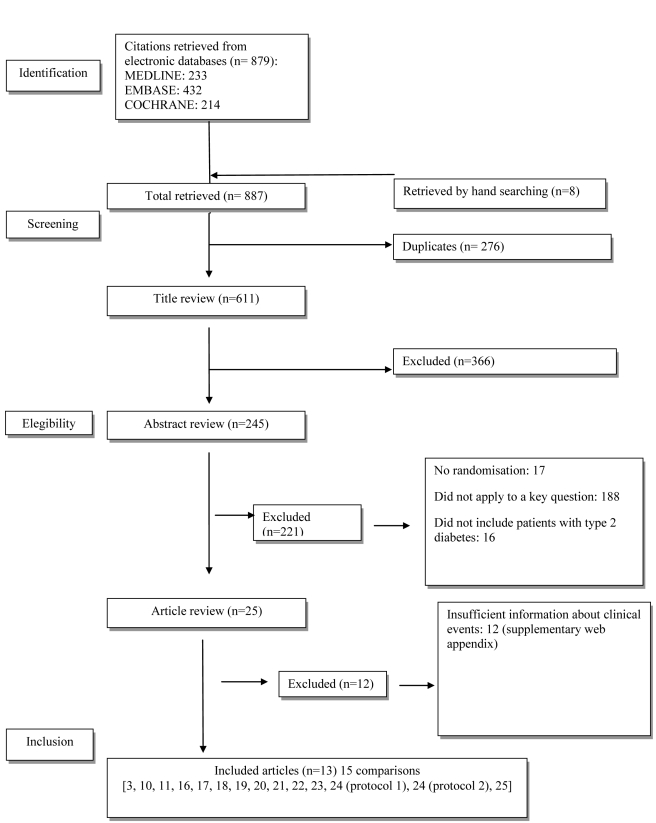
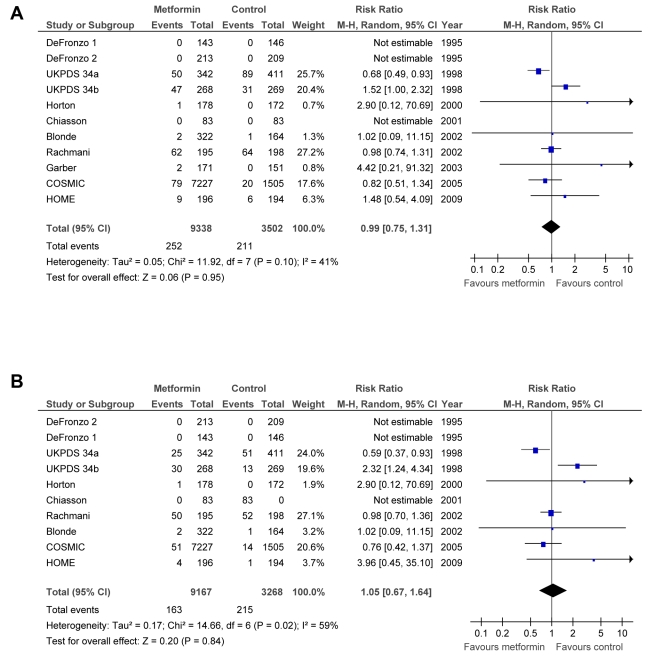
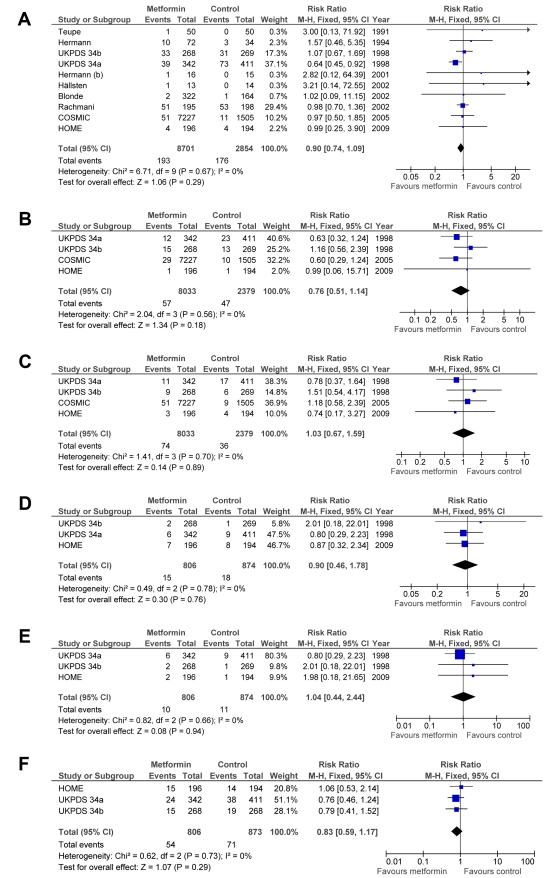
BACKGROUND: The UK Prospective Diabetes Study showed that metformin decreases mortality compared to diet alone in overweight patients with type 2 diabetes mellitus. Since then, it has been the first-line treatment in overweight patients with type 2 diabetes. However, metformin-sulphonylurea bitherapy may increase mortality. METHODS AND FINDINGS: This meta-analysis of randomised controlled trials evaluated metformin efficacy (in studies of metformin versus diet alone, versus placebo, and versus no treatment; metformin as an add-on therapy; and metformin withdrawal) against cardiovascular morbidity or mortality in patients with type 2 diabetes. We searched Medline, Embase, and the Cochrane database. Primary end points were all-cause mortality and cardiovascular death. Secondary end points included all myocardial infarctions, all strokes, congestive heart failure, peripheral vascular disease, leg amputations, and microvascular complications. Thirteen randomised controlled trials (13,110 patients) were retrieved; 9,560 patients were given metformin, and 3,550 patients were given conventional treatment or placebo. Metformin did not significantly affect the primary outcomes all-cause mortality, risk ratio (RR)=0.99 (95% CI: 0.75 to 1.31), and cardiovascular mortality, RR=1.05 (95% CI: 0.67 to 1.64). The secondary outcomes were also unaffected by metformin treatment: all myocardial infarctions, RR=0.90 (95% CI: 0.74 to 1.09); all strokes, RR=0.76 (95% CI: 0.51 to 1.14); heart failure, RR=1.03 (95% CI: 0.67 to 1.59); peripheral vascular disease, RR=0.90 (95% CI: 0.46 to 1.78); leg amputations, RR=1.04 (95% CI: 0.44 to 2.44); and microvascular complications, RR=0.83 (95% CI: 0.59 to 1.17). For all-cause mortality and cardiovascular mortality, there was significant heterogeneity when including the UK Prospective Diabetes Study subgroups (I(2)=41% and 59%). There was significant interaction with sulphonylurea as a concomitant treatment for myocardial infarction (p=0.10 and 0.02, respectively). CONCLUSIONS: Although metformin is considered the gold standard, its benefit/risk ratio remains uncertain. We cannot exclude a 25% reduction or a 31% increase in all-cause mortality. We cannot exclude a 33% reduction or a 64% increase in cardiovascular mortality. Further studies are needed to clarify this situation.
Overview
The claims and statistics of this paper haven’t been checked yet.
Run the check — free, no account needed. It reads the open-access text and checks the sources it cites.
Integrity signals
Registry
Cites
Statistics
Figures
Verification
Claims the paper makes
The claims and statistics of this paper haven’t been checked yet.
Run the check — free, no account needed. It reads the open-access text and checks the sources it cites.
Claims other papers make about this one
Each is checked against this paper’s own text: does it say what the citing paper says it does?
In the citing paper
“A recent meta-analysis suggested that the cardiovascular effects of metformin could be smaller than had been hypothesized on the basis of the UKPDS; however, its results must be interpreted with caution given the low number of randomized controlled trials included [77].”
From Metformin: An Old But Still the Best Treatment for Type 2 Diabetes (2013) · cites this paper as [77]
In the citing paper
“The risk of developing cardiac heart failure (CHF) in diabetic individuals nearly doubles as the population ages [77].”
From Metformin: An Old But Still the Best Treatment for Type 2 Diabetes (2013) · cites this paper as [77]
Self-check
Percentages, sums and reported differences re-computed from the paper’s own numbers.
The self-check needs the paper’s full text.
Citations
Cites
1 retracted
Metformin monotherapy for type 2 diabetes mellitus
Sáenz, A., Fernandez-Esteban, I., Mataix, A. L., Segura, M. A., Figuls, M. R. I., & Moher, D. (2005) · Cochrane Database of Systematic Reviews · doi:10.1002/14651858.cd002966.pub3 · Cited by 310
RetractedQuantifying heterogeneity in a meta‐analysis
Higgins, J. P. T., & Thompson, S. G. (2002) · Statistics in Medicine · doi:10.1002/sim.1186 · Cited by 36,763
Assessing the quality of reports of randomized clinical trials: Is blinding necessary?
Jadad, A. R., Moore, R. A., Carroll, D., Jenkinson, C., Reynolds, D. J. M., Gavaghan, D. J., & McQuay, H. J. (1996) · Controlled Clinical Trials · doi:10.1016/0197-2456(95)00134-4 · Cited by 17,582
Wild, S., Roglic, G., Green, A., Sicree, R., & King, H. (2004) · Diabetes Care · doi:10.2337/diacare.27.5.1047 · Cited by 15,297
Zhang, Q., Wang, C., Zheng, M., Li, Y., Li, J., Zhang, L., Shang, X., & Yan, C. (2014) · Cerebrovascular Diseases · doi:10.1159/000369778 · Cited by 11,609
Turner, R. C., Fox, C., Matthews, McElroy, H. H., Cull, C. A., Holman, R. R., Neil, P., Hadden, D. R., Wright, D., Manley, E., et al. (1998) · The Lancet · Cited by 8,419
Intensive blood glucose control and vascular outcomes in patients with type 2 diabetes
(2008) · New England Journal of Medicine · doi:10.1056/nejmoa0802987 · Cited by 7,397
Schulz (1995) · doi:10.1001/jama.1995.03520290060030 · Cited by 5,634
Cited by
Sorted by citations
McDonagh, T. A., Metra, M., Adamo, M., Gardner, R. S., Baumbach, A., Böhm, M., Burri, H., Butler, J., Čelutkienė, J., Chioncel, O. D., et al. (2021) · PubMed · doi:10.1093/eurheartj/ehab670 · Cited by 20,604
2016 ESC Guidelines for the diagnosis and treatment of acute and chronic heart failure
Ponikowski, P., Voors, A. A., Anker, S. D., Bueno, H., Cleland, J. G. F., Coats, A. J. S., Falk, V., González-Juanatey, J. R., Harjola, V.-P., Jankowska, E. A., et al. (2016) · European Heart Journal · doi:10.1093/eurheartj/ehw128 · Cited by 11,429
2016 ESC Guidelines for the Diagnosis and Treatment of Acute and Chronic Heart Failure
Ponikowski, P., Voors, A. A., Anker, S. D., Bueno, H., Cleland, J. G. F., Coats, A. J. S., Falk, V., González-Juanatey, J. R., Harjola, V.-P., Jankowska, E. A., et al. (2016) · European Journal of Heart Failure · doi:10.1002/ejhf.592 · Cited by 5,866
Metformin: from mechanisms of action to therapies
Foretz, M., Guigas, B., Bertrand, L., Pollak, M., & Viollet, B. (2014) · Cell Metabolism · doi:10.1016/j.cmet.2014.09.018 · Cited by 1,501
Metformin—mode of action and clinical implications for diabetes and cancer
Pernicova, I., & Korbonits, M. (2014) · Nature Reviews Endocrinology · doi:10.1038/nrendo.2013.256 · Cited by 1,393
Metadata
- Authors
- Boussageon, R., Supper, I., Bejan-Angoulvant, T., Kellou, N., Cucherat, M., Boissel, J.-P., Kassai, B., Moreau, A., Gueyffier, F., & Cornu, C.
- Affiliations
- Lyon 1 Université (FR)
- Corresponding author
- Cornu, Catherine
- ORCID
- Venue
- PLoS Medicine
- Publisher
- Public Library of Science (PLoS)
- Published
- 2012-04-10
- Volume
- 9
- Issue
- 4
- Pages
- e1001204
- ISSN
- 1549-1277 (ISSN-L)
- 1549-1676
- PMC
- PMC3323508
- OpenAlex
- W2043807347
- Cited by
- 266
- References
- 65
- Citations by year
- 2026: 8 · 2025: 7 · 2024: 11 · 2023: 8 · 2022: 12 · 2021: 19 · 2020: 30 · 2019: 19 · 2018: 28 · 2017: 18 · 2016: 24 · 2015: 23 · 2014: 23 · 2013: 27 · 2012: 9
- FWCI
- 3.64
- Type
- journal article
- Language
- en
- Open access
- gold
- doi.org
- Locations
- PLoS Medicine (publishedVersion, cc-by)
- PubMed Central (publishedVersion, cc-by)
- PubMed (publishedVersion)
- HAL (submittedVersion, other-oa)
- HAL (submittedVersion)
- RePEc: Research Papers in Economics (submittedVersion)
- DOAJ (DOAJ: Directory of Open Access Journals) (submittedVersion, cc-by-sa)
- Figshare (submittedVersion, cc-by)
- Topics
- Health Sciences › Medicine › Endocrinology, Diabetes and Metabolism › Diabetes Treatment and Management
- Health Sciences › Medicine › Endocrinology, Diabetes and Metabolism › Diabetes, Cardiovascular Risks, and Lipoproteins
- Life Sciences › Biochemistry, Genetics and Molecular Biology › Molecular Biology › Metabolism, Diabetes, and Cancer
- Keywords
- metformin, type 2 diabetes, all-cause mortality, cardiovascular mortality, cardiovascular morbidity, myocardial infarction, stroke, congestive heart failure, peripheral vascular disease, leg amputation, microvascular complications, UK Prospective Diabetes Study, first-line therapy, drug efficacy
- MeSH terms
- Diabetes Mellitus, Type 2, Diabetic Angiopathies, Humans, Metformin, Sulfonylurea Compounds, Outcome Assessment, Health Care, Overweight
About these checks
Registry, retraction, Cites and statistics results are computed, not judged, with one exception: a printed reference that no index lists is read once by a model before it counts as a citation error. Claims are extracted by a model and kept only when their quote appears verbatim in the text; each cited source is then checked, with a model’s help, for whether it says what the claim relies on. Those verdicts can be wrong — read the claim’s quote and the cited source before relying on one.
Statistics and arithmetic are recomputed, not judged.
Confidence bands are shown only for fields calibrated on our annotated test set. None is calibrated yet, so no band is shown.
What counts as a claim ›How we measure confidence ›How we check this ›
Are you an author, or do you see a problem with this page? Request a review
