

The DOI matches its Crossref record; 66 of the 67 references it cites were found in a registry or an index.
Effect of Treatment of Obstructive Sleep Apnea on Depressive Symptoms: Systematic Review and Meta-Analysis
Open accessAbstract
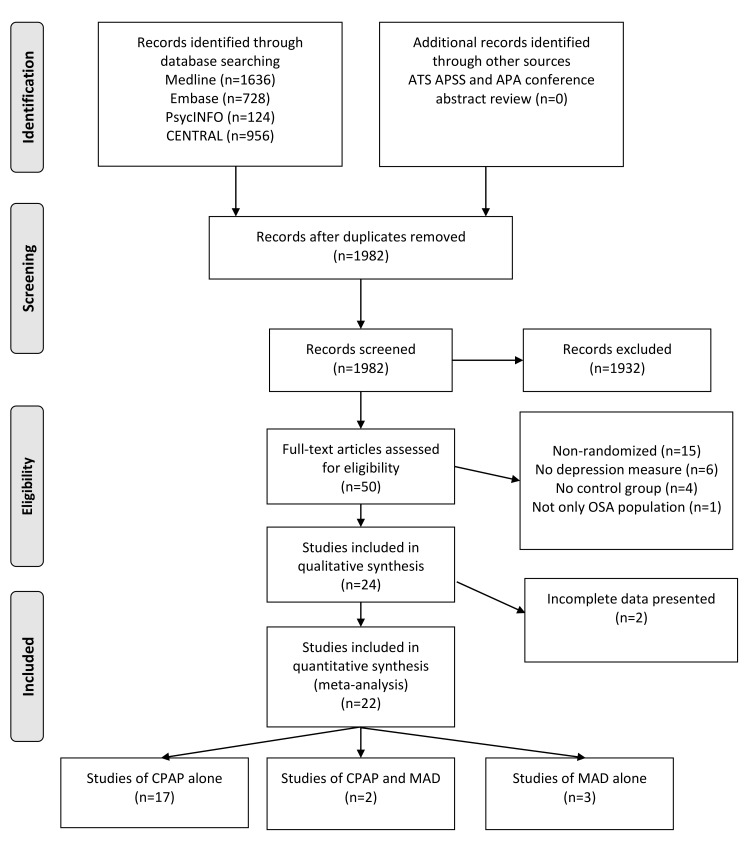
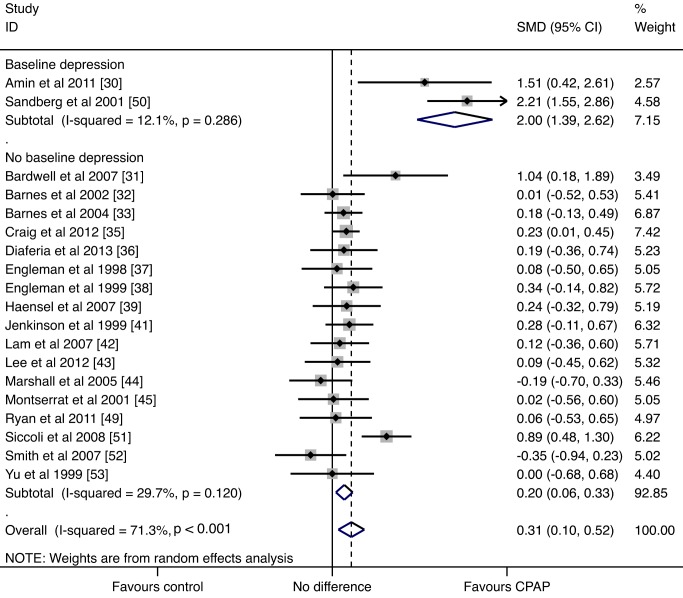
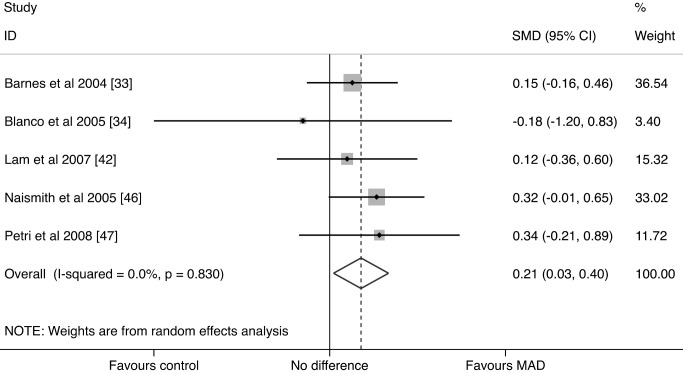
BACKGROUND: Obstructive sleep apnea (OSA) is associated with increased morbidity and mortality, and decreased quality of life. Treatment with continuous positive airway pressure (CPAP) or mandibular advancement devices (MADs) is effective for many symptoms of OSA. However, it remains controversial whether treatment with CPAP or MAD also improves depressive symptoms. METHODS AND FINDINGS: We performed a systematic review and meta-analysis of randomized controlled trials that examined the effect of CPAP or MADs on depressive symptoms in patients with OSA. We searched Medline, EMBASE, the Cochrane Central Registry of Controlled Trials, and PsycINFO from the inception of the databases until August 15, 2014, for relevant articles. In a random effects meta-analysis of 19 identified trials, CPAP treatment resulted in an improvement in depressive symptoms compared to control, but with significant heterogeneity between trials (Q statistic, p<0.001; I(2) = 71.3%, 95% CI: 54%, 82%). CPAP treatment resulted in significantly greater improvement in depressive symptoms in the two trials with a higher burden of depression at baseline (meta-regression, p<0.001). The pooled standardized mean difference (SMD) in depressive symptoms with CPAP treatment in these two trial populations with baseline depression was 2.004 (95% CI: 1.387, 2.621), compared to 0.197 (95% CI: 0.059, 0.334) for 15 trials of populations without depression at baseline. Pooled estimates of the treatment effect of CPAP were greater in parallel arm trials than in crossover trials (meta-regression, p = 0.076). Random effects meta-analysis of five trials of MADs showed a significant improvement in depressive symptoms with MADs versus controls: SMD = 0.214 (95% CI: 0.026, 0.401) without significant heterogeneity (I(2) = 0%, 95% CI: 0%, 79%). Studies were limited by the use of depressive symptom scales that have not been validated specifically in people with OSA. CONCLUSIONS: CPAP and MADs may be useful components of treatment of depressive symptoms in individuals with OSA and depression. The efficacy of CPAP and MADs compared to standard therapies for depression is unknown. Please see later in the article for the Editors' Summary.
Overview
The claims and statistics of this paper haven’t been checked yet.
Run the check — free, no account needed. It reads the open-access text and checks the sources it cites.
Integrity signals
Registry
Cites
Statistics
Figures
Verification
Claims the paper makes
The claims and statistics of this paper haven’t been checked yet.
Run the check — free, no account needed. It reads the open-access text and checks the sources it cites.
Claims other papers make about this one
Each is checked against this paper’s own text: does it say what the citing paper says it does?
The source backs part of the claim, not all of it — or backs it for a different population, condition or comparison.
In the citing paper
“A meta‐analysis of 22 RCTs reported that therapy of OSA resulted in a dose‐dependent improvement in depressive symptomatology using recognised depression scales (Povitz et al., 2014).”
From Obstructive sleep apnea: transition from pathophysiology to an integrative disease model (2022) · cites this paper as Povitz et al., 2014
Experimental — accuracy not yet measuredThe source backs part of the claim, not all of it — or backs it for a different population, condition or comparison.
In the citing paper
“Of note, whereas many trials have shown the alleviation of subclinical depressive symptoms following sleep interventions, the available evidence suggests that even larger effects of sleep therapies on depression are observed in those with mental illness 79-81,94 .”
From A meta-review of "lifestyle psychiatry": the role of exercise, smoking, diet and sleep in the prevention and treatment of mental disorders (2020) · cites this paper as [80]
Experimental — accuracy not yet measuredThe cited source says what the claim attributes to it.
In the citing paper
“Large, significant reductions in depressive symptoms were also found from continuous positive airway pressure in people with depression and comorbid obstructive sleep apnoea (NIH=6, SMD=2.00, 95% CI: 1.39-2.62, I²=12%) 80”
From A meta-review of "lifestyle psychiatry": the role of exercise, smoking, diet and sleep in the prevention and treatment of mental disorders (2020) · cites this paper as [80]
Self-check
Percentages, sums and reported differences re-computed from the paper’s own numbers.
The self-check needs the paper’s full text.
Citations
Cites
Preferred Reporting Items for Systematic Reviews and Meta-Analyses: the PRISMA statement
Moher, D., Liberati, A., Tetzlaff, J., Altman, D. G., & for the PRISMA Group (2009) · BMJ · doi:10.1136/bmj.b2535 · Cited by 83,823
The Hospital Anxiety and Depression Scale
Zigmond, A. S., & Snaith, R. P. (1983) · Acta Psychiatrica Scandinavica · doi:10.1111/j.1600-0447.1983.tb09716.x · Cited by 47,139
Preferred reporting items for systematic reviews and meta-analyses: the PRISMA Statement.
(2009) · PubMed Central · Cited by 44,859
Preferred reporting items for systematic reviews and meta-analyses: The PRISMA statement
Moher, D., Liberati, A., Tetzlaff, J., Altman, D. G., & the PRISMA Group* (2009) · Annals of Internal Medicine · doi:10.7326/0003-4819-151-4-200908180-00135 · Cited by 37,554
The Cochrane Collaboration's tool for assessing risk of bias in randomised trials
Higgins, J. P. T., Altman, D. G., Gotzsche, P. C., Juni, P., Moher, D., Oxman, A. D., Savovic, J., Schulz, K. F., Weeks, L., Sterne, J. A. C., et al. (2011) · BMJ · doi:10.1136/bmj.d5928 · Cited by 33,817
(1992) · PubMed · Cited by 33,716
The MOS 36-ltem Short-Form Health Survey (SF-36): I. Conceptual Framework and Item Selection
Ware, J. E., & Sherbourne, C. D. (1992) · Medical Care · doi:10.1097/00005650-199206000-00002 · Cited by 30,033
Cochrane Handbook for Systematic Reviews of Interventions: Cochrane Book Series
(2008) · doi:10.1002/9780470712184 · Cited by 25,048
Dermyshi, E., Wang, Y., Yan, C., Hong, W., Qiu, G., Gong, X., & Zhang, T. (2017) · Neonatology · doi:10.1159/000454668 · Cited by 24,586
Preferred Reporting Items for Systematic Reviews and Meta-Analyses: The PRISMA Statement
Moher, D., Liberati, A., Tetzlaff, J., & Altman, D. G. (2009) · Journal of Clinical Epidemiology · doi:10.1016/j.jclinepi.2009.06.005 · Cited by 19,575
Research works printed but not linked: 1
- S Redline, 1998, Improvement of mild sleep-disordered breathing with CPAP compared with conservative therapy, Am J Respir Crit Care Med, 157, 858, 10.1164/ajrccm.157.3.9709042 · DOI · Paper page
Cited by
Sorted by citations
Items 101–147 of 147
Parenti, S. I., Aroni, E., Laffranchi, L., Paganelli, C., & Bonetti, G. A. (2019) · European Journal of Orthodontics · doi:10.1093/ejo/cjz065 · Cited by 2
Funahashi, K., Hirose, M., Kondo, S., Sano, Y., Fujita, S., Iwata, N., & Kitajima, T. (2023) · PubMed Central · doi:10.20407/fmj.2022-023 · Cited by 2
Delbarre, A., Gagnadoux, F., Gohier, B., & Pelletier‐Fleury, N. (2018) · Scientific Reports · doi:10.1038/s41598-018-32142-6 · Cited by 2
Mood After CPAP: Fewer Patients With Depression, but not Fewer With Anxiety
Marrone, O. (2019) · EClinicalMedicine · doi:10.1016/j.eclinm.2019.06.008 · Cited by 2
Pal, A., Sidana, I. S., & Avinash, P. (2022) · Springer eBooks · doi:10.1007/978-981-16-0123-1_19 · Cited by 3
EVANS, M., Crowther, M., Brown, B. W. J., Wanstall, S. E., Rayner, T., Vakulin, A., Adams, R., & Reynolds, A. C. (2024) · Industrial Health · doi:10.2486/indhealth.2023-0135 · Cited by 1
Ishikawa, Y., Oguro, N., Ichikawa, T., Kishida, D., Sakurai, N., Hidekawa, C., Shidahara, K., Hayashi, K., Miyawaki, Y., Shimojima, Y., et al. (2025) · Modern Rheumatology · doi:10.1093/mr/roaf047 · Cited by 1
Poletti, V., Battaglia, E., Banfi, P. I., & Volpato, E. (2025) · Sleep Medicine · doi:10.1016/j.sleep.2025.106726 · Cited by 1
Cheshmi, B., & Keyhan, S. O. (2021) · Springer eBooks · doi:10.1007/978-3-030-46993-1_67 · Cited by 1
The relationship between positive airway pressure tolerance and adherence: defining a new metric
Tekumalla, S., Plawecki, A. M., Kaffenberger, T. M., Alapati, R., Doghramji, K., Boon, M. S., & Huntley, C. T. (2024) · Journal of Clinical Sleep Medicine · doi:10.5664/jcsm.11050 · Cited by 1
Meghji, Z., Hategan, A., Maclean, M., & Amoako-Tuffour, A. (2024) · Springer eBooks · doi:10.1007/978-3-031-47802-4_24 · Cited by 1
Prevalence and risk factors of depression in Korean patients with untreated obstructive sleep apnea
Kim, J. S., Park, H. R., Joo, E. Y., Seo, D., & Shon, Y. (2025) · Frontiers in Neurology · doi:10.3389/fneur.2025.1643587 · Cited by 2
Ulusoy, S., Yavuz, N., Dinç, M., & Acar, M. (2015) · ENT Updates · doi:10.2399/jmu.2015003010 · Cited by 1
Araújo, M., & Norton, A. (2020) · Cureus · doi:10.7759/cureus.12152 · Cited by 1
Owora, A. H. (2022) · Brain and Behavior · doi:10.1002/brb3.2614
Profile Of Depressive Symptoms In Sleep Apnea - Gender Differences And The Role Of Obesity
de Farias, P. A. M., Medeiros, C. A. M., Gurgel, M., Maia, C., de Bruin, P. F. C., & de Bruin, V. M. S. (2016) · International Archives of Medicine · doi:10.3823/2097
Die obstruktive Schlafapnoe als zusätzliche Diagnose
Eschle, D. (2017) · DNP - Der Neurologe und Psychiater · doi:10.1007/s15202-017-1561-6
Bonsignore, M. R., Marrone, O., & McNicholas, W. T. (2017) · Barcelona Respiratory Network · doi:10.23866/brnrev:2017-m0037
Sleep-Wake Disorders in Late Life
Meghji, Z., Hategan, A., & Amoako-Tuffour, A. (2017) · Springer eBooks · doi:10.1007/978-3-319-67555-8_24
Depressive symptomatology in obstructive sleep apnoea
Nanthakumar, S. (2017) · UWA Profiles and Research Repository (UWA) · doi:10.4225/23/5a273b1510c3c
Poirot, I., Brion, A., Schroder, C. M., & Touitou, Y. (2016) · Dunod eBooks · doi:10.3917/dunod.schro.2016.01.0089 · Cited by 1
Xiong, M., Zhao, Z., Nie, Q., Shi, Z., Wu, B., Yang, H., Fang, Y., Song, Y., He, X., Wang, M. E., et al. (2021) · Research Square · doi:10.21203/rs.3.rs-484633/v1
AVALIAÇÃO DA QUALIDADE DE VIDA DE PACIENTES COM A SÍNDROME DA APNEIA OBSTRUTIVA DO SONO
Santos, N. L. (2021) · Anais dos Seminários de Iniciação Científica · doi:10.13102/semic.v0i23.6538
Xiong, M., Zhao, Z., Nie, Q., Shi, Z., Wu, B., Song, Y., He, X., Wang, M. E., & Hu, K. (2021) · Research Square · doi:10.21203/rs.3.rs-688417/v1
Hertenstein, E., Wetter, T. C., & Nissen, C. (2020) · Elsevier eBooks · doi:10.1016/b978-3-437-21321-2.00059-4
Lau, E. Y. Y. (2022) · Elsevier eBooks · doi:10.1016/b978-0-12-822963-7.00277-2
Individual and socioeconomic impact of sleep related breathing disorders
He, K., Palen, B. N., & Kapur, V. K. (2021) · Elsevier eBooks · doi:10.1016/b978-0-12-822963-7.00153-5
Positive Pressure Therapy in OSA
Grote, L., & Palm, A. (2021) · Elsevier eBooks · doi:10.1016/b978-0-08-102723-3.00163-3
Sleep-Wake Disorders in Late Life
Hategan, A., Bourgeois, J. A., Cheng, T. Z., & Young, J. A. (2018) · Springer eBooks · doi:10.1007/978-3-319-77128-1_12
Bonsignore, M. R., Marrone, O., & McNicholas, W. T. (2017) · Barcelona Respiratory Network · doi:10.24875/brn.m17000005
Beesdo‐Baum, K. (2020) · Faculty Opinions – Post-Publication Peer Review of the Biomedical Literature · doi:10.3410/f.738680951.793580928
Soft Styles of Motivating Patients to Adopt CPAP
Khullar, A. (2022) · Springer eBooks · doi:10.1007/978-3-030-93146-9_4
Eren, F., & Duksal, F. (2023) · Genel Tıp Dergisi · doi:10.54005/geneltip.1308110
Champagne, K., Chapados, D., Barriga, P. C., & Trottier, M. (2024) · Elsevier eBooks · doi:10.1016/b978-0-323-95082-4.00043-8
Beyond the Breath: Exploring the Complex Nexus of Obstructive Sleep Apnea and Comorbid Conditions
Kumar, R., Rathi, V., Ish, P., Gupta, N., Mohan, S., & Vaghasia, N. (2024) · Indian Journal of Sleep Medicine · doi:10.5005/jp-journals-10069-0133
The Impact of Obstructive Sleep-Disordered Breathing on Behavior and Mental Health in Adults
de Sousa, F. A., & Costa, S. (2024) · Springer eBooks · doi:10.1007/978-3-031-32035-4_174-1
Clinical perspective on non-sleepy obstructive sleep apnea; to treat or not to treat?
Luu, S., Nanayakkara, B., & Yee, B. J. (2025) · Expert Review of Respiratory Medicine · doi:10.1080/17476348.2025.2539542
The Impact of Obstructive Sleep-Disordered Breathing on Behavior and Mental Health in Adults
de Sousa, F. A., & Costa, S. (2025) · Springer eBooks · doi:10.1007/978-3-031-73368-0_174
den Bleijker, N. M., van Schothorst, M. M. E., Hendriksen, I. J. M., Cahn, W., de Vries, N. K., van Harten, P. N., & Deenik, J. (2022) · Figshare · doi:10.6084/m9.figshare.19498114
Pakzamir, P., Keyhan, S. O., & Cheshmi, B. (2025) · Springer eBooks · doi:10.1007/978-3-031-36962-9_243-1
van Bruggen, F. H., & McIntyre, R. S. (2026) · Sleep Medicine · doi:10.1016/j.sleep.2026.108831
Feasibility of home testing to detect undiagnosed obstructive sleep apnea in late life depression
Singh, R., Berger, S., Siddiqui, M., Rapoport, M. J., Herrmann, N., Lanctôt, K. L., Boulos, M. I., & Gallagher, D. (2026) · Sleep Medicine · doi:10.1016/j.sleep.2026.108948
Yuan, S., Yan, R., Li, W., & Hua, M. (2026) · Sleep And Breathing · doi:10.1007/s11325-026-03705-z
Murray, J., Helly, F., Coss, P., Brennan, A., Kennedy, B., Kent, B. D., & Piggott, L. M. (2026) · Sleep Medicine X · doi:10.1016/j.sleepx.2026.100195
Garrivet, J., Blanchard, M., Gohier, B., Geoffroy, P. A., Solelhac, G., Jouvenot, M., Thomas, A., Gagnadoux, F., & Trzépizur, W. (2026) · Journal of Sleep Research · doi:10.1111/jsr.70452
CPAP adherence and depressive symptoms in post-stroke/TIA patients with OSA
Ali, H. O., Gyenes, M., Xie, H. T. H., Kamra, M., Colelli, D. R., Kirolos, N., Gladstone, D. J., Boyle, K., Sundaram, A. N. E., Hopyan, J. J., et al. (2026) · Sleep Medicine · doi:10.1016/j.sleep.2026.109286
Individual and Socioeconomic Impact of Sleep-Related Breathing Disorders
Palen, B. N., & Kapur, V. K. (2013) · Elsevier eBooks · doi:10.1016/b978-0-12-378610-4.00348-x
Metadata
- Authors
- Povitz, M., Bolo, C. E., Heitman, S. J., Tsai, W. H., Wang, J., & James, M. T.
- Affiliations
- Western University (CA)
- University of Calgary (CA)
- Corresponding author
- James, Matthew T.
- Venue
- PLoS Medicine
- Publisher
- Public Library of Science (PLoS)
- Published
- 2014-11-25
- Volume
- 11
- Issue
- 11
- Pages
- e1001762
- ISSN
- 1549-1277 (ISSN-L)
- 1549-1676
- PMC
- PMC4244041
- OpenAlex
- W2096306751
- Cited by
- 147
- References
- 67
- Citations by year
- 2026: 8 · 2025: 7 · 2024: 14 · 2023: 10 · 2022: 14 · 2021: 15 · 2020: 13 · 2019: 10 · 2018: 17 · 2017: 12 · 2016: 15 · 2015: 10 · 2014: 1
- FWCI
- 1.49
- Type
- journal article
- Language
- en
- Open access
- gold
- doi.org
- Locations
- PLoS Medicine (publishedVersion, cc-by)
- Europe PMC (PubMed Central) (publishedVersion, cc-by)
- PubMed Central (publishedVersion, cc-by)
- PubMed (publishedVersion)
- RePEc: Research Papers in Economics (submittedVersion)
- DOAJ (DOAJ: Directory of Open Access Journals) (submittedVersion, cc-by-sa)
- Figshare (submittedVersion, cc-by)
- Topics
- Health Sciences › Medicine › Physiology (medical) › Obstructive Sleep Apnea Research
- Social Sciences › Psychology › Experimental and Cognitive Psychology › Sleep and related disorders
- Health Sciences › Dentistry › Oral Surgery › Temporomandibular Joint Disorders
- Keywords
- obstructive sleep apnea, depressive symptoms, depression, continuous positive airway pressure, mandibular advancement device, sleep apnea treatment, quality of life, quality of life interventions, sleep-disordered breathing, sleep apnea comorbidity
- MeSH terms
- Depression, Humans, Quality of Life, Mandibular Advancement, Sleep Apnea, Obstructive, Continuous Positive Airway Pressure
About these checks
Registry, retraction, Cites and statistics results are computed, not judged, with one exception: a printed reference that no index lists is read once by a model before it counts as a citation error. Claims are extracted by a model and kept only when their quote appears verbatim in the text; each cited source is then checked, with a model’s help, for whether it says what the claim relies on. Those verdicts can be wrong — read the claim’s quote and the cited source before relying on one.
Statistics and arithmetic are recomputed, not judged.
Confidence bands are shown only for fields calibrated on our annotated test set. None is calibrated yet, so no band is shown.
What counts as a claim ›How we measure confidence ›How we check this ›
Are you an author, or do you see a problem with this page? Request a review
