

The DOI matches its Crossref record; 14 of the 15 references it cites were found in a registry or an index.
The expanding epidemic of HIV-1 in the Russian Federation
Open accessAbstract
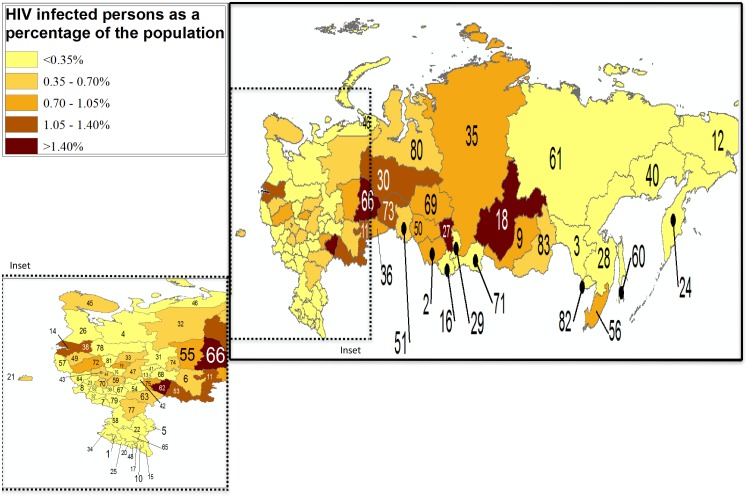
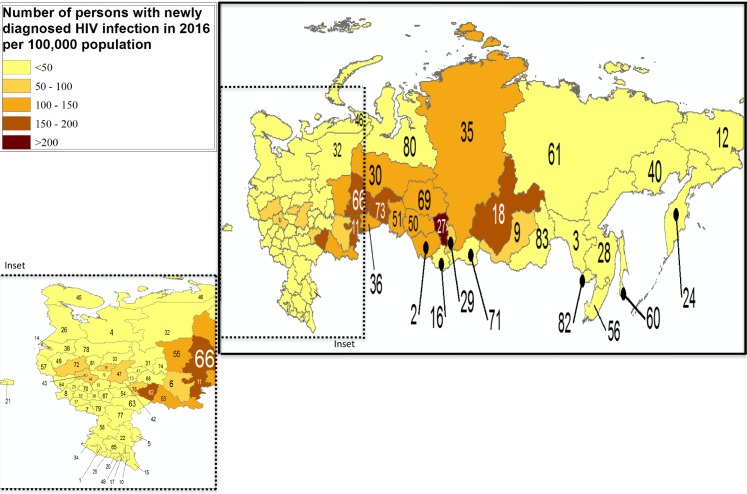
had been increasing at some 10% per year from 2011-2016 [2].Among Russian men aged 30-39 years of age, a group that has the highest male infection burden, some 2.8% were living with HIV infection in 2016 [2].AIDS deaths, too, are rising and now negatively impact life expectancy [3].From January to June 2017, some 14,631 AIDS deaths were recorded, a 13.5% increase over the previous 6-month period [3].HIV/AIDS has risen to feature in the top 10 causes of premature death in the RF-a 35% increase from 2005 [4].These realities should concern all who seek global control of the HIV pandemic.Despite the severity of this epidemic, including its scale, scope, and trajectory, remarkably little attention has been paid to the associated public health crisis in the international scientific literature.This may in part be due to the limited availability of data on HIV-1 in the RF that are presented and published outside Russia, and to the few international collaborations on HIV in the RF under the current administration.Therefore, we reviewed publicly available data in the Russian language on HIV-1 in the RF through mid-2017 and analyzed Russian federal and oblast (province)-level HIV policies and programs to assess the current burden of HIV-1 prevalence and incidence, the state of prevention programs as they relate to the epidemiology of HIV in the country, and policy impacts of current Russian laws, policies, and practices on the future trajectory of the epidemic.Cumulative Russian federal data through mid-2017 are available on Russian language websites from several oblasts, a Federal AIDS Center report, and from Rosstat, the Russian Federal Statistics Bureau [2,[5][6][7].Russian federal data are reported as cumulative diagnoses and as new diagnoses per 100,000 population.We used these data to generate burden maps of reported prevalence and of new diagnoses, by oblast, across the RF (Fig 1 and Fig 2).Neither measure can be said to yield true HIV prevalence or incidence infection estimates, since they do not account for deaths (in the case of cumulative infections) or estimate the rate of new infections,
Overview
The claims and statistics of this paper haven’t been checked yet.
Run the check — free, no account needed. It reads the open-access text and checks the sources it cites.
Integrity signals
Registry
Cites
Statistics
Figures
Verification
Claims the paper makes
The claims and statistics of this paper haven’t been checked yet.
Run the check — free, no account needed. It reads the open-access text and checks the sources it cites.
Claims other papers make about this one
Each is checked against this paper’s own text: does it say what the citing paper says it does?
The source backs part of the claim, not all of it — or backs it for a different population, condition or comparison.
In the citing paper
“HIV incidence and mortality continue to increase in spite of global progress.13”
From An acceptance-based, intersectional stigma coping intervention for people with HIV who inject drugs—a randomized clinical trial (2023) · cites this paper as [13]
Experimental — accuracy not yet measured
Self-check
Percentages, sums and reported differences re-computed from the paper’s own numbers.
The self-check needs the paper’s full text.
Citations
Cites
Public health and international drug policy
Csete, J., Kamarulzaman, A., Kazatchkine, M. D., Altice, F. L., Balicki, M., Buxton, J., Cepeda, J., Comfort, M. L., Goosby, E., Goulão, J., et al. (2016) · The Lancet · doi:10.1016/s0140-6736(16)00619-x · Cited by 680
Self-citationBaggaley, R. C., Armstrong, A., Dodd, Z., Ngoksin, E., & Krug, A. (2015) · Journal of the International AIDS Society · doi:10.7448/ias.18.2.19438 · Cited by 185
Degenhardt, L. J., Mathers, B. M., Wirtz, A. L., Wolfe, D., Kamarulzaman, A., Carrieri, P., Strathdee, S. A., Malinowska-Sempruch, K., Kazatchkine, M. D., & Beyrer, C. (2013) · International Journal of Drug Policy · doi:10.1016/j.drugpo.2013.08.004 · Cited by 163
Self-citationTime to act: a call for comprehensive responses to HIV in people who use drugs
Beyrer, C., Malinowska-Sempruch, K., Kamarulzaman, A., Kazatchkine, M. D., Sidibé, M., & Strathdee, S. A. (2010) · The Lancet · doi:10.1016/s0140-6736(10)60928-2 · Cited by 153
Self-citationHylton, E., Wirtz, A. L., Zelaya, C. E., Latkin, C. A., Peryshkina, A., Mogilniy, V., Dzhigun, P., Kostetskaya, I., Galai, N., & Beyrer, C. (2017) · Journal of Urban Health · doi:10.1007/s11524-017-0133-6 · Cited by 57
Self-citationWirtz, A. L., Zelaya, C. E., Peryshkina, A., Latkin, C. A., Mogilniy, V., Galai, N., Dyakonov, K., & Beyrer, C. (2013) · AIDS Care · doi:10.1080/09540121.2013.819407 · Cited by 41
Self-citationMulti-drug-resistant tuberculosis in HIV positive patients in Eastern Europe
Post, F. A., Grint, D. J., Werlinrud, A. M., Panteleev, A., Riekstiņa, V., Малашенков, Е. А., Skrahina, A. M., Duiculescu, D., Podlekareva, D. N., Karpov, I., et al. (2013) · Journal of Infection · doi:10.1016/j.jinf.2013.09.034 · Cited by 38
Gaps remain in Russia's response to HIV/AIDS
Clark, F. (2016) · The Lancet · doi:10.1016/s0140-6736(16)31480-5 · Cited by 27
The cascade of HIV care in Russia, 2011–2013
Pokrovskaya, A. V., Попова, А., Ladnaya, N. N., & Yurin, O. (2014) · Journal of the International AIDS Society · doi:10.7448/ias.17.4.19506 · Cited by 26
Wirtz, A. L., Zelaya, C. E., Latkin, C. A., Peryshkina, A., Galai, N., Mogilniy, V., Dzhigun, P., Kostetskaya, I., Mehta, S. H., & Beyrer, C. (2015) · Sexually Transmitted Infections · doi:10.1136/sextrans-2015-052076 · Cited by 26
Self-citation
Research works printed but not linked: 3
- S Keshavjee, 2014, The Sputnik Initiative: Patient-centered accompaniment for Tuberculosis in Russia, Partners in Health
- Federal Scientific for the Prevention and Combat of AIDS of the Public Office of the Central Scientific Research Institute Rospotrebnadzor. ВИЧ-ИНФЕКЦИЯ Информационный бюллетень № 40 (HIV Infection Bulletin № 40). Moscow, 2015.
- M Elder, 2013, Russia passes law banning gay 'propaganda', The Guardian
Cited by
Sorted by citations
Bekker, L., Alleyne, G. A. O., Baral, S., Cepeda, J., Daskalakis, D., Dowdy, D. W., Dybul, M. R., Eholié, S. P., Esom, K., Garnett, G. P., et al. (2018) · The Lancet · doi:10.1016/s0140-6736(18)31070-5 · Cited by 793
Self-citationNanotechnology approaches for global infectious diseases
Kirtane, A. R., Verma, M., Karandikar, P., Furin, J., Langer, R., & Traverso, G. (2021) · Nature Nanotechnology · doi:10.1038/s41565-021-00866-8 · Cited by 520
Davis, S. L. M. (2020) · Cambridge University Press eBooks · doi:10.1017/9781108649544 · Cited by 56
Gutt, J., & Dieckmann, G. (2020) · Cambridge University Press eBooks · doi:10.1017/9781108683319 · Cited by 38
Wang, Y., Jing, W., Liu, J., & Liu, M. (2022) · Scandinavian Journal of Infectious Diseases · doi:10.1080/23744235.2022.2092647 · Cited by 32
Metadata
- Authors
- Beyrer, C., Wirtz, A. L., O’Hara, G., Léon, N., & Kazatchkine, M.
- Affiliations
- Johns Hopkins University (US)
- Haverford College (US)
- Global Health Centre (CH)
- Corresponding author
- Beyrer, Chris
- Venue
- PLoS Medicine
- Publisher
- Public Library of Science (PLoS)
- Published
- 2017-11-28
- Volume
- 14
- Issue
- 11
- Pages
- e1002462
- ISSN
- 1549-1277 (ISSN-L)
- 1549-1676
- PMC
- PMC5705067
- OpenAlex
- W2769321721
- Cited by
- 108
- References
- 15
- Citations by year
- 2025: 5 · 2024: 5 · 2023: 6 · 2022: 9 · 2021: 9 · 2020: 49 · 2019: 15 · 2018: 7 · 2017: 2
- FWCI
- 15.36
- Type
- journal article
- Language
- en
- Open access
- gold
- doi.org
- Licence
- Locations
- PLoS Medicine (publishedVersion, cc-by)
- Europe PMC (PubMed Central) (publishedVersion, cc-by)
- PubMed Central (publishedVersion, cc-by)
- PubMed (publishedVersion)
- DOAJ (DOAJ: Directory of Open Access Journals) (submittedVersion, cc-by-sa)
- Funders
- Johns Hopkins University (P30 AI 094189)
- National Institutes of Health
- Center for AIDS Research, University of Washington (P30AI094189)
- National Institute on Aging
- National Heart, Lung, and Blood Institute
- National Institute of Mental Health
- National Institute on Drug Abuse
- National Cancer Institute
- National Institute of General Medical Sciences
- National Institute of Allergy and Infectious Diseases (P30AI094189)
- National Institute of Diabetes and Digestive and Kidney Diseases
- Topics
- Health Sciences › Medicine › Infectious Diseases › HIV/AIDS Research and Interventions
- Health Sciences › Medicine › Epidemiology › HIV, Drug Use, Sexual Risk
- Health Sciences › Medicine › Public Health, Environmental and Occupational Health › HIV, TB, and STIs Epidemiology
- Keywords
- HIV-1 epidemic, HIV prevalence, HIV incidence, AIDS mortality, HIV prevention programs, HIV/AIDS policy, HIV epidemiology, Russia
- MeSH terms
- Humans, Russia, HIV-1, HIV Infections, Epidemics
About these checks
Registry, retraction, Cites and statistics results are computed, not judged, with one exception: a printed reference that no index lists is read once by a model before it counts as a citation error. Claims are extracted by a model and kept only when their quote appears verbatim in the text; each cited source is then checked, with a model’s help, for whether it says what the claim relies on. Those verdicts can be wrong — read the claim’s quote and the cited source before relying on one.
Statistics and arithmetic are recomputed, not judged.
Confidence bands are shown only for fields calibrated on our annotated test set. None is calibrated yet, so no band is shown.
What counts as a claim ›How we measure confidence ›How we check this ›
Are you an author, or do you see a problem with this page? Request a review
