

The DOI matches its Crossref record; 35 of the 35 references it cites were found in a registry or an index.
The global gap in treatment coverage for major depressive disorder in 84 countries from 2000–2019: A systematic review and Bayesian meta-regression analysis
Open accessAbstract
Background: The treatment coverage for major depressive disorder (MDD) is low in many parts of the world despite MDD being a major contributor to disability globally. Most existing reviews of MDD treatment coverage do not account for potential sources of study-level heterogeneity that contribute to variation in reported treatment rates. This study aims to provide a comprehensive review of the evidence and analytically quantify sources of heterogeneity to report updated estimates of MDD treatment coverage and gaps by location and treatment type between 2000 and 2019. Methods and findings: A systematic review of the literature was conducted to identify relevant studies that provided data on treatment rates for MDD between January 1, 2000, and November 26, 2021, from 2 online scholarly databases PubMed and Embase. Cohort and cross-sectional studies were included if treatment rates pertaining to the last 12 months or less were reported directly or if sufficient information was available to calculate this along with 95% uncertainty intervals (UIs). Studies were included if they made use of population-based surveys that were representative of communities, countries, or regions under study. Studies were included if they used established diagnostic criteria to diagnose cases of MDD. Sample and methodological characteristics were extracted from selected studies. Treatment rates were modeled using a Bayesian meta-regression approach and adjusted for select covariates that quantified heterogeneity in the data. These covariates included age, sex, treatment type, location, and choice of MDD assessment tool. A total of 149 studies were included for quantitative analysis. Treatment coverage for health service use ranged from 51% [95% UI 20%, 82%] in high-income locations to 20% [95% UI 1%, 53%] in low- and lower middle-income locations. Treatment coverage for mental health service use ranged from 33% [95% UI 8%, 66%] in high-income locations to 8% [95% UI <1%, 36%] in low- and lower middle-income countries. Minimally adequate treatment (MAT) rates ranged from 23% [95% UI 2%, 55%] in high-income countries to 3% [95% UI <1%, 25%]) in low- and lower middle-income countries. A primary methodological limitation was the lack of sufficient data from low- and lower middle-income countries, which precluded our ability to provide more detailed treatment rate estimates. Conclusions: In this study, we observed that the treatment coverage for MDD continues to be low in many parts of the world and in particular in low- and lower middle-income countries. There is a continued need for routine data collection that will help obtain more accurate estimates of treatment coverage globally.
Overview
The claims and statistics of this paper haven’t been checked yet.
Run the check — free, no account needed. It reads the open-access text and checks the sources it cites.
Integrity signals
Registry
Cites
Statistics
Figures
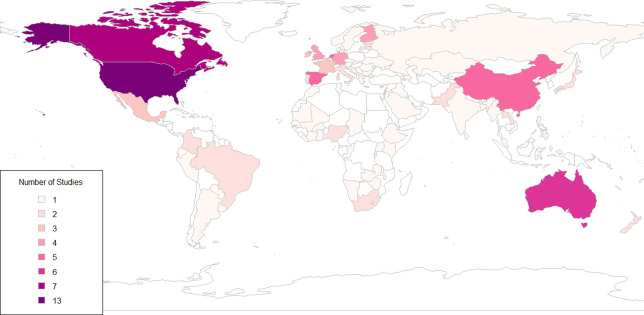
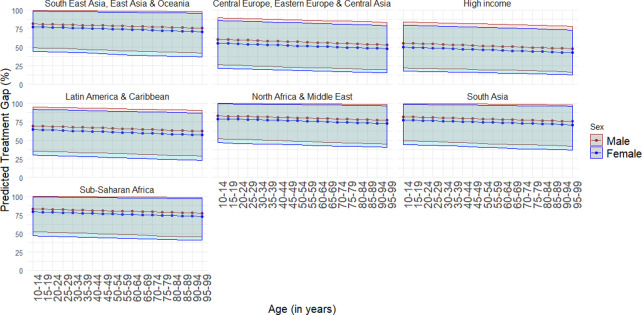
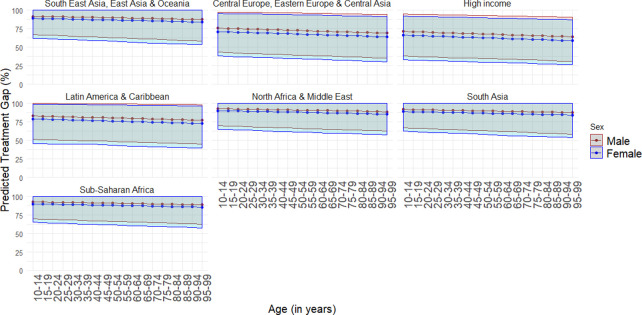
Verification
Claims the paper makes
The claims and statistics of this paper haven’t been checked yet.
Run the check — free, no account needed. It reads the open-access text and checks the sources it cites.
Claims other papers make about this one
Each is checked against this paper’s own text: does it say what the citing paper says it does?
The source backs part of the claim, not all of it — or backs it for a different population, condition or comparison.
In the citing paper
“Among the women who receive screening, only one-third with depression receive formal mental health care [192].”
From Brain structural and functional outcomes in the offspring of women experiencing psychological distress during pregnancy (2024) · cites this paper as [192]
Experimental — accuracy not yet measuredThe cited source says what the claim attributes to it.
In the citing paper
“A significant gap exists between mental ill-health and access to clinical services.”
From Providing Self-Led Mental Health Support Through an Artificial Intelligence–Powered Chat Bot (Leora) to Meet the Demand of Mental Health Care (2023) · cites this paper as [2]
In the citing paper
“The anticipation of discrimination, such as the fear of being discredited by police, having to withdraw from educational activities, or being avoided by family, friends, neighbours, also accounts for substantial negative effects.42,79”
From The Lancet Commission on ending stigma and discrimination in mental health (2022) · cites this paper as [42]
In the citing paper
“Doing so may help bridge the gap in treatment coverage by increasing the range of first line options for patients and health systems.9”
From Effect of exercise for depression: systematic review and network meta-analysis of randomised controlled trials (2024) · cites this paper as [9]
In the citing paper
“Notably, a significant proportion of mental health problems remain undiagnosed and untreated, with estimates suggesting that as many as two-thirds of individuals with depression do not receive the necessary care [Moitra et al., 2022].”
From Closing the accessibility gap to mental health treatment with a personalized self-referral chatbot (2024) · cites this paper as Moitra et al., 2022
Self-check
Percentages, sums and reported differences re-computed from the paper’s own numbers.
The self-check needs the paper’s full text.
Citations
Cites
R: A Language and Environment for Statistical Computing
R Core Team (2000) · doi:10.32614/r.manuals · Cited by 355,893
Preferred reporting items for systematic reviews and meta-analyses: The PRISMA statement
Moher, D., Liberati, A., Tetzlaff, J., Altman, D. G., & the PRISMA Group* (2009) · Annals of Internal Medicine · doi:10.7326/0003-4819-151-4-200908180-00135 · Cited by 37,554
Vos, T., Lim, S. S., Abbafati, C., Abbas, K. M., Abbasi, M., Abbasifard, M., Abbasi-Kangevari, M., Abbastabar, H., Abd-Allah, F., Abdelalim, A., et al. (2020) · The Lancet · doi:10.1016/s0140-6736(20)30925-9 · Cited by 19,358
Self-citationTransformations Related to the Angular and the Square Root
Freeman, M. F., & Tukey, J. W. (1950) · The Annals of Mathematical Statistics · doi:10.1214/aoms/1177729756 · Cited by 2,665
Estimating the true global burden of mental illness
Vigo, D., Thornicroft, G., & Atun, R. (2016) · The Lancet Psychiatry · doi:10.1016/s2215-0366(15)00505-2 · Cited by 2,494
Resources for mental health: scarcity, inequity, and inefficiency
Saxena, S., Thornicroft, G., Knapp, M., & Whiteford, H. (2007) · The Lancet · doi:10.1016/s0140-6736(07)61239-2 · Cited by 1,789
Self-citationTreatment gap in mental health care.
Abramowitz, M. Z., Greenberg, D., & Levav, I. (2008) · PubMed · Cited by 1,483
Scaling-up treatment of depression and anxiety: a global return on investment analysis
Chisholm, D., Sweeny, K., Sheehan, P., Rasmussen, B., Smit, F., Cuijpers, P., & Saxena, S. (2016) · The Lancet Psychiatry · doi:10.1016/s2215-0366(16)30024-4 · Cited by 1,451
Self-citationThe treatment gap in mental health care.
(2004) · Europe PMC (PubMed Central) · Cited by 1,419
Self-citationNational Institute for Health Research
Evans, R. G. (2014) · Nursing Standard · doi:10.7748/ns.28.49.32.s37 · Cited by 1,350
Cited by
Sorted by citations
Items 301–356 of 356
Remvall, S., Jarbin, H., & Hofvander, B. (2026) · Clinical Child Psychology and Psychiatry · doi:10.1177/13591045261427558
Diao, S., Weiwei, S. O. N. G., & Xiaoming, S. H. E. N. (2026) · Metabolism Open · doi:10.1016/j.metop.2026.100464
Hierarchical Dynamics Aggregation Network for Speech-Based Depression Detection
Zhou, L., Li, L., Lan, R., Liu, Z., Luo, X., & Hu, B. (2026) · IEEE Transactions on Affective Computing · doi:10.1109/taffc.2026.3684889
Chishima, I., Koga, C., & Tabuchi, T. (2026) · Journal of Child & Adolescent Trauma · doi:10.1007/s40653-026-00883-6
van den Boom, W., Noon, K., Yang, S., Menart, R., Momoh, F., Bah, A. J., Placencio‐Castro, M., & Betancourt, T. S. (2026) · Journal of Child Psychology and Psychiatry · doi:10.1111/jcpp.70158
Mapping programmes for mental health promotion in Singapore: A scoping review
Asharani, P. V., Ong, X. E., Karuvetil, M. Z., Chen, C. S. M., Ther, L., Cheng, L., Subramaniam, M., & Liu, T. (2026) · PLoS ONE · doi:10.1371/journal.pone.0347518
Honcharova, O. Y., Kozidubova, V. M., Doluda, S. M., Barycheva, E. M., & Gurnytskyi, O. V. (2026) · EMERGENCY MEDICINE · doi:10.22141/2224-0586.22.3.2026.2011
Uribe-Velázquez, T., Hurtado‐Romero, A., Godínez-Rubí, M., Bitzer-Quintero, O. K., Ramírez-Jirano, L. J., Ortiz-Sánchez, F. T., Cárdenas-Bedoya, J., Quintero-Gutiérrez, P., Luzardo-Ocampo, I., Sánchez-López, A. L., et al. (2026) · Nutrients · doi:10.3390/nu18101558
Kang, B., Hahm, B., Seong, S. J., Seo, H. Y., Kim, B.-S., Chang, S. M., Hong, J. Y., Kim, H. J., Park, D., Lee, H., et al. (2026) · Psychiatry Research · doi:10.1016/j.psychres.2026.117226
Exploring Mental Health and Anxiety Among Youth Amid Ongoing Conflict in PakistanPreprint
Manzoor, M., Panhwar, M., Dalair, Z., Mohiuddin, S., Nauman, A. M., & Altaf, Y. (2026) · Research Square · doi:10.21203/rs.3.rs-9482459/v1
Aminesmaeili, M., Baheshmat, S., Rahimi-Movaghar, A., Ardestani, S. M. S., Samadi, R., Hajebi, A., Farzy, Y., Moghimi-Sarani, E., Khatibzadeh, S., & Shahraz, S. (2026) · Archives of Iranian medicine · doi:10.34172/aim.34141
Multi-Task Mental Health Detection with Large Language Models under Class Imbalance
Xue, X., Zhang, T., Kostakos, V., Dang, T., & Jia, H. (2026) · International Conference on Mobile Systems, Applications, and Services · doi:10.1145/3812836.3814757
Per una riorganizzazione dei servizi di cura orientati alla comunità. Un'analisi di scenario
Venuleo, C., & Mannarini, T. (2026) · PSICOLOGIA DI COMUNITA · doi:10.3280/psc2024-002003 · Cited by 1
Zhang, L., Xiong, Z., Chen, S., Zhu, Q., Wang, Y., Lu, Q., Bu, X., Xia, A., Chen, L., Chen, C., et al. (2026) · Journal of Medicinal Chemistry · doi:10.1021/acs.jmedchem.6c00391
Seven, M., & Halidi, A. G. (2026) · BMC Psychiatry · doi:10.1186/s12888-026-08238-z
Exercise-induced sweat suppresses depression-like behaviors in micePreprint
Yao, H., Xing, S., Liang, M., Fei, Q., Cao, J., Liang, T., Yang, B., Cui, C., Liu, H., & Cui, Q. (2026) · bioRxiv (Cold Spring Harbor Laboratory) · doi:10.64898/2026.06.02.728455
Bifftu, B. B., Thomas, S. J., & Win, K. T. (2026) · BMC Health Services Research · doi:10.1186/s12913-026-14897-1
Nævdal, R., Vis, C., Teig, I. L., Beurs, D. P. D., & Kenter, R. M. F. (2026) · Internet Interventions · doi:10.1016/j.invent.2026.100965
Khanal, G., Selvamani, Y., & Sapkota, P. (2026) · Brain and Behavior · doi:10.1002/brb3.71551
Baharuddin, K. A., Hashim, N. A., Omar, S. A., Mohamad, M., Mohamed, S., Azhar, Z. I., Ali, N. F., Zainuddin, M. Z., Shuib, N., Saw, J. A., et al. (2026) · Middle East Current Psychiatry · doi:10.1186/s43045-026-00653-y
Argaw, M. M., Jingili, N., Oyelere, S. S., & Nyström, M. B. T. (2026) · JMIR XR and spatial computing. · doi:10.2196/66713
Enelamah, N. V., Villodas, M. L., Foell, A., Rayamajhi, S., Yu, M., Lombe, M., Newransky, C., & Peng, L. (2026) · Child Indicators Research · doi:10.1007/s12187-026-10405-3
Quijada-Fernandez, D., van Os, H. J. A., Kleinsmann, M. S., & Jung, J. (2026) · Proceedings of the Design Society · doi:10.1017/pds.2026.10538
Anjorin, O., Stark, B., & Kakuma, R. (2026) · Journal of Psychosocial Rehabilitation and Mental Health · doi:10.1007/s40737-026-00542-x
Are antidepressants held to a different standard?
Wadoo, O., Khan, Y. S., Latoo, J., Gania, A. M., & Alabdulla, M. (2026) · BJPsych Open · doi:10.1192/bjo.2026.12043
Zhang, S., Lu, N., & Sun, Y. W. (2026) · Clinical Psychologist · doi:10.1080/13284207.2026.2700194
She, W. J., Tabbaa, L., Covaci, A., Siriaraya, P., Yip, B., Perusquía-Hernández, M., Nakajima, S., Yamashita, N., Shibuya, Y., & Ang, C. S. (2026) · International Journal of Human-Computer Interaction · doi:10.1080/10447318.2026.2708444
RST-Enhanced Depression Detection: A Feature-Fusion Ensemble Framework
Ajmal, S., Shoaib, M., Iqbal, F., Azam, A., Sarfraz, M. S., & Boonchieng, E. (2026) · Algorithms · doi:10.3390/a19080659
Depression prevalence estimates in Spain (1995–2021): a systematic review
Ruiz-Sánchez, S., González‐Teruel, A., & Novella, E. J. (2026) · Open Medicine · doi:10.1515/med-2026-1498
Conrow, A. R., Swift, J. K., & Bingham, J. (2026) · Journal of Social and Clinical Psychology · doi:10.1521/jscp.2026.45.4.303
Yuan, M.-L., Liang, X.-Q., Jin, W.-Y., Zheng, M., Feng, S.-Y., Zhao, J.-L., Li, S.-R., Zhu, L.-L., Tan, L., Zeng, Y.-D., et al. (2026) · Frontiers in Public Health · doi:10.3389/fpubh.2026.1916777
Halaj, A., & Zimmerman, M. (2026) · Harvard Review of Psychiatry · doi:10.1097/hrp.0000000000000474
Angarita‐Osorio, N., García-Estela, A., Terraneo, L., Pazmiño, N. N., Haro, N., Pozo, Ó. J., & Colom, F. (2026) · JMIR Research Protocols · doi:10.2196/99700
From Mental Health Rights to People-Centred Policy Praxis
Joseph, J., & Srinivasan, S. (2026) · IGI Global eBooks · doi:10.4018/979-8-3373-7670-7.ch012
Dong, Z., Zheng, W., Lv, S., Peng, L., Wang, Y., & Wang, Q. (2026) · Biomolecules · doi:10.3390/biom16091225
Depression or Anxiety by Region, Small-Area Deprivation, and Health Care Level in Sweden
Johansson, E. W., Shaaban, A. N., Ohlis, A., Mattsson, M., van der Velde, L., Wicks, S., Dalman, C., & Agardh, E. E. (2026) · JAMA Network Open · doi:10.1001/jamanetworkopen.2026.30530
Nieminen, H., Kopra, J., Vartiainen, A., Raymond, B., Emilia, L., Mulvenna, M. D., & Lauri, K. (2026) · Behaviour and Information Technology · doi:10.1080/0144929x.2026.2716287
Giusto, A. M., Johnson, S., Jaguga, F., Korir, M., Rono, W., Gonzalez, J. C., Aburi, D., & Mania, W. (2026) · American Journal of Psychotherapy · doi:10.1176/appi.psychotherapy.20250070
Schneider, J., Berger, T., Schewe, D., Wöllner, J., Krieger, T., & Spaeth, M. (2026) · doi:10.2196/preprints.110672
Erawati, A. D. (2026) · Societies · doi:10.3390/soc16090278
Chen, Y., Xiao, N., Zhou, Q., Qu, J., Sun, J., & Zhao, X. (2026) · Psychiatry Research · doi:10.1016/j.psychres.2026.117455
Elia, F. L., García‐Palacios, A., Botella, C., Penedo, J. M. G., Holtforth, M. G., Berger, T., & Fernández‐Álvarez, J. (2026) · Frontiers in Psychiatry · doi:10.3389/fpsyt.2026.1918892
Halaj, A. (2026) · Journal of Affective Disorders Reports · doi:10.1016/j.jadr.2026.101169
Riper, H. M., Kleiboer, A. M., Hoogendoorn, A. W., Bosmans, J. E., Schulte, M. H. J., Mathiasen, K., Hazo, J., Holtzmann, J., Chevreul, K., Ebert, D. D., et al. (2026) · Interactive Journal of Medical Research · doi:10.2196/72866
Wiebel, C., Eijsbroek, V. C., Varadarajan, V., Kjell, K., Schwartz, H. A., & Kjell, O. (2026) · JMIR Mental Health · doi:10.2196/105460
Humayun, A., Muneeb, N. U. A., Nisa, A., & Aziz, A. (2026) · medRxiv · doi:10.64898/2026.09.29.26363287
Meng, Y., 阳雨露, Li, Q., Fu, Q., Gao, M., He, L., Zhang, J., & Qiu, C. (2026) · Depression and Anxiety · doi:10.1155/da/9921579
Prevalence and determinants of readmission at a tertiary psychiatric hospital in Zanzibar
Abdallah, A. K., Ottaru, T. A., & Moshiro, C. S. (2026) · South African Journal of Psychiatry · doi:10.4102/sajpsychiatry.v32i0.2694
Stamatis, C. A., Hentges, E., Hsu, J., Ungless, M. A., & Hull, T. D. (2026) · JMIR Medical Informatics · doi:10.2196/96515
Han, X., Xue, Q., Yang, Z., Zhou, J., & Jiang, B. (2026) · Journal of Pharmaceutical Policy and Practice · doi:10.1080/20523211.2026.2719527
Sequeira, M., Gandhi, Y., Velleman, R. D. B., Singla, D. R., Mirchandani, K., Fernandes, L., Weiss, H. A., Biswal, B., Bhatia, U., Karapurkar, L., et al. (2026) · BJPsych Open · doi:10.1192/bjo.2026.12092
Shervinskie, A., Hadd, A. R., & Clark, C. J. (2026) · Social Psychiatry and Psychiatric Epidemiology · doi:10.1007/s00127-026-03195-0
Psychological distress among smallholder farmers in rural Tanzania: Drivers and coping mechanisms
Shayo, G., & Faße, A. (2026) · SSM - Mental Health · doi:10.1016/j.ssmmh.2026.100719
Fysisk trening som behandling av depresjon – Forskningsevidens og norske psykologers bidrag
Herrebrøden, H., Wara, A. T., & Skaftnes, K. (2026) · Tidsskrift for Norsk psykologforening · doi:10.52734/eprb7436
Tran, L. C. T., Nguyễn, M. T., Suksaroj, T. T., Laosee, O. C., Phương, N. M., Nguyen, T. D., Dương, T. T. V., & Rattanapan, C. (2026) · Research Square · doi:10.21203/rs.3.rs-11185757/v1
Untitled work
(2025) · World Health Organization
Metadata
- Authors
- Moitra, M., Santomauro, D., Collins, P. Y., Vos, T., Whiteford, H., Saxena, S., & Ferrari, A. J.
- Affiliations
- University of Washington (US)
- The University of Queensland (AU)
- Harvard University (US)
- Corresponding author
- Ferrari, Alize J.
- ORCID
- Venue
- PLOS Medicine
- Publisher
- Public Library of Science (PLoS)
- Published
- 2022-02-15
- Volume
- 19
- Issue
- 2
- Pages
- e1003901
- ISSN
- 1549-1277 (ISSN-L)
- 1549-1676
- PMC
- PMC8846511
- OpenAlex
- W4212909683
- Cited by
- 355
- References
- 33
- Citations by year
- 2026: 98 · 2025: 96 · 2024: 81 · 2023: 53 · 2022: 27
- FWCI
- 9.62
- Type
- journal article
- Language
- en
- Open access
- gold
- doi.org
- Licence
- Locations
- PLoS Medicine (publishedVersion, cc-by)
- PubMed Central (publishedVersion, cc-by)
- PubMed (publishedVersion)
- DOAJ (DOAJ: Directory of Open Access Journals) (submittedVersion, cc-by-sa)
- Funders
- Bill and Melinda Gates Foundation
- Department of Health, Queensland
- National Health and Medical Research Council Early Career Fellowship Grant (APP1121516)
- Topics
- Health Sciences › Medicine › Psychiatry and Mental health › Mental Health Treatment and Access
- Health Sciences › Medicine › Pharmacology (medical) › Treatment of Major Depression
- Social Sciences › Psychology › Clinical Psychology › Psychological Treatments and Disorders
- Keywords
- major depressive disorder, treatment coverage, mental health service utilization, health care utilization, global health disparities, low- and middle-income countries, Bayesian meta-regression, study heterogeneity, antidepressant treatment, antidepressant side effects, antidepressant discontinuation
- MeSH terms
- Global Burden of Disease, Bayes Theorem, Major Depressive Disorder, Humans, Regression Analysis, Global Health, Treatment Outcome, Insurance Coverage
About these checks
Registry, retraction, Cites and statistics results are computed, not judged, with one exception: a printed reference that no index lists is read once by a model before it counts as a citation error. Claims are extracted by a model and kept only when their quote appears verbatim in the text; each cited source is then checked, with a model’s help, for whether it says what the claim relies on. Those verdicts can be wrong — read the claim’s quote and the cited source before relying on one.
Statistics and arithmetic are recomputed, not judged.
Confidence bands are shown only for fields calibrated on our annotated test set. None is calibrated yet, so no band is shown.
What counts as a claim ›How we measure confidence ›How we check this ›
Are you an author, or do you see a problem with this page? Request a review
