

The DOI matches its Crossref record; 29 of the 29 references it cites were found in a registry or an index.
Toxocariasis in North America: A Systematic Review
Open accessAbstract
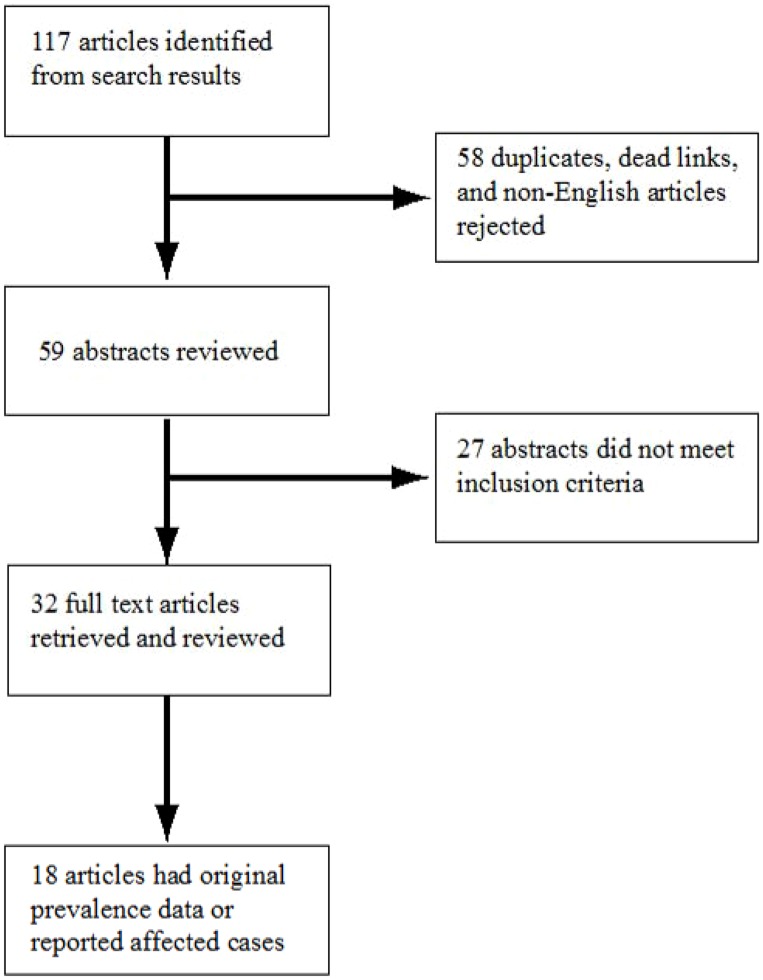
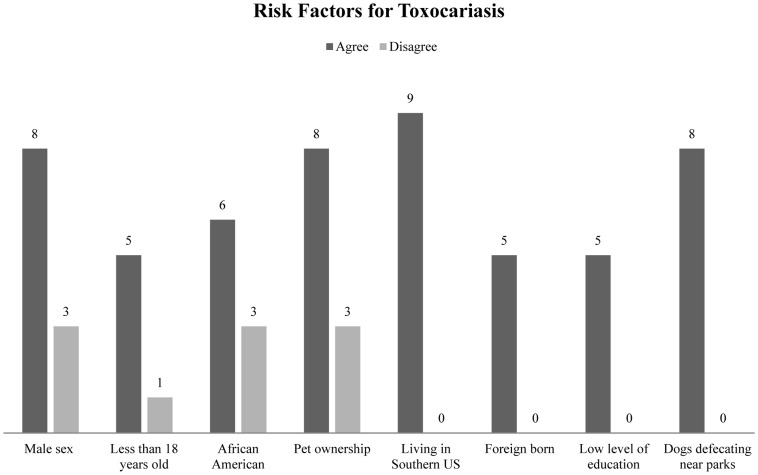
Toxocariasis is an important neglected tropical disease that can manifest as visceral or ocular larva migrans, or covert toxocariasis. All three forms pose a public health problem and cause significant morbidity in areas of high prevalence. To determine the burden of toxocariasis in North America, we conducted a systematic review of the literature following PRISMA guidelines. We found 18 articles with original prevalence, incidence, or case data for toxocariasis. Prevalence estimates ranged from 0.6% in a Canadian Inuit community to 30.8% in Mexican children with asthma. Commonly cited risk factors included: African-American race, poverty, male sex, and pet ownership or environmental contamination by animal feces. Increased prevalence of Toxocara spp. infection was linked in a group of case control studies conducted in Mexico to several high risk groups including waste pickers, asthmatic children, and inpatient psychiatry patients. Further research is needed to determine the true current burden of toxocariasis in North America; however the prevalence estimates gathered in this review suggest that the burden of disease is significant.
Overview
The claims and statistics of this paper haven’t been checked yet.
Run the check — free, no account needed. It reads the open-access text and checks the sources it cites.
Integrity signals
Registry
Cites
Statistics
Figures
Verification
Claims the paper makes
The claims and statistics of this paper haven’t been checked yet.
Run the check — free, no account needed. It reads the open-access text and checks the sources it cites.
Claims other papers make about this one
Each is checked against this paper’s own text: does it say what the citing paper says it does?
The source backs part of the claim, not all of it — or backs it for a different population, condition or comparison.
In the citing paper
“The highest risk is in young children owing to an increased likelihood of high inoculum after the ingestion of dog or cat feces containing ova. 26”
From Reducing the risk of pet-associated zoonotic infections (2015) · cites this paper as [26]
Experimental — accuracy not yet measuredThe source backs part of the claim, not all of it — or backs it for a different population, condition or comparison.
In the citing paper
“Because most household pets are regularly dewormed and larvae require two to three weeks after being passed in feces to become infective, the risk of exposure is highest after contact with soil contaminated with waste from untreated or stray animals, such as in sandboxes, gardens or playing fields. 2,26”
From Reducing the risk of pet-associated zoonotic infections (2015) · cites this paper as [26]
Experimental — accuracy not yet measured
Self-check
Percentages, sums and reported differences re-computed from the paper’s own numbers.
The self-check needs the paper’s full text.
Citations
Cites
Neglected Infections of Poverty in the United States of America
Hotez, P. J. (2008) · PLoS neglected tropical diseases · doi:10.1371/journal.pntd.0000256 · Cited by 370
Self-citationHarrington, M. (1962) · Cited by 365
Hotez, P. J., & Wilkins, P. P. (2009) · PLoS neglected tropical diseases · doi:10.1371/journal.pntd.0000400 · Cited by 285
Self-citationNeglected Parasitic Infections in the United States: Toxoplasmosis
Jones, J. L., Parise, M. E., & Fiore, A. E. (2014) · American Journal of Tropical Medicine and Hygiene · doi:10.4269/ajtmh.13-0722 · Cited by 268
National Seroprevalence and Risk Factors for Zoonotic Toxocara spp. Infection
Won, K. Y., Kruszon‐Moran, D., Schantz, P. M., & Jones, J. L. (2008) · American Journal of Tropical Medicine and Hygiene · doi:10.4269/ajtmh.2008.79.552 · Cited by 267
PREVALENCE, CLINICAL FEATURES, AND CAUSES OF VISION LOSS AMONG PATIENTS WITH OCULAR TOXOCARIASIS
Stewart, J. M., Cubillan, L. D., & Cunningham, E. T. (2005) · Retina · doi:10.1097/00006982-200512000-00009 · Cited by 211
Woodhall, D. M., Starr, M. C., Montgomery, S. P., Jones, J. L., Lum, F., Read, R. W., & Moorthy, R. S. (2012) · Ophthalmology · doi:10.1016/j.ophtha.2011.12.013 · Cited by 120
Neglected Parasitic Infections in the United States: Toxocariasis
Woodhall, D. M., Eberhard, M. L., & Parise, M. E. (2014) · American Journal of Tropical Medicine and Hygiene · doi:10.4269/ajtmh.13-0725 · Cited by 109
Walsh, M. G., & Haseeb, M. A. (2012) · International Journal for Parasitology · doi:10.1016/j.ijpara.2012.10.002 · Cited by 104
Childhood Parasitic Infections Endemic to the United States
Barry, M. A., Weatherhead, J. E., Hotez, P. J., & Woc-Colburn, L. E. (2013) · Pediatric Clinics of North America · doi:10.1016/j.pcl.2012.12.011 · Cited by 93
Self-citation
Research works printed but not linked: 1
- PJ Hotez, 2014, Neglected infections of poverty and the American brain, JAMA Psychiatry
Cited by
Sorted by citations
Ma, G., Holland, C. V., Wang, T., Hofmann, A., Fan, C., Maizels, R. M., Hotez, P. J., & Gasser, R. B. (2017) · The Lancet Infectious Diseases · doi:10.1016/s1473-3099(17)30331-6 · Cited by 450
Self-citationOtranto, D., Dantas‐Torres, F., Mihalca, A. D., Traub, R. J., Lappin, M. R., & Baneth, G. (2017) · Trends in Parasitology · doi:10.1016/j.pt.2017.05.013 · Cited by 215
Otranto, D., Cantacessi, C., Dantas‐Torres, F., Brianti, E., Pfeffer, M., Genchi, C., Gubertì, V., Capelli, G., & Deplazes, P. (2015) · Veterinary Parasitology · doi:10.1016/j.vetpar.2015.04.020 · Cited by 194
Zoonotic nematodes of wild carnivores
Otranto, D., & Deplazes, P. (2019) · International Journal for Parasitology Parasites and Wildlife · doi:10.1016/j.ijppaw.2018.12.011 · Cited by 174
Reducing the risk of pet-associated zoonotic infections
Stull, J. W., Brophy, J., & Weese, J. S. (2015) · Canadian Medical Association Journal · doi:10.1503/cmaj.141020 · Cited by 177
Metadata
- Authors
- Lee, R. M., Moore, L. B., Bottazzi, M. E., & Hotez, P. J.
- Affiliations
- Baylor College of Medicine (US)
- Rice University (US)
- Corresponding author
- Hotez, Peter J.
- Venue
- PLoS Neglected Tropical Diseases
- Publisher
- Public Library of Science (PLoS)
- Published
- 2014-08-28
- Volume
- 8
- Issue
- 8
- Pages
- e3116
- ISSN
- 1935-2727 (ISSN-L)
- 1935-2735
- PMC
- PMC4148222
- OpenAlex
- W1990683804
- Cited by
- 122
- References
- 29
- Citations by year
- 2026: 2 · 2025: 8 · 2024: 6 · 2023: 13 · 2022: 10 · 2021: 10 · 2020: 13 · 2019: 10 · 2018: 12 · 2017: 15 · 2016: 11 · 2015: 11 · 2014: 1
- FWCI
- 1.79
- Type
- journal article
- Language
- en
- Open access
- gold
- doi.org
- Locations
- PLoS neglected tropical diseases (publishedVersion, cc-by)
- Europe PMC (PubMed Central) (publishedVersion, cc-by)
- PubMed Central (publishedVersion, cc-by)
- PubMed (publishedVersion)
- RePEc: Research Papers in Economics (submittedVersion)
- DOAJ (DOAJ: Directory of Open Access Journals) (submittedVersion, cc-by-sa)
- Figshare (submittedVersion, cc-by)
- Rice Research Repository (Rice University) (submittedVersion)
- Topics
- Life Sciences › Immunology and Microbiology › Parasitology › Parasitic infections in humans and animals
- Life Sciences › Immunology and Microbiology › Parasitology › Parasites and Host Interactions
- Health Sciences › Medicine › Infectious Diseases › Parasitic Diseases Research and Treatment
- Keywords
- toxocariasis, Toxocara, visceral larva migrans, ocular larva migrans, prevalence, incidence, disease burden, risk factors, pet ownership, poverty, asthma, waste pickers, psychiatric patients, North America
- MeSH terms
- Adolescent, Adult, Aged, Aged, 80 and over, Child, Child, Preschool, Female, Humans, Male, Middle Aged, North America, Risk Factors, Toxocariasis, Young Adult
About these checks
Registry, retraction, Cites and statistics results are computed, not judged, with one exception: a printed reference that no index lists is read once by a model before it counts as a citation error. Claims are extracted by a model and kept only when their quote appears verbatim in the text; each cited source is then checked, with a model’s help, for whether it says what the claim relies on. Those verdicts can be wrong — read the claim’s quote and the cited source before relying on one.
Statistics and arithmetic are recomputed, not judged.
Confidence bands are shown only for fields calibrated on our annotated test set. None is calibrated yet, so no band is shown.
What counts as a claim ›How we measure confidence ›How we check this ›
Are you an author, or do you see a problem with this page? Request a review
