

The DOI matches its Crossref record; 57 of the 60 references it cites were found in a registry or an index.
Community-Centered Responses to Ebola in Urban Liberia: The View from Below
Open accessAbstract
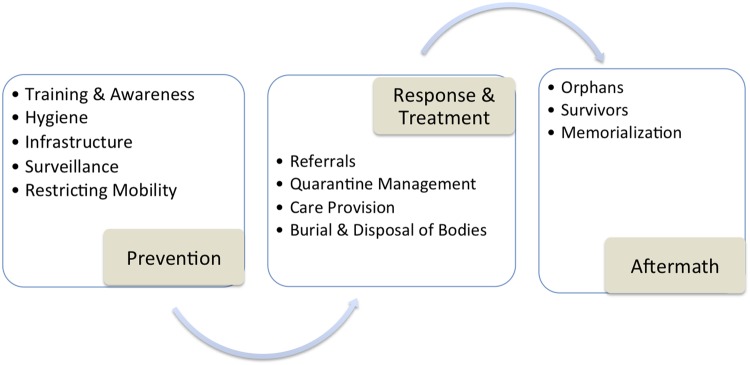
BACKGROUND: The West African Ebola epidemic has demonstrated that the existing range of medical and epidemiological responses to emerging disease outbreaks is insufficient, especially in post-conflict contexts with exceedingly poor healthcare infrastructures. In this context, community-based responses have proven vital for containing Ebola virus disease (EVD) and shifting the epidemic curve. Despite a surge in interest in local innovations that effectively contained the epidemic, the mechanisms for community-based response remain unclear. This study provides baseline information on community-based epidemic control priorities and identifies innovative local strategies for containing EVD in Liberia. METHODOLOGY/PRINCIPAL FINDINGS: This study was conducted in September 2014 in 15 communities in Monrovia and Montserrado County, Liberia--one of the epicenters of the Ebola outbreak. Findings from 15 focus group discussions with 386 community leaders identified strategies being undertaken and recommendations for what a community-based response to Ebola should look like under then-existing conditions. Data were collected on the following topics: prevention, surveillance, care-giving, community-based treatment and support, networks and hotlines, response teams, Ebola treatment units (ETUs) and hospitals, the management of corpses, quarantine and isolation, orphans, memorialization, and the need for community-based training and education. Findings have been presented as community-based strategies and recommendations for (1) prevention, (2) treatment and response, and (3) community sequelae and recovery. Several models for community-based management of the current Ebola outbreak were proposed. Additional findings indicate positive attitudes towards early Ebola survivors, and the need for community-based psychosocial support. CONCLUSIONS/SIGNIFICANCE: Local communities' strategies and recommendations give insight into how urban Liberian communities contained the EVD outbreak while navigating the systemic failures of the initial state and international response. Communities in urban Liberia adapted to the epidemic using multiple coping strategies. In the absence of health, infrastructural and material supports, local people engaged in self-reliance in order to contain the epidemic at the micro-social level. These innovations were regarded as necessary, but as less desirable than a well-supported health-systems based response; and were seen as involving considerable individual, social, and public health costs, including heightened vulnerability to infection.
Overview
The claims and statistics of this paper haven’t been checked yet.
Run the check — free, no account needed. It reads the open-access text and checks the sources it cites.
Integrity signals
Registry
Cites
Statistics
Figures
Verification
Claims the paper makes
The claims and statistics of this paper haven’t been checked yet.
Run the check — free, no account needed. It reads the open-access text and checks the sources it cites.
Claims other papers make about this one
Each is checked against this paper’s own text: does it say what the citing paper says it does?
In the citing paper
“Nine studies stressed how mass quarantine aggravated inequalities in individuals’ access to, understanding of, and actions on prevention and control of infections.21,23–26,31–34”
From Social consequences of mass quarantine during epidemics: a systematic review with implications for the COVID-19 response (2020) · cites this paper as [21]
In the citing paper
“Housing conditions, poverty and the presence of health care facilities were reported as determinants of individuals’ compliance with mass quarantine.21,24,31”
From Social consequences of mass quarantine during epidemics: a systematic review with implications for the COVID-19 response (2020) · cites this paper as [21]
In the citing paper
“Liberian community leaders argued that, despite being aware of EVD, they could not respond effectively to EVD control without a functioning health care system.21”
From Social consequences of mass quarantine during epidemics: a systematic review with implications for the COVID-19 response (2020) · cites this paper as [21]
In the citing paper
“In one study of the EVD outbreak in Liberia, some informants observed an increased number of deaths and complications from preventable health conditions, as most medical facilities within reasonable travel distances were closed.21”
From Social consequences of mass quarantine during epidemics: a systematic review with implications for the COVID-19 response (2020) · cites this paper as [21]
In the citing paper
“Three studies revealed changes in health-seeking behaviour during lockdowns, including reduced visits to nutrition screening, hiding treatable illnesses and seeking help from unverified sources.21,29,31”
From Social consequences of mass quarantine during epidemics: a systematic review with implications for the COVID-19 response (2020) · cites this paper as [21]
In the citing paper
“Four studies stressed how school closures under lockdowns affected children and adolescents.21,24,25,29”
From Social consequences of mass quarantine during epidemics: a systematic review with implications for the COVID-19 response (2020) · cites this paper as [21]
In the citing paper
“During the EVD outbreak, informants in Sierra Leone reported no schooling in general, whereas several community members in Liberia took on the responsibility to educate children who had lost their parents.21,29”
From Social consequences of mass quarantine during epidemics: a systematic review with implications for the COVID-19 response (2020) · cites this paper as [21]
In the citing paper
“Female participants described their strategies for making protective equipment using available but non-standardized materials to deliver home-based care during the EVD outbreak.”
From Social consequences of mass quarantine during epidemics: a systematic review with implications for the COVID-19 response (2020) · cites this paper as [21]
In the citing paper
“Three articles highlighted how mass quarantine and movement restrictions could deepen gender inequality and gender-based violence.21,28,30”
From Social consequences of mass quarantine during epidemics: a systematic review with implications for the COVID-19 response (2020) · cites this paper as [21]
In the citing paper
“The authors also argued that women might delay visits to hospitals because being hospitalized would risk their family care responsibilities.”
From Social consequences of mass quarantine during epidemics: a systematic review with implications for the COVID-19 response (2020) · cites this paper as [21]
In the citing paper
“Abramowitz et al.21 described the inequality of housework distribution, as women were regarded as default caregivers of children and sick family members at home.”
From Social consequences of mass quarantine during epidemics: a systematic review with implications for the COVID-19 response (2020) · cites this paper as [21]
In the citing paper
“During the EVD outbreak, informants in Sierra Leone reported no schooling in general, whereas several community members in Liberia took on the responsibility to educate children who had lost their parents.21,29”
From Social consequences of mass quarantine during epidemics: a systematic review with implications for the COVID-19 response (2020) · cites this paper as [21]
Self-check
Percentages, sums and reported differences re-computed from the paper’s own numbers.
The self-check needs the paper’s full text.
Citations
Cites
Weapons of the weak: Everyday forms of peasant resistance
(1986) · World Development · doi:10.1016/0305-750x(86)90141-5 · Cited by 9,858
What is participatory research?
Cornwall, A., & Jewkes, R. (1995) · Social Science & Medicine · doi:10.1016/0277-9536(95)00127-s · Cited by 2,560
Methodology of Social Sciences
Weber, M. (2017) · Routledge eBooks · doi:10.4324/9781315124445 · Cited by 2,547
Weapons of the Weak: Everyday Forms of Peasant Resistance
Bailey, F. G. (1987) · Pacific Affairs · doi:10.2307/2758183 · Cited by 1,897
Ebola virus disease in West Africa—the first 9 months of the epidemic and forward projections
WHO Ebola Response Team (2014) · New England Journal of Medicine · doi:10.1056/nejmoa1411100 · Cited by 1,674
Modelling the influence of human behaviour on the spread of infectious diseases: a review
Funk, S., Salathé, M., & Jansen, V. A. A. (2010) · Journal of The Royal Society Interface · doi:10.1098/rsif.2010.0142 · Cited by 1,322
Syndemics and public health: Reconceptualizing disease in bio-social context
Singer, M., & Clair, S. (2003) · Medical Anthropology Quarterly · doi:10.1525/maq.2003.17.4.423 · Cited by 1,140
The spread of awareness and its impact on epidemic outbreaks
Funk, S., Gilad, E., Watkins, C., & Jansen, V. A. A. (2009) · Proceedings of the National Academy of Sciences · doi:10.1073/pnas.0810762106 · Cited by 1,134
The Methodology of the Social Sciences
Kilzer, E., Weber, M., Shils, E. A., & Finch, H. A. (1949) · The American Catholic Sociological Review · doi:10.2307/3707961 · Cited by 929
Participatory rural appraisal (PRA): Challenges, potentials and paradigm
Chambers, R. (1994) · World Development · doi:10.1016/0305-750x(94)90030-2 · Cited by 853
Research works printed but not linked: 1
- Faye, Ousmane, et al. "Chains of transmission and control of Ebola virus disease in Conakry, Guinea, in 2014: an observational study." The Lancet Infectious Diseases. Available online 23 January 2015. · DOI · Paper page
Cited by
Sorted by citations
Public health and public trust: Survey evidence from the Ebola Virus Disease epidemic in Liberia
Blair, R. A., Morse, B. S., & Tsai, L. L. (2017) · Social Science & Medicine · doi:10.1016/j.socscimed.2016.11.016 · Cited by 614
Moon, S., Sridhar, D., Pate, M. A., Jha, A. K., Clinton, C., Delaunay, S., Edwin, V., Fallah, M., Fidler, D. P., Garrett, L., et al. (2015) · The Lancet · doi:10.1016/s0140-6736(15)00946-0 · Cited by 629
Self-citationCarrying Out Rapid Qualitative Research During a Pandemic: Emerging Lessons From COVID-19
Vindrola‐Padros, C., Chisnall, G., Cooper, S., Dowrick, A., Djellouli, N., Symmons, S. M., Martin, S., Singleton, G. F., Vanderslott, S., Juan, N. V. S., et al. (2020) · Qualitative Health Research · doi:10.1177/1049732320951526 · Cited by 448
Methods in the Time of COVID-19: The Vital Role of Qualitative Inquiries
Teti, M., Schatz, E. J., & Liebenberg, L. (2020) · International Journal of Qualitative Methods · doi:10.1177/1609406920920962 · Cited by 342
Smith, J. (2019) · Gender & Development · doi:10.1080/13552074.2019.1615288 · Cited by 256
Metadata
- Authors
- Abramowitz, S. A., McLean, K. E., McKune, S. L., Bardosh, K. L., Fallah, M., Monger, J., Tehoungue, K., & Omidian, P. A.
- Affiliations
- University of Florida (US)
- Yale University (US)
- Action Contre la Faim (FR)
- Corresponding author
- McLean, Kristen E.
- ORCID
- Venue
- PLOS Neglected Tropical Diseases
- Publisher
- Public Library of Science (PLoS)
- Published
- 2015-04-09
- Volume
- 9
- Issue
- 4
- Pages
- e0003706
- ISSN
- 1935-2727 (ISSN-L)
- 1935-2735
- PMC
- PMC4391876
- OpenAlex
- W2161752078
- Cited by
- 298
- References
- 60
- Citations by year
- 2026: 16 · 2025: 16 · 2024: 18 · 2023: 20 · 2022: 21 · 2021: 41 · 2020: 72 · 2019: 19 · 2018: 16 · 2017: 26 · 2016: 25 · 2015: 7
- FWCI
- 19.47
- Type
- journal article
- Language
- en
- Update notices
- correction (2015-05-07)
- Open access
- gold
- doi.org
- Licence
- Locations
- PLoS neglected tropical diseases (publishedVersion, cc-by)
- PubMed Central (publishedVersion, cc-by)
- PubMed (publishedVersion)
- Issue Lab (Candid) (submittedVersion, cc-by)
- DOAJ (DOAJ: Directory of Open Access Journals) (submittedVersion)
- Funders
- World Health Organization
- Yale University
- UNICEF
- University of Florida
- Center for African Studies
- Topics
- Health Sciences › Medicine › Infectious Diseases › Viral Infections and Outbreaks Research
- Health Sciences › Health Professions › Emergency Medical Services › Disaster Response and Management
- Social Sciences › Sociology and Political Science › COVID-19 Prevention and Impact
- Keywords
- Ebola virus disease, Monrovia, community leaders, Ebola prevention, Ebola treatment units, community-based care, corpse management, quarantine and isolation, psychosocial support, Ebola survivors, community coping strategies, post-conflict health systems
- MeSH terms
- Communicable Disease Control, Community Health Services, Humans, Liberia, Public Health, Hemorrhagic Fever, Ebola, Epidemics
About these checks
Registry, retraction, Cites and statistics results are computed, not judged, with one exception: a printed reference that no index lists is read once by a model before it counts as a citation error. Claims are extracted by a model and kept only when their quote appears verbatim in the text; each cited source is then checked, with a model’s help, for whether it says what the claim relies on. Those verdicts can be wrong — read the claim’s quote and the cited source before relying on one.
Statistics and arithmetic are recomputed, not judged.
Confidence bands are shown only for fields calibrated on our annotated test set. None is calibrated yet, so no band is shown.
What counts as a claim ›How we measure confidence ›How we check this ›
Are you an author, or do you see a problem with this page? Request a review
