

Aseptic Meningitis in Children: Analysis of 506 Cases
Open accessThe DOI matches its Crossref record; 23 of the 23 references it cites were found in a registry or an index; 1 of the 8 sources its claims cite were checked for support.
Abstract
BACKGROUND: Non-polio human enteroviruses are the leading cause of aseptic meningitis in children. The role of enterovirus PCR for diagnosis and management of aseptic meningitis has not been fully explored. METHODOLOGY/PRINCIPAL FINDINGS: A retrospective study was conducted to determine the epidemiological, clinical, and laboratory characteristics of aseptic meningitis and to evaluate the role of enterovirus PCR for the diagnosis and management of this clinical entity. The medical records of children who had as discharge diagnosis aseptic or viral meningitis were reviewed. A total of 506 children, median age 5 years, were identified. The annual incidence rate was estimated to be 17/100,000 children less than 14 years of age. Most of the cases occurred during summer (38%) and autumn (24%). The dominant clinical symptoms were fever (98%), headache (94%) and vomiting (67%). Neck stiffness was noted in 60%, and irritation in 46% of the patients. The median number of CSF cell count was 201/mm(3) with polymorphonuclear predominance (>50%) in 58.3% of the cases. Enterovirus RNA was detected in CSF in 47 of 96 (48.9%) children tested. Children with positive enterovirus PCR had shorter hospitalization stay as compared to children who had negative PCR or to children who were not tested (P = 0.01). There were no serious complications or deaths. CONCLUSIONS: Enteroviruses accounted for approximately one half of cases of aseptic meningitis. PCR may reduce the length of hospitalization and plays important role in the diagnosis and management of children with aseptic meningitis.
Overview
CoChat Summary
TL;DR
This retrospective study of 506 children with aseptic meningitis found that enteroviruses accounted for about half of PCR-tested cases and that PCR-positive children stayed in hospital for a shorter time. The authors conclude that enterovirus PCR can help diagnose and manage pediatric aseptic meningitis.
Key findings
- Of 532 identified records, 506 children were included; median age was 5 years, and the estimated annual incidence was 17/100,000 children under 14 years.
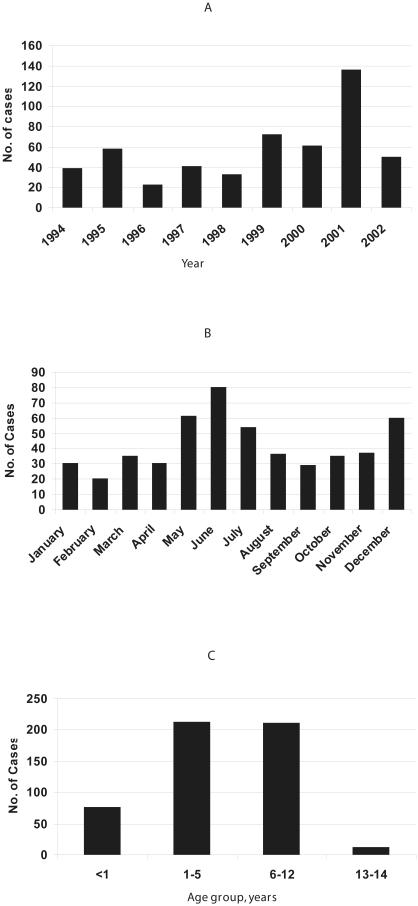
- Cases clustered in summer and autumn: 38% occurred in June–August and 24% in September–November; the peak month was June (86 cases, 17%).
- Common features were fever (98%), headache (94%), vomiting (67%), neck stiffness (60%), and irritation/lethargy (46%).
- Enterovirus RNA was detected in 47 of 96 CSF samples tested (48.9%); PCR-positive children had shorter hospitalization than PCR-negative or untested children (P = 0.01).
- No serious complications or deaths occurred; no fatalities, serious complications, or sequelae were reported among hospitalized patients.
Methods
- Retrospective review of medical records from a tertiary children’s hospital in Athens of children hospitalized from January 1994 to December 2002 with discharge diagnoses of aseptic or viral meningitis.
- Included children aged 1 month to 14 years who met CSF criteria for aseptic meningitis or had confirmed viral meningitis; excluded children who had received antibiotics before CSF examination. Total sample: 506 children.
- Main analyses used descriptive statistics and group comparisons (chi-square, t-test, Mann-Whitney U, Kruskal Wallis), plus linear regression for monthly temperature vs. viral meningitis hospitalizations; incidence was calculated using the hospital catchment population.
Limitations
- The paper states it was retrospective and based on medical records, which limits available information and is an inherent study limitation.
- The incidence is likely underestimated because it was based on patients presenting to the index hospital, while some children may have sought care elsewhere.
- PCR testing was ordered by physicians rather than by predefined criteria, which may have affected hospitalization length; the paper also notes that the impact on cost-benefit strategy and optimal PCR use frequency remains unanswered.
Model-written summary. Check it against the paper before relying on it.
Integrity signals
Registry
Cites
Statistics
Figures
Verification
Claims the paper makes
1 Valid · 0 Not valid · 6 Not checked · 45 Own results and interpretations
A result the paper reports from its own data — it cites no other source for it, so there is none to check. The quote shows it is in the paper.
In the paper
“The annual incidence rate was estimated to be 17/100,000 children less than 14 years of age.”
- Also stated in: § Epidemiology · hedged
“The mean annual incidence rate for the hospitalized aseptic meningitis cases in the region of Athens was estimated to be 17/100,000 children less than 14 years of age”
§ Aseptic Meningitis in Children: Analysis of 506 Cases > Abstract > Methodology/Principal Findings
hedgedn = 506- Asserted: passes — The authors put it forward as true.
- Checkable: passes — It can be checked against evidence.
- Load-bearing: unclear — It is unclear whether the paper’s conclusions depend on it.
- Based: passes — The paper gives a reason why it holds.
- Also stated in: § Epidemiology · hedged
A result the paper reports from its own data — it cites no other source for it, so there is none to check. The quote shows it is in the paper.
In the paper
“the highest incidence was observed in the age group of 1–5 years (26/100,000 children)”
§ Aseptic Meningitis in Children: Analysis of 506 Cases > Results > Epidemiology
plainstates an associationn = 506- Asserted: passes — The authors put it forward as true.
- Checkable: passes — It can be checked against evidence.
- Load-bearing: unclear — It is unclear whether the paper’s conclusions depend on it.
- Based: passes — The paper gives a reason why it holds.
A result the paper reports from its own data — it cites no other source for it, so there is none to check. The quote shows it is in the paper.
In the paper
“the lowest in the age group of 13–14 years (7/100,000 in children).”
§ Aseptic Meningitis in Children: Analysis of 506 Cases > Results > Epidemiology
plainn = 506- Asserted: passes — The authors put it forward as true.
- Checkable: passes — It can be checked against evidence.
- Load-bearing: unclear — It is unclear whether the paper’s conclusions depend on it.
- Based: passes — The paper gives a reason why it holds.
A result the paper reports from its own data — it cites no other source for it, so there is none to check. The quote shows it is in the paper.
In the paper
“A total of 506 children, median age 5 years, were identified.”
- Also stated in: § Epidemiology · plain
“A total of 506 patients were included in the analysis.”
§ Aseptic Meningitis in Children: Analysis of 506 Cases > Abstract > Methodology/Principal Findings
plainn = 506- Asserted: passes — The authors put it forward as true.
- Checkable: passes — It can be checked against evidence.
- Load-bearing: passes — The paper’s conclusions depend on it.
- Based: passes — The paper gives a reason why it holds.
- Also stated in: § Epidemiology · plain
A result the paper reports from its own data — it cites no other source for it, so there is none to check. The quote shows it is in the paper.
In the paper
“The peak calendar month over the 9-year period was June with a total of 86 cases (17%).”
§ Aseptic Meningitis in Children: Analysis of 506 Cases > Results > Epidemiology
plainn = 86- Asserted: passes — The authors put it forward as true.
- Checkable: passes — It can be checked against evidence.
- Load-bearing: unclear — It is unclear whether the paper’s conclusions depend on it.
- Based: passes — The paper gives a reason why it holds.
30 more claims
Create a free account to see all 52 claims and every source verdict.
- Probably not a substantial claim. 7
- It may state two separate claims as one. 12
Citations
Cites
Enteroviral infections of the central nervous system.
Rotbart, H. A. (1995) · Clinical Infectious Diseases · doi:10.1093/clinids/20.4.971 · Cited by 312 · cited 15×
“All children who had an acute illness with 10 or more white blood cells (WBC) in the CSF in the absence of microorganism on Gram stain and on routine culture, negative latex agglutination tests for bacterial antigens, and clinical course consistent with aseptic meningitis as well as those who had confirmed viral menin…”
BackgroundInfluentialNigrovic, L. E. (2007) · JAMA · doi:10.1001/jama.297.1.52 · Cited by 306 · cited 1×
“There are studies that have developed clinical prediction algorithms to help excluding the possibility for bacterial meningitis [14].”
BackgroundRamers, C. (2000) · JAMA · doi:10.1001/jama.283.20.2680 · Cited by 291 · cited 2×
“The polymerase chain reaction (PCR) has been shown to be an effective alternative to viral culture in diagnosing NPHEV meningitis and its use may reduce the hospital related cost by rapid diagnosis and earlier discharge from the hospital [3,7–12].”
BackgroundMethodTemporal and Geographic Patterns of Isolates of Nonpolio Enterovirus in the United States, 1970-1983
Strikas, R. A., Anderson, L. J., & Parker, R. A. (1986) · Journal of Infectious Diseases · doi:10.1093/infdis/153.2.346 · Cited by 238 · cited 1×
“Most of the cases occur in epidemics during summer and autumn although sporadic cases can occur throughout the year [3,5,6].”
BackgroundAseptic Meningitis in Infants <2 Years of Age: Diagnosis and Etiology
Berlin, L. E., Rorabaugh, M. L., Heidrich, F., Roberts, K., Doran, T., & Modlin, J. F. (1993) · Journal of Infectious Diseases · doi:10.1093/infdis/168.4.888 · Cited by 174 · cited 2×
“Non-polio human enteroviruses (NPHEV) are the leading recognizable cause of aseptic meningitis accounting for 80% to 92% of all cases in which a pathogen is identified [1–3].”
BackgroundSAWYER, M. H., HOLLAND, D., AINTABLIAN, N., CONNOR, J. D., KEYSER, E. F., & WAECKER, N. J. (1994) · The Pediatric Infectious Disease Journal · doi:10.1097/00006454-199403000-00002 · Cited by 171 · cited 1×
“CSF examination also does not always help to distinguish aseptic from bacterial meningitis since the number of cells vary from few to thousands and early in the course of the disease, in some cases, there is polymorphonuclear predominance [12,15,16].”
BackgroundIshiko, H., Shimada, Y., Yonaha, M., Hashimoto, O., Hayashi, A., Sakae, K., & Takeda, N. (2002) · The Journal of Infectious Diseases · doi:10.1086/339298 · Cited by 152 · cited 1×
“Enteroviruses constitute a genus of the picornavirus family which includes poliovirus types 1, 2, 3, and human enterovirus A, B, C, and D [4].”
BackgroundROBINSON, C. C., WILLIS, M., MEAGHER, A., GIESEKER, K. E., ROTBART, H., & GLODÉ, M. P. (2002) · The Pediatric Infectious Disease Journal · doi:10.1097/00006454-200204000-00005 · Cited by 131 · cited 1×
“In another study, although the time of reporting PCR results (less or more than 24 hours) had no significant reduction in antibiotic use or length of hospitalization, the earlier report of results reduced by 37% the hospital related expenses [23].”
ResultEnterovirus infections: diagnosis and treatment.
SAWYER, M. H. (1999) · The Pediatric Infectious Disease Journal · doi:10.1097/00006454-199912000-00002 · Cited by 127
Schlesinger, Y., Sawyer, M. H., & Storch, G. A. (1994) · Pediatrics · doi:10.1542/peds.94.2.157 · Cited by 99
Cited by
Items 101–146 of 146
Evaluation of an Xpert EV (Cepheid ® ) molecular diagnostic technique for enteroviral meningitis
Pérez, N. A., Sagastizábal, B., Tato, L. M. P., Martín, S. G., Torralba, A. G., García-Bermejo, I., & Amador, J. T. R. (2017) · Anales de Pediatría (English Edition) · doi:10.1016/j.anpede.2016.09.011 · Cited by 1
Othman, I., Slama, I., Mastouri, M., Bailly, J., & Aouni, M. (2022) · Future Virology · doi:10.2217/fvl-2021-0284 · Cited by 1
Enterovirus-Associated Meningoencephalitis and Enteroviruses in Patients with Acute Encephalitis
Halawani, A., Khan, S. R., Masood, S., & Firoze, S. (2023) · Springer eBooks · doi:10.1007/978-981-99-6445-1_6 · Cited by 1
Impact of the COVID-19 Outbreak on Aseptic Meningitis in Children.
Arad, B., Moghadam, H. F., Jamshidi, M., & Pirzadeh, Z. (2024) · Iranian journal of child neurology. · doi:10.22037/ijcn.v18i3.40219 · Cited by 1
Mazaba, M., Ndumba, I., Mpabalwani, E. M., Kasolo, F. C., Mufunda, J., Chizema, E., & Monze, M. (2016) · Medical Journal of Zambia · doi:10.55320/mjz.43.1.316 · Cited by 1
Yosry, A., Fouad, R., Hafez, H. A., et al. (2014) · Cited by 1
Clinical Differences between Enterovirus and Human Parechovirus in Children and Infants
Rhie, S. (2019) · Annals of Child Neurology · doi:10.26815/acn.2019.00227 · Cited by 1
“This is especially the case during summer and early fall [2], where aseptic meningitis caused by HPeV infection might lead to an increase in the cases of febrile children with mild headache.”
BackgroundKim, J. W., Chae, S. A., Kim, S. Y., Lee, N. M., Yi, D. Y., Yun, S. W., & Lim, I. S. (2020) · Annals of Child Neurology · doi:10.26815/acn.2020.00178 · Cited by 1
“The age-dependent frequency rate showed that viral meningitis was equally likely to occur across all age groups; however, bacterial meningitis was most likely to occur in infants [9,10,12,29,30].”
BackgroundKarmiris, E., Vasilakos, G., Tsiripidis, K., & Chalkiadaki, E. (2022) · Ocular Immunology and Inflammation · doi:10.1080/09273948.2022.2028288 · Cited by 1
“They can cause a broad spectrum of illnesses such as febrile disease, hand-foot-mouth, herpangina, aseptic meningitis, encephalitis, pancreatitis, chronic inflammatory myopathy, myocarditis and neonatal sepsis.(9,10) Their clinical presentation may be varied, and symptoms such as fever, headache, neck stiffness, alter…”
BackgroundAcute Viral Encephalitis: Herpesviruses and Enteroviruses
Sánchez-Menoyo, J. L., & Portillo, J. B. (2017) · Springer eBooks · doi:10.1007/978-3-319-70296-4_5 · Cited by 1
Nunes, R. A. L. (2013) · Digital Library of Theses and Dissertations (Universidade de São Paulo) · doi:10.11606/d.42.2013.tde-19032014-160513 · Cited by 2
Álvarez, M. D., Arias, M. I. A., Alés, L. R., Isás, D. C., García, M. I. M., & Vázquez, O. M. (2011) · DOAJ (DOAJ: Directory of Open Access Journals)
Acute Viral Encephalitis: Herpesviruses and Enteroviruses
Sánchez-Menoyo, J. L., & Ruiz‐Ojeda, J. (2014) · Springer eBooks · doi:10.1007/978-1-4471-6401-2_5
Development of enterovirus diagnostic assay system for human patients
Lim, B., Ju, E., Lao, D. H., Yun, S., Lee, Y., Kim, D., & Jeon, E. (2013) · Microbiology and Immunology · doi:10.1111/j.1348-0421.12028
ECHO virus 30-related meningitis: potential for regional increase in incidence.
Beyrer, K., Korn, K., Raab, K., Schaffer, A. A., & Windorfer, A. (2010) · Monatsschrift Kinderheilkunde
Pérez, N. A., Sagastizábal, B., Prieto, L. M., Martín, S. G., Torralba, A. G., García-Bermejo, I., & Amador, J. T. R. (2016) · Anales de Pediatría · doi:10.1016/j.anpedi.2016.09.010 · Cited by 4
“Polimorfonucleares en LCR %, mediana (RIQ) 49 (10-97) 68,5 (7-95) ns”
BackgroundInfluentialApproach to the Pediatric Patient with Headache in the Emergency Department
Orr, S. L., & Sheridan, D. C. (2017) · Cambridge University Press eBooks · doi:10.1017/9781316819388.012
Clinical Characteristics of Childhood Enteroviral Meningitis according to Age and Viral Serotype
양재혁, 송지호, 정재근, 우영종, 김영옥, 송은송, ChoiYoungYoun, & 천경렬 (2016) · Annals of Child Neurology · doi:10.26815/jkcns.2016.24.1.1
Utilità dell’introduzione di uno strumento POCT di Real-Time PCR per le urgenze virologiche
Nicosia, A. M., Ravanini, P., & Villani, A. P. (2013) · La Rivista Italiana della Medicina di Laboratorio - Italian Journal of Laboratory Medicine · doi:10.1007/s13631-013-0020-4
Наиболее распространенные клинические формы энтеровирусной инфекции в Днепропетровском регионе
Budaeva, I. V., Ревенко, Г. О., Якімова, С. В., Олійник, В. В., & Дорошенко, В. Ф. (2018) · ACTUAL INFECTOLOGY · doi:10.22141/2312-413x.5.5.2017.121631
Surveillance nationale des entérovirus non poliomyélitiques au Canada : pourquoi est-ce important?
Booth, T., Grudeski, E., & McDermid, A. (2015) · Relevé des maladies transmissibles au Canada · doi:10.14745/ccdr.v41is1a03f
Pypa, L. V., Svistilnik, R. V., Lysytsia, Y. N., Романчук, К. Ю., & Odarchuk, I. V. (2019) · Journal Infectology · doi:10.22625/2072-6732-2019-11-1-41-45
Nicosia, A. M., Ravanini, P., & Villani, A. P. (2013)
Analysis of Meningitis Cases in Pediatric Intensive Care Unit: 8-Year Single Center Experience
Hatipoğlu, N., & Şevketoğlu, E. (2020) · Bakirkoy Tip Dergisi / Medical Journal of Bakirkoy · doi:10.5222/bmj.2020.09719 · Cited by 1
“(13) reported M/F ratio in bacterial meningitis as 1.”
BackgroundRoles of the Choroid Plexus in CNS Infections
Schwerk, C., Tenenbaum, T., & Schroten, H. (2020) · Physiology in health and disease · doi:10.1007/978-1-0716-0536-3_11 · Cited by 1
Kabuga, A. I., Nejati, A., & Shahmahmoodi, S. (2021) · African Journal of Clinical and Experimental Microbiology · doi:10.4314/ajcem.v22i1.3
“Nausea, vomiting, diarrhea, poor feeding, irritability, convulsions, headache, and altered level of consciousness are notable symptoms (24,31,56,60-64,71,77,82,93-95).”
BackgroundEtiology of viral meningitis in Aleppo-Syria: a retrospective study
Yahia, M. A. M. K., Bery, K., Alherk, M. A., & Kaddour, S. H. (2022) · International Journal of Research in Medical Sciences · doi:10.18203/2320-6012.ijrms20221576
Rahman, S. N., Hossain, S. M. M., & Ashraf, R. (2022) · Scholars Academic Journal of Biosciences · doi:10.36347/sajb.2022.v10i11.008
Childhood Meningitis in an Urban Tertiary Medical Center: A 20-year Review
Calderon, A., & Garcia, R. D. (2019) · Pediatric Infectious Disease Society of the Philippines Journal · doi:10.56964/pidspj20192002005
Le infezioni da enterovirus nel neonato e nel lattante
Sandoni, M., Ciardo, L., Tamburini, C., Marrozzini, L., Boncompagni, A., Rossi, C., Guidotti, I., Garetti, E., Rossi, K., Lugli, L., et al. (2023) · Medico e Bambino · doi:10.53126/meb42437
Chansaenroj, J., & Poovorawan, Y. (2017) · Chula Digiverse · doi:10.58837/chula.the.2017.361
Viral Meningitis in Children and Hearing Loss
Kara, B., Güngör, M., Arısoy, E. S., & Demmler‐Harrison, G. J. (2023) · Comprehensive ENT · doi:10.1007/978-3-031-38495-0_24
Retrospective evaluation of lumbar puncture analysis in the pediatric intensive care unit
Aykaç, M. Ö., Aslan, M., & Samancı, N. (2024) · The Annals of Clinical and Analytical Medicine · doi:10.4328/acam.21832
“In the study by Michos et al., in which they examined 506 patients with aseptic meningitis in Greece, the median cell number in the CSF was found to be 201/mm3, and PMNL was the dominant cell in 58.3% of the patients [9].”
InfluentialTrends in the Causes of Meningitis/Encephalitis Analyzed Using the BioFire FilmArray Panel
Hong, Y. J., Jung, B. K., & Kim, J. K. (2024) · American journal of biochemistry & biotechnology/American journal of biochemistry and biotechnology · doi:10.3844/ajbbsp.2024.208.214
“This finding contrasts with the results of previous studies, which showed a decrease in the positivity rate during the winter months (Kelly et al ., 2013; Michos et al ., 2007).”
ResultAbdinia, B., Habibi, P., Dastranji, A., Fattahi, N., & rezaee, M. A. (2024) · Studies in Medical Sciences · doi:10.61186/umj.35.8.644
Süt Çocuğunda Nadir Bir Durum: Eksantem Subitum Kaynaklı Ensefalit
Yorulmaz, U., Yiğitoğlu, O., Barın, D., Eravcı, S. Y., Çaksen, H., & Akkuş, A. (2025) · Niğde Tıp Dergisi · doi:10.70846/nigdetip.1564248
Viral Infections of the CNS: Is It All About Breaching Barriers?
Schmidt, S., & Rudolph, H. (2025) · Current human cell research and applications · doi:10.1007/978-981-97-9495-9_9 · Cited by 1
Virale meningitis en encefalitis
Westendorp, W. F., & Brouwer, M. C. (2025) · doi:10.1007/978-90-368-3059-1_24
Infectious meningitis and encephalitis
Makowiecki, M., Bednarska, A., Paciorek, M., Bursa, D., Porowski, D., Furman-Dłubała, A., Czyżyk, A., & Laskus, T. (2026) · Aktualności Neurologiczne · doi:10.15557/an.2025.0025
Chirizzi, D., Spedicato, A., Bianco, G., Lupo, L. I., Serafini, I., Pisanò, D., Orsi, M. R., Moschettini, G., Sorge, A., Bruno, R., et al. (2026) · Microorganisms · doi:10.3390/microorganisms14071574 · Cited by 1
“…led by enterovirus, in keeping with the established European epidemiology of aseptic meningitis, in which non-polio enteroviruses, particularly echovirus 30 and coxsackie/echovirus B-species, are the leading cause, with summer–autumn peaks and a marked predilection for infants and adults [11,12].”
Prevalence and Genetic Diversity of Human Enteroviruses in the Context of Poliovirus Eradication
van der Sanden, S. (2012) · Rivm Repository (Netherlands National Institute for Public Health and the Environment)
Neuroborreliosis in children: Epidemiological and clinical aspects
Tveitnes, D. (2012) · NORA - Norwegian Open Research Archives
Metadata
- Authors
- Michos, A. G., Syriopoulou, V. P., Hadjichristodoulou, C., Daikos, G. L., Lagona, E., Douridas, P., Mostrou, G., & Theodoridou, M.
- Affiliations
- National and Kapodistrian University of Athens (GR)
- University of Thessaly (GR)
- Venue
- PLoS ONE
- Publisher
- Public Library of Science (PLoS)
- Published
- 2007-08-01
- Volume
- 2
- Issue
- 8
- Pages
- e674
- ISSN
- 1932-6203 (ISSN-L)
- PMC
- PMC1933255
- OpenAlex
- W2016972426
- Semantic Scholar
- 68b280a63ef5aa63832bc9acca7caeb8a2cc7b34
- Cited by
- 147
- References
- 23
- Citations by year
- 2026: 3 · 2025: 4 · 2024: 8 · 2023: 7 · 2022: 10 · 2021: 7 · 2020: 12 · 2019: 9 · 2018: 5 · 2017: 11 · 2016: 12 · 2015: 9 · 2014: 8 · 2013: 12 · 2012: 8
- FWCI
- 3.04
- Type
- journal article
- Language
- en
- Open access
- gold
- doi.org
- Locations
- PLoS ONE (publishedVersion, cc-by)
- PubMed Central (publishedVersion, cc-by)
- PubMed (publishedVersion)
- DOAJ (DOAJ: Directory of Open Access Journals) (submittedVersion, cc-by-sa)
- University of Thessaly Institutional Repository (University of Thessaly) (submittedVersion)
- Topics
- Health Sciences › Medicine › Infectious Diseases › Viral Infections and Immunology Research
- Health Sciences › Medicine › Infectious Diseases › Infectious Encephalopathies and Encephalitis
- Health Sciences › Medicine › Public Health, Environmental and Occupational Health › Mosquito-borne diseases and control
- Keywords
- aseptic meningitis, non-polio enteroviruses, cerebrospinal fluid, incidence, clinical symptoms, length of hospital stay, seasonal variation
- MeSH terms
- Adolescent, Child, Child, Preschool, Enterovirus Infections, Enterovirus, Female, Greece, Humans, Male, Meningitis, Aseptic, Retrospective Studies, Seasons, Incidence, Polymerase Chain Reaction
About these checks
Registry, retraction, Cites and statistics results are computed, not judged, with one exception: a printed reference that no index lists is read once by a model before it counts as a citation error. Claims are extracted by a model and kept only when their quote appears verbatim in the text; each cited source is then checked, with a model’s help, for whether it says what the claim relies on. Those verdicts can be wrong — read the claim’s quote and the cited source before relying on one.
The claim verdicts this report counts are experimental: their accuracy is not yet measured.
A language model drew the claims from the paper on 2026-10-11, under version 3 of the claim definition (model deepseek-v4.1-flash, prompt extract-v3).
A second model labelled each claim on 2026-10-11 (model jev-1.13-20260917, definition revision gold-guideline-v0.2).
Statistics and arithmetic are recomputed, not judged.
Confidence bands are shown only for fields calibrated on our annotated test set. None is calibrated yet, so no band is shown.
What counts as a claim ›How we measure confidence ›How we check this ›
Are you an author, or do you see a problem with this page? Request a review
Data sources
Bibliographic data: Semantic Scholar, OpenAlex, Crossref.
Contains information from the Semantic Scholar Academic Graph Datasets, made available under the ODC Attribution License (ODC-BY 1.0).
Semantic Scholar’s data is described in: Kinney, R., et al. (2023). The Semantic Scholar Open Data Platform. arXiv:2301.10140.
