

The DOI matches its Crossref record; 39 of the 39 references it cites were found in a registry or an index.
In Vivo Hippocampal Measurement and Memory: A Comparison of Manual Tracing and Automated Segmentation in a Large Community-Based Sample
Open accessAbstract
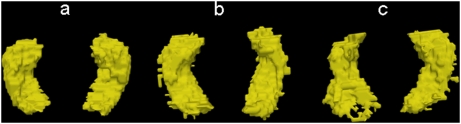
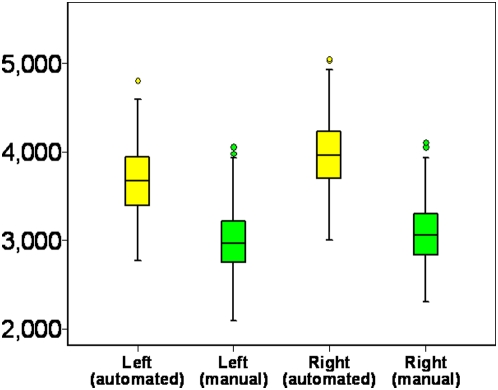
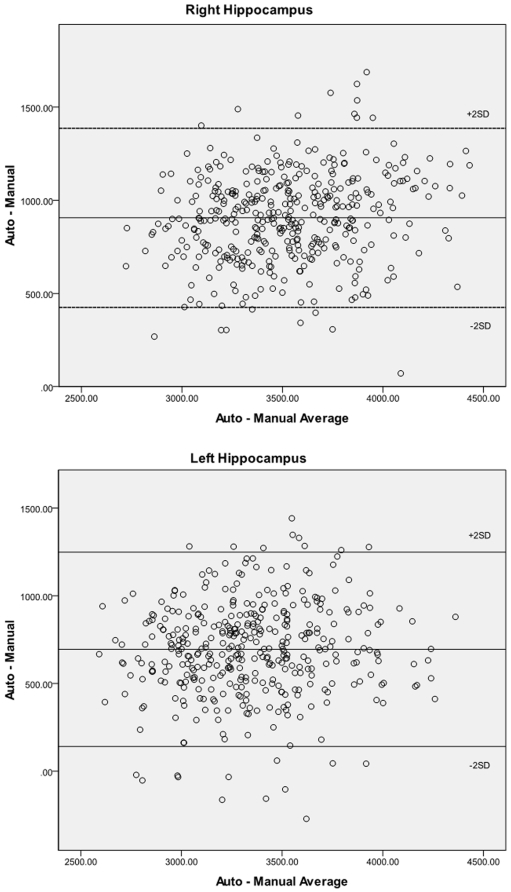
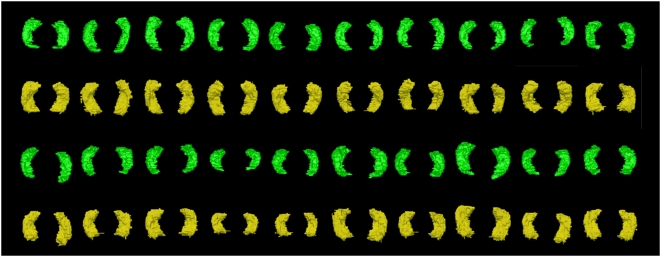
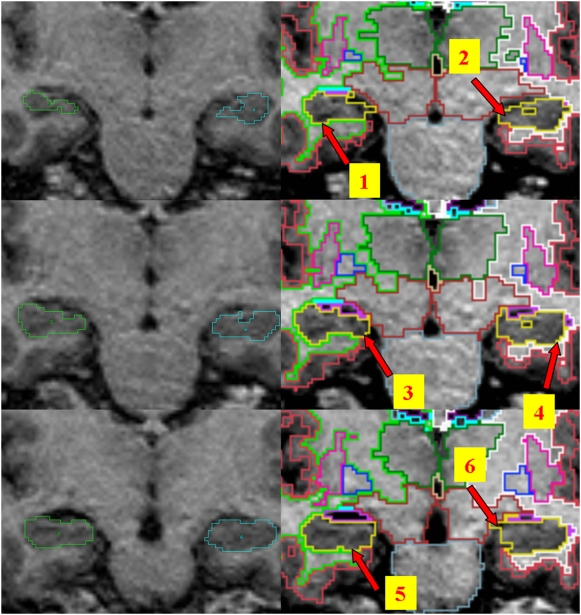
While manual tracing is the method of choice in measuring hippocampal volume, its time intensive nature and proneness to human error make automated methods attractive, especially when applied to large samples. Few studies have systematically compared the performance of the two techniques. In this study, we measured hippocampal volumes in a large (N = 403) population-based sample of individuals aged 44-48 years using manual tracing by a trained researcher and automated procedure using Freesurfer (http://surfer.nmr.mgh.harvard.edu) imaging suite. Results showed that absolute hippocampal volumes assessed with these methods were significantly different, with automated measures using the Freesurfer software suite being significantly larger, by 23% for the left and 29% for the right hippocampus. The correlation between the two methods varied from 0.61 to 0.80, with lower correlations for hippocampi with visible abnormalities. Inspection of 2D and 3D models suggested that this difference was largely due to greater inclusion of boundary voxels by the automated method and variations in subiculum/entorhinal segmentation. The correlation between left and right hippocampal volumes was very similar by the two methods. The relationship of hippocampal volumes to selected sociodemographic and cognitive variables was not affected by the measurement method, with each measure showing an association with memory performance and suggesting that both were equally valid for this purpose. This study supports the use of automated measures, based on Freesurfer in this instance, as being sufficiently reliable and valid particularly in the context of larger sample sizes when the research question does not rely on 'true' hippocampal volumes.
Overview
The claims and statistics of this paper haven’t been checked yet.
Run the check — free, no account needed. It reads the open-access text and checks the sources it cites.
Integrity signals
Registry
Cites
Statistics
Figures
Verification
Claims the paper makes
The claims and statistics of this paper haven’t been checked yet.
Run the check — free, no account needed. It reads the open-access text and checks the sources it cites.
Claims other papers make about this one
Each is checked against this paper’s own text: does it say what the citing paper says it does?
The source backs part of the claim, not all of it — or backs it for a different population, condition or comparison.
In the citing paper
“Although Freesurfer is extensively validated and it has been used in a large number of studies, various studies have also reported high rates of failures resulting in exclusion of large number of scans, inconsistencies in segmentations and age related bias (Wenger et al., 2014; Cherbuin et al., 2009).”
From A comparison of Freesurfer and multi-atlas MUSE for brain anatomy segmentation: Findings about size and age bias, and inter-scanner stability in multi-site aging studies (2020) · cites this paper as Cherbuin et al., 2009
Experimental — accuracy not yet measured
Self-check
Percentages, sums and reported differences re-computed from the paper’s own numbers.
The self-check needs the paper’s full text.
Citations
Cites
Neuropathological stageing of Alzheimer-related changes.
Braak, H., & Braak, E. (1991) · Acta Neuropathologica · doi:10.1007/bf00308809 · Cited by 16,123
Fischl, B., Salat, D. H., Busa, E., Albert, M., Dieterich, M., Haselgrove, C., van der Kouwe, A., Killiany, R., Kennedy, D., Klaveness, S., et al. (2002) · Neuron · doi:10.1016/s0896-6273(02)00569-x · Cited by 8,610
Navigation-related structural change in the hippocampi of taxi drivers
Maguire, E. A., Gadian, D. G., Johnsrude, I. S., Good, C. D., Ashburner, J., Frackowiak, R. S. J., & Frith, C. D. (2000) · Proceedings of the National Academy of Sciences · doi:10.1073/pnas.070039597 · Cited by 3,225
Braak, H., Alafuzoff, I., Arzberger, T., Kretzschmar, H., & Del Tredici, K. (2006) · Acta Neuropathologica · doi:10.1007/s00401-006-0127-z · Cited by 3,172
The human hippocampus and spatial and episodic memory
Burgess, N., Maguire, E. A., & O'Keefe, J. (2002) · Neuron · doi:10.1016/s0896-6273(02)00830-9 · Cited by 2,401
A hybrid approach to the skull stripping problem in MRI
Ségonne, F., Dale, A. M., Busa, E., Glessner, M., Salat, D. H., Hahn, H., & Fischl, B. R. (2004) · NeuroImage · doi:10.1016/j.neuroimage.2004.03.032 · Cited by 2,227
Sequence-independent segmentation of magnetic resonance images
Fischl, B. R., Salat, D. H., van der Kouwe, A. J. W., Makris, N., Ségonne, F., Quinn, B. T., & Dale, A. M. (2004) · NeuroImage · doi:10.1016/j.neuroimage.2004.07.016 · Cited by 2,117
California Verbal Learning Test
Delis, D. C., Freeland, J., Kramer, J. H., & Kaplan, E. (1987) · PsycTESTS Dataset · doi:10.1037/t48844-000 · Cited by 1,450
Morris, R., Schenk, F., Tweedie, F., & Jarrard, L. E. (1990) · European Journal of Neuroscience · doi:10.1111/j.1460-9568.1990.tb00014.x · Cited by 666
Memory and MRI-based hippocampal volumes in aging and AD
Petersen, R. C., Jack, C. R., Xu, Y.-C., Waring, S. C., O’Brien, P. C., Smith, G. E., Ivnik, R. J., Tangalos, E. G., Boeve, B. F., & Kokmen, E. (2000) · Neurology · doi:10.1212/wnl.54.3.581 · Cited by 426
Cited by
Sorted by citations
Items 101–116 of 116
Butts, A. M. (2013) · e-Publications@Marquette (Marquette University) · Cited by 3
The impact of hippocampal segmentation methods on correlations with clinical data
Aljondi, R., Szoeke, C. E. I., Steward, C., LUI, E. H., Alghamdi, S. S., & Desmond, P. M. (2019) · Acta Radiologica · doi:10.1177/0284185119885120 · Cited by 2
Lidauer, K., Pulli, E. P., Copeland, A., Silver, E. A., Kumpulainen, V., Hashempour, N., Merisaari, H., Saunavaara, J. P., Parkkola, R. K., Lähdesmäki, T., et al. (2021) · bioRxiv (Cold Spring Harbor Laboratory) · doi:10.1101/2021.05.28.445926 · Cited by 2
de Florès, R., Joie, R. L., Landeau, B., Perrotin, A., Mézenge, F., Sayette, V. D. L., Eustache, F., Desgranges, B., & Chételat, G. (2014) · Alzheimer s & Dementia · doi:10.1016/j.jalz.2014.05.098 · Cited by 1
Liedlgruber, M., Butz, K. H. G., Höller, Y., Kuchukhidze, G., Taylor, A., Thomschewski, A. C., Tomasi, O. S., Trinka, E., & Uhl, A. (2019) · Lecture notes in computer science · doi:10.1007/978-3-030-20205-7_38 · Cited by 1
Improving brain registration and segmentation using anatomical guidance
KHAN, A. R. (2011) · Summit (Simon Fraser University) · Cited by 1
Brains, genes and environment of suicide attempters
Vang, F. (2012) · Lund University Publications (Lund University)
Phillips, J. L. (2015) · uO Research (University of Ottawa) · doi:10.20381/ruor-2800
Revisiting Cognitive and Neuropsychological Novelty Effects
Poppenk, J. (2012) · TSpace (University of Toronto)
Aljondi, R. (2017) · Minerva Access (University of Melbourne)
Using movies to assess cognitive and neural functioning in temporal lobe epilepsy
Ladowski, D. (2019) · Scholarship@Western (Western University)
Elmukashfi, O. T. A., Elsheikh, T. A. E., Elmukashfi, E. A. T. A., & Nurein, M. A. (2023) · World Journal of Advanced Research and Reviews · doi:10.30574/wjarr.2023.18.3.1128
Elmukashfi’s Protocol for Hippocampal Volumetry; 2022
Elmukashfi, O. T. A. (2023) · World Journal of Advanced Research and Reviews · doi:10.30574/wjarr.2023.20.2.2222
Stitcher: A Surface Reconstruction Tool for Highly Gyrified Brains
Mynssen, H., Avelino‐de‐Souza, K., Chaim, K. T., Ribeiro, V. L., Patzke, N., & Mota, B. (2024) · Neuroinformatics · doi:10.1007/s12021-024-09678-2
Carter, L., Surti, T., Abildskov, T. J., Shum, E., Hertzler, A., Dodda, M., Rodriguez, A., Brown, C., Sanchez, J. R., Tar, D., et al. (2026) · Neuroimage Reports · doi:10.1016/j.ynirp.2026.100361
Metadata
- Authors
- Cherbuin, N., Anstey, K. J., Réglade-Meslin, C., & Sachdev, P. S.
- Affiliations
- Australian National University (AU)
- UNSW Sydney (AU)
- Corresponding author
- Cherbuin, Nicolas
- Venue
- PLoS ONE
- Publisher
- Public Library of Science (PLoS)
- Published
- 2009-04-16
- Volume
- 4
- Issue
- 4
- Pages
- e5265
- ISSN
- 1932-6203 (ISSN-L)
- PMC
- PMC2667216
- OpenAlex
- W2061639197
- Cited by
- 116
- References
- 39
- Citations by year
- 2026: 1 · 2025: 2 · 2024: 2 · 2023: 5 · 2022: 6 · 2021: 4 · 2020: 5 · 2019: 6 · 2018: 8 · 2017: 6 · 2016: 10 · 2015: 13 · 2014: 9 · 2013: 11 · 2012: 7
- FWCI
- 10.30
- Type
- journal article
- Language
- en
- Open access
- gold
- doi.org
- Locations
- PLoS ONE (publishedVersion, cc-by)
- PubMed Central (publishedVersion, cc-by)
- PubMed (publishedVersion)
- UNSWorks (University of New South Wales, Sydney, Australia) (submittedVersion, cc-by-nc-nd)
- UNSWorks (UNSW Sydney) (submittedVersion, cc-by-nc-nd)
- RePEc: Research Papers in Economics (submittedVersion)
- DOAJ (DOAJ: Directory of Open Access Journals) (submittedVersion, cc-by-sa)
- ANU Open Research (Australian National University) (submittedVersion, cc-by)
- Funders
- Australian Rotary Health
- Medical Research Council
- National Health and Medical Research Council (973302, 366756, 418020, 157125, 179805)
- Topics
- Physical Sciences › Computer Science › Computer Vision and Pattern Recognition › Medical Image Segmentation Techniques
- Health Sciences › Medicine › Psychiatry and Mental health › Dementia and Cognitive Impairment Research
- Life Sciences › Neuroscience › Cognitive Neuroscience › Memory and Neural Mechanisms
- Keywords
- hippocampal volume, FreeSurfer, measurement method comparison, memory performance, community sample
- MeSH terms
- Adult, Female, Hippocampus, Humans, Image Processing, Computer-Assisted, Magnetic Resonance Imaging, Male, Memory, Middle Aged, Organ Size, Pattern Recognition, Automated, Regression Analysis, Socioeconomic Factors, Imaging, Three-Dimensional
About these checks
Registry, retraction, Cites and statistics results are computed, not judged, with one exception: a printed reference that no index lists is read once by a model before it counts as a citation error. Claims are extracted by a model and kept only when their quote appears verbatim in the text; each cited source is then checked, with a model’s help, for whether it says what the claim relies on. Those verdicts can be wrong — read the claim’s quote and the cited source before relying on one.
Statistics and arithmetic are recomputed, not judged.
Confidence bands are shown only for fields calibrated on our annotated test set. None is calibrated yet, so no band is shown.
What counts as a claim ›How we measure confidence ›How we check this ›
Are you an author, or do you see a problem with this page? Request a review
