

The DOI matches its Crossref record; 69 of the 71 references it cites were found in a registry or an index.
Hippocampal Atrophy as a Quantitative Trait in a Genome-Wide Association Study Identifying Novel Susceptibility Genes for Alzheimer's Disease
Open accessAbstract
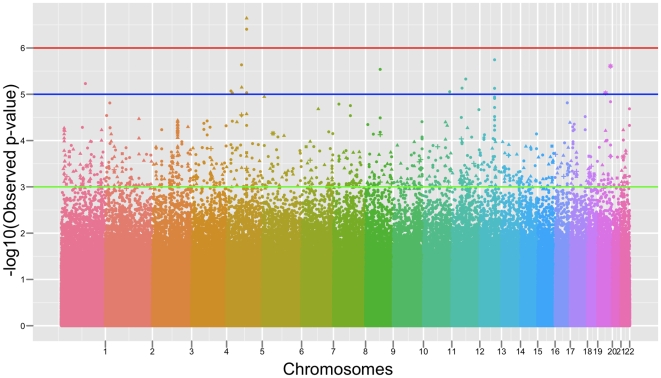
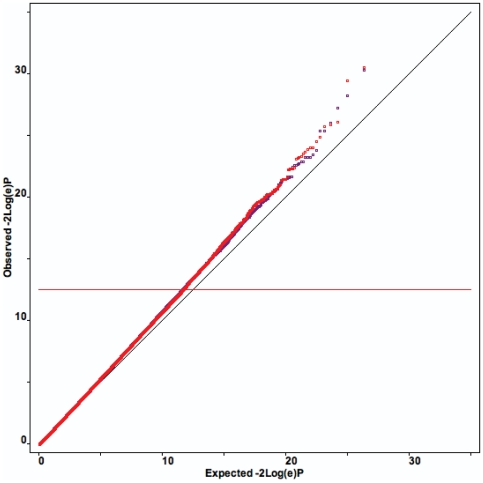
BACKGROUND: With the exception of APOE epsilon4 allele, the common genetic risk factors for sporadic Alzheimer's Disease (AD) are unknown. METHODS AND FINDINGS: We completed a genome-wide association study on 381 participants in the ADNI (Alzheimer's Disease Neuroimaging Initiative) study. Samples were genotyped using the Illumina Human610-Quad BeadChip. 516,645 unique Single Nucleotide Polymorphisms (SNPs) were included in the analysis following quality control measures. The genotype data and raw genetic data are freely available for download (LONI, http://www.loni.ucla.edu/ADNI/Data/). Two analyses were completed: a standard case-control analysis, and a novel approach using hippocampal atrophy measured on MRI as an objectively defined, quantitative phenotype. A General Linear Model was applied to identify SNPs for which there was an interaction between the genotype and diagnosis on the quantitative trait. The case-control analysis identified APOE and a new risk gene, TOMM40 (translocase of outer mitochondrial membrane 40), at a genome-wide significance level of < or =10(-6) (10(-11) for a haplotype). TOMM40 risk alleles were approximately twice as frequent in AD subjects as controls. The quantitative trait analysis identified 21 genes or chromosomal areas with at least one SNP with a p-value < or =10(-6), which can be considered potential "new" candidate loci to explore in the etiology of sporadic AD. These candidates included EFNA5, CAND1, MAGI2, ARSB, and PRUNE2, genes involved in the regulation of protein degradation, apoptosis, neuronal loss and neurodevelopment. Thus, we identified common genetic variants associated with the increased risk of developing AD in the ADNI cohort, and present publicly available genome-wide data. Supportive evidence based on case-control studies and biological plausibility by gene annotation is provided. Currently no available sample with both imaging and genetic data is available for replication. CONCLUSIONS: Using hippocampal atrophy as a quantitative phenotype in a genome-wide scan, we have identified candidate risk genes for sporadic Alzheimer's disease that merit further investigation.
Overview
The claims and statistics of this paper haven’t been checked yet.
Run the check — free, no account needed. It reads the open-access text and checks the sources it cites.
Integrity signals
Registry
Cites
Statistics
Figures
Verification
Claims the paper makes
The claims and statistics of this paper haven’t been checked yet.
Run the check — free, no account needed. It reads the open-access text and checks the sources it cites.
Claims other papers make about this one
Each is checked against this paper’s own text: does it say what the citing paper says it does?
In the citing paper
“from a strict association perspective it does appear that the TOMM40 gene, and by extension its protein product, could potentially impact LOAD.”
From The Alzheimer’s disease mitochondrial cascade hypothesis: progress and perspectives (2014) · cites this paper as [148]
In the citing paper
“a large number of novel loci and genes have been nominated by these analyses [222, 229–231]”
From Genetic architecture of Alzheimer's disease (2020) · cites this paper as [230]
Self-check
Percentages, sums and reported differences re-computed from the paper’s own numbers.
The self-check needs the paper’s full text.
Citations
Cites
McKhann, G., Drachman, D., Folstein, M., Katzman, R., Price, D., & Stadlan, E. M. (1984) · Neurology · doi:10.1212/wnl.34.7.939 · Cited by 27,915
Tzourio-Mazoyer, N., Landeau, B., Papathanassiou, D., Crivello, F., Etard, O., Delcroix, N., Mazoyer, B., & Joliot, M. (2002) · NeuroImage · doi:10.1006/nimg.2001.0978 · Cited by 16,319
Haploview: analysis and visualization of LD and haplotype maps
Barrett, J. C., Fry, B., Maller, J., & Daly, M. J. (2004) · Bioinformatics · doi:10.1093/bioinformatics/bth457 · Cited by 14,563
Advances in functional and structural MR image analysis and implementation as FSL
Smith, S. M., Jenkinson, M., Woolrich, M. W., Beckmann, C. F., Behrens, T. E. J., Johansen-Berg, H., Bannister, P. R., De Luca, M., Drobnjak, I., Flitney, D. E., et al. (2004) · NeuroImage · doi:10.1016/j.neuroimage.2004.07.051 · Cited by 13,630
Principal components analysis corrects for stratification in genome-wide association studies
Price, A. L., Patterson, N. J., Plenge, R. M., Weinblatt, M. E., Shadick, N. A., & Reich, D. (2006) · Nature Genetics · doi:10.1038/ng1847 · Cited by 10,248
Voxel-Based Morphometry—The Methods
Ashburner, J., & Friston, K. J. (2000) · NeuroImage · doi:10.1006/nimg.2000.0582 · Cited by 8,676
A second generation human haplotype map of over 3.1 million SNPs
The International HapMap Consortium (2007) · Nature · doi:10.1038/nature06258 · Cited by 4,438
Research criteria for the diagnosis of Alzheimer's disease: revising the NINCDS–ADRDA criteria
Dubois, B., Feldman, H. H., Jacova, C., DeKosky, S. T., Barberger-Gateau, P., Cummings, J., Delacourte, A., Galasko, D., Gauthier, S., Jicha, G., et al. (2007) · The Lancet Neurology · doi:10.1016/s1474-4422(07)70178-3 · Cited by 4,411
The Alzheimer’s disease neuroimaging initiative (ADNI): MRI methods
Jack, C. R., Bernstein, M. A., Fox, N. C., Thompson, P., Alexander, G., Harvey, D., Borowski, B., Britson, P. J., L. Whitwell, J., Ward, C., et al. (2008) · Journal of Magnetic Resonance Imaging · doi:10.1002/jmri.21049 · Cited by 4,347
Genome-wide association studies for common diseases and complex traits
Hirschhorn, J. N., & Daly, M. J. (2005) · Nature Reviews Genetics · doi:10.1038/nrg1521 · Cited by 2,923
Cited by
Sorted by citations
Epidemiology of Alzheimer disease
Reitz, C., Brayne, C., & Mayeux, R. (2011) · Nature Reviews Neurology · doi:10.1038/nrneurol.2011.2 · Cited by 1,675
Epidemiology of Alzheimer DiseasePreprint
Mayeux, R. P., & Stern, Y. (2012) · Cold Spring Harbor Perspectives in Medicine · doi:10.1101/cshperspect.a006239 · Cited by 1,127
The Alzheimer's Disease Neuroimaging Initiative: A review of papers published since its inception
Weiner, M. W., Veitch, D. P., Aisen, P. S. S., Beckett, L. A., Cairns, N. J., Green, R. C., Harvey, D. J., Jack, C. R., Jagust, W. J., Liu, E., et al. (2013) · Alzheimer s & Dementia · doi:10.1016/j.jalz.2013.05.1769 · Cited by 1,033
The Genetics of Alzheimer Disease: Back to the Future
Bertram, L., Lill, C. M., & Tanzi, R. E. (2010) · Neuron · doi:10.1016/j.neuron.2010.10.013 · Cited by 834
The ENIGMA Consortium: large-scale collaborative analyses of neuroimaging and genetic data
the Alzheimer’s Disease Neuroimaging Initiative, E. C., Thompson, P. M., Stein, J. L., Medland, S. E., Hibar, D. P., Vasquez, A. A., Renteria, M. E., Toro, R., Jahanshad, N., Schumann, G., et al. (2014) · Brain Imaging and Behavior · doi:10.1007/s11682-013-9269-5 · Cited by 838
Self-citation
Metadata
- Authors
- Potkin, S. G., Guffanti, G., Lakatos, A., Turner, J. A., Kruggel, F., Fallon, J. H., Saykin, A. J., Orro, A., Lupoli, S., Salvi, E., Weiner, M., Macciardi, F., & Initiative, F. T. A. D. N.
- Affiliations
- University of California, Irvine (US)
- University of Milan (IT)
- Indiana University Indianapolis (US)
- Institute of Biomedical Technologies (IT)
- Vita-Salute San Raffaele University (IT)
- University of California, San Francisco (US)
- Corresponding author
- Potkin, Steven G.
- ORCID
- Venue
- PLoS ONE
- Publisher
- Public Library of Science (PLoS)
- Published
- 2009-08-07
- Volume
- 4
- Issue
- 8
- Pages
- e6501
- ISSN
- 1932-6203 (ISSN-L)
- PMC
- PMC2719581
- OpenAlex
- W2162988145
- Cited by
- 376
- References
- 71
- Citations by year
- 2026: 2 · 2025: 8 · 2024: 15 · 2023: 17 · 2022: 15 · 2021: 6 · 2020: 22 · 2019: 14 · 2018: 21 · 2017: 25 · 2016: 21 · 2015: 27 · 2014: 28 · 2013: 36 · 2012: 36
- FWCI
- 25.99
- Type
- journal article
- Language
- en
- Open access
- gold
- doi.org
- Locations
- PLoS ONE (publishedVersion, cc-by)
- PubMed Central (publishedVersion, cc-by)
- PubMed (publishedVersion)
- Archivio Istituzionale della Ricerca (Universita Degli Studi Di Milano) (submittedVersion, other-oa)
- DOAJ (DOAJ: Directory of Open Access Journals) (submittedVersion, cc-by-sa)
- eScholarship (California Digital Library) (submittedVersion, cc-by)
- Figshare (submittedVersion, cc-by)
- IUScholarWorks (Indiana University) (submittedVersion, cc-by)
- Funders
- Foundation for the National Institutes of Health (U01AG024904, AG024904)
- Alzheimer's Association (U01 AG024904)
- Bristol-Myers Squibb (U01 AG024904, AG024904)
- Eli Lilly and Company (U01 AG024904, AG024904)
- Pfizer (AG024904, U01 AG024904)
- AstraZeneca
- GlaxoSmithKline
- Alzheimer's Disease Neuroimaging Initiative (3U01AG024904-03S5, ADNI U01 AG024904-01, U01AG024904, AG024904)
- Novartis Pharmaceuticals Corporation (U01 AG024904, AG024904)
- Northern California Institute for Research and Education (U01 AG024904)
- Vanda Pharmaceuticals
- Elan (U01 AG024904)
- Eisai (U01 AG024904, AG024904)
- National Institutes of Health (3u01ag024904-03s5, U01-AG024904, AG024904, ADNI U01 AG024904)
- U.S. Food and Drug Administration
- University of California, Los Angeles
- University of California, San Diego
- National Institute on Alcohol Abuse and Alcoholism
- National Institute on Aging (U01-AG-024904, U01 AG024904-01, AG 024904, 3U01AG024904-03S5, U19AG010483, U24AG021886, 3U01AG024904)
- National Institute of Biomedical Imaging and Bioengineering (U01 AG024904, AG024904)
- National Center for Research Resources (U24RR021992, FBIRN U24-RR021992, RR021992, P20RR020837, TIGC-P20 RR020837-01, U01 AG024904)
- Topics
- Life Sciences › Neuroscience › Cellular and Molecular Neuroscience › Alzheimer's disease research and treatments
- Health Sciences › Medicine › Psychiatry and Mental health › Dementia and Cognitive Impairment Research
- Life Sciences › Biochemistry, Genetics and Molecular Biology › Genetics › Genetic Associations and Epidemiology
- Keywords
- Alzheimer's disease, hippocampal atrophy, genetic susceptibility, genome-wide association study, quantitative traits, apolipoprotein E, TOMM40, ephrin-A5, CAND1, MAGI2, arsB, single nucleotide polymorphisms, MRI phenotypes, sporadic Alzheimer's disease, ADNI
- MeSH terms
- Adult, Alzheimer Disease, Female, Hippocampus, Humans, Magnetic Resonance Imaging, Male, Case-Control Studies, Genetic Predisposition to Disease, Polymorphism, Single Nucleotide, Quantitative Trait Loci, Genome-Wide Association Study
About these checks
Registry, retraction, Cites and statistics results are computed, not judged, with one exception: a printed reference that no index lists is read once by a model before it counts as a citation error. Claims are extracted by a model and kept only when their quote appears verbatim in the text; each cited source is then checked, with a model’s help, for whether it says what the claim relies on. Those verdicts can be wrong — read the claim’s quote and the cited source before relying on one.
Statistics and arithmetic are recomputed, not judged.
Confidence bands are shown only for fields calibrated on our annotated test set. None is calibrated yet, so no band is shown.
What counts as a claim ›How we measure confidence ›How we check this ›
Are you an author, or do you see a problem with this page? Request a review
