

Abnormally High Levels of Virus-Infected IFN-γ+CCR4+CD4+CD25+ T Cells in a Retrovirus-Associated Neuroinflammatory Disorder
Open accessThe DOI matches its Crossref record; 48 of the 48 references it cites were found in a registry or an index.
Abstract
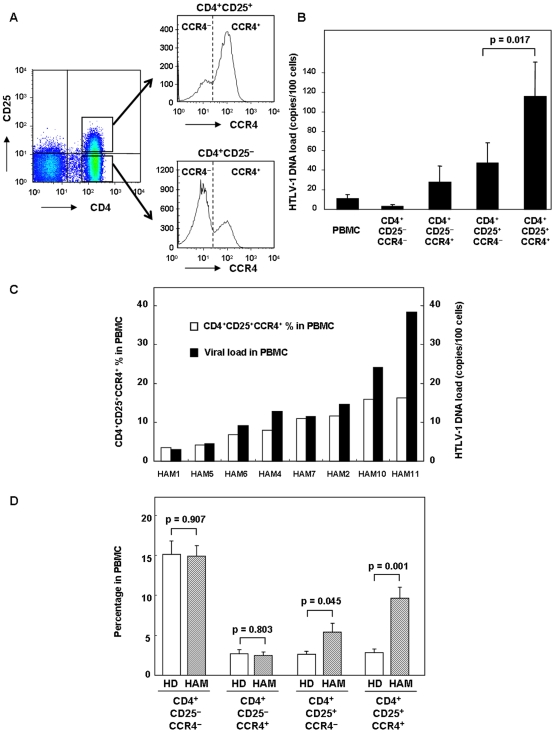
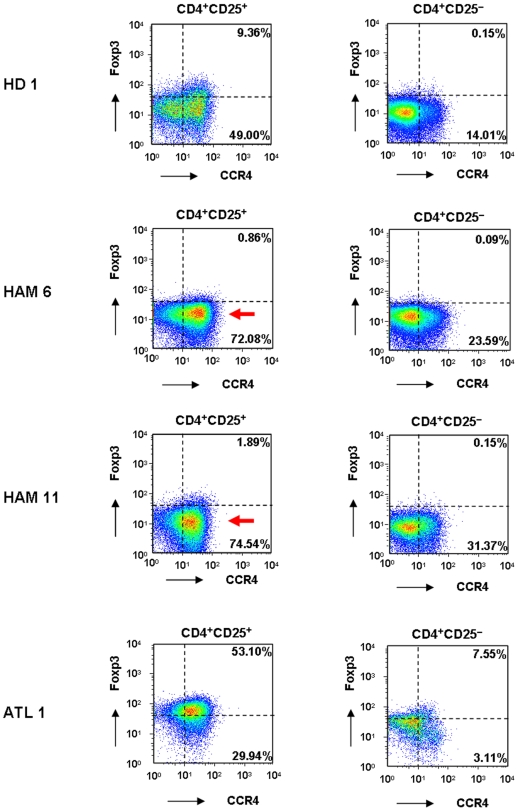
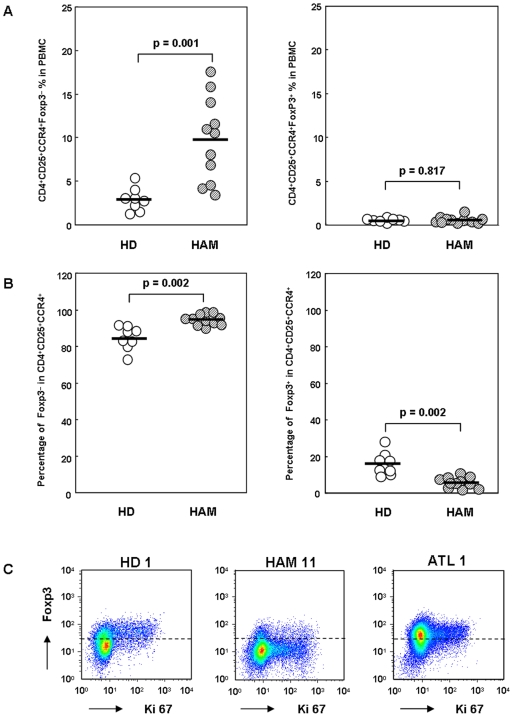
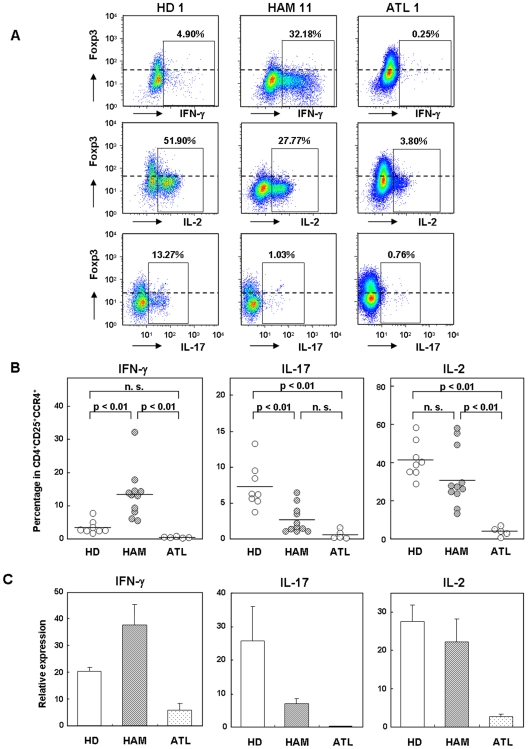
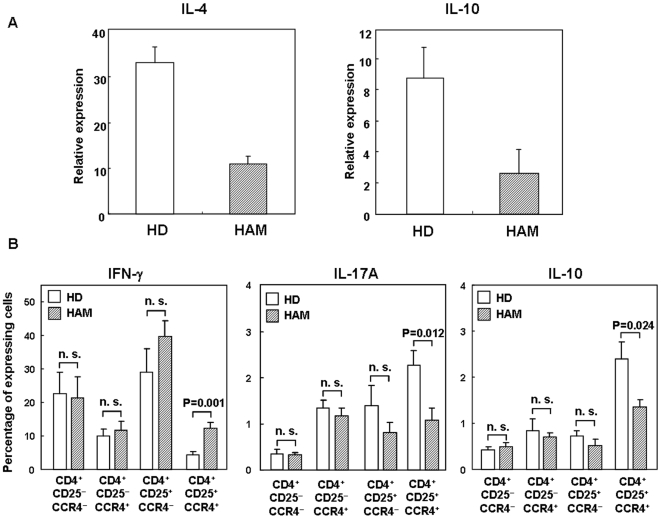
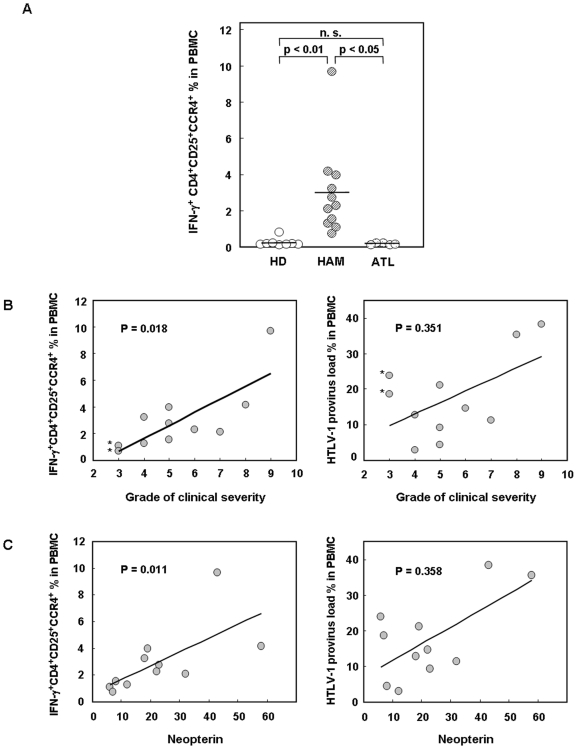
BACKGROUND: Human T-lymphotropic virus type 1 (HTLV-1) is a human retrovirus associated with both HTLV-1-associated myelopathy/tropical spastic paraparesis (HAM/TSP), which is a chronic neuroinflammatory disease, and adult T-cell leukemia (ATL). The pathogenesis of HAM/TSP is known to be as follows: HTLV-1-infected T cells trigger a hyperimmune response leading to neuroinflammation. However, the HTLV-1-infected T cell subset that plays a major role in the accelerated immune response has not yet been identified. PRINCIPAL FINDINGS: Here, we demonstrate that CD4(+)CD25(+)CCR4(+) T cells are the predominant viral reservoir, and their levels are increased in HAM/TSP patients. While CCR4 is known to be selectively expressed on T helper type 2 (Th2), Th17, and regulatory T (Treg) cells in healthy individuals, we demonstrate that IFN-gamma production is extraordinarily increased and IL-4, IL-10, IL-17, and Foxp3 expression is decreased in the CD4(+)CD25(+)CCR4(+) T cells of HAM/TSP patients as compared to those in healthy individuals, and the alteration in function is specific to this cell subtype. Notably, the frequency of IFN-gamma-producing CD4(+)CD25(+)CCR4(+)Foxp3(-) T cells is dramatically increased in HAM/TSP patients, and this was found to be correlated with disease activity and severity. CONCLUSIONS: We have defined a unique T cell subset--IFN-gamma(+)CCR4(+)CD4(+)CD25(+) T cells--that is abnormally increased and functionally altered in this retrovirus-associated inflammatory disorder of the central nervous system.
Overview
The claims and statistics of this paper haven’t been checked yet.
Free: it reads the open-access text and checks the first 5 claims that cite a source we can check. Create a free account to check every claim.
Integrity signals
Registry
Cites
Statistics
Figures
Verification
Claims the paper makes
The claims and statistics of this paper haven’t been checked yet.
Free: it reads the open-access text and checks the first 5 claims that cite a source we can check. Create a free account to check every claim.
Claims other papers make about this one
Each is checked against this paper’s own text: does it say what the citing paper says it does?
The source backs part of the claim, not all of it — or backs it for a different population, condition or comparison.
In the citing paper
“Mogamulizumab targets CCR4, a chemokine receptor highly expressed by HTLV-1-infected T cells [198,199,200], with phase I and II clinical trials resulting in an overall response rate (ORR) of 50% [201,202,203].”
From Current State of Therapeutics for HTLV-1 (2024) · cites this paper as [200]
Experimental — accuracy not yet measured
Self-check
Percentages, sums and reported differences re-computed from the paper’s own numbers.
The self-check needs the paper’s full text.
Citations
Cites
Control of Regulatory T Cell Development by the Transcription Factor Foxp3
Hori, S., Nomura, T., & Sakaguchi, S. (2003) · Science · doi:10.1126/science.1079490 · Cited by 8,187
The Role of Tumoral FOXP3 on Cell Proliferation, Migration, and Invasion in Gastric Cancer
Zhang, L., Xu, J., Zhang, X., Zhang, Y., Wang, L., Huang, X., & Xu, Z. (2017) · Cellular Physiology and Biochemistry · doi:10.1159/000479442 · Cited by 4,088
ANTIBODIES TO HUMAN T-LYMPHOTROPIC VIRUS TYPE-I IN PATIENTS WITH TROPICAL SPASTIC PARAPARESIS
Gessain, A., Vernant, J. C., Maurs, L., Barin, F., Gout, O., Calender, A., & De Thé, G. (1985) · The Lancet · doi:10.1016/s0140-6736(85)92734-5 · Cited by 2,843
HTLV-I ASSOCIATED MYELOPATHY, A NEW CLINICAL ENTITY
Osame, M., Usuku, K., Izumo, S., Ijichi, N., Amitani, H., Igata, A., Matsumoto, M., & Tara, M. (1986) · The Lancet · doi:10.1016/s0140-6736(86)91298-5 · Cited by 2,404
Adult T-cell leukemia: clinical and hematologic features of 16 cases
Uchiyama, T., Yodoi, J., Sagawa, K., Takatsuki, K., & Uchino, H. (1977) · Blood · doi:10.1182/blood.v50.3.481.481 · Cited by 2,316
Loss of Functional Suppression by CD4+CD25+ Regulatory T Cells in Patients with Multiple Sclerosis
Viglietta, V., Baecher-Allan, C., Weiner, H. L., & Hafler, D. A. (2004) · The Journal of Experimental Medicine · doi:10.1084/jem.20031579 · Cited by 1,856 · cited 1×
“Previous studies have observed significant reductions in Foxp3 expression and/or Treg function in several human autoimmune diseases, including multiple sclerosis (MS), myasthenia gravis, and type I diabetes [17,19], suggesting that defects in Foxp3 expression and/or Treg function may precipitate the loss of immunologi…”
ResultSurface phenotype and antigenic specificity of human interleukin 17–producing T helper memory cells
Acosta-Rodriguez, E. V., Rivino, L., Geginat, J., Jarrossay, D., Gattorno, M., Lanzavecchia, A., Sallusto, F., & Napolitani, G. (2007) · Nature Immunology · doi:10.1038/ni1467 · Cited by 1,828 · cited 3×
“More recently, it has been observed that CCR4 is expressed on Th17 cells [23].”
BackgroundShimoyama, M., & members of The Lymphoma Study Group (1984–87) (1991) · British Journal of Haematology · doi:10.1111/j.1365-2141.1991.tb08051.x · Cited by 1,608 · cited 1×
“HAM/TSP was diagnosed according to the guidelines defined by the WHO, and ATL was diagnosed on the basis of the criteria proposed by Shimoyama [46].”
MethodFoxp3+CD25+CD4+ natural regulatory T cells in dominant self‐tolerance and autoimmune disease
Sakaguchi, S., Ono, M., Setoguchi, R., Yagi, H., Hori, S., Fehervari, Z., Shimizu, J., Takahashi, T., & Nomura, T. (2006) · Immunological Reviews · doi:10.1111/j.0105-2896.2006.00427.x · Cited by 1,555 · cited 4×
“Although Treg cells are phenotypically similar to activated T cells, they can be identified ex vivo by the intracellular expression of the transcriptional regulator Foxp3 [18], which is critical for the development and function of Treg cells in both mice and humans [17].”
BackgroundResultInfluentialFOXP3 Controls Regulatory T Cell Function through Cooperation with NFAT
Wu, Y., Borde, M., Heissmeyer, V., Feuerer, M., Lapan, A. D., Stroud, J. C., Bates, D. L., Guo, L., Han, A., Ziegler, S. F., et al. (2006) · Cell · doi:10.1016/j.cell.2006.05.042 · Cited by 1,189 · cited 1×
“The high Foxp3 expression without cytokine production and low Foxp3 expression with cytokine production in CD4CD25CCR4 T cells (Figure 3A) are consistent with recent reports demonstrating that Foxp3 can target and repress the transcriptional activity of NFAT-AP-1 complexes present at the cytokine promoter [43].”
Result
Cited by
Yamano, Y., & Sato, T. (2012) · Frontiers in Microbiology · doi:10.3389/fmicb.2012.00389 · Cited by 204
Self-citationInflammatory manifestations of HTLV-1 and their therapeutic options
Martin, F., Taylor, G. P., & Jacobson, S. (2014) · Expert Review of Clinical Immunology · doi:10.1586/1744666x.2014.966690 · Cited by 147
“Although short-term (up to 12 months) treatment with HTLV-1 reverse transcriptase inhibitors did not reduce pVL, the identification of CCR4 expression as a marker of infected cells [218,219] offers new hope for a treatment to reduce the viral burden and thus the inflammatory response.”
BackgroundSelf-citationThe role of viral infections in the development of autoimmune diseases
Hussein, H. M., & Rahal, E. A. (2019) · Critical Reviews in Microbiology · doi:10.1080/1040841x.2019.1614904 · Cited by 154
“…Treg-defining transcription factor forkhead box P3 (FOXP3) gene was low in these subjects consequently resulting in decreased levels of anti-inflammatory cytokines produced by Tregs such as IL-10 and TGF-b (Brito-Melo et al. 2007; Toulza et al. 2008; Yamano et al. 2009; Satou and Matsuoka 2010).”
BackgroundInfluentialHTLV-1 modulates the frequency and phenotype of FoxP3+CD4+T cells in virus-infected individuals
Satou, Y., Utsunomiya, A., Tanabe, J., Nakagawa, M., Nosaka, K., & Matsuoka, M. (2012) · Retrovirology · doi:10.1186/1742-4690-9-46 · Cited by 130
“Furthermore, FoxP3 CD4 T cells in HAM/TSP patient contain an increased FoxP3 non-Treg population (Figure 5F), which would contribute to the inflammatory phenotype of HAM/TSP via generation of pro-inflammatory cytokine-producing CD4 T cells such as THAM cells [46] or exFoxp3 cells [47].”
BackgroundSelf-citationHTLV-1 induces a Th1-like state in CD4+CCR4+ T cells
Araya, N., Sato, T., Ando, H., Tomaru, U., Yoshida, M., Coler-Reilly, A., Yagishita, N., Yamauchi, J., Hasegawa, A., Kannagi, M., et al. (2014) · Journal of Clinical Investigation · doi:10.1172/jci75250 · Cited by 113
“Due to the high proportion of CCR4 positivity among HTLV-1–infected cells (19), the high proviral load in the CSF of HAM/TSP patients (47), and the elevated levels of CCL22 in HAM/TSP patient peripheral blood (30), one might hypothesize that the infected cells migrate across the blood-brain barrier…”
InfluentialSelf-citation
Metadata
- Authors
- Yamano, Y., Araya, N., Sato, T., Utsunomiya, A., Azakami, K., Hasegawa, D., Izumi, T., Fujita, H., Aratani, S., Yagishita, N., Fujii, R., Nishioka, K., Jacobson, S., & Nakajima, T.
- Affiliations
- St. Marianna University School of Medicine (JP)
- Imamura Hospital (JP)
- National Institutes of Health (US)
- Corresponding author
- Yamano, Yoshihisa
- ORCID
- Venue
- PLoS ONE
- Publisher
- Public Library of Science (PLoS)
- Published
- 2009-08-05
- Volume
- 4
- Issue
- 8
- Pages
- e6517
- ISSN
- 1932-6203 (ISSN-L)
- PMC
- PMC2715877
- OpenAlex
- W2123524329
- Cited by
- 140
- References
- 48
- Citations by year
- 2026: 10 · 2025: 5 · 2024: 12 · 2023: 6 · 2022: 7 · 2021: 6 · 2020: 8 · 2019: 9 · 2018: 6 · 2017: 9 · 2016: 10 · 2015: 11 · 2014: 10 · 2013: 11 · 2012: 7
- FWCI
- 2.87
- Type
- journal article
- Language
- en
- Open access
- gold
- doi.org
- Licence
- Locations
- PLoS ONE (publishedVersion, public-domain)
- PubMed Central (publishedVersion, public-domain)
- PubMed (publishedVersion)
- DOAJ (DOAJ: Directory of Open Access Journals) (submittedVersion, cc-by-sa)
- Figshare (submittedVersion, cc-by)
- Funders
- Uehara Memorial Foundation
- Ministry of Education, Culture, Sports, Science and Technology
- National Institute of Biomedical Innovation
- Mishima Kaiun Memorial Foundation
- Japan Society for the Promotion of Science (20249052)
- Topics
- Life Sciences › Immunology and Microbiology › Immunology › T-cell and Retrovirus Studies
- Life Sciences › Immunology and Microbiology › Immunology › T-cell and B-cell Immunology
- Life Sciences › Immunology and Microbiology › Virology › HIV Research and Treatment
- Keywords
- HTLV-1, HAM/TSP, adult T-cell leukemia/lymphoma, CCR4, CD4+CD25+ T cells, regulatory T cells, Foxp3, interferon-gamma, neuroinflammation, viral reservoir, Th17 cells, Th2 cells, IL-17, IL-10, IL-4, disease activity
- MeSH terms
- Interferon-gamma, Nervous System Diseases, T-Lymphocytes, Human T-lymphotropic virus 1, HTLV-I Infections, CD4 Antigens, Interleukin-4, Case-Control Studies, Interleukin-10, Cell Proliferation, Interleukin-2 Receptor alpha Subunit, Receptors, CCR4
About these checks
Registry, retraction, Cites and statistics results are computed, not judged, with one exception: a printed reference that no index lists is read once by a model before it counts as a citation error. Claims are extracted by a model and kept only when their quote appears verbatim in the text; each cited source is then checked, with a model’s help, for whether it says what the claim relies on. Those verdicts can be wrong — read the claim’s quote and the cited source before relying on one.
Statistics and arithmetic are recomputed, not judged.
Confidence bands are shown only for fields calibrated on our annotated test set. None is calibrated yet, so no band is shown.
What counts as a claim ›How we measure confidence ›How we check this ›
Are you an author, or do you see a problem with this page? Request a review
Data sources
Bibliographic data: Semantic Scholar, OpenAlex, Crossref.
Contains information from the Semantic Scholar Academic Graph Datasets, made available under the ODC Attribution License (ODC-BY 1.0).
Semantic Scholar’s data is described in: Kinney, R., et al. (2023). The Semantic Scholar Open Data Platform. arXiv:2301.10140.
