

A Comprehensive Microarray-Based DNA Methylation Study of 367 Hematological Neoplasms
Open accessThe DOI matches its Crossref record; 65 of the 65 references it cites were found in a registry or an index.
Abstract
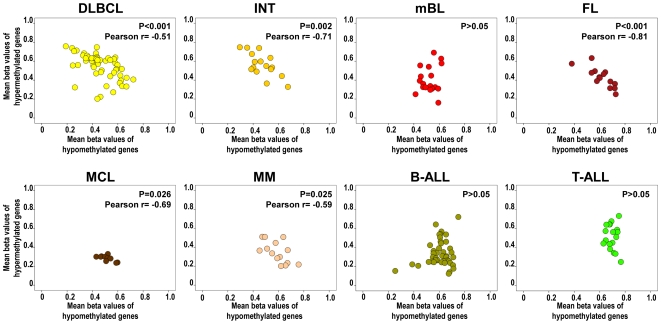
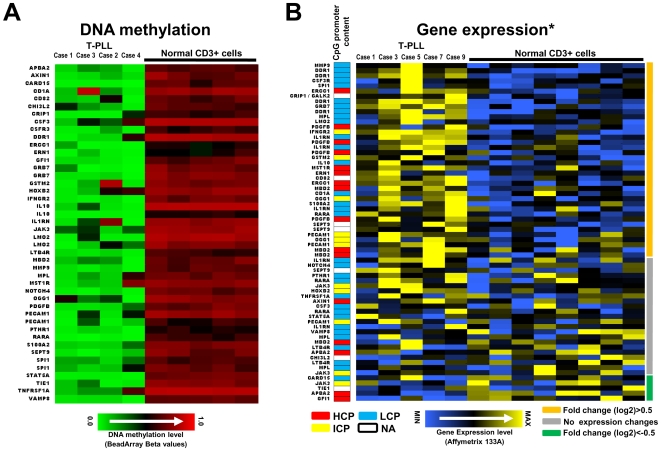
BACKGROUND: Alterations in the DNA methylation pattern are a hallmark of leukemias and lymphomas. However, most epigenetic studies in hematologic neoplasms (HNs) have focused either on the analysis of few candidate genes or many genes and few HN entities, and comprehensive studies are required. METHODOLOGY/PRINCIPAL FINDINGS: Here, we report for the first time a microarray-based DNA methylation study of 767 genes in 367 HNs diagnosed with 16 of the most representative B-cell (n = 203), T-cell (n = 30), and myeloid (n = 134) neoplasias, as well as 37 samples from different cell types of the hematopoietic system. Using appropriate controls of B-, T-, or myeloid cellular origin, we identified a total of 220 genes hypermethylated in at least one HN entity. In general, promoter hypermethylation was more frequent in lymphoid malignancies than in myeloid malignancies, being germinal center mature B-cell lymphomas as well as B and T precursor lymphoid neoplasias those entities with highest frequency of gene-associated DNA hypermethylation. We also observed a significant correlation between the number of hypermethylated and hypomethylated genes in several mature B-cell neoplasias, but not in precursor B- and T-cell leukemias. Most of the genes becoming hypermethylated contained promoters with high CpG content, and a significant fraction of them are targets of the polycomb repressor complex. Interestingly, T-cell prolymphocytic leukemias show low levels of DNA hypermethylation and a comparatively large number of hypomethylated genes, many of them showing an increased gene expression. CONCLUSIONS/SIGNIFICANCE: We have characterized the DNA methylation profile of a wide range of different HNs entities. As well as identifying genes showing aberrant DNA methylation in certain HN subtypes, we also detected six genes--DBC1, DIO3, FZD9, HS3ST2, MOS, and MYOD1--that were significantly hypermethylated in B-cell, T-cell, and myeloid malignancies. These might therefore play an important role in the development of different HNs.
Overview
The claims and statistics of this paper haven’t been checked yet.
Free: it reads the open-access text and checks the first 5 claims that cite a source we can check. Create a free account to check every claim.
Integrity signals
Registry
Cites
Statistics
Figures
Verification
Claims the paper makes
The claims and statistics of this paper haven’t been checked yet.
Free: it reads the open-access text and checks the first 5 claims that cite a source we can check. Create a free account to check every claim.
Claims other papers make about this one
Each is checked against this paper’s own text: does it say what the citing paper says it does?
The source backs part of the claim, not all of it — or backs it for a different population, condition or comparison.
In the citing paper
“CpG sites that become more methylated with normal myeloid maturation were not significantly more methylated in independent dataset MDS/myeloproliferative disease (MDS/MPD) (n=13) or AML bone marrow (n=116) (figure S2).”
From CpG methylation patterns and decitabine treatment response in acute myeloid leukemia cells and normal hematopoietic precursors (2012) · cites this paper as [31]
Experimental — accuracy not yet measuredThe check wasn’t confident either way, so it gives no verdict — never disputed.
In the citing paper
“All 6 CpG sites that were >20% less methylated in AML cells than NCD34 were from the category of 157 CpG sites that become less methylated with normal myeloid maturation (figure S3).”
From CpG methylation patterns and decitabine treatment response in acute myeloid leukemia cells and normal hematopoietic precursors (2012) · cites this paper as [31]
Experimental — accuracy not yet measuredIn the citing paper
“In unbiased hierarchical cluster analysis of methylation data from an independent study (31), clusters generated using maturation-responsive CpG discriminated best between NCD34 and NBM, despite 7 to 8-fold more CpG sites in the ‘no methylation change’ category (figure S1).”
From CpG methylation patterns and decitabine treatment response in acute myeloid leukemia cells and normal hematopoietic precursors (2012) · cites this paper as [31]
In the citing paper
“Methylation of maturation-responsive CpG (hypo and hypermethylated in NCD34) changed in the expected directions from independent NCD34 to NBM (figure S2, red and blue box plots).”
From CpG methylation patterns and decitabine treatment response in acute myeloid leukemia cells and normal hematopoietic precursors (2012) · cites this paper as [31]
In the citing paper
“Therefore, maturation-responsive CpG sites were over-represented amongst the most hypermethylated CpG sites in AML bone marrow (p<0.0001, Chi-Square test).”
From CpG methylation patterns and decitabine treatment response in acute myeloid leukemia cells and normal hematopoietic precursors (2012) · cites this paper as [31]
5 more claims about this paper
Create a free account to see every claim other papers make about this one.
Self-check
Percentages, sums and reported differences re-computed from the paper’s own numbers.
The self-check needs the paper’s full text.
Citations
Cites
1 retracted
Epigenetic regulation of Wnt-signaling pathway in acute lymphoblastic leukemia
Román-Gómez, J., Cordeu, L., Agirre, X., Jiménez-Velasco, A., San José-Eneriz, E., Garate, L., Calasanz, M. J., Heiniger, A., Torres, A., & Prosper, F. (2007) · Blood · doi:10.1182/blood-2006-09-047043 · Cited by 168
Self-citationRetractedWHO Classification of Tumours of Haematopoietic and Lymphoid Tissues
Swerdlow, S. H. (2017) · Medical Entomology and Zoology · Cited by 12,933
Jones, P. A., & Baylin, S. B. (2007) · Cell · doi:10.1016/j.cell.2007.01.029 · Cited by 4,515 · cited 1×
“Epigenetic changes, which represent reversible modifications that affect gene expression without altering the DNA sequence itself, are also a hallmark of cancer [4,5].”
Esteller, M. (2008) · New England Journal of Medicine · doi:10.1056/nejmra072067 · Cited by 3,662
Fenaux, P., Mufti, G. J., Hellstrom-Lindberg, E., Santini, V., Finelli, C., Giagounidis, A., Schoch, R., Gattermann, N., Sanz, G., List, A., et al. (2009) · The Lancet Oncology · doi:10.1016/s1470-2045(09)70003-8 · Cited by 2,663 · cited 1×
“For instance, results from a phase III study have indicated that treatment of patients with higher risk MDS with 5-azacitidine results in significant improvement in overall survival [65].”
Control of Developmental Regulators by Polycomb in Human Embryonic Stem Cells
Lee, T. I., Jenner, R. G., Boyer, L. A., Guenther, M. G., Levine, S. S., Kumar, R. M., Chevalier, B., Johnstone, S. E., Cole, M. F., Isono, K.-I., et al. (2006) · Cell · doi:10.1016/j.cell.2006.02.043 · Cited by 2,268
Weber, M., Hellmann, I., Stadler, M. B., Ramos, L., Pääbo, S., Rebhan, M., & Schübeler, D. (2007) · Nature Genetics · doi:10.1038/ng1990 · Cited by 2,221
The Polycomb group protein EZH2 directly controls DNA methylation
Viré, E., Brenner, C., Deplus, R., Blanchon, L., Fraga, M., Didelot, C., Morey, L., Van Eynde, A., Bernard, D., Vanderwinden, J.-M., et al. (2006) · Nature · doi:10.1038/nature04431 · Cited by 2,204
Bernstein, B. E., Meissner, A., & Lander, E. S. (2007) · Cell · doi:10.1016/j.cell.2007.01.033 · Cited by 2,086 · cited 1×
“The best studied epigenetic change is the hypermethylation of tumor suppressor genes which is reported to be associated with gene inactivation [6].”
DNA methylation in cancer: too much, but also too little
Ehrlich, M. (2002) · Oncogene · doi:10.1038/sj.onc.1205651 · Cited by 1,538
Cited by
Items 101–137 of 137
Dugge, R., Wagener, R., Mӧller, P., & Barth, T. F. E. (2021) · British Journal of Haematology · doi:10.1111/bjh.17193 · Cited by 3
Carbohydrate sulfotransferases in glycosaminoglycan biosynthesis
Barone, D., Joshi, L., & Kilcoyne, M. (2024) · Elsevier eBooks · doi:10.1016/b978-0-12-819655-7.00013-8 · Cited by 5
Epigenetic Alterations of Viral and Cellular Genomes in EBV-Infected Cells
Ernberg, I., Niller, H. H., & Minárovits, J. (2016) · Epigenetics and human health · doi:10.1007/978-3-319-27186-6_6 · Cited by 1
Epigenetics and Human Infectious Diseases
Niller, H. H., & Minárovits, J. (2018) · Elsevier eBooks · doi:10.1016/b978-0-12-812215-0.00021-2 · Cited by 4
Methylation in haematological malignancies : techniques and prospects
Chantepie, S., Krieger, S., & Leporrier, M. (2012) · Hématologie · doi:10.1684/hma.2012.0698 · Cited by 1
Epigenetics and human infectious diseases
Niller, H. H., & Minárovits, J. (2023) · Elsevier eBooks · doi:10.1016/b978-0-443-21863-7.00006-8 · Cited by 1
Role of Genetic and Epigenetic Factors in Oral Squamous Cell Carcinoma - A Structured Review
Durgesh, B., & Manjunatha, B. S. (2015) · Recent Patents on Biomarkerse · doi:10.2174/2210309005666150313002603 · Cited by 2
Contribución de la epigenética al manejo personalizado del cáncer
Dávalos, V., & Esteller, M. (2010) · Elsevier eBooks · doi:10.1016/b978-84-458-2025-4.00012-7 · Cited by 1
Ricart, G. M. (2013) · LA Referencia (Red Federada de Repositorios Institucionales de Publicaciones Científicas)
Genetic and Epigenetic Profiling of Mantle Cell Lymphoma and Chronic Lymphocytic Leukemia
Halldórsdóttir, A. M. (2011) · Uppsala University Publications (Uppsala University)
Cahill, N. (2012) · Arrow - TU Dublin (Technological University Dublin) · doi:10.21427/d7v01b
Veränderungen der DNA-Methylierung bei männlicher Infertilität
Friemel, C. (2015) · Multimedialen Archiv und Publikationsserver der Christian-Albrechts-Universität zu Kiel (Christian-Albrechts-Universität zu Kiel)
Events responsible for aberrant genetic and epigenetic codes in cancer
Thiagalingam, S. (2015) · Cambridge University Press eBooks · doi:10.1017/cbo9780511979811.008
The genetics of mature B‐cell malignancies
Strefford, J. C., Fitzgibbon, J., Rose-Zerilli, M. J. J., & Bödör, C. (2016) · Wiley eBooks · doi:10.1002/9781118527948.ch6
Neidhart, M. (2015) · Elsevier eBooks · doi:10.1016/b978-0-12-420194-1.00029-4
Eberle, F. C., Hanson, J. C., Killian, J. K., Wei, L., Ylaya, K., Hewitt, S. M., Jaffe, E. S., Emmert‐Buck, M. R., & Rodriguez‐Canales, J. (2010)
Gómez, L. M. M., Palacio, G. V., & Peña, C. M. M. (2016) · Revista Colombiana de Cancerología · doi:10.1016/j.rccan.2016.09.002
Das Tumorepigenom – von der Genregulation über die Tumorklassifikation zum Therapietarget
Ammerpohl, O., Deckert, M., & Montesinos‐Rongen, M. (2016) · Medizinische Genetik · doi:10.1007/s11825-016-0115-1
Self-citationEGFR confers exquisite specificity of Wnt9a-Fzd9b signaling in hematopoietic stem cell developmentPreprint
Grainger, S. J., Nguyen, N. A., Richter, J., Setayesh, J., Lonquich, B., Oon, C. H., Wozniak, J. M., Barahona, R. A., Kamei, C. N., Houston, J., et al. (2018) · bioRxiv (Cold Spring Harbor Laboratory) · doi:10.1101/387043
Self-citationPontali, G., Cascione, L., Arribas, A. J., Rinaldi, A., Bertoni, F., & Giugno, R. (2019) · Lecture notes in computer science · doi:10.1007/978-3-030-17935-9_3
Leonard, S. M. (2010) · University of Birmingham Institutional Research Archive (University of Birmingham)
Research progress on epigenetics of small B-cell lymphoma
Ruan, X., Zhang, R., Zhu, H., Ye, C., Wang, Z., Dong, E., Li, R., Cheng, Z., & Peng, H. (2022) · Clinical & Translational Oncology · doi:10.1007/s12094-022-02820-z
Choi, J.-H., Li, Y., Guo, J., Pei, L., Rauch, T. A., Kramer, R. S., Macmil, S. L., Wiley, G. B., Bennett, L. B., Schnabel, J. L., et al. (2011) · PLoS ONE · doi:10.1371/annotation/ef58e5ee-1aaf-47b8-a0c5-1f1bf6886a8c
Martín-Subero, J. I., & Esteller, M. (2015) · Cambridge University Press eBooks · doi:10.1017/cbo9780511979811.009
Goldmann, T., Schmitt, B., Müller, J., Kröger, M., Scheufele, S., Marwitz, S., Nitschkowski, D., Schneider, M. A., Meister, M. A., Muley, T., et al. (2021) · Figshare · doi:10.6084/m9.figshare.14052810
Self-citationGoldmann, T., Schmitt, B., Müller, J., Kröger, M., Scheufele, S., Marwitz, S., Nitschkowski, D., Schneider, M. A., Meister, M. A., Muley, T., et al. (2021) · Figshare · doi:10.6084/m9.figshare.14052813
Self-citationGoldmann, T., Schmitt, B., Müller, J., Kröger, M., Scheufele, S., Marwitz, S., Nitschkowski, D., Schneider, M. A., Meister, M. A., Muley, T., et al. (2021) · Figshare · doi:10.6084/m9.figshare.14052807
Self-citationGoldmann, T., Schmitt, B., Müller, J., Kröger, M., Scheufele, S., Marwitz, S., Nitschkowski, D., Schneider, M. A., Meister, M., Muley, T., et al. (2021) · Figshare · doi:10.6084/m9.figshare.14052804
Self-citationGoldmann, T., Schmitt, B., Müller, J., Kröger, M., Scheufele, S., Marwitz, S., Nitschkowski, D., Schneider, M. A., Meister, M., Muley, T., et al. (2021) · Figshare · doi:10.6084/m9.figshare.14052798
Self-citationGoldmann, T., Schmitt, B., Müller, J., Kröger, M., Scheufele, S., Marwitz, S., Nitschkowski, D., Schneider, M. A., Meister, M., Muley, T., et al. (2021) · Figshare · doi:10.6084/m9.figshare.14052801
Self-citationGoldmann, T., Schmitt, B., Müller, J., Kröger, M., Scheufele, S., Marwitz, S., Nitschkowski, D., Schneider, M. A., Meister, M., Muley, T., et al. (2021) · Figshare · doi:10.6084/m9.figshare.14052795
Self-citationGoldmann, T., Schmitt, B., Müller, J., Kröger, M., Scheufele, S., Marwitz, S., Nitschkowski, D., Schneider, M. A., Meister, M., Muley, T., et al. (2021) · Figshare · doi:10.6084/m9.figshare.14052816
Self-citationGoldmann, T., Schmitt, B., Müller, J., Kröger, M., Scheufele, S., Marwitz, S., Nitschkowski, D., Schneider, M. A., Meister, M., Muley, T., et al. (2021) · Figshare · doi:10.6084/m9.figshare.14052819
Self-citationEtapes précoces de la lymphomagenèse folliculaire
Sungalee, S. (2010) · theses.fr (ABES) · doi:10.70675/a26d5e5fzf79az42bczae57zc19deae4d7e0 · Cited by 1
Abdelouahab, O. B. (2021) · theses.fr (ABES) · doi:10.70675/97f4885fz3f5cz4234zb8e2ze3fa7c4e3d41
Alsaleh, A. A. (2014) · Otago University Research Archive (University of Otago)
Metadata
- Authors
- Martin-Subero, J. I., Ammerpohl, O., Bibikova, M., Wickham-Garcia, E., Agirre, X., Alvarez, S., Brüggemann, M., Bug, S., Calasanz, M. J., Deckert, M., Dreyling, M., Du, M. Q., Dürig, J., Dyer, M. J. S., Fan, J.-B., Gesk, S., Hansmann, M.-L., Harder, L., Hartmann, S., Klapper, W., Küppers, R., Montesinos-Rongen, M., Nagel, I., Pott, C., Richter, J., Román-Gómez, J., Seifert, M., Stein, H., Suela, J., Trümper, L., Vater, I., Prosper, F., Haferlach, C., Cigudosa, J. C., & Siebert, R.
- Affiliations
- Christian-Albrechts-Universität zu Kiel (DE)
- Illumina (United States) (US)
- Universidad de Navarra (ES)
- University Hospital Cologne (DE)
- Ludwig-Maximilians-Universität München (DE)
- University of Cambridge (GB)
- University of Duisburg-Essen (DE)
- University of Leicester (GB)
- University Hospital Frankfurt (DE)
- Spanish National Cancer Research Centre (ES)
- University of Göttingen (DE)
- Munich Leukemia Laboratory (Germany) (DE)
- Corresponding author
- Siebert, Reiner
- ORCID
- Ammerpohl, Ole
- Agirre, Xabier
- Brüggemann, Monika
- Deckert, Martina
- Dreyling, Martin
- Du, Ming Q.
- Dürig, Jan
- Dyer, Martin J. S.
- Fan, Jian-Bing
- Harder, Lana
- Hartmann, Sylvia
- Klapper, Wolfram
- Küppers, Ralf
- Nagel, Inga
- Pott, Christiane
- Richter, Julia
- Seifert, Marc
- Suela, Javier
- Haferlach, Claudia
- Cigudosa, Juan Cruz
- Siebert, Reiner
- Venue
- PLoS ONE
- Publisher
- Public Library of Science (PLoS)
- Published
- 2009-09-11
- Volume
- 4
- Issue
- 9
- Pages
- e6986
- ISSN
- 1932-6203 (ISSN-L)
- PMC
- PMC2737286
- OpenAlex
- W2145166916
- Cited by
- 134
- References
- 65
- Citations by year
- 2024: 1 · 2023: 1 · 2022: 3 · 2021: 9 · 2020: 3 · 2019: 5 · 2018: 6 · 2017: 2 · 2016: 11 · 2015: 13 · 2014: 11 · 2013: 10 · 2012: 18
- FWCI
- 7.93
- Type
- journal article
- Language
- en
- Open access
- gold
- doi.org
- Locations
- PLoS ONE (publishedVersion, cc-by)
- PubMed Central (publishedVersion, cc-by)
- PubMed (publishedVersion)
- RECERCAT (Consorci de Serveis Universitaris de Catalunya) (publishedVersion, other-oa)
- RePEc: Research Papers in Economics (submittedVersion)
- Deposito Adademico Digital Universidad De Navarra (University of Navarra) (submittedVersion, other-oa)
- Dipòsit Digital de la Universitat de Barcelona (Universitat de Barcelona) (submittedVersion, cc-by)
- DOAJ (DOAJ: Directory of Open Access Journals) (submittedVersion)
- Figshare (submittedVersion, cc-by)
- GoeScholar The Publication Server of the Georg-August-Universität Göttingen (Georg-August-Universität Göttingen) (submittedVersion, cc-by)
- Leicester Research Archive (University of Leicester) (submittedVersion, cc-by)
- Publication Server of Goethe University Frankfurt am Main (Goethe University Frankfurt) (submittedVersion, cc-by)
- Funders
- Wilhelm Sander-Stiftung
- Deutsche Krebshilfe (70‐3173‐Tr3)
- Topics
- Life Sciences › Biochemistry, Genetics and Molecular Biology › Molecular Biology › Epigenetics and DNA Methylation
- Health Sciences › Medicine › Hematology › Acute Myeloid Leukemia Research
- Life Sciences › Biochemistry, Genetics and Molecular Biology › Molecular Biology › Genomics and Chromatin Dynamics
- Keywords
- DNA methylation, hematologic malignancies, promoter hypermethylation, promoter hypomethylation, B-cell lymphoma, T-cell lymphoma, myeloid neoplasms, T-cell prolymphocytic leukemia, CpG content, DBC1, DIO3, FZD9, HS3ST2, MOS, MyoD, epigenetics
- MeSH terms
- B-Lymphocytes, Humans, Promoter Regions, Genetic, T-Lymphocytes, Cluster Analysis, CpG Islands, DNA Methylation, Hematologic Neoplasms, Oligonucleotide Array Sequence Analysis, Gene Expression Profiling
About these checks
Registry, retraction, Cites and statistics results are computed, not judged, with one exception: a printed reference that no index lists is read once by a model before it counts as a citation error. Claims are extracted by a model and kept only when their quote appears verbatim in the text; each cited source is then checked, with a model’s help, for whether it says what the claim relies on. Those verdicts can be wrong — read the claim’s quote and the cited source before relying on one.
Statistics and arithmetic are recomputed, not judged.
Confidence bands are shown only for fields calibrated on our annotated test set. None is calibrated yet, so no band is shown.
What counts as a claim ›How we measure confidence ›How we check this ›
Are you an author, or do you see a problem with this page? Request a review
Data sources
Bibliographic data: Semantic Scholar, OpenAlex, Crossref.
Contains information from the Semantic Scholar Academic Graph Datasets, made available under the ODC Attribution License (ODC-BY 1.0).
Semantic Scholar’s data is described in: Kinney, R., et al. (2023). The Semantic Scholar Open Data Platform. arXiv:2301.10140.
