

The DOI matches its Crossref record; 49 of the 49 references it cites were found in a registry or an index.
Prevalence of Depression in a Large Urban South Indian Population — The Chennai Urban Rural Epidemiology Study (Cures – 70)
Open accessAbstract
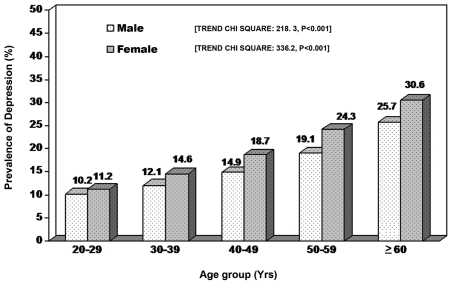
BACKGROUND: In India there are very few population based data on prevalence of depression. The aim of the study was to determine the prevalence of depression in an urban south Indian population. METHODS AND FINDINGS: Subjects were recruited from the Chennai Urban Rural Epidemiology Study (CURES), involving 26,001 subjects randomly recruited from 46 of the 155 corporation wards of Chennai (formerly Madras) city in South India. 25,455 subjects participated in this study (response rate 97.9%). Depression was assessed using a self-reported and previously validated instrument, the Patient Health Questionnaire (PHQ) - 12. Age adjustment was made according to the 2001 census of India. The overall prevalence of depression was 15.1% (age-adjusted, 15.9%) and was higher in females (females 16.3% vs. males 13.9%, p<0.0001). The odds ratio (OR) for depression in female subjects was 1.20 [Confidence Intervals (CI): 1.12-1.28, p<0.001] compared to male subjects. Depressed mood was the most common symptom (30.8%), followed by tiredness (30.0%) while more severe symptoms such as suicidal thoughts (12.4%) and speech and motor retardation (12.4%) were less common. There was an increasing trend in the prevalence of depression with age among both female (p<0.001) and male subjects (p<0.001). The prevalence of depression was higher in the low income group (19.3%) compared to the higher income group (5.9%, p<0.001). Prevalence of depression was also higher among divorced (26.5%) and widowed (20%) compared to currently married subjects (15.4%, p<0.001). CONCLUSIONS: This is the largest population-based study from India to report on prevalence of depression and shows that among urban south Indians, the prevalence of depression was 15.1%. Age, female gender and lower socio-economic status are some of the factors associated with depression in this population.
Overview
The claims and statistics of this paper haven’t been checked yet.
Run the check — free, no account needed. It reads the open-access text and checks the sources it cites.
Integrity signals
Registry
Cites
Statistics
Figures
Verification
Claims the paper makes
The claims and statistics of this paper haven’t been checked yet.
Run the check — free, no account needed. It reads the open-access text and checks the sources it cites.
Claims other papers make about this one
Each is checked against this paper’s own text: does it say what the citing paper says it does?
The cited source says what the claim attributes to it.
In the citing paper
“The PHQ has previously been validated among South Asian populations and used in previous studies measuring the prevalence of depressive symptoms among various communities in India.15–19”
From Mental Health, Suicidality, Health, and Social Indicators Among College Students Across Nine States in India (2025) · cites this paper as [17]
Self-check
Percentages, sums and reported differences re-computed from the paper’s own numbers.
The self-check needs the paper’s full text.
Citations
Cites
Kessler, R. C. (1994) · Archives of General Psychiatry · doi:10.1001/archpsyc.1994.03950010008002 · Cited by 12,370
No health without mental health
Prince, M. J., Patel, V., Saxena, S., Maj, M., Maselko, J., Phillips, M. R., & Rahman, A. (2007) · The Lancet · doi:10.1016/s0140-6736(07)61238-0 · Cited by 4,028
Cross-national prevalence and risk factors for suicidal ideation, plans and attempts
Nock, M. K., Borges, G., Bromet, E. J., Alonso, J., Angermeyer, M., Beautrais, A., Bruffaerts, R., Chiu, W. T., de Girolamo, G., Gluzman, S., et al. (2008) · British Journal of Psychiatry · doi:10.1192/bjp.bp.107.040113 · Cited by 2,654
(1994) · American Journal of Psychiatry · doi:10.1176/ajp.151.7.979 · Cited by 1,485 · cited 1×
“Several large epidemiological studies have shown that women have higher depression rates than men [37,38].”
BackgroundKessler, R. C. (2005) · JAMA · doi:10.1001/jama.293.20.2487 · Cited by 1,101
Mirowsky, J., & Ross, C. E. (1992) · Journal of Health and Social Behavior · doi:10.2307/2137349 · Cited by 856
Wilhelm, K. A. (1991) · Choice Reviews Online · doi:10.5860/choice.28-3566 · Cited by 852
Gender, Poverty, and Postnatal Depression: A Study of Mothers in Goa, India
Patel, V., Rodrigues, M., & DeSouza, N. (2002) · American Journal of Psychiatry · doi:10.1176/appi.ajp.159.1.43 · Cited by 774
Mental illness in general health care : an international study
Üstün, T. B., & Sartorius, N. (1995) · Medical Entomology and Zoology · Cited by 610
Research works printed but not linked: 2
- A Gadit, 1998, Mental Health Morbidity: An experience in a community psychiatric clinic., J Coll Phys Surg Pk, 8, 262
- RM Parikh, 2001, Depression in college students in Bombay. Program and abstracts of the American Psychiatric Association 2001 Annual Meeting; May 5-10, New Orleans, Louisiana., Symposium, 70
Cited by
Sorted by citations
Sagar, R., Dandona, R., Gururaj, G., Dhaliwal, R. S., Singh, A., Ferrari, A., Dua, T., Ganguli, A., Varghese, M., Chakma, J. K., et al. (2020) · The Lancet Psychiatry · doi:10.1016/s2215-0366(19)30475-4 · Cited by 886
Non-communicable disease syndemics: poverty, depression, and diabetes among low-income populations
Mendenhall, E., Kohrt, B. A., Norris, S. A., Ndetei, D., & Prabhakaran, D. (2017) · The Lancet · doi:10.1016/s0140-6736(17)30402-6 · Cited by 556
Pilania, M., Yadav, V., Bairwa, M. L., Behera, P., Gupta, S. D., Khurana, H., Mohan, V., Baniya, G. C., & Poongothai, S. (2019) · BMC Public Health · doi:10.1186/s12889-019-7136-z · Cited by 319
Self-citationLogie, C. H., Newman, P. A., Chakrapani, V., & Shunmugam, M. (2012) · Social Science & Medicine · doi:10.1016/j.socscimed.2012.01.008 · Cited by 198
An overview of Indian research in depression
Grover, S., Dutt, A., & Avasthi, A. (2010) · Indian Journal of Psychiatry · doi:10.4103/0019-5545.69231 · Cited by 177
Metadata
- Authors
- Poongothai, S., Pradeepa, R., Ganesan, A., & Mohan, V.
- Affiliations
- Madras Diabetes Research Foundation (IN)
- Corresponding author
- Mohan, Viswanathan
- Venue
- PLoS ONE
- Publisher
- Public Library of Science (PLoS)
- Published
- 2009-09-28
- Volume
- 4
- Issue
- 9
- Pages
- e7185
- ISSN
- 1932-6203 (ISSN-L)
- PMC
- PMC2748692
- OpenAlex
- W2008310014
- Cited by
- 308
- References
- 49
- Citations by year
- 2026: 8 · 2025: 10 · 2024: 22 · 2023: 37 · 2022: 24 · 2021: 18 · 2020: 27 · 2019: 15 · 2018: 21 · 2017: 32 · 2016: 21 · 2015: 12 · 2014: 25 · 2013: 18 · 2012: 9
- FWCI
- 7.80
- Type
- journal article
- Language
- en
- Open access
- gold
- doi.org
- Locations
- PLoS ONE (publishedVersion, cc-by)
- PubMed Central (publishedVersion, cc-by)
- PubMed (publishedVersion)
- DOAJ (DOAJ: Directory of Open Access Journals) (submittedVersion)
- Greater South Information System
- Funders
- Madras Diabetes Research Foundation
- Topics
- Health Sciences › Medicine › Psychiatry and Mental health › Mental Health Treatment and Access
- Health Sciences › Medicine › Pharmacology (medical) › Treatment of Major Depression
- Social Sciences › Psychology › Clinical Psychology › Health and Well-being Studies
- Keywords
- depression prevalence, sex differences in depression, socioeconomic status, marital status, depressive symptoms
- MeSH terms
- Adult, Depression, Female, Humans, India, Male, Middle Aged, Surveys and Questionnaires, Regression Analysis, Rural Health, Rural Population, Social Class, Urban Health, Urban Population, Prevalence, Odds Ratio
About these checks
Registry, retraction, Cites and statistics results are computed, not judged, with one exception: a printed reference that no index lists is read once by a model before it counts as a citation error. Claims are extracted by a model and kept only when their quote appears verbatim in the text; each cited source is then checked, with a model’s help, for whether it says what the claim relies on. Those verdicts can be wrong — read the claim’s quote and the cited source before relying on one.
Statistics and arithmetic are recomputed, not judged.
Confidence bands are shown only for fields calibrated on our annotated test set. None is calibrated yet, so no band is shown.
What counts as a claim ›How we measure confidence ›How we check this ›
Are you an author, or do you see a problem with this page? Request a review
