

The DOI matches its Crossref record; 47 of the 47 references it cites were found in a registry or an index.
Anti-Inflammatory Pharmacotherapy with Ketoprofen Ameliorates Experimental Lymphatic Vascular Insufficiency in Mice
Open accessAbstract
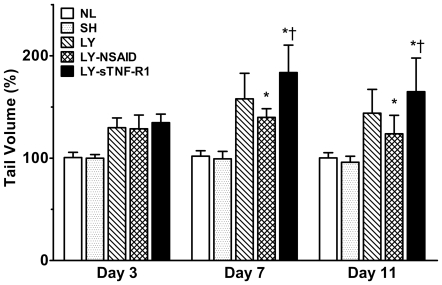
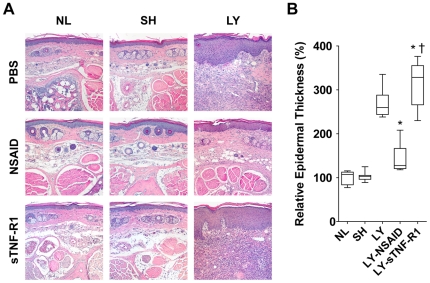
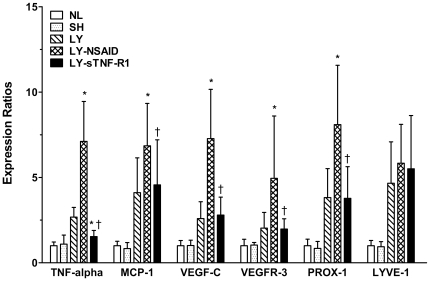
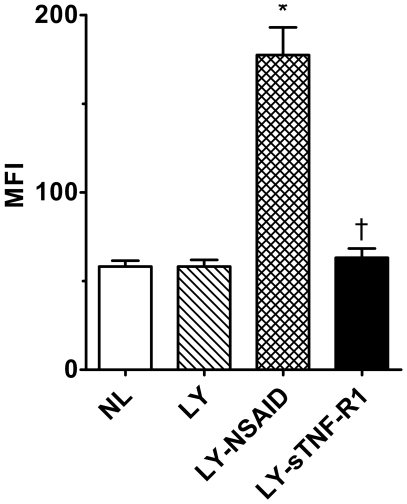
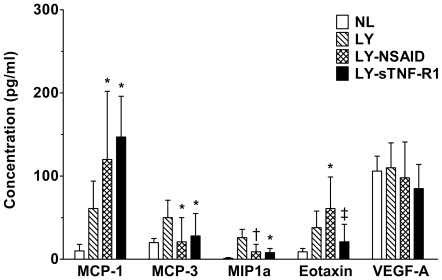
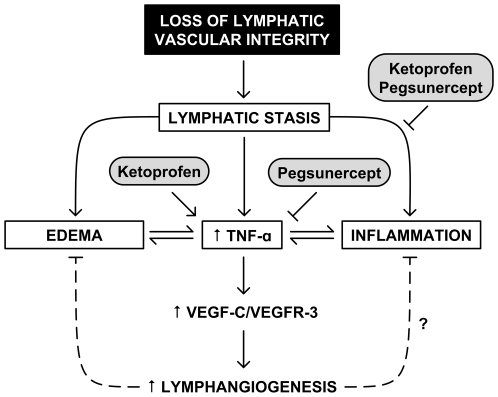
BACKGROUND: Disruption of the lymphatic vasculature causes edema, inflammation, and end-tissue destruction. To assess the therapeutic efficacy of systemic anti-inflammatory therapy in this disease, we examined the impact of a nonsteroidal anti-inflammatory drug (NSAID), ketoprofen, and of a soluble TNF-alpha receptor (sTNF-R1) upon tumor necrosis factor (TNF)-alpha activity in a mouse model of acquired lymphedema. METHODS AND FINDINGS: Lymphedema was induced by microsurgical ablation of major lymphatic conduits in the murine tail. Untreated control mice with lymphedema developed significant edema and extensive histopathological inflammation compared to sham surgical controls. Short-term ketoprofen treatment reduced tail edema and normalized the histopathology while paradoxically increasing TNF-alpha gene expression and cytokine levels. Conversely, sTNF-R1 treatment increased tail volume, exacerbated the histopathology, and decreased TNF-alpha gene expression. Expression of vascular endothelial growth factor-C (VEGF-C), which stimulates lymphangiogenesis, closely correlated with TNF-alpha expression. CONCLUSIONS: Ketoprofen therapy reduces experimental post-surgical lymphedema, yet direct TNF-alpha inhibition does not. Reducing inflammation while preserving TNF-alpha activity appears to optimize the repair response. It is possible that the observed favorable responses, at least in part, are mediated through enhanced VEGF-C signaling.
Overview
The claims and statistics of this paper haven’t been checked yet.
Run the check — free, no account needed. It reads the open-access text and checks the sources it cites.
Integrity signals
Registry
Cites
Statistics
Figures
Verification
Claims the paper makes
The claims and statistics of this paper haven’t been checked yet.
Run the check — free, no account needed. It reads the open-access text and checks the sources it cites.
Claims other papers make about this one
Each is checked against this paper’s own text: does it say what the citing paper says it does?
The cited source says what the claim attributes to it.
In the citing paper
“The nonsteroidal anti-inflammatory drug ketoprofen (148) and the leukotriene B4 (LTB4) inhibitor bestatin (44) showed promise in their respective mouse studies, but neither clinical trial produced limb volume reduction in lymphedema patients (trial identifiers NCT02257970, NCT02700529).”
From Transport and Immune Functions of the Lymphatic System. (2025) · cites this paper as [148]
Self-check
Percentages, sums and reported differences re-computed from the paper’s own numbers.
The self-check needs the paper’s full text.
Citations
Cites
Identifying biological themes within lists of genes with EASE
Hosack, D. A., Dennis, G., Sherman, B. T., Lane, H. C., & Lempicki, R. A. (2003) · Genome biology · doi:10.1186/gb-2003-4-10-r70 · Cited by 1,961
VEGF-D promotes the metastatic spread of tumor cells via the lymphatics
Stacker, S. A., Caesar, C., Baldwin, M. E., Thornton, G. E., Williams, R. A., Prevo, R., Jackson, D. G., Nishikawa, S., Kubo, H., & Achen, M. G. (2001) · Nature Medicine · doi:10.1038/84635 · Cited by 1,249
Vascular endothelial growth factor‐C‐mediated lymphangiogenesis promotes tumour metastasis
Mandriota, S. J., Jussila, L., Jeltsch, M., Compagni, A., Baetens, D., Prevo, R., Banerji, S., Huarte, J., Montesano, R., Jackson, D. G., et al. (2001) · The EMBO Journal · doi:10.1093/emboj/20.4.672 · Cited by 983
Rockson, S. G. (2001) · The American Journal of Medicine · doi:10.1016/s0002-9343(00)00727-0 · Cited by 472
Self-citationRistimaki, A. P., Narko, K., Enholm, B., Joukov, V., & Alitalo, K. K. (1998) · Journal of Biological Chemistry · doi:10.1074/jbc.273.14.8413 · Cited by 404
Skobe, M., Hamberg, L. M., Hawighorst, T., Schirner, M., Wolf, G. L., Alitalo, K. K., & Detmar, M. J. (2001) · American Journal Of Pathology · doi:10.1016/s0002-9440(10)61765-8 · Cited by 396
Renz, H., Gong, J., Schmidt, A. S., Nain, M., & Gemsa, D. (1988) · The Journal of Immunology · doi:10.4049/jimmunol.141.7.2388 · Cited by 391
Anti-Cytokine Therapy for Rheumatoid Arthritis
Maini, R. N., & Taylor, P. C. (2000) · Annual Review of Medicine · doi:10.1146/annurev.med.51.1.207 · Cited by 375
Novel Role for the Potent Endogenous Inotrope Apelin in Human Cardiac Dysfunction
Chen, M. M., Ashley, E. A., Deng, D. X.-F., Tsalenko, A., Deng, A. C., Tabibiazar, R., Ben‐Dor, A., Fenster, B. E., Yang, E., King, J. Y., et al. (2003) · Circulation · doi:10.1161/01.cir.0000091235.94914.75 · Cited by 352
Identifying biological themes within lists of genes with EASE
Hosack, D. A., Dennis, G., Sherman, B. T., Lane, H. C., & Lempicki, R. A. (2003) · Genome biology · doi:10.1186/gb-2003-4-6-p4 · Cited by 272
Cited by
Sorted by citations
New developments in clinical aspects of lymphatic disease
Mortimer, P. S., & Rockson, S. G. (2014) · Journal of Clinical Investigation · doi:10.1172/jci71608 · Cited by 356
Self-citationLymphatic Vessel Network Structure and Physiology
Breslin, J. W., Yang, Y., Scallan, J. P., Sweat, R. S., Adderley, S., & Murfee, W. L. (2018) · Comprehensive physiology · doi:10.1002/cphy.c180015 · Cited by 420
Avraham, T., Zampell, J. C., Yan, A., Elhadad, S., Weitman, E. S., Rockson, S. G., Bromberg, J., & Mehrara, B. J. (2013) · The FASEB Journal · doi:10.1096/fj.12-222695 · Cited by 241
Self-citationCD4+ cells regulate fibrosis and lymphangiogenesis in response to lymphatic fluid stasis
Zampell, J. C., Yan, A., Elhadad, S., Avraham, T., Weitman, E., & Mehrara, B. J. (2012) · PLoS ONE · doi:10.1371/journal.pone.0049940 · Cited by 235
Cancer-associated secondary lymphoedema
Rockson, S. G., Keeley, V. L., Kilbreath, S. L., Szuba, A., & Towers, A. (2019) · Nature Reviews Disease Primers · doi:10.1038/s41572-019-0072-5 · Cited by 230
Self-citation
Metadata
- Authors
- Nakamura, K., Radhakrishnan, K., Wong, Y. M., & Rockson, S. G.
- Affiliations
- Stanford Medicine (US)
- Corresponding author
- Rockson, Stanley G.
- Venue
- PLoS ONE
- Publisher
- Public Library of Science (PLoS)
- Published
- 2009-12-21
- Volume
- 4
- Issue
- 12
- Pages
- e8380
- ISSN
- 1932-6203 (ISSN-L)
- PMC
- PMC2791214
- OpenAlex
- W1988070199
- Cited by
- 118
- References
- 47
- Citations by year
- 2026: 6 · 2025: 9 · 2024: 9 · 2023: 7 · 2022: 15 · 2021: 12 · 2020: 6 · 2019: 10 · 2018: 4 · 2017: 9 · 2016: 5 · 2015: 4 · 2014: 6 · 2013: 3 · 2012: 5
- FWCI
- 2.00
- Type
- journal article
- Language
- en
- Open access
- gold
- doi.org
- Locations
- PLoS ONE (publishedVersion, cc-by)
- PubMed Central (publishedVersion, cc-by)
- PubMed (publishedVersion)
- DOAJ (DOAJ: Directory of Open Access Journals) (submittedVersion)
- Funders
- Susan G. Komen for the Cure
- American Heart Association
- Amgen
- Topics
- Health Sciences › Medicine › Oncology › Lymphatic System and Diseases
- Health Sciences › Medicine › Surgery › Lymphatic Disorders and Treatments
- Health Sciences › Medicine › Infectious Diseases › Parasitic Diseases Research and Treatment
- Keywords
- ketoprofen, lymphedema, nonsteroidal anti-inflammatory drugs, TNF-α, VEGF-C, lymphangiogenesis, inflammation
- MeSH terms
- Animals, Anti-Inflammatory Agents, Anti-Inflammatory Agents, Non-Steroidal, Gene Expression Regulation, Ketoprofen, Lymphedema, Organ Specificity, Solubility, Cytokines, Models, Immunological, Inflammation Mediators, Reverse Transcriptase Polymerase Chain Reaction, Lymphatic Vessels, Receptors, Tumor Necrosis Factor, Type I, Mice
About these checks
Registry, retraction, Cites and statistics results are computed, not judged, with one exception: a printed reference that no index lists is read once by a model before it counts as a citation error. Claims are extracted by a model and kept only when their quote appears verbatim in the text; each cited source is then checked, with a model’s help, for whether it says what the claim relies on. Those verdicts can be wrong — read the claim’s quote and the cited source before relying on one.
Statistics and arithmetic are recomputed, not judged.
Confidence bands are shown only for fields calibrated on our annotated test set. None is calibrated yet, so no band is shown.
What counts as a claim ›How we measure confidence ›How we check this ›
Are you an author, or do you see a problem with this page? Request a review
