

A Role for Fibrillar Collagen Deposition and the Collagen Internalization Receptor Endo180 in Glioma Invasion
Open accessThe DOI matches its Crossref record; 46 of the 46 references it cites were found in a registry or an index.
Abstract
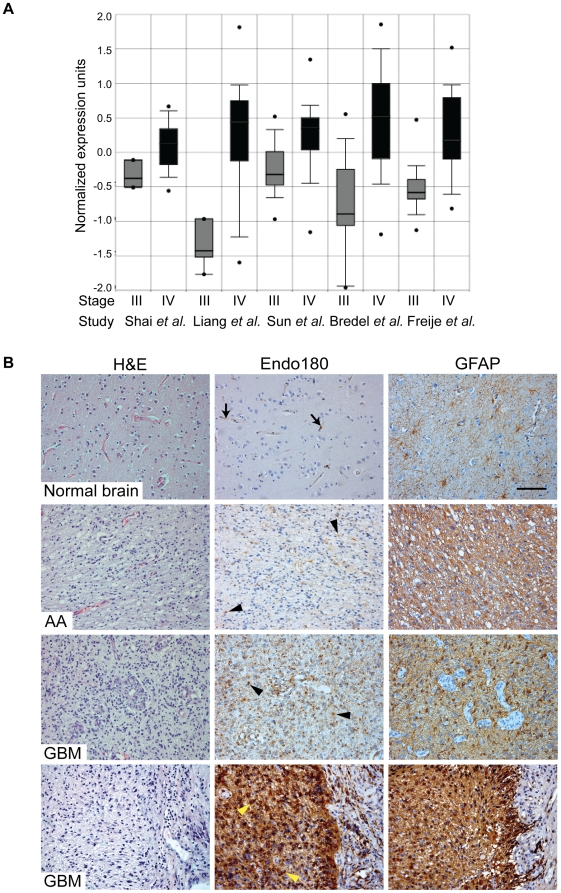
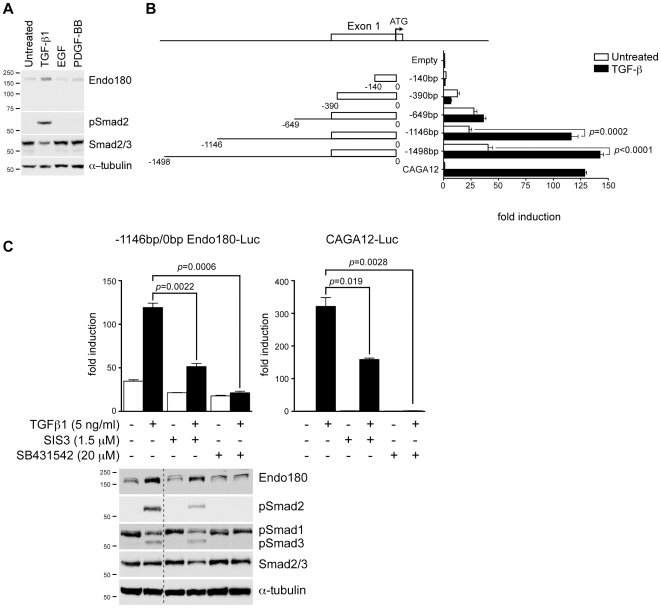
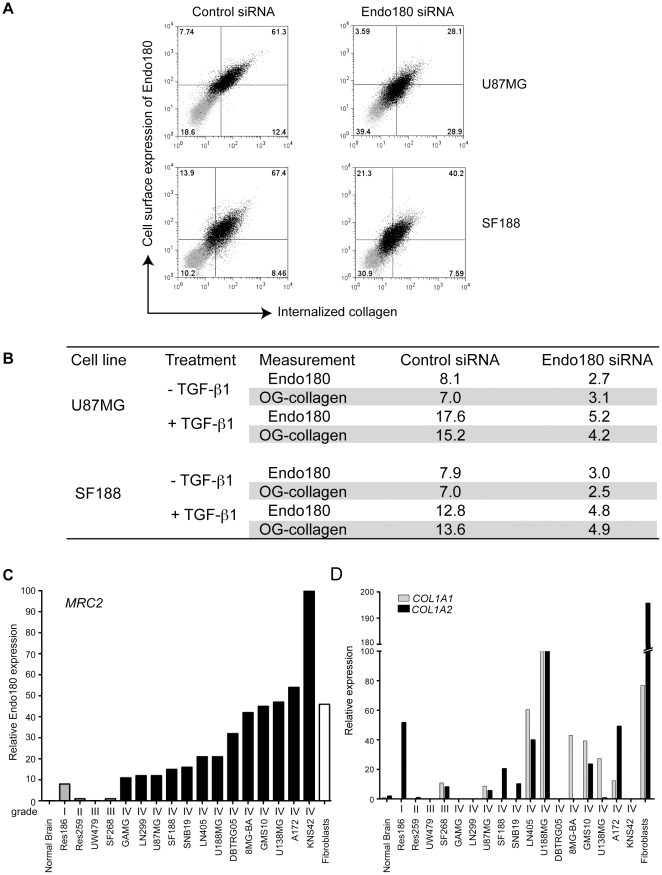
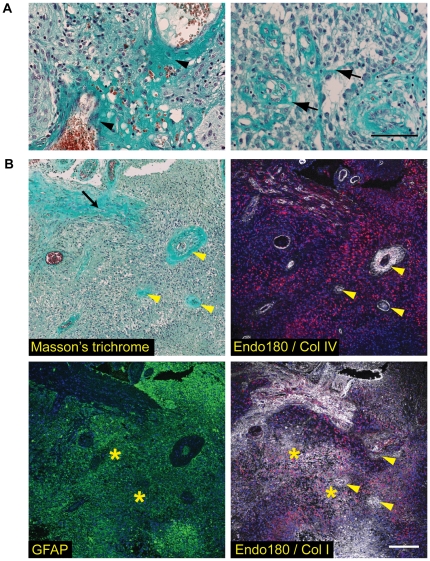
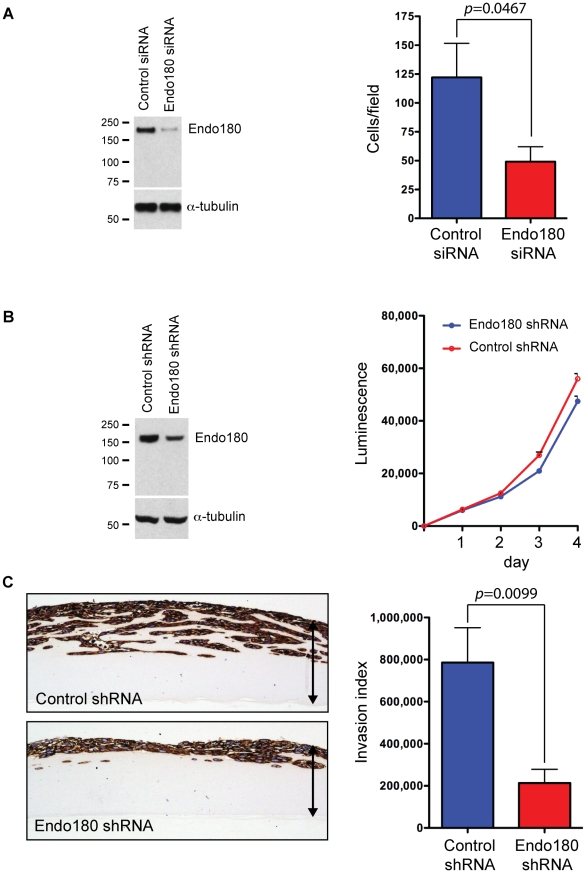
BACKGROUND: Glioblastoma multiforme (GBM, WHO grade IV) is the most common and most malignant of astrocytic brain tumors, and is associated with rapid invasion into neighboring tissue. In other tumor types it is well established that such invasion involves a complex interaction between tumor cells and locally produced extracellular matrix. In GBMs, surprisingly little is known about the associated matrix components, in particular the fibrillar proteins such as collagens that are known to play a key role in the invasion of other tumor types. METHODOLOGY/PRINCIPAL FINDINGS: In this study we have used both the Masson's trichrome staining and a high resolution multiple immunofluorescence labeling method to demonstrate that intratumoral fibrillar collagens are an integral part of the extracellular matrix in a subset of GBMs. Correlated with this collagen deposition we observed high level expression of the collagen-binding receptor Endo180 (CD280) in the tumor cells. Further, interrogation of multiple expression array datasets identified Endo180 as one of the most highly upregulated transcripts in grade IV GBMs compared to grade III gliomas. Using promoter analysis studies we show that this increased expression is, in part, mediated via TGF-beta signaling. Functionally, we demonstrate that Endo180 serves as the major collagen internalization receptor in GBM cell lines and provide the first evidence that this activity is critical for the invasion of GBM cells through fibrillar collagen matrices. CONCLUSIONS/SIGNIFICANCE: This study demonstrates, for the first time, that fibrillar collagens are extensively deposited in GBMs and that the collagen internalization receptor Endo180 is both highly expressed in these tumors and that it serves to mediate the invasion of tumor cells through collagen-containing matrices. Together these data provide important insights into the mechanism of GBM invasion and identify Endo180 as a potential target to limit matrix turnover by glioma cells and thereby restrict tumor progression.
Overview
The claims and statistics of this paper haven’t been checked yet.
Free: it reads the open-access text and checks the first 5 claims that cite a source we can check. Create a free account to check every claim.
Integrity signals
Registry
Cites
Statistics
Figures
Verification
Claims the paper makes
The claims and statistics of this paper haven’t been checked yet.
Free: it reads the open-access text and checks the first 5 claims that cite a source we can check. Create a free account to check every claim.
Self-check
Percentages, sums and reported differences re-computed from the paper’s own numbers.
The self-check needs the paper’s full text.
Citations
Cites
The 2007 WHO Classification of Tumours of the Central Nervous System
Louis, D. N., Ohgaki, H., Wiestler, O. D., Cavenee, W. K., Burger, P. C., Jouvet, A., Scheithauer, B. W., & Kleihues, P. (2007) · Acta Neuropathologica · doi:10.1007/s00401-007-0243-4 · Cited by 15,397 · cited 1×
“High-grade gliomas are the most common brain tumors in adults, and are characterized by their treatment-refractory nature and poor clinical outcome. They are classified into four grades as defined by the World Health Organization”
BackgroundErratum to: The 2007 WHO classification of tumours of the central nervous system
Louis, D. N., Ohgaki, H., Wiestler, O. D., Cavenee, W. K., Burger, P. C., Jouvet, A., Scheithauer, B. W., & Kleihues, P. (2007) · Zurich Open Repository and Archive (University of Zurich) · doi:10.5167/uzh-156115 · Cited by 4,442
Massagué, J. (2008) · Cell · doi:10.1016/j.cell.2008.07.001 · Cited by 3,907
ONCOMINE: A Cancer Microarray Database and Integrated Data-Mining Platform
Rhodes, D. R., Yu, J., Shanker, K., Deshpande, N., Varambally, R., Ghosh, D., Barrette, T., Pander, A., & Chinnaiyan, A. M. (2004) · Neoplasia · doi:10.1016/s1476-5586(04)80047-2 · Cited by 3,612 · cited 1×
“Bioinformatic analysis A profile search for glioblastoma was performed on the ONCOMINE database [44].”
MethodPhillips, H. S., Kharbanda, S., Chen, R., Forrest, W. F., Soriano, R. H., Wu, T. D., Misra, A., Nigro, J. M., Colman, H., Soroceanu, L., et al. (2006) · Cancer Cell · doi:10.1016/j.ccr.2006.02.019 · Cited by 3,143 · cited 4×
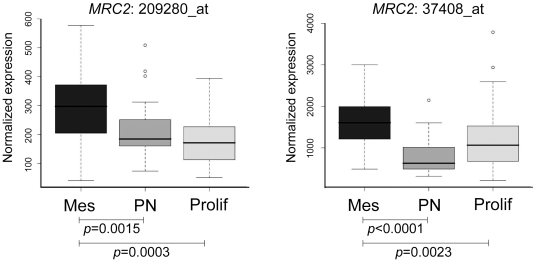
“Recently, Phillips and colleagues have described three prognostic subclasses of high-grade glioma: proneural, proliferative and mesenchymal [24].”
BackgroundMethodInfluentialDennler, S. (1998) · The EMBO Journal · doi:10.1093/emboj/17.11.3091 · Cited by 1,793 · cited 1×
“The pGL3 CAGA12-Luciferase reporter plasmid has been described previously [30].”
MethodRegulation of matrix biology by matrix metalloproteinases
Mott, J. D., & Werb, Z. (2004) · Current Opinion in Cell Biology · doi:10.1016/j.ceb.2004.07.010 · Cited by 1,104 · cited 1×
“Tumors need to remodel the ECM to physically expand and liberate latent growth factors [31,32].”
BackgroundNeuronal and glioma-derived stem cell factor induces angiogenesis within the brain
Sun, L., Hui, A.-M., Su, Q., Vortmeyer, A., Kotliarov, Y., Pastorino, S., Passaniti, A., Menon, J., Walling, J., Bailey, R., et al. (2006) · Cancer Cell · doi:10.1016/j.ccr.2006.03.003 · Cited by 877 · cited 6×
“First, interrogation of the ONCOMINETM microarray data revealed that within the 100 most highly upregulated genes in GBM compared to grade III tumors were fibrillar collagen genes and genes encoding collagen processing enzymes (Table S2).”
BackgroundInfluentialMolecular mechanisms of glioma invasiveness: the role of proteases
Rao, J. S. (2003) · Nature Reviews Cancer · doi:10.1038/nrc1121 · Cited by 847 · cited 1×
“This invasive process is characterized by adhesion of the tumor cells to locally produced extracellular matrix (ECM) components, cell locomotion and the ability of invading cells to remodel their local extracellular space [3,4].”
BackgroundGene Expression Profiling of Gliomas Strongly Predicts Survival
Freije, W. A., Castro-Vargas, F. E., Fang, Z., Horvath, S., Cloughesy, T., Liau, L. M., Mischel, P. S., & Nelson, S. F. (2004) · Cancer Research · doi:10.1158/0008-5472.can-04-0452 · Cited by 744 · cited 6×
“First, interrogation of the ONCOMINETM microarray data revealed that within the 100 most highly upregulated genes in GBM compared to grade III tumors were fibrillar collagen genes and genes encoding collagen processing enzymes (Table S2).”
BackgroundInfluential
Cited by
Items 201–228 of 228
Collective features in the control of cell behavior
Lakatos, D. (2019) · Eötvös Loránd Tudományegyetem · doi:10.15476/elte.2018.069
Puri, M. (2020) · Otago University Research Archive (University of Otago) · Cited by 1
Mouse Mast Cell Protease 4 Protects Against Ultraviolet-B Induced Skin Tumourigenesis
Taing, H. (2017) · Adelaide Research & Scholarship (AR&S) (University of Adelaide)
Halakos, E. G. (2020) · Library, Museums and Press - UDSpace (University of Delaware) · doi:10.58088/wbm8-yy83
Função da progesterona e da protease ADAMTS-1 na migração de células derivadas de câncer de ovário.
Lima, M. A. (2020) · Digital Library of Theses and Dissertations (Universidade de São Paulo) · doi:10.11606/t.42.2020.tde-13082020-092104
Minnick, C. (2017) · Wiley eBooks · doi:10.1002/9781394406418.part4
Zhou, M., Li, S., Wang, H., Zhang, X., Tan, J., & Wang, L. (2022) · Exploratory Research and Hypothesis in Medicine · doi:10.14218/erhm.2021.00048
Gronau, J. H., Isacke, C. M., & Sturge, J. (2012) · Springer eBooks · doi:10.1007/978-1-4419-0461-4_79
Self-citationGronau, J. H., Isacke, C. M., & Sturge, J. (2017) · Springer eBooks · doi:10.1007/978-3-319-67199-4_79
Self-citationNaganuma, T. (2024) · Colloids and Surfaces B Biointerfaces · doi:10.1016/j.colsurfb.2024.113794
Role of caveolae mechanics in the dynamics of extracellular vesicles involved in tumor progression
Saquel, C. (2023) · theses.fr (ABES) · doi:10.70675/44b00a51z0d01z479cz9f77z03f8717e88ff
Induction of Tumor-Associated Phenotype in Normal Fibroblasts by Glioma Cell Apoptotic Bodies
Kovalskaya, K. V., Titov, M. M., Baskaev, K. K., Lupatov, A. Y., Potashnikova, D. M., Susova, O. Y., Kim, Y. S., Yarygin, K. N., Kholodenko, R. V., & Kholodenko, I. V. (2025) · Biochemistry (Moscow) · doi:10.1134/s0006297925602631
“However, many studies have shown that glioblastomas contain significant levels of fibrillar collagens both in the tumor mass and surrounding stromal tissue [62, 63].”
Wang, C.-C., Barkholt, P., Woźniak, A., Vanleeuw, U., Lee, C., Sutter, L. D., Cock, L. D., Verbeeck, K., Engelholm, L. H., Lynch, C. M., et al. (2026) · Translational Oncology · doi:10.1016/j.tranon.2026.102708
FTIR imaging of collagens in gliomas
Noreen, R. (2011) · theses.fr (ABES) · doi:10.70675/89d2e5adz3190z465bzb9cbz22500a7381f4
Souleyreau, W. (2015) · theses.fr (ABES) · doi:10.70675/73b994f8z2331z40a6za2e3zc8ae8f7ffcc3
Wang, C., Paternostro, F., Woźniak, A., Cock, L. D., Sutter, L. D., Verbeeck, K., Vanleeuw, U., Gorgels, D., Lee, C. A., Sciot, R., et al. (2026) · International Journal of Cancer · doi:10.1002/ijc.70463
Dabaja, A. A., Apu, E. H., Zhao, V., Manimaran, S., Slayton, M. D., Li, H., Serhan, H. A., Bao, L., Morikawa, A., Lowenstein, P. R., et al. (2026) · Biomaterials · doi:10.1016/j.biomaterials.2026.124224
Sanazzaro, T., Cotner, M., Arvinth, N., Brock, A., & Seidlits, S. K. (2026) · bioRxiv (Cold Spring Harbor Laboratory) · doi:10.64898/2026.06.15.732361
Beyond the scaffold: extracellular matrix uptake in breast cancer
Rainero, E. (2026) · Biochemical Society Transactions · doi:10.1042/bst20250121
Nalkıran, İ., Nalkıran, H. S., Altuntaş, D. B., Mamuk, A. E., Koçak, Ç., Can, E., & Aslan, S. (2026) · Biomolecules · doi:10.3390/biom16081077
“Compared with normal brain tissue, glioblastoma-associated ECM exhibits substantial compositional and architectural alterations, including increased deposition of fibronectin, collagen, and other matrix proteins that facilitate tumor progression and invasion [7,8].”
Cantu, K., Shippy, T. D., & Yao, L. (2026) · ACS Applied Bio Materials · doi:10.1021/acsabm.6c00146
Kheir, W. E. (2024) · Knowledge UdeS (Institutional Deposit of the University of Sherbrooke)
Cortès, B. M., Groetzner, S., Mayr, C. H., Kallabis, S., Boryń, Ł. M., Thomas, M. J., Meissner, F., Skrońska-Wąsek, W., & Herrmann, F. E. (2026) · Research Square · doi:10.21203/rs.3.rs-10626944/v1
Towards understanding the role of cellular force in cancer progression
Emon, B. (2023) · Illinois Digital Environment for Access to Learning and Scholarship (University of Illinois at Urbana-Champaign) · Cited by 1
Role of the Extracellular Matrix: Enzyme Activities and Metastasis
Choi, I.-K., & Yun, C. (2013) · Springer eBooks · doi:10.1007/978-1-4614-7876-8_11
Metadata
- Authors
- Huijbers, I. J., Iravani, M., Popov, S., Robertson, D., Al-Sarraj, S., Jones, C., & Isacke, C. M.
- Affiliations
- Institute of Cancer Research (GB)
- Corresponding author
- Isacke, Clare M.
- Venue
- PLoS ONE
- Publisher
- Public Library of Science (PLoS)
- Published
- 2010-03-22
- Volume
- 5
- Issue
- 3
- Pages
- e9808
- ISSN
- 1932-6203 (ISSN-L)
- PMC
- PMC2842440
- OpenAlex
- W2092459115
- Semantic Scholar
- 2c24277dca9c12900042a07e0bf469083eee9225
- Cited by
- 223
- References
- 46
- Citations by year
- 2026: 9 · 2025: 7 · 2024: 10 · 2023: 12 · 2022: 21 · 2021: 13 · 2020: 17 · 2019: 16 · 2018: 15 · 2017: 22 · 2016: 14 · 2015: 15 · 2014: 12 · 2013: 15 · 2012: 9
- FWCI
- 5.71
- Type
- journal article
- Language
- en
- Open access
- gold
- doi.org
- Locations
- PLoS ONE (publishedVersion, cc-by)
- PubMed Central (publishedVersion, cc-by)
- PubMed (publishedVersion)
- DOAJ (DOAJ: Directory of Open Access Journals) (submittedVersion, cc-by-sa)
- Figshare (submittedVersion, cc-by)
- Research Portal (King's College London) (submittedVersion, other-oa)
- Funders
- Royal Marsden NHS Foundation Trust
- Cancer Research UK
- National Institute for Health and Care Research
- Imperial College London
- Topics
- Health Sciences › Medicine › Oncology › Glioma Diagnosis and Treatment
- Life Sciences › Biochemistry, Genetics and Molecular Biology › Cell Biology › Cellular Mechanics and Interactions
- Life Sciences › Biochemistry, Genetics and Molecular Biology › Cancer Research › Protease and Inhibitor Mechanisms
- Keywords
- glioblastoma, glioma invasion, Endo180, extracellular matrix, TGF-beta signaling, matrix turnover
- MeSH terms
- Adult, Aged, Aged, 80 and over, Collagen, Female, Glioblastoma, Glioma, Humans, Male, Middle Aged, Neoplasm Invasiveness, Receptors, Mitogen, Signal Transduction, Gene Expression Regulation, Neoplastic, Transforming Growth Factor beta
About these checks
Registry, retraction, Cites and statistics results are computed, not judged, with one exception: a printed reference that no index lists is read once by a model before it counts as a citation error. Claims are extracted by a model and kept only when their quote appears verbatim in the text; each cited source is then checked, with a model’s help, for whether it says what the claim relies on. Those verdicts can be wrong — read the claim’s quote and the cited source before relying on one.
Statistics and arithmetic are recomputed, not judged.
Confidence bands are shown only for fields calibrated on our annotated test set. None is calibrated yet, so no band is shown.
What counts as a claim ›How we measure confidence ›How we check this ›
Are you an author, or do you see a problem with this page? Request a review
Data sources
Bibliographic data: Semantic Scholar, OpenAlex, Crossref.
Contains information from the Semantic Scholar Academic Graph Datasets, made available under the ODC Attribution License (ODC-BY 1.0).
Semantic Scholar’s data is described in: Kinney, R., et al. (2023). The Semantic Scholar Open Data Platform. arXiv:2301.10140.
