

The DOI matches its Crossref record; 53 of the 57 references it cites were found in a registry or an index.
Internet Treatment for Depression: A Randomized Controlled Trial Comparing Clinician vs. Technician Assistance
Open accessAbstract
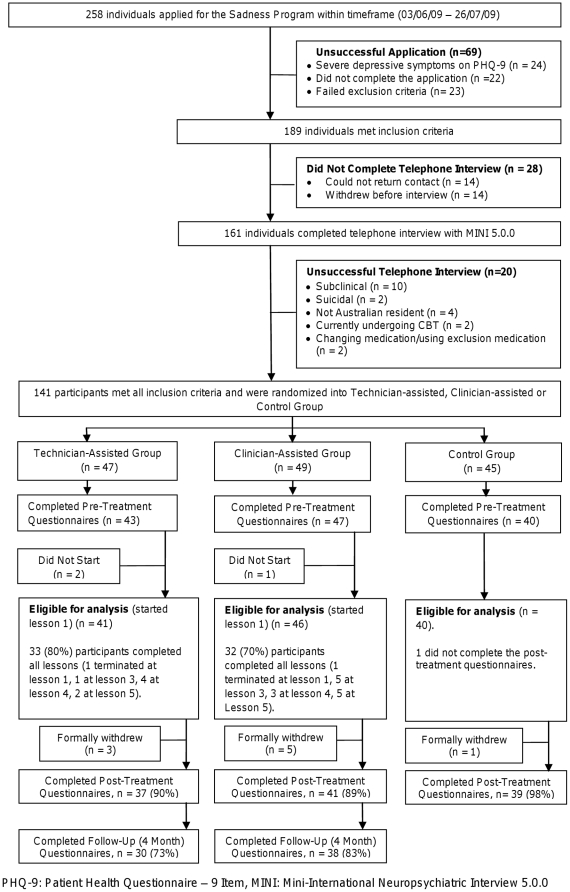
BACKGROUND: Internet-based cognitive behavioural therapy (iCBT) for depression is effective when guided by a clinician, less so if unguided. QUESTION: Would guidance from a technician be as effective as guidance from a clinician? METHOD: Randomized controlled non-inferiority trial comparing three groups: Clinician-assisted vs. technician-assisted vs. delayed treatment. Community-based volunteers applied to the VirtualClinic (www.virtualclinic.org.au) research program, and 141 participants with major depressive disorder were randomized. Participants in the clinician- and technician-assisted groups received access to an iCBT program for depression comprising 6 online lessons, weekly homework assignments, and weekly supportive contact over a treatment period of 8 weeks. Participants in the clinician-assisted group also received access to a moderated online discussion forum. The main outcome measures were the Beck Depression Inventory (BDI-II) and the Patient Health QUESTIONnaire-9 Item (PHQ-9). Completion rates were high, and at post-treatment, both treatment groups reduced scores on the BDI-II (p<0.001) and PHQ-9 (p<0.001) compared to the delayed treatment group but did not differ from each other. Within group effect sizes on the BDI-II were 1.27 and 1.20 for the clinician- and technician-assisted groups respectively, and on the PHQ-9, were 1.54 and 1.60 respectively. At 4-month follow-up participants in the technician group had made further improvements and had significantly lower scores on the PHQ-9 than those in the clinician group. A total of approximately 60 minutes of clinician or technician time was required per participant during the 8-week treatment program. CONCLUSIONS: Both clinician- and technician-assisted treatment resulted in large effect sizes and clinically significant improvements comparable to those associated with face-to-face treatment, while a delayed treatment control group did not improve. These results provide support for large scale trials to determine the clinical effectiveness and acceptability of technician-assisted iCBT programs for depression. This form of treatment has potential to increase the capacity of existing mental health services. TRIAL REGISTRATION: Australian New Zealand Clinical Trials Registry ACTRN12609000559213.
Overview
The claims and statistics of this paper haven’t been checked yet.
Free: it reads the open-access text and checks the first 5 claims that cite a source we can check. Create a free account to check every claim.
Integrity signals
Registry
Cites
Statistics
Figures
Verification
Claims the paper makes
The claims and statistics of this paper haven’t been checked yet.
Free: it reads the open-access text and checks the first 5 claims that cite a source we can check. Create a free account to check every claim.
Claims other papers make about this one
Each is checked against this paper’s own text: does it say what the citing paper says it does?
The cited source doesn’t support the claim as written.
In the citing paper
“Other studies on the combination of online sessions and personal support only investigated support through e-mail, or instant messaging (e.g. [19,36-38]).”
From Blending online therapy into regular face-to-face therapy for depression: content, ratio and preconditions according to patients and therapists using a Delphi study (2014) · cites this paper as [38]
Checked by a reasoning model — may be wrong.
Experimental — accuracy not yet measuredThe source backs part of the claim, not all of it — or backs it for a different population, condition or comparison.
In the citing paper
“Similarly, the level of training did not impact the effectiveness of a digital intervention for depression [96].”
From The therapeutic alliance in digital mental health interventions for serious mental illnesses: narrative review (2020) · cites this paper as [96]
Experimental — accuracy not yet measuredThe source backs part of the claim, not all of it — or backs it for a different population, condition or comparison.
In the citing paper
“Moreover, outcomes for DMHTs supported by non–mental health specialists do not differ from outcomes for DMHTs supported by mental health specialists (43), which allows for task-shifting options to lower levels of licensure, education requirements, and cost.”
From Banbury forum consensus statement on the path forward for digital mental health treatment (2021) · cites this paper as [43]
Experimental — accuracy not yet measuredThe source backs part of the claim, not all of it — or backs it for a different population, condition or comparison.
In the citing paper
“Characteristics of the intervention that may improve adherence to the intervention include a strong theoretical foundation [41], perceived personal relevance to the user [65,66], perceived effectiveness [67,68], tailoring [69,70], persuasive technologies [71], credibility [72,73], social networking [74,75], and regular “push factors” including human support [76-78] and/or periodic prompts (eg, by”
From Web-Based Interventions for Behavior Change and Self-Management: Potential, Pitfalls, and Progress (2012) · cites this paper as [77]
Experimental — accuracy not yet measuredThe source backs part of the claim, not all of it — or backs it for a different population, condition or comparison.
In the citing paper
“In a series of studies, Titov and colleagues have found that support administered from a technician can be equivalent to the support provided by a psychologist [26,27].”
From The promise and pitfalls of the internet for cognitive behavioral therapy (2010) · cites this paper as [27]
Experimental — accuracy not yet measured
6 more claims about this paper
Create a free account to see every claim other papers make about this one.
Self-check
Percentages, sums and reported differences re-computed from the paper’s own numbers.
The self-check needs the paper’s full text.
Citations
Cites
The PHQ-9: Validity of a brief depression severity measure
Kroenke, K., Spitzer, R. L., & Williams, J. B. W. (2001) · Journal of General Internal Medicine · doi:10.1046/j.1525-1497.2001.016009606.x · Cited by 44,910
(1998) · The Journal of Clinical Psychiatry · Cited by 19,139
KESSLER, R. C., ANDREWS, G., COLPE, L. J., HIRIPI, E., MROCZEK, D. K., NORMAND, S.-L. T., WALTERS, E. E., & ZASLAVSKY, A. M. (2002) · Psychological Medicine · doi:10.1017/s0033291702006074 · Cited by 10,327 · cited 9×
“Large (.0.80) within-group effect sizes (ESs) were found for both treatment groups on the K-10 and SDS. Clinical Significance: Remission, Recovery, and Reliable Clinical Change.”
MethodInfluentialSelf-citation(1998) · PubMed · Cited by 10,216
Jacobson, N. S., & Truax, P. (1991) · Journal of Consulting and Clinical Psychology · doi:10.1037/0022-006x.59.1.12 · Cited by 7,770 · cited 1×
“This was defined as the proportion of participants who met the criteria of statistically reliable change as described in Jacobson and Truax [46] and who also demonstrated a reduction in BDI-II scores of at least 10 points, a magnitude of change that has been used in similar research [47].”
MethodThe mini international neuropsychiatric interview
Lecrubier, Y., Sheehan, D., Hergueta, T., & Weiller, E. (1998) · European Psychiatry · doi:10.1016/s0924-9338(99)80239-9 · Cited by 5,872
Moher, D., Schulz, K. F., & Altman, D. G. (2001) · BMC Medical Research Methodology · doi:10.1186/1471-2288-1-2 · Cited by 2,755 · cited 1×
“The present CONSORT-Revised compliant randomized controlled trial (RCT)”
MethodMoher, D. (2001) · JAMA · doi:10.1001/jama.285.15.1987 · Cited by 2,545
Psychometric properties of the credibility/expectancy questionnaire
Devilly, G. J., & Borkovec, T. D. (2000) · Journal of Behavior Therapy and Experimental Psychiatry · doi:10.1016/s0005-7916(00)00012-4 · Cited by 2,295 · cited 4×
“The SDS is a 3 item measure of disability with scores ranging from 0–30 and the CEQ is a widely used measure of the expectancies or perception of treatment credibility.”
MethodInfluentialCredibility of analogue therapy rationales
Borkovec, T. D., & Nau, S. D. (1972) · Journal of Behavior Therapy and Experimental Psychiatry · doi:10.1016/0005-7916(72)90045-6 · Cited by 1,553 · cited 4×
“The SDS is a 3 item measure of disability with scores ranging from 0–30 and the CEQ is a widely used measure of the expectancies or perception of treatment credibility.”
MethodInfluential
Research works printed but not linked: 2
- N Titov, 2009, An RCT comparing two types of support on severity of symptoms for people completing Internet-based cognitive behavior therapy for social phobia., Aust N Z J Psychiatry, 43, 920, 10.1080/00048670903179228 · DOI
- 1994, Diagnostic and Statistical Manual of Mental Disorders (4th ed.).
Cited by
Computer-based psychological treatments for depression: A systematic review and meta-analysis
Richards, D., & Richardson, T. (2012) · Clinical Psychology Review · doi:10.1016/j.cpr.2012.02.004 · Cited by 1,442
“…than one active treatment intervention (Christensen et al., 2004; Spek, Nyklicek, et al., 2007; Warmerdam et al., 2008), or delivered the same intervention in different modes: clinician versus technician assisted (Titov et al., 2010), individualised e-mail versus no support (Vernmark et al., 2010).”
BackgroundInfluentialAndrews, G., Cuijpers, P., Craske, M. G., McEvoy, P., & Titov, N. (2010) · PLoS ONE · doi:10.1371/journal.pone.0013196 · Cited by 1,311
Self-citationMohr, D. C., Cuijpers, P., & Lehman, K. (2011) · Journal of Medical Internet Research · doi:10.2196/jmir.1602 · Cited by 1,097
“Indeed, specific lay coaches may be just as effective as professionals in supporting eHealth interventions [10].”
BackgroundAdvantages and limitations of Internet-based interventions for common mental disorders
Andersson, G., & Titov, N. (2014) · World Psychiatry · doi:10.1002/wps.20083 · Cited by 1,160
“ICBT is highly structured (34-36), it is unclear whether similar outcomes would be obtained with less structured interventions.”
BackgroundSelf-citationThe impact of guidance on Internet-based mental health interventions — A systematic review
Baumeister, H., Reichler, L., Munzinger, M., & Lin, J. (2014) · Internet Interventions · doi:10.1016/j.invent.2014.08.003 · Cited by 1,037
“Titov et al. (2010), compared guidance from a qualified clinical psychologist (Johnston et al., 2011) respectively qualified psychiatrist (Titov et al., 2010) with guidance provided by an administration employee without clinical experience.”
BackgroundResultInfluential
Metadata
- Authors
- Titov, N., Andrews, G., Davies, M., McIntyre, K., Robinson, E., & Solley, K.
- Affiliations
- UNSW Sydney (AU)
- St Vincent's Hospital Sydney (AU)
- Corresponding author
- Titov, Nickolai
- Venue
- PLoS ONE
- Publisher
- Public Library of Science (PLoS)
- Published
- 2010-06-08
- Volume
- 5
- Issue
- 6
- Pages
- e10939
- ISSN
- 1932-6203 (ISSN-L)
- PMC
- PMC2882336
- OpenAlex
- W2056813394
- Semantic Scholar
- 433011dba85527e73ea0ec22c25ce00808babfdc
- Cited by
- 406
- References
- 57
- Citations by year
- 2026: 6 · 2025: 16 · 2024: 19 · 2023: 26 · 2022: 27 · 2021: 26 · 2020: 17 · 2019: 28 · 2018: 20 · 2017: 39 · 2016: 34 · 2015: 24 · 2014: 37 · 2013: 40 · 2012: 23
- FWCI
- 41.93
- Type
- journal article
- Language
- en
- Open access
- gold
- doi.org
- Locations
- PLoS ONE (publishedVersion, cc-by)
- PubMed Central (publishedVersion, cc-by)
- PubMed (publishedVersion)
- RePEc: Research Papers in Economics (submittedVersion)
- DOAJ (DOAJ: Directory of Open Access Journals) (submittedVersion, cc-by-sa)
- Figshare (submittedVersion, cc-by)
- Topics
- Social Sciences › Psychology › Applied Psychology › Digital Mental Health Interventions
- Social Sciences › Psychology › Experimental and Cognitive Psychology › Anxiety, Depression, Psychometrics, Treatment, Cognitive Processes
- Health Sciences › Medicine › Public Health, Environmental and Occupational Health › Telemedicine and Telehealth Implementation
- Keywords
- internet-based cognitive behavioral therapy, depression, major depressive disorder, treatment completion, treatment delay, non-inferiority, mental health service capacity
- MeSH terms
- Adult, Aged, Depression, Female, Health Personnel, Humans, Male, Middle Aged, Surveys and Questionnaires, Treatment Outcome, Internet
About these checks
Registry, retraction, Cites and statistics results are computed, not judged, with one exception: a printed reference that no index lists is read once by a model before it counts as a citation error. Claims are extracted by a model and kept only when their quote appears verbatim in the text; each cited source is then checked, with a model’s help, for whether it says what the claim relies on. Those verdicts can be wrong — read the claim’s quote and the cited source before relying on one.
Statistics and arithmetic are recomputed, not judged.
Confidence bands are shown only for fields calibrated on our annotated test set. None is calibrated yet, so no band is shown.
What counts as a claim ›How we measure confidence ›How we check this ›
Are you an author, or do you see a problem with this page? Request a review
How to cite
Cite CoChat for the checks on this page, and the paper for its own findings.
- This page
- CoChat. (2026). Citation check: Internet Treatment for Depression: A Randomized Controlled Trial Comparing Clinician vs. Technician Assistance. https://app.cochat.ai/papers/10.1371/journal.pone.0010939
- The paper
- Titov, N., Andrews, G., Davies, M., McIntyre, K., Robinson, E., & Solley, K. (2010). Internet Treatment for Depression: A Randomized Controlled Trial Comparing Clinician vs. Technician Assistance. PLoS ONE. https://doi.org/10.1371/journal.pone.0010939
Data sources
Bibliographic data: Semantic Scholar, OpenAlex, Crossref.
Contains information from the Semantic Scholar Academic Graph Datasets, made available under the ODC Attribution License (ODC-BY 1.0).
Semantic Scholar’s data is described in: Kinney, R., et al. (2023). The Semantic Scholar Open Data Platform. arXiv:2301.10140.
