

Changes in the Viral Distribution Pattern after the Appearance of the Novel Influenza A H1N1 (pH1N1) Virus in Influenza-Like Illness Patients in Peru
Open accessThe DOI matches its Crossref record; 13 of the 13 references it cites were found in a registry or an index.
Abstract
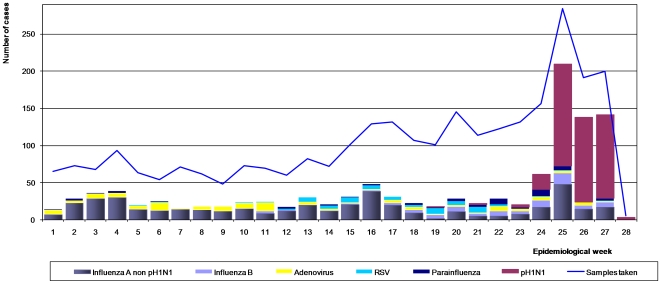
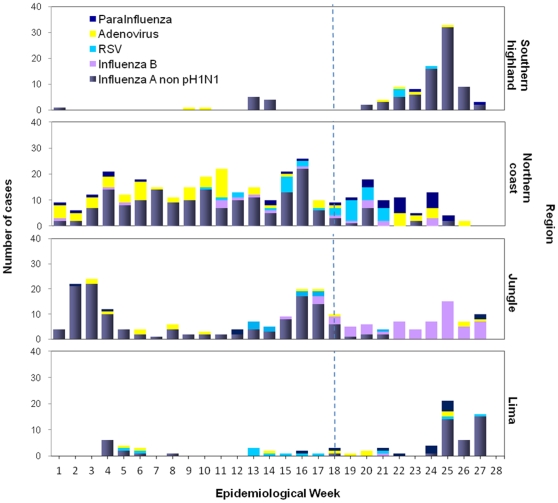
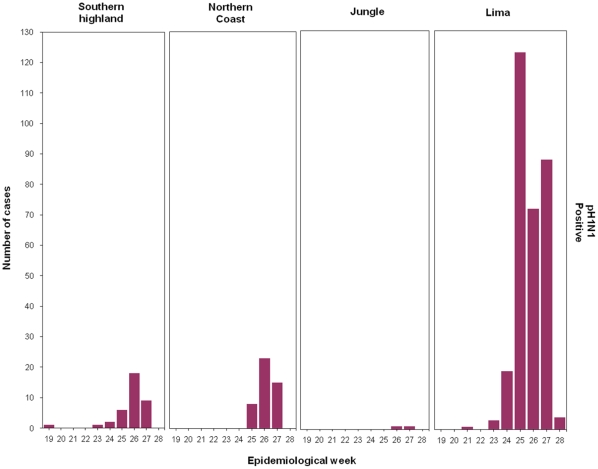
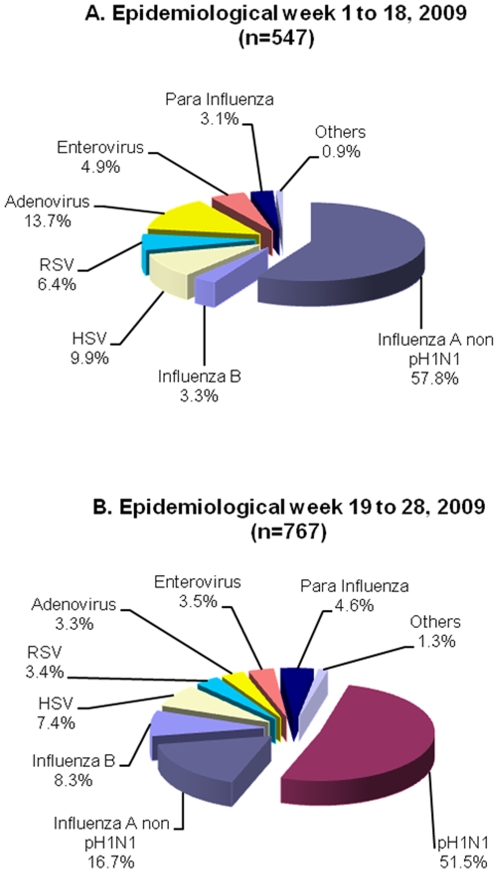
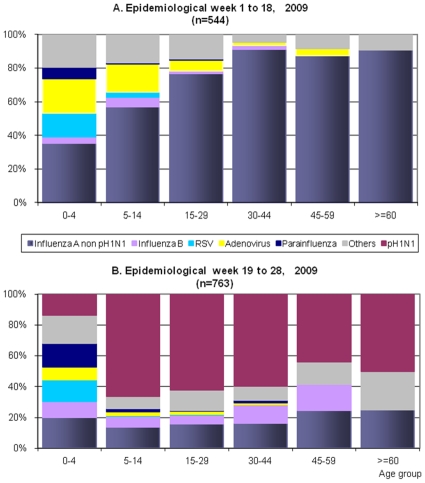
BACKGROUND: We describe the temporal variation in viral agents detected in influenza like illness (ILI) patients before and after the appearance of the ongoing pandemic influenza A (H1N1) (pH1N1) in Peru between 4-January and 13-July 2009. METHODS: At the health centers, one oropharyngeal swab was obtained for viral isolation. From epidemiological week (EW) 1 to 18, at the US Naval Medical Research Center Detachment (NMRCD) in Lima, the specimens were inoculated into four cell lines for virus isolation. In addition, from EW 19 to 28, the specimens were also analyzed by real time-polymerase-chain-reaction (rRT-PCR). RESULTS: We enrolled 2,872 patients: 1,422 cases before the appearance of the pH1N1 virus, and 1,450 during the pandemic. Non-pH1N1 influenza A virus was the predominant viral strain circulating in Peru through (EW) 18, representing 57.8% of the confirmed cases; however, this predominance shifted to pH1N1 (51.5%) from EW 19-28. During this study period, most of pH1N1 cases were diagnosed in the capital city (Lima) followed by other cities including Cusco and Trujillo. In contrast, novel influenza cases were essentially absent in the tropical rain forest (jungle) cities during our study period. The city of Iquitos (Jungle) had the highest number of influenza B cases and only one pH1N1 case. CONCLUSIONS: The viral distribution in Peru changed upon the introduction of the pH1N1 virus compared to previous months. Although influenza A viruses continue to be the predominant viral pathogen, the pH1N1 virus predominated over the other influenza A viruses.
Overview
The claims and statistics of this paper haven’t been checked yet.
Free: it reads the open-access text and checks the first 5 claims that cite a source we can check. Create a free account to check every claim.
Integrity signals
Registry
Cites
Statistics
Figures
Verification
Claims the paper makes
The claims and statistics of this paper haven’t been checked yet.
Free: it reads the open-access text and checks the first 5 claims that cite a source we can check. Create a free account to check every claim.
Claims other papers make about this one
Each is checked against this paper’s own text: does it say what the citing paper says it does?
The cited source doesn’t support the claim as written.
In the citing paper
“A one‐year study in Peru found 5·5% of virological surveillance samples to be positive for influenza plus additional respiratory viruses”
From Bacterial and viral infections associated with influenza (2013) · cites this paper as [60]
Checked by a reasoning model — may be wrong.
Experimental — accuracy not yet measured
Self-check
Percentages, sums and reported differences re-computed from the paper’s own numbers.
The self-check needs the paper’s full text.
Citations
Cites
Infectious Diseases of Humans: Dynamics and Control
Anderson, R. M., & May, R. M. (1991) · doi:10.1093/oso/9780198545996.001.0001 · Cited by 6,179
Hall, A. J. (1992) · Transactions of the Royal Society of Tropical Medicine and Hygiene · doi:10.1016/0035-9203(92)90276-i · Cited by 2,131
Pandemic Potential of a Strain of Influenza A (H1N1): Early Findings
Fraser, C., Donnelly, C. A., Cauchemez, S., Hanage, W. P., Van Kerkhove, M. D., Hollingsworth, T. D., Griffin, J., Baggaley, R. F., Jenkins, H. E., Lyons, E. J., et al. (2009) · Science · doi:10.1126/science.1176062 · Cited by 1,909 · cited 2×
“In an earlier report [4,8,9] we estimated the reproduction number from the initial pandemic growth phase in the range 1.”
BackgroundResultSevere Respiratory Disease Concurrent with the Circulation of H1N1 Influenza
Chowell, G., Bertozzi, S. M., Colchero, M. A., Lopez-Gatell, H., Alpuche-Aranda, C., Hernandez, M., & Miller, M. A. (2009) · New England Journal of Medicine · doi:10.1056/nejmoa0904023 · Cited by 684 · cited 1×
“60 y suggests relative protection for persons who were exposed to H1N1 strains during childhood prior to the 1957 pandemic [16].”
BackgroundSelf-citationThe global impact of influenza on morbidity and mortality
Simonsen, L. (1999) · Vaccine · doi:10.1016/s0264-410x(99)00099-7 · Cited by 399 · cited 1×
“The influenza virus causes significant morbidity and mortality worldwide [1].”
BackgroundCHOWELL, G., MILLER, M. A., & VIBOUD, C. (2008) · Epidemiology and Infection · doi:10.1017/s0950268807009144 · Cited by 284 · cited 2×
“7, which is in good agreement with estimates of the reproduction number of inter-pandemic influenza in temperate countries [10].”
BackgroundSelf-citationTransmission potential of the new influenza A(H1N1) virus and its age-specificity in Japan
Nishiura, H., Castillo-Chavez, C., Safan, M., & Chowell, G. (2009) · Eurosurveillance · doi:10.2807/ese.14.22.19227-en · Cited by 220 · cited 2×
“In an earlier report [4,8,9] we estimated the reproduction number from the initial pandemic growth phase in the range 1.”
BackgroundResultSelf-citationCurrent status of live attenuated influenza virus vaccine in the US
Belshe, R. B. (2004) · Virus Research · doi:10.1016/j.virusres.2004.02.031 · Cited by 117 · cited 1×
“This phenomenon could be partially explained by higher population susceptibility to pH1N1 than non-pH1N1 virus to which the population might have acquired partial immunity in previous years via prior natural exposure with antigenically-related strains and annual immunization campaigns of a fraction of the high-risk po…”
BackgroundMunayco, C. V., Gómez, J., Laguna-Torres, V. A., Arrasco, J., Kochel, T. J., Fiestas, V., García, J., Perez, J., Torres, I., Condori, F. J., et al. (2009) · Eurosurveillance · doi:10.2807/ese.14.32.19299-en · Cited by 99 · cited 4×
“Following this event, the pH1N1 quickly spread throughout the country [4,5].”
BackgroundResultInfluentialSelf-citationInfluenza-Like Illness Sentinel Surveillance in Peru
Laguna-Torres, V. A., Gómez, J., Ocaña, V., Aguilar, P., Saldarriaga, T., Chávez-Cruzado, E., Perez, J., Zamalloa, H., Forshey, B. M., Paz, I., et al. (2009) · PLoS ONE · doi:10.1371/journal.pone.0006118 · Cited by 96 · cited 5×
“Influenza circulation in Peru has been detected throughout the whole year during 2006 to 2008 [3] and within that period a total of 6,308 patients with influenza-like illness (ILI) were enrolled in this passive surveillance study.”
BackgroundMethodInfluentialSelf-citation
Cited by
Bacterial and viral infections associated with influenza
Joseph, C., Togawa, Y., & Shindo, N. (2013) · Influenza and Other Respiratory Viruses · doi:10.1111/irv.12089 · Cited by 250
Characterizing the Epidemiology of the 2009 Influenza A/H1N1 Pandemic in Mexico
Chowell, G., Echevarría-Zuno, S., Viboud, C., Simonsen, L., Tamerius, J., Miller, M. A., & Borja-Aburto, V. H. (2011) · PLoS Medicine · doi:10.1371/journal.pmed.1000436 · Cited by 240
Self-citationViral etiology and seasonality of influenza-like illness in Gabon, March 2010 to June 2011
Lekana-Douki, S. E., Nkoghe, D., Drosten, C., Ngoungou, E. B., Drexler, J. F., & Leroy, E. M. (2014) · BMC Infectious Diseases · doi:10.1186/1471-2334-14-373 · Cited by 67
“Most previous studies have shown a viral prevalence below 50% [13,37-39], although figures up to 75% have been reported [14,16,17].”
BackgroundBurden of influenza in Latin America and the Caribbean: a systematic review and meta‐analysis
Savy, V., Ciapponi, A., Bardach, A., Glujovsky, D., Aruj, P. K., Mazzoni, A., Gibbons, L., Ortega‐Barría, E., & Colindres, R. E. (2012) · Influenza and Other Respiratory Viruses · doi:10.1111/irv.12036 · Cited by 76
Spatial and Temporal Characteristics of the 2009 A/H1N1 Influenza Pandemic in Peru
Chowell, G., Viboud, C., Munayco, C. V., Gómez, J., Simonsen, L., Miller, M. A., Tamerius, J., Fiestas, V., Halsey, E. S., & Laguna-Torres, V. A. (2011) · PLoS ONE · doi:10.1371/journal.pone.0021287 · Cited by 49
“In 2006, the MoH of Peru expanded the surveillance network by joining efforts with the US Naval Medical Research Unit – 6 (NAMRU-6) and scaled up its coverage to a total of 50 inpatients and outpatients Sentinel health care centers, uniformly distributed across geographic regions of Peru [13,19].”
BackgroundInfluentialSelf-citation
Metadata
- Authors
- Laguna-Torres, V. A., Gómez, J., Aguilar, P. V., Ampuero, J. S., Munayco, C., Ocaña, V., Pérez, J., Gamero, M. E., Arrasco, J. C., Paz, I., Chávez, E., Cruz, R., Chavez, J., Mendocilla, S., Gomez, E., Antigoni, J., Gonzalez, S., Tejada, C., Chowell, G., Kochel, T. J., & the Peru Influenza working group
- Affiliations
- Naval Medical Research Command (US)
- Direccion General de Epidemiologia (MX)
- Ministry of Health (PE)
- Universidad Nacional de San Agustin de Arequipa (PE)
- EsSALUD (PE)
- Walter Reed National Military Medical Center (US)
- National Institutes of Health (US)
- Corresponding author
- Laguna-Torres, Victor Alberto
- ORCID
- Venue
- PLoS ONE
- Publisher
- Public Library of Science (PLoS)
- Published
- 2010-07-27
- Volume
- 5
- Issue
- 7
- Pages
- e11719
- ISSN
- 1932-6203 (ISSN-L)
- PMC
- PMC2910706
- OpenAlex
- W2061264314
- Cited by
- 36
- References
- 13
- Citations by year
- 2024: 1 · 2023: 1 · 2021: 3 · 2019: 2 · 2018: 1 · 2017: 1 · 2016: 2 · 2014: 5 · 2013: 5 · 2012: 9
- FWCI
- 4.65
- Type
- journal article
- Language
- en
- Open access
- gold
- doi.org
- Licence
- Locations
- PLoS ONE (publishedVersion, public-domain)
- PubMed Central (publishedVersion, public-domain)
- PubMed (publishedVersion)
- LA Referencia (Red Federada de Repositorios Institucionales de Publicaciones Científicas) (publishedVersion, other-oa)
- Digital Archive @ GSU (submittedVersion, cc-by)
- Americanae (AECID Library) (submittedVersion, other-oa)
- DOAJ (DOAJ: Directory of Open Access Journals) (submittedVersion, cc-by-sa)
- LA Referencia (Red Federada de Repositorios Institucionales de Publicaciones Científicas) (submittedVersion, cc-by-nc-nd)
- Greater South Information System
- Funders
- Ministerio de Salud
- Naval Medical Research Center
- Topics
- Health Sciences › Medicine › Epidemiology › Influenza Virus Research Studies
- Health Sciences › Medicine › Epidemiology › Respiratory viral infections research
- Health Sciences › Medicine › Epidemiology › Virology and Viral Diseases
- Keywords
- pandemic influenza A(H1N1), 2009 H1N1 pandemic, influenza-like illness, virus distribution, influenza A virus, influenza B, Peru, Lima, Iquitos
- MeSH terms
- Adolescent, Adult, Child, Child, Preschool, Female, Humans, Infant, Infant, Newborn, Influenza, Human, Male, Middle Aged, Peru, Reverse Transcriptase Polymerase Chain Reaction, Influenza A Virus, H1N1 Subtype, Young Adult
About these checks
Registry, retraction, Cites and statistics results are computed, not judged, with one exception: a printed reference that no index lists is read once by a model before it counts as a citation error. Claims are extracted by a model and kept only when their quote appears verbatim in the text; each cited source is then checked, with a model’s help, for whether it says what the claim relies on. Those verdicts can be wrong — read the claim’s quote and the cited source before relying on one.
Statistics and arithmetic are recomputed, not judged.
Confidence bands are shown only for fields calibrated on our annotated test set. None is calibrated yet, so no band is shown.
What counts as a claim ›How we measure confidence ›How we check this ›
Are you an author, or do you see a problem with this page? Request a review
Data sources
Bibliographic data: Semantic Scholar, OpenAlex, Crossref.
Contains information from the Semantic Scholar Academic Graph Datasets, made available under the ODC Attribution License (ODC-BY 1.0).
Semantic Scholar’s data is described in: Kinney, R., et al. (2023). The Semantic Scholar Open Data Platform. arXiv:2301.10140.
