

Characterization of Major Histocompatibility Complex (MHC) DRB Exon 2 and DRA Exon 3 Fragments in a Primary Terrestrial Rabies Vector (Procyon lotor)
Open accessThe DOI matches its Crossref record; 57 of the 57 references it cites were found in a registry or an index.
Abstract
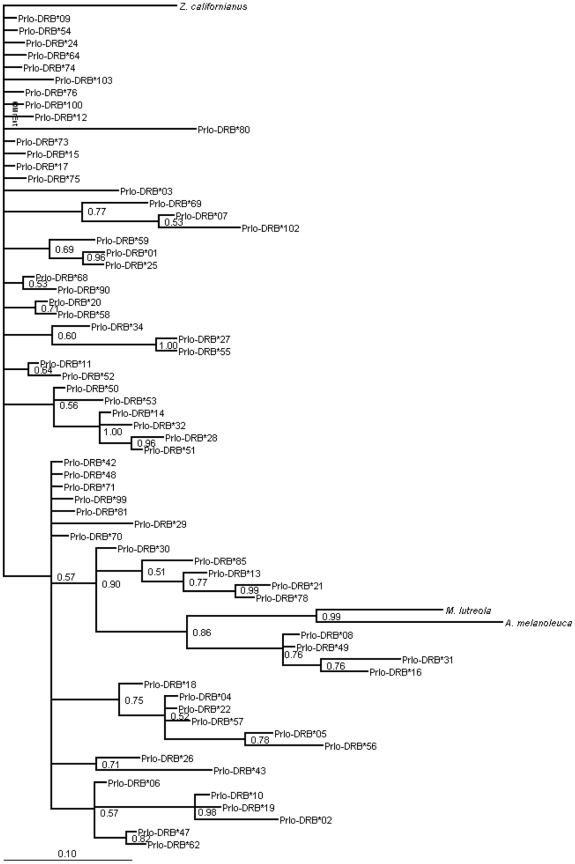
The major histocompatibility complex (MHC) presents a unique system to explore links between genetic diversity and pathogens, as diversity within MHC is maintained in part by pathogen driven selection. While the majority of wildlife MHC studies have investigated species that are of conservation concern, here we characterize MHC variation in a common and broadly distributed species, the North American raccoon (Procyon lotor). Raccoons host an array of broadly distributed wildlife diseases (e.g., canine distemper, parvovirus and raccoon rabies virus) and present important human health risks as they persist in high densities and in close proximity to humans and livestock. To further explore how genetic variation influences the spread and maintenance of disease in raccoons we characterized a fragment of MHC class II DRA exon 3 (250 bp) and DRB exon 2 (228 bp). MHC DRA was found to be functionally monomorphic in the 32 individuals screened; whereas DRB exon 2 revealed 66 unique alleles among the 246 individuals screened. Between two and four alleles were observed in each individual suggesting we were amplifying a duplicated DRB locus. Nucleotide differences between DRB alleles ranged from 1 to 36 bp (0.4-15.8% divergence) and translated into 1 to 21 (1.3-27.6% divergence) amino acid differences. We detected a significant excess of nonsynonymous substitutions at the peptide binding region (P = 0.005), indicating that DRB exon 2 in raccoons has been influenced by positive selection. These data will form the basis of continued analyses into the spatial and temporal relationship of the raccoon rabies virus and the immunogenetic response in its primary host.
Overview
The claims and statistics of this paper haven’t been checked yet.
Free: it reads the open-access text and checks the first 5 claims that cite a source we can check. Create a free account to check every claim.
Integrity signals
Registry
Cites
Statistics
Figures
Verification
Claims the paper makes
The claims and statistics of this paper haven’t been checked yet.
Free: it reads the open-access text and checks the first 5 claims that cite a source we can check. Create a free account to check every claim.
Claims other papers make about this one
Each is checked against this paper’s own text: does it say what the citing paper says it does?
The source backs part of the claim, not all of it — or backs it for a different population, condition or comparison.
In the citing paper
“Of note, the genetic background of susceptible populations may influence disease parameters, such as the incubation period or virus shedding, which ultimately may influence the disease dynamics.”
From Genetic and spatial characterization of the red fox (Vulpes vulpes) population in the area stretching between the Eastern and Dinaric Alps and its relationship with rabies and canine distemper dynamics (2019) · cites this paper as [83]
Experimental — accuracy not yet measuredThe source backs part of the claim, not all of it — or backs it for a different population, condition or comparison.
In the citing paper
“Although empirical data indicate a high variability in terms of resistance and immune response to rabies of raccoon (Procyon lotor), such an association is difficult to demonstrate in practice [83][84][85][86][87][88].”
From Genetic and spatial characterization of the red fox (Vulpes vulpes) population in the area stretching between the Eastern and Dinaric Alps and its relationship with rabies and canine distemper dynamics (2019) · cites this paper as [83]
Experimental — accuracy not yet measuredThe check wasn’t confident either way, so it gives no verdict — never disputed.
In the citing paper
“As for the red fox, no data indicate genetic variability linked to resistance to diseases [83][84][85].”
From Genetic and spatial characterization of the red fox (Vulpes vulpes) population in the area stretching between the Eastern and Dinaric Alps and its relationship with rabies and canine distemper dynamics (2019) · cites this paper as [83]
Experimental — accuracy not yet measured
Self-check
Percentages, sums and reported differences re-computed from the paper’s own numbers.
The self-check needs the paper’s full text.
Citations
Cites
1 retracted
ALCAIDE, M., LEMUS, J. A., BLANCO, G., TELLA, J. L., SERRANO, D., NEGRO, J. J., RODRÍGUEZ, A., & GARCÍA-MONTIJANO, M. (2010) · Molecular Ecology · doi:10.1111/j.1365-294x.2009.04507.x · Cited by 61
RetractedGapped BLAST and PSI-BLAST: a new generation of protein database search programs
Altschul, S. (1997) · Nucleic Acids Research · doi:10.1093/nar/25.17.3389 · Cited by 73,302 · cited 2×
“All alleles were also found to identify in the 80 percentile with DRB alleles from other animals, further suggesting that we were amplifying the DRB locus [44].”
MrBayes 3: Bayesian phylogenetic inference under mixed models
Ronquist, F., & Huelsenbeck, J. P. (2003) · Bioinformatics · doi:10.1093/bioinformatics/btg180 · Cited by 29,077 · cited 1×
“Bayes, using Bayesian inference [40,41], with the best-fit model of nucleotide substitution (F81+I+G) indicated by the likelihood ratio test of JModel test [42,43].”
MEGA4: Molecular Evolutionary Genetics Analysis (MEGA) Software Version 4.0
Tamura, K., Dudley, J., Nei, M., & Kumar, S. (2007) · Molecular Biology and Evolution · doi:10.1093/molbev/msm092 · Cited by 28,730
MRBAYES: Bayesian inference of phylogenetic trees.
Huelsenbeck, J. P., & Ronquist, F. (2001) · Bioinformatics · doi:10.1093/bioinformatics/17.8.754 · Cited by 21,937 · cited 1×
“A phylogenetic tree was constructed with Mr.Bayes, using Bayesian inference”
MethodA Simple, Fast, and Accurate Algorithm to Estimate Large Phylogenies by Maximum Likelihood
Guindon, S., & Gascuel, O. (2003) · Systematic Biology · doi:10.1080/10635150390235520 · Cited by 16,806 · cited 2×
“Bayes, using Bayesian inference [40,41], with the best-fit model of nucleotide substitution (F81+I+G) indicated by the likelihood ratio test of JModel test [42,43].”
MethodjModelTest: Phylogenetic Model Averaging
Posada, D. (2008) · Molecular Biology and Evolution · doi:10.1093/molbev/msn083 · Cited by 10,499 · cited 2×
“Bayes, using Bayesian inference [40,41], with the best-fit model of nucleotide substitution (F81+I+G) indicated by the likelihood ratio test of JModel test [42,43].”
Simple methods for estimating the numbers of synonymous and nonsynonymous nucleotide substitutions.
(1986) · Molecular Biology and Evolution · doi:10.1093/oxfordjournals.molbev.a040410 · Cited by 4,894 · cited 1×
“Average pairwise nucleotide distances (Kimura 2 parameter model or K2P), Poisson-corrected amino acid distances and average rate of synonymous (dS) and nonsynonymous (dN) substitutions per site were computed in MEGA 4 [26] using the modified Nei-Gojobori method with the Jukes-Cantor correction for multiple substitutio…”
MethodMRBAYES: Bayesian inference of phylogeny
Huelsenbeck, J. P., & Ronquist, F. (2001) · Bioinformatics · Cited by 4,892
Three-dimensional structure of the human class II histocompatibility antigen HLA-DR1
Brown, J. H., Jardetzky, T. S., Gorga, J. C., Stern, L. J., Urban, R. G., Strominger, J. L., & Wiley, D. C. (1993) · Nature · doi:10.1038/364033a0 · Cited by 2,379
Research works printed but not linked: 2
- Gillett RM (2009) MHC genotypes and reproductive Success in the Northern Atlantic Right Whale (Eubalanea Glacialis) Ph.D. Biology Thesis, Trent University, Peterborough, ON.
- Szanto A (2009) Molecular genetics of the raccoon rabies virus. Ph.D. Biology Thesis, Trent University, Peterborough, ON.
Cited by
Kyle, C. J., Rico, Y., Castillo, S., Srithayakumar, V., Cullingham, C. I., White, B. N., & Pond, B. A. (2014) · Molecular Ecology · doi:10.1111/mec.12726 · Cited by 38
“Population genetic analyses based on biallelic MHC genotypes were not possible as DRB exon 2 was found to be duplicated in raccoons, as indicated by the two to four alleles per individual (Castillo et al. 2010).”
BackgroundMethodSelf-citationSrithayakumar, V., Castillo, S., Rosatte, R. C., & Kyle, C. J. (2011) · Immunogenetics · doi:10.1007/s00251-010-0485-5 · Cited by 36
“Recent study by Castillo et al. (2010), characterizing MHC class II DRB in raccoons, found extensive polymorphism with 66 alleles in the 246 samples screened.”
BackgroundMethodSelf-citationOomen, R. A., Gillett, R. M., & Kyle, C. J. (2012) · Molecular Ecology Resources · doi:10.1111/1755-0998.12027 · Cited by 36
“…than synonymous substitutions at the peptide binding region for DRB1 and DRB2, respectively (Table 3), a difference similar to that observed for raccoons when utilizing the same peptide binding sites (in which dN was 2.6 times greater than dS for the two loci combined; Castillo et al. 2010).”
BackgroundMethodResultInfluentialSelf-citationSantos, P. S. C., Michler, F., & Sommer, S. (2017) · Molecular Ecology · doi:10.1111/mec.14035 · Cited by 26
“Some of these alleles had also been observed in other North American areas (Castillo et al. 2010).”
BackgroundInfluentialEvidence for evolutionary convergence at MHC in two broadly distributed mesocarnivores
Srithayakumar, V., Castillo, S., Mainguy, J., & Kyle, C. J. (2011) · Immunogenetics · doi:10.1007/s00251-011-0588-7 · Cited by 23
Self-citationZecchin, B., De Nardi, M., Nouvellet, P., Vernesi, C., Babbucci, M., Crestanello, B., Bagó, Z., Bedeković, T., Hostnik, P., Milani, A., et al. (2019) · PLOS ONE · doi:10.1371/journal.pone.0213515 · Cited by 20
Biedrzycka, A., Popiołek, M., & Zalewski, A. (2020) · BMC Evolutionary Biology · doi:10.1186/s12862-020-01610-x · Cited by 24
“Due to the random reduction of genetic diversity in comparison with the native range [31, 35, 36], those two clusters vary Biedrzycka et al.”
BackgroundGaigher, A., Rota, A., Neves, F., Muñoz‐Mérida, A., Blasco-Aróstegui, J., Almeida, T., & Veríssimo, A. (2023) · Scientific Reports · doi:10.1038/s41598-023-30876-6 · Cited by 18
Strand, T., & Höglund, J. (2011) · BMC Research Notes · doi:10.1186/1756-0500-4-183 · Cited by 13
“[56-58].”
Biedrzycka, A., Konopiński, M. K., Hoffman, E. A., Trujillo, A. L., & Zalewski, A. (2019) · Evolutionary Applications · doi:10.1111/eva.12898 · Cited by 12
“We identified 43 putatively expressed alleles, among individuals from native and invasive populations (Table S1); 37 alleles were previously described in either native raccoon populations (Castillo et al., 2010) or invasive populations (Santos et al., 2017).”
BackgroundMethodFerrandiz‐Rovira, M., Bigot, T., Allainé, D., Callait‐Cardinal, M., & Cohas, A. (2015) · Heredity · doi:10.1038/hdy.2015.13 · Cited by 11
Ruiz‐López, M. J., Monello, R. J., Schuttler, S., Lance, S. L., Gompper, M. E., & Eggert, L. S. (2014) · Infection Genetics and Evolution · doi:10.1016/j.meegid.2014.10.015 · Cited by 14
“We analyzed the MHC II DRB exon 2 because it is highly polymorphic, is subject to natural selection (Castillo et al., 2010), and has been linked to rabies resistance and susceptibility in raccoons (Srithayakumar et al., 2011) and to CDV and canine parvovirus resistance in wolves (Hedrick et al.,…”
BackgroundMethodResultInfluentialWang, Z., Zhou, X., Lin, Q., Fang, W., & Chen, X. (2013) · PLoS ONE · doi:10.1371/journal.pone.0074185 · Cited by 11
“The presence of both expressed loci and pseudogenes further complicates the problem in identifying functional variants [14,20,26].”
BackgroundMarshall, H. D., Langille, B. L., Hann, C. A., & Whitney, H. G. (2016) · Immunogenetics · doi:10.1007/s00251-016-0907-0 · Cited by 9
“Following Castillo et al. (2010), to avoid such errors, distinct sequences were only considered alleles if they were not obvious recombinants of other alleles in the individual and if they differed from the other alleles in the individual by at least two nucleotide substitutions.”
BackgroundInfluentialMultifunctional DRB3, a MHC Class II Gene, as a Useful Biomarker in Small Ruminants: A Review
Paracha, H. (2015) · Journal of Infection and Molecular Biology · doi:10.14737/journal.jimb/2015/3.1.19.23 · Cited by 6
“MHC presents pathogen derived antigens to the effector cells and hence they activate adaptive immune response (Castillo et al., 2010).”
BackgroundPatra, B., Panigrahi, M., Ahmad, S. F., Dandapat, S., Kumar, P., & Bhushan, B. (2019) · Veterinary Microbiology · doi:10.1016/j.vetmic.2019.108569 · Cited by 4
Osborne, A. J. (2011) · Otago University Research Archive (University of Otago) · Cited by 5
Wild Boar (Sus scrofa)—Fascioloides magna Interaction from the Perspective of the MHC Genes
Konjević, D., Erman, V., Bujanić, M., Svetličić, I., Arbanasić, H., Strunjak, S. L., & Galov, A. (2022) · Pathogens · doi:10.3390/pathogens11111359 · Cited by 3
Evidence of Mixed Selection Acting on the MHC Class II DQA Gene in Captive Thai Elephant Populations
Budi, T., Enguito, M. R., Singchat, W., Panthum, T., Nguyen, T. H. D., Chaiyes, A., Muangmai, N., Griffin, D. K., Duengkae, P., & Srikulnath, K. (2025) · Genes · doi:10.3390/genes16101180 · Cited by 1
“This is true for shared pathogens, including parasites, foot-and-mouth disease virus, rabies, tuberculosis, trypanosomiasis and septicemia [30,31].”
Variation at the MHCI and MHCII gene regions in Squalus acanthias : evidence for selection.
Palmer, K. (2013) · Wheaton College Digital Repository (Wheaton College (MA))
Inbreeding does not reduce major histocompatibility complex diversity in the banded mongoose
Schubert, N., Nichols, H. J., Mwanguhya, F., Businge, R., Kyambulima, S., Mwesige, K., Cant, M. A., & Winternitz, J. C. (2025) · BMC Ecology and Evolution · doi:10.1186/s12862-025-02456-x · Cited by 4
“Conversely, widespread carnivore species with large populations, such as North American raccoons, can exhibit high MHC variation, with 66 unique MHC-II DRB alleles identified among 246 individuals [41].”
COKER, O. M., OSAIYUWU, O. H., & FATOKI, A. O. (2023) · Genetics and Biodiversity Journal · doi:10.46325/gabj.v7i2.318
“Some vertebrate species have been found to have low MHC variation in wild populations that have experienced population reduction in the past (Castillo et al., 2010; Castro-Prieto et al., 2011; Niskanen et al., 2014; Kohyama et al., 2015), making them vulnerable to pathogens and increasing the risk…”
Influential
Metadata
- Authors
- Castillo, S., Srithayakumar, V., Meunier, V., & Kyle, C. J.
- Affiliations
- Trent University (CA)
- Corresponding author
- Castillo, Sarrah
- Venue
- PLoS ONE
- Publisher
- Public Library of Science (PLoS)
- Published
- 2010-08-10
- Volume
- 5
- Issue
- 8
- Pages
- e12066
- ISSN
- 1932-6203 (ISSN-L)
- PMC
- PMC2919397
- OpenAlex
- W2075029700
- Cited by
- 21
- References
- 57
- Citations by year
- 2025: 2 · 2023: 1 · 2022: 1 · 2020: 1 · 2019: 3 · 2017: 1 · 2016: 1 · 2015: 2 · 2014: 2 · 2013: 2 · 2012: 1
- FWCI
- 1.26
- Type
- journal article
- Language
- en
- Open access
- gold
- doi.org
- Locations
- PLoS ONE (publishedVersion, cc-by)
- PubMed Central (publishedVersion, cc-by)
- PubMed (publishedVersion)
- DOAJ (DOAJ: Directory of Open Access Journals) (submittedVersion, cc-by-sa)
- Funders
- U.S. Department of Agriculture
- Ministry of Natural Resources
- Canadian Food Inspection Agency
- Natural Sciences and Engineering Research Council of Canada
- Topics
- Life Sciences › Biochemistry, Genetics and Molecular Biology › Genetics › Genetic diversity and population structure
- Life Sciences › Biochemistry, Genetics and Molecular Biology › Genetics › Evolution and Genetic Dynamics
- Life Sciences › Biochemistry, Genetics and Molecular Biology › Genetics › Genetic and phenotypic traits in livestock
- Keywords
- major histocompatibility complex, MHC class II, raccoons, MHC polymorphism, positive selection, nonsynonymous substitutions, peptide-binding region, wildlife disease, host-pathogen coevolution
- MeSH terms
- Amino Acid Sequence, Animals, Bayes Theorem, Disease Vectors, Exons, HLA-DR Antigens, Humans, Molecular Sequence Data, Phylogeny, Rabies, Raccoons, Selection, Genetic, Evolution, Molecular, Genetic Loci, HLA-DR alpha-Chains
About these checks
Registry, retraction, Cites and statistics results are computed, not judged, with one exception: a printed reference that no index lists is read once by a model before it counts as a citation error. Claims are extracted by a model and kept only when their quote appears verbatim in the text; each cited source is then checked, with a model’s help, for whether it says what the claim relies on. Those verdicts can be wrong — read the claim’s quote and the cited source before relying on one.
Statistics and arithmetic are recomputed, not judged.
Confidence bands are shown only for fields calibrated on our annotated test set. None is calibrated yet, so no band is shown.
What counts as a claim ›How we measure confidence ›How we check this ›
Are you an author, or do you see a problem with this page? Request a review
Data sources
Bibliographic data: Semantic Scholar, OpenAlex, Crossref.
Contains information from the Semantic Scholar Academic Graph Datasets, made available under the ODC Attribution License (ODC-BY 1.0).
Semantic Scholar’s data is described in: Kinney, R., et al. (2023). The Semantic Scholar Open Data Platform. arXiv:2301.10140.
